

 Nothing is sacred, nothing is untainted or unambiguous. The result is a world of the most exquisite, moribund beauty, of breath-taking atrocities and a pervasive entropy that lends every moment of play deliciously despairing poetry. From Software's epoch-making forays into the realms of role-playing video games characteristically distinguish themselves by an acute mingling of fantastical and horror elements. Both the legendary Dark Souls series and the incredible stand-alone Bloodborne evince influences as diverse as Manga such as Berserk, the art of Junji-Ito, The Lord of The Rings and the cosmic horror mythologies of H.P. Lovecraft. In terms of subject, little is off the cards: from witty reimaginings of Dungeons and Dragons monsters to creations more redolent of surrealist art or renaissance depictions of Hell itself, From Software's franchises represent arguably the most diverse menageries of entities, situations and concepts ever boasted by video game franchises. Quite apart from the various abominations and atrocities each game includes, their horror also operates on metaphysical levels: In Dark Souls, players are confronted with the existential despair of a mythology that has already failed, an entire reality rotting on the vine, whose purported mechanisms of salvation turn out to be deceptions and corruptions of the truth. This leaves players in the unenviable position of having no good choices: there are no binary conclusions here. Whatever path they ultimately take, reality is condemned to the same sorry rounds of corrupt renaissance and descents into entropy, all thanks to the ego of a mad god who cannot accept his own decline. Bloodborne, by contrast, paints a reality in which nothing is stable or certain from the very first step; a condition in which dreams are indistinct from reality and insight from madness, where the most surreal and mind-shattering horrors become pathways to strange transcendence or more sorry rounds of the same despairing pilgrimage. Here, dreams and nightmares are indistinct from waking reality, such binaries meaning little next to the screaming, fractured madness that is creation itself. Unlike Dark Souls, which is obliquely communicated but clearly defined by the series' end, Bloodborne's metaphysics is entirely without definition or stricture, echoing in form the insanity and disturbia of its content. Both games utilise certain imagery and archetypes from fantasy and horror to create something uniquely compelling and uniquely monstrous: a species of horror that may not be readily apparent, but that swells and congeals as the games progress, to the point whereby reality and sanity themselves begin to collapse in latter chapters.  All of this is communicated in peculiarly sophisticated fashion; not through extensive exposition, cut scenes etc, but via subtle symbolism and implication. Much is left up to player inference, meaning that engagement is essential and necessarily intense. Unlike most other franchises and, indeed, storytelling mediums, the audience is not a passive entity when it comes to these mythologies: the games oblige them to become active participants if they are to even begin understanding the depth and complexity bubbling beneath the surface, not to mention reconcile the ambiguities and contradictions the games deliberately subject them to. A significant part of the leg-work here is committed by the audience, meaning that no two players come away from these experiences with quite the same responses or assumptions. Every player experiences something unique, and builds a unique mythology in their minds utilising the materials and parameters provided. Beyond that, both Dark Souls and Bloodborne acknowledge this in their mythologies as well as their technical qualities: both games are haunted by the spectral echoes of other players, who are progressing through related but subtly different narrative tracks. In Dark Souls, a deliberate multiverse is drawn whereby each “game” is another reality, subtly removed from the other in Mandella Effect fashion, but also interbleeding. Likewise, Bloodborne establishes that multiple “Hunters” pass through the state of dreaming at any one time, and may cycle through again and again until they find their own means of reconciling and transcending it. The resultant sophistication of storytelling here is profound: a level of player engagement arguably unlike any other narrative franchise in video game history. With the marked success of these games both technically and narratively, trepidation for the open-world experiment that is Elden Ring was as high as hope. Even when the first suggestions of what the game would consist of were made public, concerns spread like wildfire across the internet. An "open world" experience that somehow seamlessly incorporates the suggestive and ambient storytelling of the previous games, not to mention their notoriously nightmarish difficulty? The ambition seemed quixotic, to say the least. Moreover, "open world" experiences have been notoriously riven with problems in recent years: a lack of narrative rhythm and cohesion, vast expanses of emptiness or copy/pasted identical environments, plus numerous examples of predatory monetisation (loot-crates, micro-transactions etc), have all conspired to make the "open world" something of a dubious prospect for the video game playing public. From the earliest reports, it became apparent that, via the sincere genius of its creators -plus a hint of video-game alchemy-, Elden Ring has not only succeeded in fulfiling its vision, it may be the title that defines this console generation.  A technical and visionary masterpiece, Elden Ring has taken the assumptions of "open world" video games and blasted them open with the force and vividness of an LSD trip shattering parameters of perception. The experience of the game has left many of us in sincere awe at what From Software have achieved, both technically and in mythological terms. With reference to its peculiar species of horror specifically, Elden Ring serves as a boiling pot of all that has come before: Mythologically, it resembles the moribind metaphysics of its parent, Dark Souls: here, once again, From Software paint the picture of a fractured fantastical world, one whose great metaphysical events are over long, long before the player character arrives. Centring on the eponymous concept of The Elden Ring, this world is fractured and dying owing to the shattering of that artefact (which is actually neither entirely material or abstract in nature). The grand metaphysics that once held this reality together is slowly unravelling, whilst the warring god-children who claimed its pieces squabble to establish their own realms and religions. Into this state of existential collapse, dead pilgrims known as Tarnished emerge; entities whose fated purpose -or so it is proscribed- is to destroy the mad and corrupted demigods, claim the pieces of the Elden Ring and establish a new divine order by which this world might reorient itself. Echoes of Dark Souls's mythos of old gods and new, of darkness and fire, are clear. And, as in those games, the mythology proscribed to us at the outset is slowly revealed to be more ambiguous than we are initially led to believe: For all of its incredible beauty, a subtle undercurrent of moribund despair pervades Elden Ring. It is a peculiar species of horror that isn't immediately apparent in a setting that evokes so many fantasy tropes and images (dragons, magic, knightly orders, lost kingdoms, schools of sorcery etc): an existential dread akin to that evoked by H.P. Lovecraft (another significant influence on From Software) in many of his stories. Here, we are the dregs and by-products of a failing engine, a decay that becomes increasingly evident the more of the world we explore: Every society, every culture, every kingdom, has fallen into madness and abomination. Many attempt to maintain some twisted semblance of their former glory whilst most have embraced their own peculiar insanity. Even the seemimgly-human knights, soldiers and denizens of those kingdoms reveal themselves to be twisted parodies of their former selves when encountered close to. Meanwhile, the stuttering engine of reality ensures that they, like the player, are doomed to cycles of purgatorial repetition until that engine is either fixed or put out of its misery (this stands as another example of From Software marrying essential game mechanics to mythology: whenever the player rests at a "site of lost grace" -this game's equivalent of bonfires or lanterns-, reality stutters and resets once again, all of the minor enemies and encounters resurrecting, playing out their proscribed scenarios in another cycle). The impression created is of a world barely suspended above an apocalyptic abyss; one into which it might collapse at any moment. Meanwhile, the various remains of dying cultures, traditions and religions that inhabit it are all desperately scrabbling to establish their own primacy or to transcend the condition altogether. Most are lost things that have descended into cultures of insanity and abomination:  The first significant encounter in the game is with a homonculus-horror called "The Grafted Scion," a creature that is emblematic of the body-horror pervading the game: A gigantic, crab-like amalgam of magically and surgically grafted bodies, it is the product of a dark and forbidden science now practiced by Godrick The Great and his minions; a descendent of divinity who now, in his madness, actively grafts the limbs and bodies of others to his titanic frame. Elsewhere, players will encounter the wasted, lepros corpses of those consumed by a magical fungus called "The Scarlet Rot," a blight that is as much metaphysical as it is biological: The result of a feud between demi-gods, the Rot infests the air, the land and all who come into contact with it, resulting in entire townships reduced to shambling, agonised zombies, hordes of mutated knights and monsters (the latter of which even include dragons). Whilst wandering The Caelid Wilds and Swamps of Aeonia (areas completely contaminated by the Rot), the player will encounter maddened remnants of those kingdoms and settlements that have sustained its assault: The kingdom of Redmane, for example, utilises arcane technology to hold back and purge the blight: In the desolations surrounding Redmane Castle, the player will encounter entire villages charred to nothing, the semi-magical engines responsible still roaming the wastes, directionless and without purpose now, save for the imperative to burn all in their wake. Even this scorched earth policy has failed, as the burned corpses still rise from their pyres and ashes, no matter how assiduously immolated. Others have attempted arcane means of insulating themselves from the encroaching infestation, only to have reduced themselves to semi-corporeal shades and spectres; a curse at least as maddening as the Rot itself. The Scarlet Rot is a key example of Elden Ring's peculiar horror: a factor that is communicated largely through imagery, environmemt and intimation, it nevertheless charges any area in which it occurs with a dolorous dread, an atmosphere that feels actively sickening, as though the player themselves might be tainted through contact with it. In terms of the wider metaphysics, The Rot is emblematic of the pervasive sense of corrosion and collapse throughout the gaming world: As in its ancestors, Dark Souls and Bloodborne, Elden Ring paints a reality in collapse at a fundamental level; a state where every system, dream and design has comprehensively failed, leading to a condition of saturation of which the player character is simultaneously the product and victim. Even the anonymous player characters themselves -known as Tarnished- are products of that same systemic failure: Individuals resurrected from the dead, their proscribed purpose is to follow the path that "destiny" dictates; to repair the eponymous metaphysics of this world and become "Elden Lord." However, there are numerous side-quests, alternative paths, endings and revelations that suggest such may not be the best thing for the world. As in Dark Souls and its wholly ambiguous tensions, here, the system that demands the Elden Ring's repair is revealed as far from unambiguous, the events that led to its shattering more a conspiracy of liberation than one designed to plunge creation into chaos. That ambiguity ultimately leaves the player in a state where there are no good choices; no clear-cut decisions to be made; only that between -impotent, self-defeating- conformity and ruinous rebellion. The ultimate horror of the situation is Lovecraftian; a systemic sickness in which the scrabblings of humanity -and other sapient species- mean nothing. That despairing impotence is a horror all its own, that plays out in microcosmic set-pieces throughout the game: Whilst wandering a particular swamp early in the game, players may come across the ruins of a dragon-worshiping civilisation whose citizens, suspended in a state of undeath, continue their rites and rituals in the foetid remains of their temples. Should the player linger, the object of their worship, a great black dragon, swoops down and rewards their faith with further desolation, breathing death upon the congregations before settling amidst their ashes. In the ruins of Raya Lucaria, one of the great kingdoms of the dying world and an academy of magic, the player will encounter maddened scholars and sorcerers who exhibit Lovecraftian insanity, having lost their minds to cosmic revelations and the breaking of the world. Elsewhere, settlements of peoples who have lost their minds to a metaphysical madness known as "The Flames of Frenzy" sustain in states of metaphysical torment. This particular species of magical malady is a core example of the overlap in this world between the actual and the abstract: The flames are a particular kind of revelation, a dark insight that leads to the literal combustion of the mind and soul in the same way that the aforementioned Scarlet Rot infests body and spirit.  Nowhere is this peculiar horror more overt than in the game's major bosses: Whilst there is very little in the way of a strict or linear path in Elden Ring, progress is made by seeking out the demi-god children of Marika, previous incumbent of the eponymous metaphysics before its shattering, each one a holder of a shard of that divinity but also consumed by idiosyncratic madness. Marika's least divine descendent, the Shakespearian Godrick, for example, has lost both mind and body to the unclean practice of "grafting" (whereby various limbs and body parts have been magically grafted into his body, resulting in an abomination that wouldn't be out of place in Resident Evil titles). Meanwhile, Renalla, Queen of the Full Moon and high witch of Raya Lucaria, is bodily intact but has lost her sanity to the Lovecraftian revelations of her magical arts. Radahn, her former lover, meanwhile, has been entirely claimed by The Scarlet Rot, losing every vestige of his former nobility and becoming a swollen, immortal horror of cannibalistic proclivity and insane divine power. Every encounter, every character, follows a cyclical path of tragedy and damnation, as though the shattering of The Elden Ring has resulted in an entropy that pollutes even fate itself. Dead and dying civilisations, broken metaphysics, demi-gods become mad abominations, metaphysical plagues and apocalypses, Lovecraftian, cosmic insanity and a player character who is themselves an undead vessel of some process of undefined self-repair (or self-destruction?). In truth, Elden Ring exhibits so many strains and species of horror, it would be impossible -and, indeed, a profound error- to attempt a comprehensive catalogue. Instead, it is more apt to stand in awe at how seamlessly From Software has managed to integrate those elements into what is ostensibly a fantasy setting in the vein of The Lord of The Rings or Game of Thrones without friction or incongruity. The imaginations behind Elden Ring understand on a visceral level that such distinctions and parameters between genres are largely synthetic; that there has always been general thematic and subjective commonality, interbleeding and overlap. Elden Ring takes that acknowledgement to an entirely other level by exemplifying the horrors inherent to the metaphysics and subjects of fantasy fiction: Here, magic is the manifestation of mad revelations and broken mythologies. Here, demi-gods are scions of divine insanity and promulgators of existential corruption. Nothing is sacred, nothing is untainted or unambiguous. The result is a world of the most exquisite, moribund beauty, of breath-taking atrocities and a pervasive entropy that lends every moment of play deliciously despairing poetry. CHECK OUT TODAY'S OTHER ARTICLES ON GINGER NUTS OF HORROR
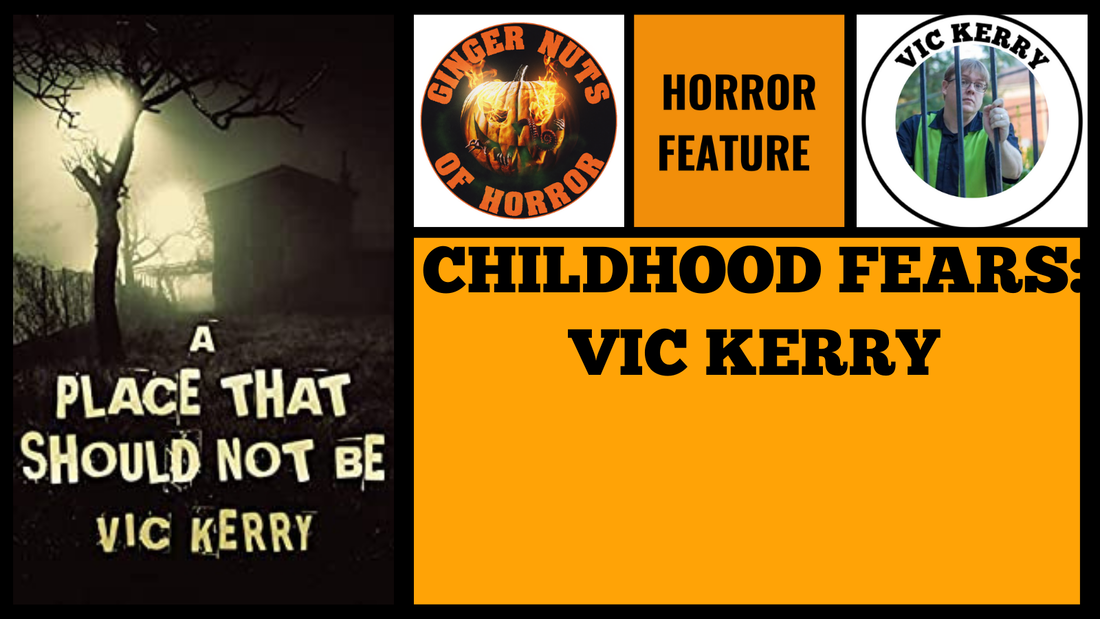
THE HEART AND SOUL OF HORROR PROMOTION WEBSITESCHILDHOOD FEARS: VIC KERRY
18/4/2022
 Now as an adult, I understand why I enjoy writing about the darkness in life. Not to sound too Freudian, it is a cathartic release. Most of my professional career has been spent working in public mental health as a psychotherapist. I’ve seen things that make Jason, Freddy, and certainly House look like Hans Christian Anderson. Some kids are fearless and in adulthood remain so. Other kids become more cautious once they grow up. I am neither one of those things. As a kid, I was afraid of lots of things, but as an adult, I have an unhealthy lack of fear. I believe it is the fact that I grew up being a relative wienie when it came to scary stuff that changed me as an adult. I was a kid of the 1980s—the last awesome time to be a kid. It was before helicopter parents and the micromanagement of kids’ lives by those hover-parents. The toys were awesome, the cartoons rocked, and free-play with lots of imagination ruled. It was also a hell of a scary time to be kid. I can remember watching TV in the evenings with its steady parade of slasher movie trailers flickering through darkness. The snippets of Freddy, Jason, and Chucky presented in those 30-second blurbs terrified me, but I remember well the movie trailers that gave me nightmares. Of all the possibilities, it was the movie House. You know the one with Norm from Cheers. Almost 40 years later I can still remember the nightmares vividly. It wasn’t even that scary of a movie, but it scarred me back then. That must be evident since I can still remember the nightmares. My dad used to tell a stupid story to scare me as well. I can’t really remember much about it beyond a guy named Tom cutting off the Devil’s tail with a hoe, and the Devil wanting it back. “Ooo, Uncle Tom, I want my tail!” he would say in his most frightening voice. Beyond those snippets, I supposed my fears were rather prosaic. I was afraid of dogs (although I’ve owned a hell of lot of them in adulthood). Storms terrified me, but to be honest I lived in the Tornado Alley of Alabama. I didn’t like snakes or bugs. Sometimes if I was riding my bike at night, I thought the Headless Horseman might come after me, but the true phobias which stick with me even until today are: I hate heights and avoid power saws at all cost. Those two things are the only fears that truly followed me into adulthood. I have considered how my childhood of being afraid turned me into a horror writer. I’m not completely sure. The strange thing is despite being afraid of the George Wendt movie House and trailers featuring hockey masks and knife gloves, I loved monsters—the classic ones at least. I also liked to write about scary things. The first story I ever wrote was a scary one. It was in Mrs. Payne’s third grade class and about ghosts that killed you and ate your head. The Ghostbusters showed up and killed them (I guess it was fanfic?). I gave it the CCR ripped-off title, “Bad Moon Rising,” and colored the paper with a brick red crayon to make it look bloody. I don’t have that story because I gave to a kid that really liked it, but that’s were it began. Now as an adult, I understand why I enjoy writing about the darkness in life. Not to sound too Freudian, it is a cathartic release. Most of my professional career has been spent working in public mental health as a psychotherapist. I’ve seen things that make Jason, Freddy, and certainly House look like Hans Christian Anderson. Working the in that field ridded me of most of my fears. When working in the in mental health field, people’s wellbeing and lives depends on you not being paralyzed by irrational phobias. After being hit and kicked too many times to remember, spit on, cursed, had sundry things, ranging from a TV set to a dirty tampon, thrown at me, and of course being shot at, I quit being afraid of anything except heights, which I can overcome with enough willpower, and power saws, which again I avoid like all get out. Horror writing is a way to keep me grounded in a bit of reality, as bizarre as that sounds. It keeps me aware that there is scary stuff out there. It keeps me sane. A childhood of being afraid of everything led me to an adulthood that is almost fear-free, but it gave me nightmare fuel to produce what I love: horror fiction. That being said, I’ve just published a new novella called A Place That Should Not Be. It’s a bit of ghost story that I wrote on a dare of sorts. My wife bet me I couldn’t write about a haunted tiny house. She wanted something funny. I came up with something else entirely. The link was previously included. Thanks for taking the time to read my ramblings. Darkly, Vic Kerry A Place That Should Not Be |

 |  |
THE HEART AND SOUL OF HORROR PROMOTION WEBSITES

Signature Entertainment are proud to present the stills, trailer, and artwork for two upcoming thrillers:
Ghosts of the Ozarks, an old West ghost story with Tim Blake Nelson and David Arquette, on digital 23rd May
Shut In, brilliantly intense survival thriller starring Rainey Qualley on digital 30th May
Check out the trailers and some stills from these two movies below.
Ghosts of the Ozarks, an old West ghost story with Tim Blake Nelson and David Arquette, on digital 23rd May
Shut In, brilliantly intense survival thriller starring Rainey Qualley on digital 30th May
Check out the trailers and some stills from these two movies below.
Ghosts of the Ozarks (107mins)
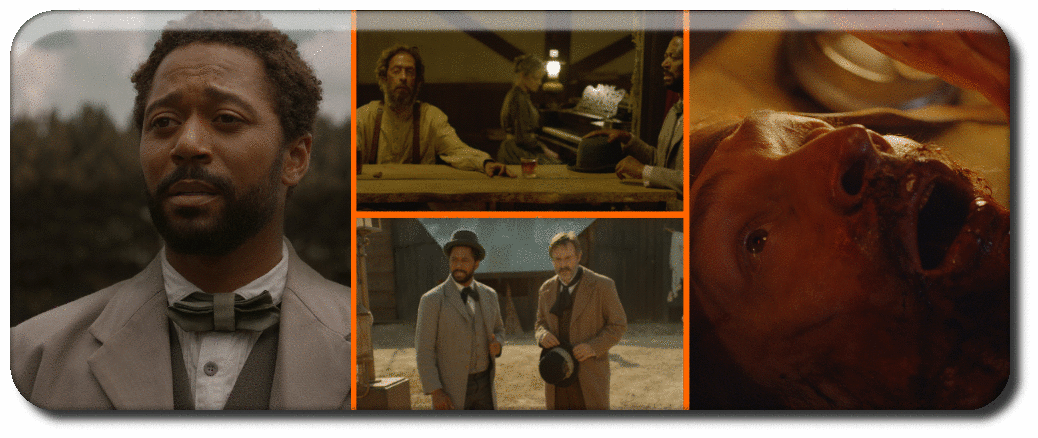
In post-civil war Arkansas, a young doctor is mysteriously summoned to a remote town in the Ozarks, only to discover the utopian paradise he expected is filled with secrets and surrounded by a menacing, supernatural presence. Starring Tim Blake Nelson and David Arquette, Ghosts of the Ozarks is a thrilling new take on the southern ghost story.
Signature Entertainment present Ghosts of the Ozarks on Digital Platforms 23rd May
Signature Entertainment present Ghosts of the Ozarks on Digital Platforms 23rd May
Shut In (Cert 15, 89mins)
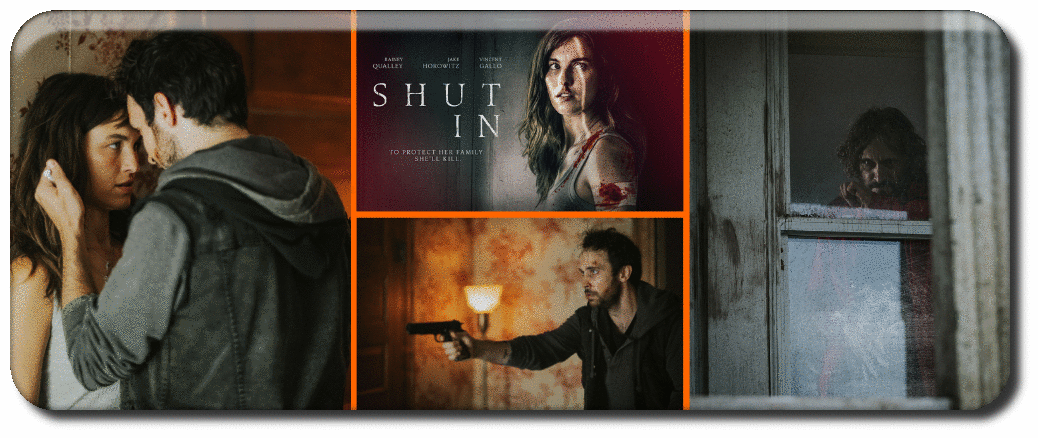
ALONE. AFRAID. SHUT IN. Get ready for an intense thrill ride of survival – at any cost! A young mother (Rainey Qualley, Perfect) finds herself barricaded inside a pantry by her violent ex (Jake Horowitz, The Vast of Night). With her kids on the other side of the door and the impending threat of violence, she must do whatever it takes to escape and get her kids out of the house. Shut In was directed by D.J. Caruso (I Am Number Four) and written by Melanie Toast.
Signature Entertainment presents Shut In on Digital Platforms 30th May
Signature Entertainment presents Shut In on Digital Platforms 30th May
CHECK OUT TODAY'S OTHER ARTICLES ON GINGER NUTS OF HORROR
 | |
THE HEART AND SOUL OF HORROR promotion websites
Something Nasty by Malcolm Devlin
12/4/2022
the stories in Nasty felt more Ken Loach than Stephen Spielberg. They were modest in scale, the stakes personal, not earthshaking or world-ending. These were horrors made on a BBC budget and all the more effective for what couldn’t afford to be shown
I wasn't one for horror, when I was a child. Or that's what I used to tell myself.
I think I always assumed it was something I'd be afraid of and assuming I wouldn't ever want to be that kind of afraid, I made sure it was something I skirted around. I have a distinct memory of standing in the library, reading and rereading the back cover copy of James Herbert's Fluke, trying to decide if it was horror or not. I knew that the book was about someone reincarnated as a dog, which didn't sound like horror, but I also knew that Herbert wrote horror novels and this book cover was the same black moody design all all his other books. The blurb on the inner flap used the word 'horror' but only once, and with such judicious care, that it didn't feel like it was a horror book.
My parents didn't really read horror either. Of all the books in the lounge, the ones my sister and I would dare each other to peek at was Golding’s Lord of The Flies (with a rotting pig head on the cover), and Wyndham's Chocky -- the cover of which featured a weird negative image of a boy with concentric circles radiating from his head. It was his teeth I found most disturbing. There’s something about teeth in negative that makes them look like broken glass.
But, I lived in the middle of the wood, so I have a suspicion that some sort of horror influence would have crept in somewhere through the cracks. Its hard not to think in ghost stories when the countryside is blotted out by acres of pitch black woodland; when eyes in the darkness met mine when it was my turn to fill the coal scuttle from the shed; when muntjac deer barked outside my window at night with a sound uncannily like someone expelling a long-held breath on the glass.
The first horror book I bought for myself might not count for anyone but me.
Nasty is a short collection by Michael Rosen, better known as the poet, Children's Laureate, Long Covid-surviving thorn in the Tory government’s side and author of We're All Going on A Bear Hunt.
My copy is boxed up in my mother’s house in the UK with a whole lot of other books I need to sort out at some point. This means — pleasingly — there really is something nasty in her attic, but also it means this piece is entirely based on my memory of the book, which might not be quite the same as the one you can buy.
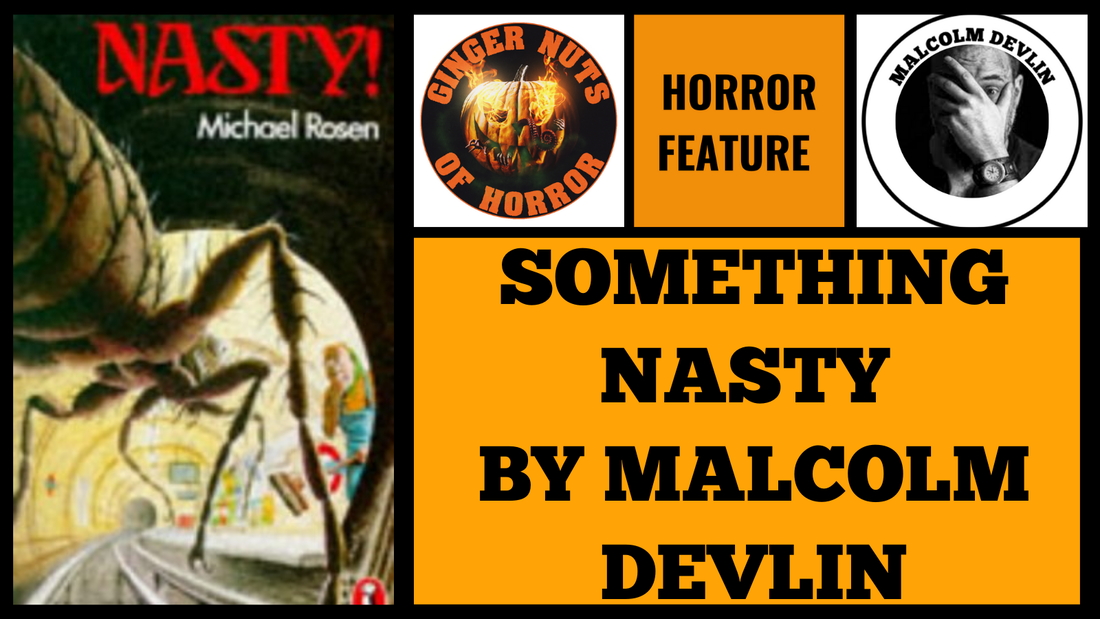
My copy of Nasty is a slim little paperback with a red spine. On the cover, a flea the size of a double-decker bus emerges from a tube tunnel to terrify a group of cleaning staff working on the platform. Up close, the image is more cartoonish than frightening. The flea is all arse and legs, its teeth like torn paper. I must have been around eight or nine or so when I bought the book and perhaps something about the image felt manageable. Here was a horror book, but from the cover, the sharper edges had been sanded down. It looked safer than it pretended it was. It was one of a whole stack of books I blew a birthday book token on in Blackwell’s Children’s Bookshop. I don’t remember any of the others I got that day. I don’t even know if I still have them, but the flea stays with me — not the story so much as the image -- it took its place on my memory’s bookshelves with the rotting pig's head and the boy with negative teeth. More importantly, the recollection of it serves as a bookmark to the other stories in the collection which didn’t grace the cover.
The Bakerloo Flea is the first story, and even these days, whenever I find myself in London, the title comes back when I look at a tube map. It was largely self-explanatory. A flea had grown fat in the labyrinth of tunnels underneath London, then got bigger still. Rosen recounts the story as an urban myth, related to him by a figure he comes to refer to as The Bakerloo Flea Woman. There’s a gossipy quality to the story of a monstrous (man-eating?) flea rampaging around the London Underground. The story is fun, but lived-in. It feels faintly gritty with dirt under its fingernails. It’s very British in that grey and slightly threadbare manner, and there’s something bittersweet about the final image of the monster being swallowed by a bin lorry.
The Bakerloo Flea Woman appears in the other stories as well. From the illustrations, she’s one of the cleaners on the cover. A middle-aged figure in a housecoat and headscarf. In each story, she runs into Rosen’s narrator with a new job, a new story to tell, and by the end of the book — inevitably — she ends up being something of a spectre herself.
What I remember most about the other stories in the book are their gentle bleakness, like an overcast British afternoon. I’d go on to read other horror stories by the usual big-name horror writers; countless classic ghost stories and weird tales, but they always felt a bit glossier by comparison. I suppose one analogue might be US readers' fondness for Alvin Schwartz’s Scary Stories to Tell in the Dark, but the stories in Nasty felt more Ken Loach than Stephen Spielberg. They were modest in scale, the stakes personal, not earthshaking or world-ending. These were horrors made on a BBC budget and all the more effective for what couldn’t afford to be shown.
Even the titles of stories like ‘Lollipop Lady’ or ‘A Plague of Wasps in Winter’ promise a certain kind of texture. That second one isn’t The Swarm, it isn’t The Killer Bees, it’s just wasps — that bane of the British summer — lots of wasps, when there shouldn’t be any at all.
‘The Loaf and the Knife’ is the one that has stuck with me and that was by design. It’s a simple story about pest control. The Bakerloo Flea Woman hires the mysterious Mrs Kent to deal with her mouse problem once and for all. Kent will do something which will make the rest of the city’s mice avoid the house at all costs. She promises to do so for free on the condition she isn’t observed. “The image will live in your mind’s eye,” The Bakerloo Flea Woman is warned. But of course she does look, and she tells Rosen, who goes on to tell us. And yes, the image really is nasty, strong enough I can still remember it today. Perhaps it won’t shock seasoned horror readers, but as an eight-or-nine-year-old, it felt like something I shouldn’t have been allowed to read and Rosen ends by suggesting the story is viral. He’s cured himself of the image by passing it to the reader, so now we’re stuck with it. I was an impressionable kid. I lived in the middle of a wood. I didn’t need to be cursed by affable poets as well, thank you very much.
What’s interesting, with hindsight, is the way the story hypes itself. Essentially, it’s the story of a single set-piece. The rest of the story — the lead up and aftermath — oversells it to the point it magnifies it. It’s a performer’s trick — I recently saw the same technique used in a Hannah Gadsby comedy special: “I will end the set with a joke about this,” she said, “and it will blow your mind.” I still find that completely fascinating. "This image will stick with you," Rosen promised and like a magic spell, it was true.
But, even then, it didn't keep me awake at night. I don't even know if I considered the book a real horror one back then, still assuming in some compartmentalised way, that horror wasn't something I particularly enjoyed; still assuming that anything I found in Blackwell’s Children’s Bookshop was horror with training wheels at best.
Years later, when I’d reached an age where I thought I liked fantasy novels more, I checked a copy of Clive Barker's ‘Weaveworld’ out of the library. It was a portal fantasy, but one set in Liverpool, which was where my mum was from and near where my grandmother lived. Part-way through, of course, I realised it was more of a horror book than the James Herbert novel ever had been, even though the copy promised magical things and didn’t use the word ‘horror’ once.
I do wonder how things will be for our son as he grows up in a house of horror readers and writers. We have plenty of books for him to find when he gets older, some with our names on them; ghouls and ghosts and horrible things leering off the page. We have pictures on the wall I wonder if we should put in storage for a while. A girl followed home by a shark from Evie Wyld's Everything Is Teeth; a dead cat in a red velvet box from the cover of Helen's second collection; at least three or four green men sculptures gurning from the walls in the garden. If I grew up in a house like this, I wonder, would I have ever developed a fascination for something as rare and special as being frightened? Or would it be normal, common-place, already tame. I wonder what will frighten him and instinctively I want to protect him from it. But will that rob him of something more important? What will intrigue him? I wonder what images — glorious, fantastical, horrible, strange — will live on in his mind's eye?
I think I always assumed it was something I'd be afraid of and assuming I wouldn't ever want to be that kind of afraid, I made sure it was something I skirted around. I have a distinct memory of standing in the library, reading and rereading the back cover copy of James Herbert's Fluke, trying to decide if it was horror or not. I knew that the book was about someone reincarnated as a dog, which didn't sound like horror, but I also knew that Herbert wrote horror novels and this book cover was the same black moody design all all his other books. The blurb on the inner flap used the word 'horror' but only once, and with such judicious care, that it didn't feel like it was a horror book.
My parents didn't really read horror either. Of all the books in the lounge, the ones my sister and I would dare each other to peek at was Golding’s Lord of The Flies (with a rotting pig head on the cover), and Wyndham's Chocky -- the cover of which featured a weird negative image of a boy with concentric circles radiating from his head. It was his teeth I found most disturbing. There’s something about teeth in negative that makes them look like broken glass.
But, I lived in the middle of the wood, so I have a suspicion that some sort of horror influence would have crept in somewhere through the cracks. Its hard not to think in ghost stories when the countryside is blotted out by acres of pitch black woodland; when eyes in the darkness met mine when it was my turn to fill the coal scuttle from the shed; when muntjac deer barked outside my window at night with a sound uncannily like someone expelling a long-held breath on the glass.
The first horror book I bought for myself might not count for anyone but me.
Nasty is a short collection by Michael Rosen, better known as the poet, Children's Laureate, Long Covid-surviving thorn in the Tory government’s side and author of We're All Going on A Bear Hunt.
My copy is boxed up in my mother’s house in the UK with a whole lot of other books I need to sort out at some point. This means — pleasingly — there really is something nasty in her attic, but also it means this piece is entirely based on my memory of the book, which might not be quite the same as the one you can buy.
My copy of Nasty is a slim little paperback with a red spine. On the cover, a flea the size of a double-decker bus emerges from a tube tunnel to terrify a group of cleaning staff working on the platform. Up close, the image is more cartoonish than frightening. The flea is all arse and legs, its teeth like torn paper. I must have been around eight or nine or so when I bought the book and perhaps something about the image felt manageable. Here was a horror book, but from the cover, the sharper edges had been sanded down. It looked safer than it pretended it was. It was one of a whole stack of books I blew a birthday book token on in Blackwell’s Children’s Bookshop. I don’t remember any of the others I got that day. I don’t even know if I still have them, but the flea stays with me — not the story so much as the image -- it took its place on my memory’s bookshelves with the rotting pig's head and the boy with negative teeth. More importantly, the recollection of it serves as a bookmark to the other stories in the collection which didn’t grace the cover.
The Bakerloo Flea is the first story, and even these days, whenever I find myself in London, the title comes back when I look at a tube map. It was largely self-explanatory. A flea had grown fat in the labyrinth of tunnels underneath London, then got bigger still. Rosen recounts the story as an urban myth, related to him by a figure he comes to refer to as The Bakerloo Flea Woman. There’s a gossipy quality to the story of a monstrous (man-eating?) flea rampaging around the London Underground. The story is fun, but lived-in. It feels faintly gritty with dirt under its fingernails. It’s very British in that grey and slightly threadbare manner, and there’s something bittersweet about the final image of the monster being swallowed by a bin lorry.
The Bakerloo Flea Woman appears in the other stories as well. From the illustrations, she’s one of the cleaners on the cover. A middle-aged figure in a housecoat and headscarf. In each story, she runs into Rosen’s narrator with a new job, a new story to tell, and by the end of the book — inevitably — she ends up being something of a spectre herself.
What I remember most about the other stories in the book are their gentle bleakness, like an overcast British afternoon. I’d go on to read other horror stories by the usual big-name horror writers; countless classic ghost stories and weird tales, but they always felt a bit glossier by comparison. I suppose one analogue might be US readers' fondness for Alvin Schwartz’s Scary Stories to Tell in the Dark, but the stories in Nasty felt more Ken Loach than Stephen Spielberg. They were modest in scale, the stakes personal, not earthshaking or world-ending. These were horrors made on a BBC budget and all the more effective for what couldn’t afford to be shown.
Even the titles of stories like ‘Lollipop Lady’ or ‘A Plague of Wasps in Winter’ promise a certain kind of texture. That second one isn’t The Swarm, it isn’t The Killer Bees, it’s just wasps — that bane of the British summer — lots of wasps, when there shouldn’t be any at all.
‘The Loaf and the Knife’ is the one that has stuck with me and that was by design. It’s a simple story about pest control. The Bakerloo Flea Woman hires the mysterious Mrs Kent to deal with her mouse problem once and for all. Kent will do something which will make the rest of the city’s mice avoid the house at all costs. She promises to do so for free on the condition she isn’t observed. “The image will live in your mind’s eye,” The Bakerloo Flea Woman is warned. But of course she does look, and she tells Rosen, who goes on to tell us. And yes, the image really is nasty, strong enough I can still remember it today. Perhaps it won’t shock seasoned horror readers, but as an eight-or-nine-year-old, it felt like something I shouldn’t have been allowed to read and Rosen ends by suggesting the story is viral. He’s cured himself of the image by passing it to the reader, so now we’re stuck with it. I was an impressionable kid. I lived in the middle of a wood. I didn’t need to be cursed by affable poets as well, thank you very much.
What’s interesting, with hindsight, is the way the story hypes itself. Essentially, it’s the story of a single set-piece. The rest of the story — the lead up and aftermath — oversells it to the point it magnifies it. It’s a performer’s trick — I recently saw the same technique used in a Hannah Gadsby comedy special: “I will end the set with a joke about this,” she said, “and it will blow your mind.” I still find that completely fascinating. "This image will stick with you," Rosen promised and like a magic spell, it was true.
But, even then, it didn't keep me awake at night. I don't even know if I considered the book a real horror one back then, still assuming in some compartmentalised way, that horror wasn't something I particularly enjoyed; still assuming that anything I found in Blackwell’s Children’s Bookshop was horror with training wheels at best.
Years later, when I’d reached an age where I thought I liked fantasy novels more, I checked a copy of Clive Barker's ‘Weaveworld’ out of the library. It was a portal fantasy, but one set in Liverpool, which was where my mum was from and near where my grandmother lived. Part-way through, of course, I realised it was more of a horror book than the James Herbert novel ever had been, even though the copy promised magical things and didn’t use the word ‘horror’ once.
I do wonder how things will be for our son as he grows up in a house of horror readers and writers. We have plenty of books for him to find when he gets older, some with our names on them; ghouls and ghosts and horrible things leering off the page. We have pictures on the wall I wonder if we should put in storage for a while. A girl followed home by a shark from Evie Wyld's Everything Is Teeth; a dead cat in a red velvet box from the cover of Helen's second collection; at least three or four green men sculptures gurning from the walls in the garden. If I grew up in a house like this, I wonder, would I have ever developed a fascination for something as rare and special as being frightened? Or would it be normal, common-place, already tame. I wonder what will frighten him and instinctively I want to protect him from it. But will that rob him of something more important? What will intrigue him? I wonder what images — glorious, fantastical, horrible, strange — will live on in his mind's eye?
And Then I Woke Up Malcolm Devlin
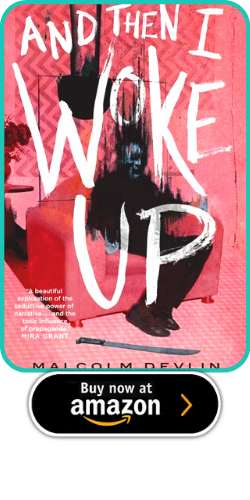
In the tradition of Mira Grant and Stephen Graham Jones, Malcolm Devlin’s And Then I Woke Up is a creepy, layered, literary story about false narratives and their ability to divide us.
"A scathing portrait of the world we live in and a running commentary on what’s story, what’s truth, and what’s not."—Stephen Graham Jones
In a world reeling from an unusual plague, monsters lurk in the streets while terrified survivors arm themselves and roam the countryside in packs. Or perhaps something very different is happening. When a disease affects how reality is perceived, it’s hard to be certain of anything…
Spence is one of the “cured” living at the Ironside rehabilitation facility. Haunted by guilt, he refuses to face the changed world until a new inmate challenges him to help her find her old crew. But if he can’t tell the truth from the lies, how will he know if he has earned the redemption he dreams of? How will he know he hasn’t just made things worse?
At the Publisher's request, this title is being sold without Digital Rights Management Software (DRM) applied.
"A scathing portrait of the world we live in and a running commentary on what’s story, what’s truth, and what’s not."—Stephen Graham Jones
In a world reeling from an unusual plague, monsters lurk in the streets while terrified survivors arm themselves and roam the countryside in packs. Or perhaps something very different is happening. When a disease affects how reality is perceived, it’s hard to be certain of anything…
Spence is one of the “cured” living at the Ironside rehabilitation facility. Haunted by guilt, he refuses to face the changed world until a new inmate challenges him to help her find her old crew. But if he can’t tell the truth from the lies, how will he know if he has earned the redemption he dreams of? How will he know he hasn’t just made things worse?
At the Publisher's request, this title is being sold without Digital Rights Management Software (DRM) applied.
Malcolm Devlin

Malcolm Devlin’s stories have appeared in Black Static, Interzone, The Shadow Booth and Shadows and Tall Trees. His first collection, You Will Grow Into Them, was published by Unsung Stories in 2017 and shortlisted for the British Fantasy and Saboteur Awards. He currently lives in Brisbane.
CHECK OUT TODAY'S OTHER ARTICLES ON GINGER NUTS OF HORROR
 | |
THE HEART AND SOUL OF HORROR PROMOTION WEBSITES
Before we begin with this one, please note that this article consists of enormous spoilers for Resident Evil VIII: Village, in particular the infamous House Beneviento sequence. Unlike most entries, House Beneviento relies upon player ignorance in order to maintain its peculiar species of escalating tension and the truly horrific surprises that lie within its shifting corridors, so, reader discression is earnestly advised.
With that said, we're hurtling bang up to date for this entry. Resident Evil VIII: Village is the latest in the Resident Evil franchise and, like VII before it, marks a significant experiment on behalf of the creators:
Unlike previous entries, which maintain a certain consistency in tone, style and the nature of horror they employ, Resident Evil VIII goes entirely off-piste, introducing a scenario that -as the game's storybook opening sequence implies- is more of a macabre fairy tale than the science fiction and horror B-Movie plots of yore.
Foregoing the the ethos of any previous entry, Resident Evil VIII forces the player to sit up and take notice by introducing elements that -initially- seem almost antithetical to established Resident Evil tradition, but which, when the back-mythology starts to become apparent, tie in beautifully to the previous entry and the history of the entire series.
Part of what makes Resident Evil VIII: Village so unique amongst the franchise's many, many entries at this point is its inclusion of various different strains of horror: each sub-section of the game evinces its own peculiar aspects and qualities, from the action, combat-oriented chaos of Heisenberg's factory to the gothic stylings of Castle Dimitrescu (more on that later in the series). Each area boasts its own unique style of gameplay and is redolent of a particular sub-genre of horror, meaning that there is no point at which the game becomes familiar or formulaic. Players have to adjust their expectations, assumptions and style of play on the fly, responding to conditions that change so suddenly, that transition in itself becomes a source of sublime panic.
Perhaps the most infamous sequence in the game -certainly the one remarked upon by those of us who enjoy the atmospheric dread so redolent of earlier entries in the series- is House Beneviento.
Unlike most areas in this game -and certainly any that precede it-, House Beneviento is a marked removal from expected gameplay in a Resident Evil title. If anything, it is more redolent of what a present-day Silent Hill game might exhibit: a descent into quiet psychological horror that pays homage not only to various films, novels et al but also numerous independent video games that have massively influenced horror as a whole (there are references here to everything from P.T. to Layers of Fear, from Amnesia: The Dark Descent to Condemned: Criminal Origins).
After passing through the gate that leads to the long and winding track to House Beneviento, player character Ethan Winters finds himself almost hopelessly lost in a mist-shrouded wood, the path uncertain, strange sounds and motions passing through the surrounding undergrowth. There are no enemies here; nothing to shoot or pose overt threat; only the cawing of crows, the pervasive mist and a lingering sense of escalating dread, as we wait for the inevitable axe to fall.
At one point, the way starts to echo scenes from the iconic Blair Witch Project, the trees strung with various dolls that twist and shift in the breeze. A strangely ritualistic grave boasts a broken plaque embossed with the name of the Beneviento family. Beyond, a door demands that Ethan give up his memories in order to proceed. This is where a photograph of Ethan and his family that the player has been carrying in their inventory since the beginning of the game comes into play: Feeding the photograph through the slot causes the door to open, revealing a murky, underground passage that leads to an elevator.
It's here that Resident Evil VIII demonstrates its removal from previous entries in the series to the Nth degree: Ethan's giving up his memories of his family is a symbolic act, the like of which one would expect to find in a Silent Hill title, and that chimes with the pervading themes of parenthood, family and the tensions that exist between one generation and the next that weave throughout the narrative. By feeding House Beneviento his most beloved memories, Ethan inadvertantly provides it the weapons with which it will inevitably assault him, but also commits an act of self-purgation: here, he relinquishes hold of something that he can never have and that will never be his again; a dream that has been shattered, along with his delusion of a life.
The elevator is where things start to take a turn for the decidedly weird: an extremely long ride up is haunted by flickering lights and phantom voices, every time the light fails revealing more and more strange missives scrawled on the walls of the elevator by unknown hands.
This is where the player might start to doubt what is happening; as different as Resident Evil VIII is from previous entries, it still functions in the same universe which, despite its many grotesque absurdities, is still a rational one: there is no magic, there are no demons or ghosts or supernatural entities here. Everything is a product of biology, to one degree or another. However, here, arguably for the first time, that certainty is thrown into profound doubt.
After emerging from the woods into a strange, derelict garden, Ethan is faced with the spectre of Mia, his wife who was apparently murdered in the game's opening sequences. The spectre demonstrates itself to be nothing but an hallucination, accusing him of abandoning her and their child before dispersing entirely.
Following the path, Ethan eventually comes upon a beautiful, cliffside vista, in which an immense waterfall flows endlessly in the distance, and the quaint, picturesque House Beneviento perches on the mountainside, almost inviting in its domesticity. Upon approaching the house, Ethan finds that everything he's been carrying up to this point is gone, including his weapons. Everything starts to take on a quietly dreaming quality; the interior of the house itself concertedly normal, so much so as to be uncanny. Everywhere Ethan wanders, there are signs of lives being lived beyond the horrors he has faced in the eponymous village heretofore, very little that is overtly sinister or threatening save, perhaps, the myriad dolls that infest every room and corridor (numerous documents gathered up to this point have obliquely referenced a “doll maker,” and Ethan has had a brief, confusing encounter with the woman herself during a communion that he barely escaped with his life).
Trespassing deeper, he finds an elevator which leads down into the sinister cellar of the house, and it's here that things start to take a turn:
Donna Beneviento -whose full name we don't learn until much later-, the presiding mistress of House Beneviento, has been affected by the “gift” of the game's antagonist, Mother Miranda, in a markedly different way than her “siblings:”
Whereas they have all been physically transformed in extremely profound ways, Donna's corruption is more subtle: whilst there are indeed physical transformations beneath her black veil and funeral garb, they are incredibly subtle in comparison to those evinced by the piscine Moreau or draconic Lady Dimitrescu:
Donna's dubious “gift” is a shift in psychology and perception: her mind has been broken, warped and reshaped by Miranda's touch, resulting in a fractured reality that she can inflict on others when in close proximity (and with the help of various hallucinogenic flowers that she cultivates in her expansive garden). Unwittingly having inhaled their toxins on his way to the house, Ethan is afflicted with visions and hallucinations that gradually escalate in intensity and that tap into his subconscious dreads and neuroses regarding his newborn daughter and his own capacity as a parent: Here, the themes of the game are made overt in the puzzles and horrors that Ethan experiences, from symbolic imagery that -frankly- shames most Silent Hill titles to a climax that is so horrifying, many players -including myself- shriek out loud upon first experiencing it.
As well as a mannequin of Mia that Ethan must carefully dissect and dismember in order to find the keys and solutions to various puzzles -symbolism!-, he is constantly afflicted by phantom sounds, shades that pass by frosted windows or lurk around corners, paintings that change, corridors that transform or distort when he turns around and myriad other seemingly-supernatural occurences that feel almost out of place in a Resident Evil title.
One particular puzzle sees Ethan having to reconstruct a home-video sequence which tells the story of his daughter Rose's life up to this point. Upon completing the puzzle, a projector will play the scratchy, distorted film of a descending stone cavern -Freudian symbolism certainly not lost on the developers here- to a sinister well. Opening a door that requires the keys and solutions from the other puzzles in the area brings Ethan directly to the mouth of that same tunnel, his descent into the dark accompanied by the crying of a child, whispers at the edge of perception. In the room with the well, he finds a crib gently rocking, but no child. Having no choice but to descend into the well, he does so, finding an item in the depths that will help him progress.
This is a moment of sublimely orchestrated tension: of course the player anticipates something in the bottom of the well, something that, perhaps, rises from the filthy water or that lurches from the shadows.
With that said, we're hurtling bang up to date for this entry. Resident Evil VIII: Village is the latest in the Resident Evil franchise and, like VII before it, marks a significant experiment on behalf of the creators:
Unlike previous entries, which maintain a certain consistency in tone, style and the nature of horror they employ, Resident Evil VIII goes entirely off-piste, introducing a scenario that -as the game's storybook opening sequence implies- is more of a macabre fairy tale than the science fiction and horror B-Movie plots of yore.
Foregoing the the ethos of any previous entry, Resident Evil VIII forces the player to sit up and take notice by introducing elements that -initially- seem almost antithetical to established Resident Evil tradition, but which, when the back-mythology starts to become apparent, tie in beautifully to the previous entry and the history of the entire series.
Part of what makes Resident Evil VIII: Village so unique amongst the franchise's many, many entries at this point is its inclusion of various different strains of horror: each sub-section of the game evinces its own peculiar aspects and qualities, from the action, combat-oriented chaos of Heisenberg's factory to the gothic stylings of Castle Dimitrescu (more on that later in the series). Each area boasts its own unique style of gameplay and is redolent of a particular sub-genre of horror, meaning that there is no point at which the game becomes familiar or formulaic. Players have to adjust their expectations, assumptions and style of play on the fly, responding to conditions that change so suddenly, that transition in itself becomes a source of sublime panic.
Perhaps the most infamous sequence in the game -certainly the one remarked upon by those of us who enjoy the atmospheric dread so redolent of earlier entries in the series- is House Beneviento.
Unlike most areas in this game -and certainly any that precede it-, House Beneviento is a marked removal from expected gameplay in a Resident Evil title. If anything, it is more redolent of what a present-day Silent Hill game might exhibit: a descent into quiet psychological horror that pays homage not only to various films, novels et al but also numerous independent video games that have massively influenced horror as a whole (there are references here to everything from P.T. to Layers of Fear, from Amnesia: The Dark Descent to Condemned: Criminal Origins).
After passing through the gate that leads to the long and winding track to House Beneviento, player character Ethan Winters finds himself almost hopelessly lost in a mist-shrouded wood, the path uncertain, strange sounds and motions passing through the surrounding undergrowth. There are no enemies here; nothing to shoot or pose overt threat; only the cawing of crows, the pervasive mist and a lingering sense of escalating dread, as we wait for the inevitable axe to fall.
At one point, the way starts to echo scenes from the iconic Blair Witch Project, the trees strung with various dolls that twist and shift in the breeze. A strangely ritualistic grave boasts a broken plaque embossed with the name of the Beneviento family. Beyond, a door demands that Ethan give up his memories in order to proceed. This is where a photograph of Ethan and his family that the player has been carrying in their inventory since the beginning of the game comes into play: Feeding the photograph through the slot causes the door to open, revealing a murky, underground passage that leads to an elevator.
It's here that Resident Evil VIII demonstrates its removal from previous entries in the series to the Nth degree: Ethan's giving up his memories of his family is a symbolic act, the like of which one would expect to find in a Silent Hill title, and that chimes with the pervading themes of parenthood, family and the tensions that exist between one generation and the next that weave throughout the narrative. By feeding House Beneviento his most beloved memories, Ethan inadvertantly provides it the weapons with which it will inevitably assault him, but also commits an act of self-purgation: here, he relinquishes hold of something that he can never have and that will never be his again; a dream that has been shattered, along with his delusion of a life.
The elevator is where things start to take a turn for the decidedly weird: an extremely long ride up is haunted by flickering lights and phantom voices, every time the light fails revealing more and more strange missives scrawled on the walls of the elevator by unknown hands.
This is where the player might start to doubt what is happening; as different as Resident Evil VIII is from previous entries, it still functions in the same universe which, despite its many grotesque absurdities, is still a rational one: there is no magic, there are no demons or ghosts or supernatural entities here. Everything is a product of biology, to one degree or another. However, here, arguably for the first time, that certainty is thrown into profound doubt.
After emerging from the woods into a strange, derelict garden, Ethan is faced with the spectre of Mia, his wife who was apparently murdered in the game's opening sequences. The spectre demonstrates itself to be nothing but an hallucination, accusing him of abandoning her and their child before dispersing entirely.
Following the path, Ethan eventually comes upon a beautiful, cliffside vista, in which an immense waterfall flows endlessly in the distance, and the quaint, picturesque House Beneviento perches on the mountainside, almost inviting in its domesticity. Upon approaching the house, Ethan finds that everything he's been carrying up to this point is gone, including his weapons. Everything starts to take on a quietly dreaming quality; the interior of the house itself concertedly normal, so much so as to be uncanny. Everywhere Ethan wanders, there are signs of lives being lived beyond the horrors he has faced in the eponymous village heretofore, very little that is overtly sinister or threatening save, perhaps, the myriad dolls that infest every room and corridor (numerous documents gathered up to this point have obliquely referenced a “doll maker,” and Ethan has had a brief, confusing encounter with the woman herself during a communion that he barely escaped with his life).
Trespassing deeper, he finds an elevator which leads down into the sinister cellar of the house, and it's here that things start to take a turn:
Donna Beneviento -whose full name we don't learn until much later-, the presiding mistress of House Beneviento, has been affected by the “gift” of the game's antagonist, Mother Miranda, in a markedly different way than her “siblings:”
Whereas they have all been physically transformed in extremely profound ways, Donna's corruption is more subtle: whilst there are indeed physical transformations beneath her black veil and funeral garb, they are incredibly subtle in comparison to those evinced by the piscine Moreau or draconic Lady Dimitrescu:
Donna's dubious “gift” is a shift in psychology and perception: her mind has been broken, warped and reshaped by Miranda's touch, resulting in a fractured reality that she can inflict on others when in close proximity (and with the help of various hallucinogenic flowers that she cultivates in her expansive garden). Unwittingly having inhaled their toxins on his way to the house, Ethan is afflicted with visions and hallucinations that gradually escalate in intensity and that tap into his subconscious dreads and neuroses regarding his newborn daughter and his own capacity as a parent: Here, the themes of the game are made overt in the puzzles and horrors that Ethan experiences, from symbolic imagery that -frankly- shames most Silent Hill titles to a climax that is so horrifying, many players -including myself- shriek out loud upon first experiencing it.
As well as a mannequin of Mia that Ethan must carefully dissect and dismember in order to find the keys and solutions to various puzzles -symbolism!-, he is constantly afflicted by phantom sounds, shades that pass by frosted windows or lurk around corners, paintings that change, corridors that transform or distort when he turns around and myriad other seemingly-supernatural occurences that feel almost out of place in a Resident Evil title.
One particular puzzle sees Ethan having to reconstruct a home-video sequence which tells the story of his daughter Rose's life up to this point. Upon completing the puzzle, a projector will play the scratchy, distorted film of a descending stone cavern -Freudian symbolism certainly not lost on the developers here- to a sinister well. Opening a door that requires the keys and solutions from the other puzzles in the area brings Ethan directly to the mouth of that same tunnel, his descent into the dark accompanied by the crying of a child, whispers at the edge of perception. In the room with the well, he finds a crib gently rocking, but no child. Having no choice but to descend into the well, he does so, finding an item in the depths that will help him progress.
This is a moment of sublimely orchestrated tension: of course the player anticipates something in the bottom of the well, something that, perhaps, rises from the filthy water or that lurches from the shadows.
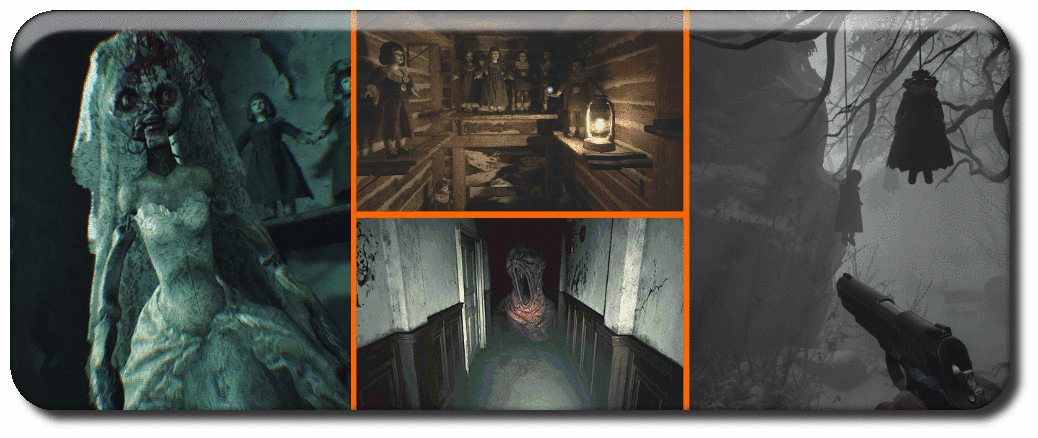
But there is nothing; the well is a red herring, meaning that the tension continues to escalate as they climb the ladder again, and the baby's crying takes on a violent note, a calamity above consisting of slammed doors, the crib being audibly knocked over, something vast throwing its weight around the small chamber.
Rising out of the well, Ethan finds the room in disarray; the crib toppled and shattered, everything else it contains hurled around or otherwise vandalised.
Most distressing of all, what can only be identified as an immense umbilical cord leads from the crib back up the staircase, into the room where the mannequin of Mia previously lay. Now, the mannequin is gone, the table in which it lay obscenely bloody, and a pulsating, red light lends events a Dario Argento-style feverishness.
Following the umbilical cord into the darkened network of corridors leading to the elevator, Ethan is faced with the manifestation of all his fears and doubts regarding Rose, his daughter, and his own capacities as a Father:
A burbling, gelatinous, foetal giant, the creature laughing and crying “Dadda!” in hunger as it crawls towards him through the corridors.
This is the most tense, terrifying moment not only in House Beneviento, but arguably the entire game: owing to the darkness in which the creature occurs, the raw panic it induces, it is incredibly difficult to make out more than suggested details. This in itself lends the creature a degree of perversity that the more overt monsters in the game lack: the player will be so busy running away, so panicked, they often won't ever stay still long enough to get a clear view of the entity (and, if they do, they're likely condemning Ethan to a grizzly, patricidal devouring).
If the entity does catch up, it stretches its gelatinous maw, burbling “Dadda!” all the while, and devours Ethan whole (the Freudian symbolism of this, I'm sure, bears no comment).
If the player manages to escape, their only option is to play a hideously tense game of cat and mouse, hiding in various cupboards and cabinets as the creature violently seeks them out, making moves only when they are sure it has passed. The object is to circle around the entity, make a way back to the elevator and the fuze box attached to it, at which point they will find that it no longer operates; a replacement fuze is required in order to make it work.
This can be found in a bedroom behind a previously locked door. However, when Ethan is making his way back, the foetus-monster will burst through a door ahread of him, giggling at having found its “Dadda,” and chase him back to the bedroom, where it is necessary to hide under the bed, wait for the slouching, unformed monster to circle around then bolt back for the elevator as fast as Ethan can run.
Even as the elevator doors close, the thing approaches, dragging its way towards Ethan before hurling itself at the gate that seals it out.
Ethan's ascent from that hideous cellar marks far more than an escape from a monster: in classic Silent Hill style, it is a symbolic event, demonstrating that he has faced the culmination of his fears as a parent and escaped from them intact, and is now ready to face the many trials that will lead him back to his daughter.
The “baby” is not only one of the most disturbing entities in the game, it marks a turning point in the entire series: this is Resident Evil trespassing in the long-defunct Silent Hill's territory, proclaiming that, not only can it do all of the psychological, deep and dark, symbolic horror that series is so renowned for, at this point, it can do it better.
A bold claim, and one that it hopefully fulfils in future entries.
Rising out of the well, Ethan finds the room in disarray; the crib toppled and shattered, everything else it contains hurled around or otherwise vandalised.
Most distressing of all, what can only be identified as an immense umbilical cord leads from the crib back up the staircase, into the room where the mannequin of Mia previously lay. Now, the mannequin is gone, the table in which it lay obscenely bloody, and a pulsating, red light lends events a Dario Argento-style feverishness.
Following the umbilical cord into the darkened network of corridors leading to the elevator, Ethan is faced with the manifestation of all his fears and doubts regarding Rose, his daughter, and his own capacities as a Father:
A burbling, gelatinous, foetal giant, the creature laughing and crying “Dadda!” in hunger as it crawls towards him through the corridors.
This is the most tense, terrifying moment not only in House Beneviento, but arguably the entire game: owing to the darkness in which the creature occurs, the raw panic it induces, it is incredibly difficult to make out more than suggested details. This in itself lends the creature a degree of perversity that the more overt monsters in the game lack: the player will be so busy running away, so panicked, they often won't ever stay still long enough to get a clear view of the entity (and, if they do, they're likely condemning Ethan to a grizzly, patricidal devouring).
If the entity does catch up, it stretches its gelatinous maw, burbling “Dadda!” all the while, and devours Ethan whole (the Freudian symbolism of this, I'm sure, bears no comment).
If the player manages to escape, their only option is to play a hideously tense game of cat and mouse, hiding in various cupboards and cabinets as the creature violently seeks them out, making moves only when they are sure it has passed. The object is to circle around the entity, make a way back to the elevator and the fuze box attached to it, at which point they will find that it no longer operates; a replacement fuze is required in order to make it work.
This can be found in a bedroom behind a previously locked door. However, when Ethan is making his way back, the foetus-monster will burst through a door ahread of him, giggling at having found its “Dadda,” and chase him back to the bedroom, where it is necessary to hide under the bed, wait for the slouching, unformed monster to circle around then bolt back for the elevator as fast as Ethan can run.
Even as the elevator doors close, the thing approaches, dragging its way towards Ethan before hurling itself at the gate that seals it out.
Ethan's ascent from that hideous cellar marks far more than an escape from a monster: in classic Silent Hill style, it is a symbolic event, demonstrating that he has faced the culmination of his fears as a parent and escaped from them intact, and is now ready to face the many trials that will lead him back to his daughter.
The “baby” is not only one of the most disturbing entities in the game, it marks a turning point in the entire series: this is Resident Evil trespassing in the long-defunct Silent Hill's territory, proclaiming that, not only can it do all of the psychological, deep and dark, symbolic horror that series is so renowned for, at this point, it can do it better.
A bold claim, and one that it hopefully fulfils in future entries.
Check out the other articles in George's series on Resident Evil
TOP TEN RESIDENT EVIL MONSTERS PART 1: THE CERBERUS
TOP TEN RESIDENT EVIL MONSTERS PART 2: THE LICKERS
FEATURE: TOP TEN RESIDENT EVIL MONSTERS NEMESIS (RESIDENT EVIL 3 REMAKE)
TOP TEN RESIDENT EVIL MONSTERS PART 1: THE CERBERUS
TOP TEN RESIDENT EVIL MONSTERS PART 2: THE LICKERS
FEATURE: TOP TEN RESIDENT EVIL MONSTERS NEMESIS (RESIDENT EVIL 3 REMAKE)
CHECK OUT TODAY'S OTHER ARTICLES ON GINGER NUTS OF HORROR
| | |
THE HEART AND SOUL OF HORROR PROMOTION WEBSITES
Book Excerpt: golumby PD Alleva
8/4/2022

The First Possession: Alena Francon Excerpt:
Whimpers held back, cries and fearful scurries came from those cages, all bathed in darkness despite the red tint overhead. Golem closed and locked the door behind them, his movements smooth and calculated. He leaned against the door. Alena arched her head back, seeing him.
“They wait for you, Baphomet,” he said. “Please, choose your desire.”
Alena turned to the cages, walked to them, felt her hand run across the steel. Inside each cage was a child. Some no more than four, but none more than ten years old.
Alena felt herself grin. “Delightful,” she said. “How did you retrieve so many so quickly?”
“The orphanage,” Golem breathed. “They came willingly, of course. So, so easy it was; they came like hungry dogs to a steak dinner.”
Alena pursed her lips, tightened her jaw.
“Please, my lady, can you help us?” A voice in a cage, soft spoken, strong.
Alena turned to the seven-year-old girl who pressed her forehead to the steel fence. Soft blue eyes gazing at Alena. The girl’s face covered in soot, matted blonde hair. Alena bent down eye to eye with her.
“Of course,” Alena said. “That is why I am here.”
The girl paused, staring at Alena, sizing her up.
“Why are your eyes like that?” The girl was trembling, Alena could see.
“Don’t be afraid, my dear. Not of me, not ever. I only wish to help you…can you believe me? That I am here to help you?”
The girl pursed her lips then swallowed. She gave a quick nod. The other children softly and quietly stood, watching, their eyes sad, confused, defeated. Listening and observing. Alena could hear their shallow breathing and the restricted beat of little hearts.
“Good,” Alena said, shaking her head and smiling. “I only need for you to do something for me. Is that ok? Can you help me too? We all need help in this world, do we not? Will you help me—?”
“Sophia,” said the girl. “My name is Sophia.”
Alena felt the grin on her lips. “Such a beautiful name. Tell me, Sophia, what are your dreams?”
Sophia hesitated. “Dreams are not real,” she said. “Not for us, not ever for us.”
“Oh, my darling, so, so not true. Dreams are for everyone.”
She heard Golem snicker over her shoulder. Sophia looked at him but Alena’s hand covered the view, returning Sophia’s eyes to her.
“Tell me, Sophia, do you wish for riches? Fame? Power? Do you wish to come away from this cage and be free?”
Sophia nodded, those blue eyes sad and downtrodden.
“Oh, wonderful. Absolutely wonderful, Sophia.” Alena felt hunger turn her stomach and wrench into her throat. She licked her lips with a slight movement of the tongue. “I can do that for you, Sophia. I can make all your dreams come true.”
“Are you a fairy godmother?”
“Oh, yes, Sophia. That I am and I have all your dreams and wishes right here…” Alena held out her hand, palm up, for Sophia to see. “In the palm of my hand.” Light emitted from her palm, sparkling red and blue light as if she held a crystal that reflected the rainbow. Sophia’s eyes glowed.
“You are a fairy godmother.”
“Of course, Sophia. I wouldn’t lie to you. Not to a child. Not ever. But can you please do something for me first? Before I give you such beautiful presents. Do I have your permission? Can you give that to me, your agreement? Like a sacred pact between two people. You do for me, and I do for you. Will you allow this, Sophia?”
Sophia looked left then right, seeing the other kids with unknowing stares. She turned those blue eyes to Alena and nodded. “Yes,” she said. “Yes, I will.”
Whimpers held back, cries and fearful scurries came from those cages, all bathed in darkness despite the red tint overhead. Golem closed and locked the door behind them, his movements smooth and calculated. He leaned against the door. Alena arched her head back, seeing him.
“They wait for you, Baphomet,” he said. “Please, choose your desire.”
Alena turned to the cages, walked to them, felt her hand run across the steel. Inside each cage was a child. Some no more than four, but none more than ten years old.
Alena felt herself grin. “Delightful,” she said. “How did you retrieve so many so quickly?”
“The orphanage,” Golem breathed. “They came willingly, of course. So, so easy it was; they came like hungry dogs to a steak dinner.”
Alena pursed her lips, tightened her jaw.
“Please, my lady, can you help us?” A voice in a cage, soft spoken, strong.
Alena turned to the seven-year-old girl who pressed her forehead to the steel fence. Soft blue eyes gazing at Alena. The girl’s face covered in soot, matted blonde hair. Alena bent down eye to eye with her.
“Of course,” Alena said. “That is why I am here.”
The girl paused, staring at Alena, sizing her up.
“Why are your eyes like that?” The girl was trembling, Alena could see.
“Don’t be afraid, my dear. Not of me, not ever. I only wish to help you…can you believe me? That I am here to help you?”
The girl pursed her lips then swallowed. She gave a quick nod. The other children softly and quietly stood, watching, their eyes sad, confused, defeated. Listening and observing. Alena could hear their shallow breathing and the restricted beat of little hearts.
“Good,” Alena said, shaking her head and smiling. “I only need for you to do something for me. Is that ok? Can you help me too? We all need help in this world, do we not? Will you help me—?”
“Sophia,” said the girl. “My name is Sophia.”
Alena felt the grin on her lips. “Such a beautiful name. Tell me, Sophia, what are your dreams?”
Sophia hesitated. “Dreams are not real,” she said. “Not for us, not ever for us.”
“Oh, my darling, so, so not true. Dreams are for everyone.”
She heard Golem snicker over her shoulder. Sophia looked at him but Alena’s hand covered the view, returning Sophia’s eyes to her.
“Tell me, Sophia, do you wish for riches? Fame? Power? Do you wish to come away from this cage and be free?”
Sophia nodded, those blue eyes sad and downtrodden.
“Oh, wonderful. Absolutely wonderful, Sophia.” Alena felt hunger turn her stomach and wrench into her throat. She licked her lips with a slight movement of the tongue. “I can do that for you, Sophia. I can make all your dreams come true.”
“Are you a fairy godmother?”
“Oh, yes, Sophia. That I am and I have all your dreams and wishes right here…” Alena held out her hand, palm up, for Sophia to see. “In the palm of my hand.” Light emitted from her palm, sparkling red and blue light as if she held a crystal that reflected the rainbow. Sophia’s eyes glowed.
“You are a fairy godmother.”
“Of course, Sophia. I wouldn’t lie to you. Not to a child. Not ever. But can you please do something for me first? Before I give you such beautiful presents. Do I have your permission? Can you give that to me, your agreement? Like a sacred pact between two people. You do for me, and I do for you. Will you allow this, Sophia?”
Sophia looked left then right, seeing the other kids with unknowing stares. She turned those blue eyes to Alena and nodded. “Yes,” she said. “Yes, I will.”
Golem
by PD Alleva

"An extraordinary psychological horror book. Excellently written, with a twisted, spiraling, unexpected end that will leave you speechless." ~ TBM Horror Experts
Detective. Angel. Victim. Devil.
A haunting tale of suspense, loss, isolation, contempt, and fear.
On November 1, 1951, war hero John Ashton was promoted to detective. His first assignment: find the district attorney's missing daughter. But his only lead is Alena Francon, a high society sculptor and socialite committed to Bellevue's psychiatric facility.
Alena has a story for the new detective. A story so outlandish John Ashton refuses to heed the warning. Alena admits to incarnating Golem, a demonic force, into her statue. A devil so profound he's infiltrated every part of New York's infrastructure. Even worse, he uses children to serve as bodily hosts for his demonic army, unleashing a horde of devils into our world.
When Alena's confidant, Annette Flemming, confirms the existence of Golem, John is sent on a collision course where fate and destiny spiral into peril, and the future of the human race hangs in the balance.
The Devil Is In The Details!
Fans of The Silence of the Lambs, Clive Barker, John Connolly, old Stephen King, and Anne Rice will be fascinated by this edge of your seat psychological horror thriller with a story that rips out the heart of humanity and throws it on a slab to be feasted on.
Detective. Angel. Victim. Devil.
A haunting tale of suspense, loss, isolation, contempt, and fear.
On November 1, 1951, war hero John Ashton was promoted to detective. His first assignment: find the district attorney's missing daughter. But his only lead is Alena Francon, a high society sculptor and socialite committed to Bellevue's psychiatric facility.
Alena has a story for the new detective. A story so outlandish John Ashton refuses to heed the warning. Alena admits to incarnating Golem, a demonic force, into her statue. A devil so profound he's infiltrated every part of New York's infrastructure. Even worse, he uses children to serve as bodily hosts for his demonic army, unleashing a horde of devils into our world.
When Alena's confidant, Annette Flemming, confirms the existence of Golem, John is sent on a collision course where fate and destiny spiral into peril, and the future of the human race hangs in the balance.
The Devil Is In The Details!
Fans of The Silence of the Lambs, Clive Barker, John Connolly, old Stephen King, and Anne Rice will be fascinated by this edge of your seat psychological horror thriller with a story that rips out the heart of humanity and throws it on a slab to be feasted on.

Author Bio:
I write books, that’s what I do. Good ones, crazy ones, fun books, entertaining books, scary creepy books that are absolutely insane, books with depth and books with excitement, and books that tear out the heart of humanity and throws it on a slab to be feasted on. Yeah, that’s what I do, I write books and that’s my day job. I also moonlight as a hypnotist. That’s always fun too. I’m working diligently on completing my Sci-Fi/Fantasy series, The Rose Vol. III, and recently started writing an urban fantasy novella series, Girl on a Mission, and I’m editing Jigglyspot and the Zero Intellect, an upcoming horror novel, a book I refer to as a satirical cosmic grindhouse horror fantasy thriller novel. Any questions?
Author Links:
Instagram: https://www.instagram.com/pdalleva_author/
Facebook Page: https://www.facebook.com/pdallevaauthor/
Facebook Reader Group and Book Club: https://www.facebook.com/groups/pdsthrillerreadsandbookclub
Twitter: https://twitter.com/PdallevaAuthor
Amazon: https://www.amazon.com/author/pdalleva
Website: www.pdalleva.com
Goodreads: https://www.goodreads.com/author/show/7634126.P_D_Alleva
Bookbub: https://www.bookbub.com/profile/p-d-alleva
Newsletter: http://eepurl.com/gxKH7P
I write books, that’s what I do. Good ones, crazy ones, fun books, entertaining books, scary creepy books that are absolutely insane, books with depth and books with excitement, and books that tear out the heart of humanity and throws it on a slab to be feasted on. Yeah, that’s what I do, I write books and that’s my day job. I also moonlight as a hypnotist. That’s always fun too. I’m working diligently on completing my Sci-Fi/Fantasy series, The Rose Vol. III, and recently started writing an urban fantasy novella series, Girl on a Mission, and I’m editing Jigglyspot and the Zero Intellect, an upcoming horror novel, a book I refer to as a satirical cosmic grindhouse horror fantasy thriller novel. Any questions?
Author Links:
Instagram: https://www.instagram.com/pdalleva_author/
Facebook Page: https://www.facebook.com/pdallevaauthor/
Facebook Reader Group and Book Club: https://www.facebook.com/groups/pdsthrillerreadsandbookclub
Twitter: https://twitter.com/PdallevaAuthor
Amazon: https://www.amazon.com/author/pdalleva
Website: www.pdalleva.com
Goodreads: https://www.goodreads.com/author/show/7634126.P_D_Alleva
Bookbub: https://www.bookbub.com/profile/p-d-alleva
Newsletter: http://eepurl.com/gxKH7P


Archives
April 2023
March 2023
February 2023
January 2023
December 2022
November 2022
October 2022
September 2022
August 2022
July 2022
June 2022
May 2022
April 2022
March 2022
February 2022
January 2022
December 2021
November 2021
October 2021
September 2021
August 2021
July 2021
June 2021
May 2021
April 2021
March 2021
February 2021
January 2021
December 2020
November 2020
October 2020
September 2020
August 2020
July 2020
June 2020
May 2020
April 2020
March 2020
February 2020
January 2020
December 2019
November 2019
October 2019
September 2019
August 2019
July 2019
June 2019
May 2019
April 2019
March 2019
February 2019
January 2019
December 2018
November 2018
October 2018
September 2018
August 2018
July 2018
June 2018
May 2018
April 2018
March 2018
February 2018
January 2018
December 2017
November 2017
October 2017
September 2017
August 2017
June 2017
May 2017
April 2017
March 2017
February 2017
January 2017
December 2016
November 2016
October 2016
September 2016
August 2016
July 2016
June 2016
May 2016
April 2016
March 2016
February 2016
January 2016
December 2015
November 2015
October 2015
September 2015
August 2015
July 2015
June 2015
May 2015
April 2015
March 2015
February 2015
January 2015
December 2014
November 2014
October 2014
September 2014
August 2014
July 2014
June 2014
May 2014
April 2014
March 2014
February 2014
January 2014
December 2013
October 2013
September 2013
August 2013
 RSS Feed

|

|