

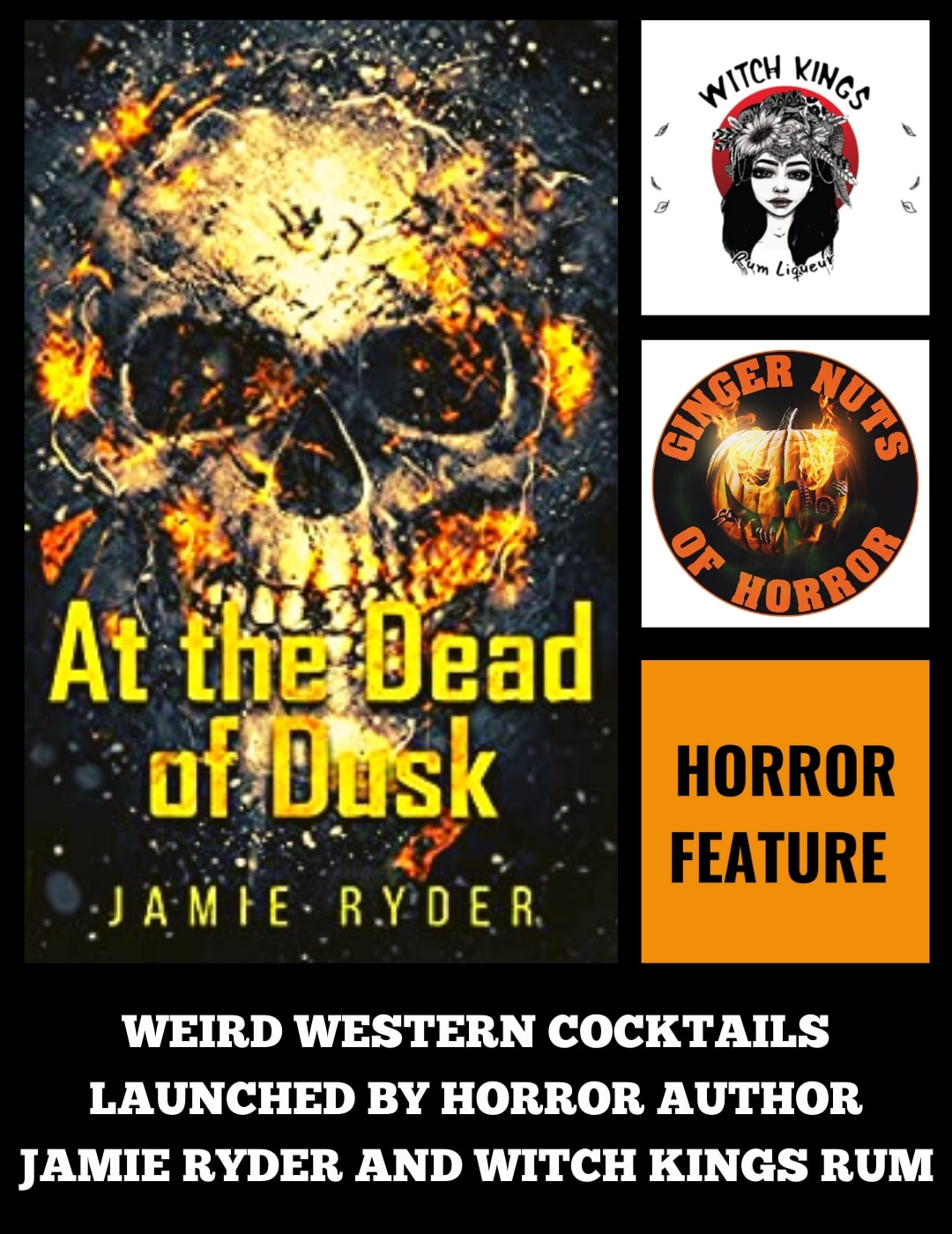
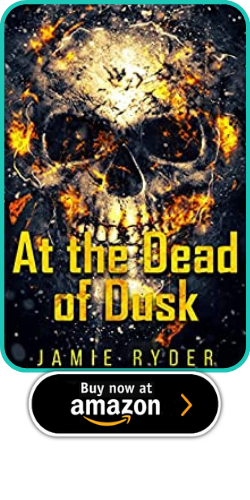
The author of the Tales Of The Frontier series, Jamie Ryder and Manchester-based rum liqueur brand Witch Kings Rum are proud to unveil a limited production run of pre-bottled cocktails based on characters from the world of The Frontier. A magical combination Celebrating the launch of Ryder’s debut novella At The Dead Of Dusk, the collaboration has involved the creation of two cocktails called Hammer Of The Witches and High Priestess. Hammer of The Witches is inspired by the protagonist of At The Dead Of Dusk Clay McNab. An infamous witch hunter, McNab is tasked with transporting a young woman across a land of darkness in the novella. The cocktail has been made using Witch Kings Rum Fires Of The Wild and bourbon for a complex, mouth-punching drink to match McNab’s personality. 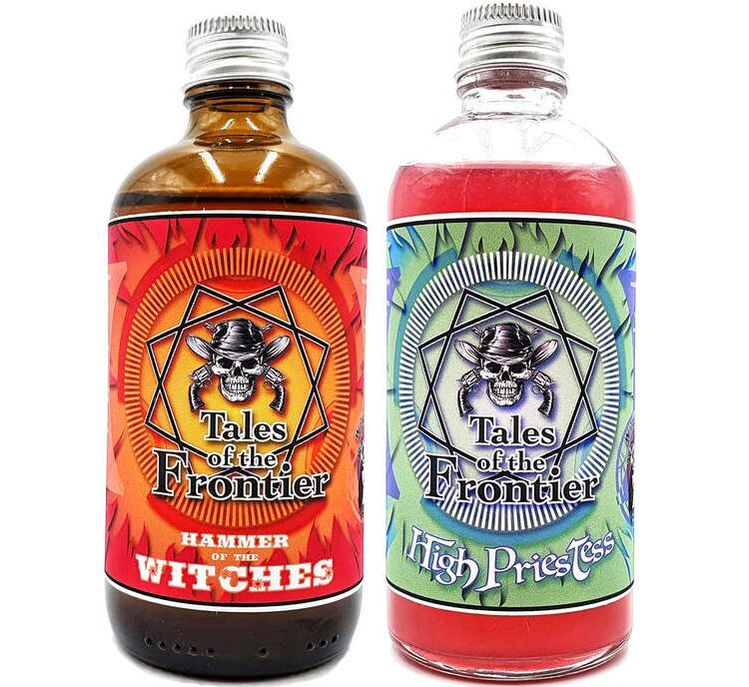 High Priestess is inspired by the antagonist of At The Dead Of Dusk and McNab’s mortal enemy, Agnus Cartwright. High Priestess uses Witch Kings Rum Bohemian Dreams and Cachaca for a tangy, fruit cocktail. Marrying fantastical flavours with a horror western Founded in 2020 by friends Maxi Tin-Bradbury and Brandon Bizzle, Witch Kings Rum has already made a name for itself in Manchester with a blend of fantastical flavours and ethereal storytelling. On teaming up with the brand, Ryder said: “Working with the Witch Kings Rum team felt like a great fit for bringing these characters and the horror western world of The Frontier to life. While coming up with the story for the drinks, it was important that there was a clear juxtaposition between McNab and Cartwright. They are the opposites of each other, yet both believe themselves to be the heroes of their own stories and I needed that to be emphasised. Maxi and Biz got the idea straight away. They’ve got an excellent knowledge of drink production and their enthusiasm about combining fantasy and alcohol together is infectious!” About Jamie Ryder  Jamie Ryder is a marketer, copywriter and the author of the Tales Of The Frontier series, a weird western world of monsters, gunslingers and superstition. At The Dead Of Dusk is the second story to be set in The Frontier. When not writing horror fiction, Ryder also manages a collection of publications. They are pop culture website The Comic Vault, rum magazine The Rum Ration and Japanese culture blog Yamato Magazine. About Witch Kings Rum  Witch Kings Rum is a Manchester-based rum liqueur brand that combines the spirit and adventure of bohemian culture with a celebration of life, music and nature. In addition to their core range, Witch Kings Rum specialises in bespoke drink creation, music events and hospitality collaborations. __________________ For more information about At The Dead Of Dusk and Witch Kings Rum products, email talesofthefrontier@hotmail.com and info@witchkingsrum.com. AT THE DEAD OF DUSK |
 | On 6th November 2021, the Sinister Horror Company will release Beheaded, the last book by Guy N. Smith, the pulp horror veteran that sadly passed away last December. |
Sinister Horror are proud to release the final book from pulp horror master Guy N. Smith. Beheaded is a collaboration with J. R. Park.

On 6th November 2021, the Sinister Horror Company will release Beheaded, the last book by Guy N. Smith, the pulp horror veteran that sadly passed away last December.
Beheaded is novel-length collaboration with J. R. Park. The two worked on the novel during the 2020, a story originally based on an unreleased short story by Guy.
The book will be released in ebook and paperback, and a special limited edition hardback will also be released, featuring a ‘making of’ article by J. R. Park and the original short story ‘Beheaded!’ by Guy N. Smith.
The cover art of the paperback was created by Mike McGee, the man whose talent has featured on the cover of the last few Sinister GNS releases.
The cover art of the hardback was created by Jorge Wiles, the man behind the covers to J. R. Park’s Death Dreams series.
Beheaded is novel-length collaboration with J. R. Park. The two worked on the novel during the 2020, a story originally based on an unreleased short story by Guy.
The book will be released in ebook and paperback, and a special limited edition hardback will also be released, featuring a ‘making of’ article by J. R. Park and the original short story ‘Beheaded!’ by Guy N. Smith.
The cover art of the paperback was created by Mike McGee, the man whose talent has featured on the cover of the last few Sinister GNS releases.
The cover art of the hardback was created by Jorge Wiles, the man behind the covers to J. R. Park’s Death Dreams series.
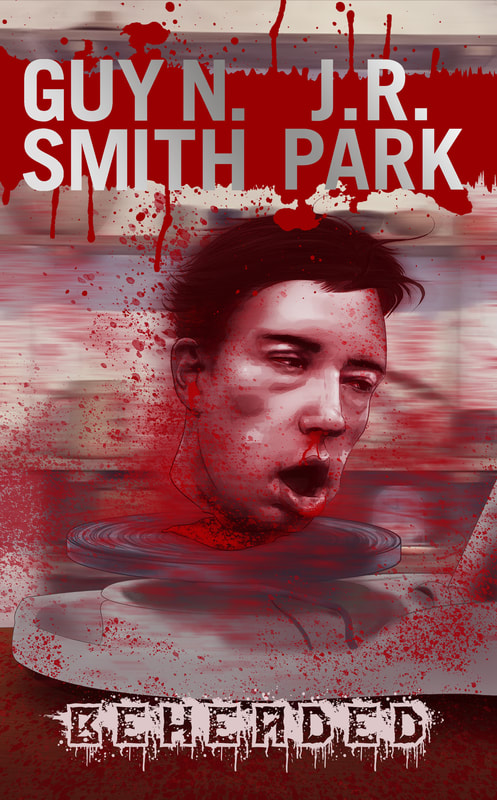
Beheaded – paperback cover
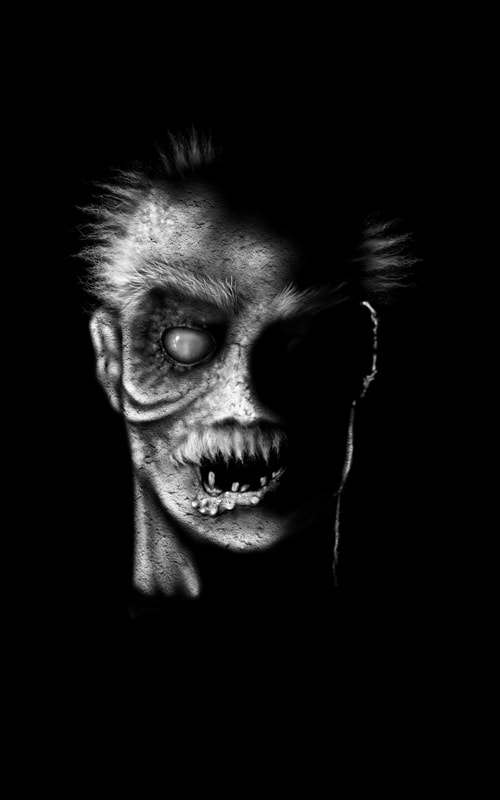
Beheaded – hardback cover
Two horror writers from two eras.
Guy N. Smith set the template for modern pulp horror. His prolific output saw him release books for six decades.
J. R. Park has bult his reputation by bending pulp horror into new shapes, revisiting and updating the genre.
Guy N. Smith set the template for modern pulp horror. His prolific output saw him release books for six decades.
J. R. Park has bult his reputation by bending pulp horror into new shapes, revisiting and updating the genre.
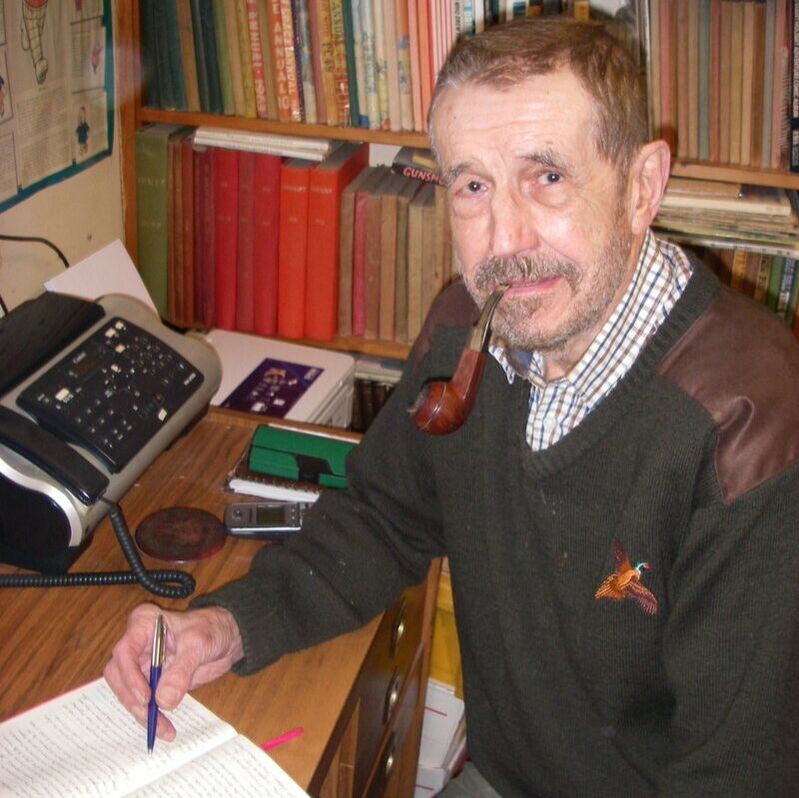 Guy N. Smith | 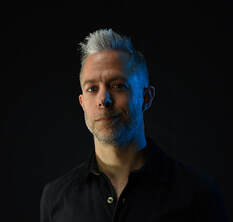 J. R. Park |
The Beheaded
Two ages of horror collide and things are about to get nasty.
Guy N. Smith & J. R. Park team up in an explosion of violence that leaves the pages soaked in blood.
Angela, a gifted potter, wants to follow her dreams, but trapped in an abusive marriage her life is crumbling around her.
Her hatred calls across time, awakening a murderous force that proves to be something far more terrifying than an old man’s ghost story.
The Sinister Horror Company are proud to present the last book worked on by pulp horror master, Guy N. Smith.
Beheaded will be available on Kindle, and Paperback from Amazon and the Sinister Horror Company website, and in limited edition Hardback from the Sinister Horror Company website from the 6th November 2021
For any enquiries or further information visit:
SinisterHorrorCompany.com
TODAY ON THE GINGER NUTS OF HORROR WEBSITE
WEIRD WESTERN COCKTAILS LAUNCHED BY HORROR AUTHOR JAMIE RYDER AND WITCH KINGS RUM

the heart and soul of horror features
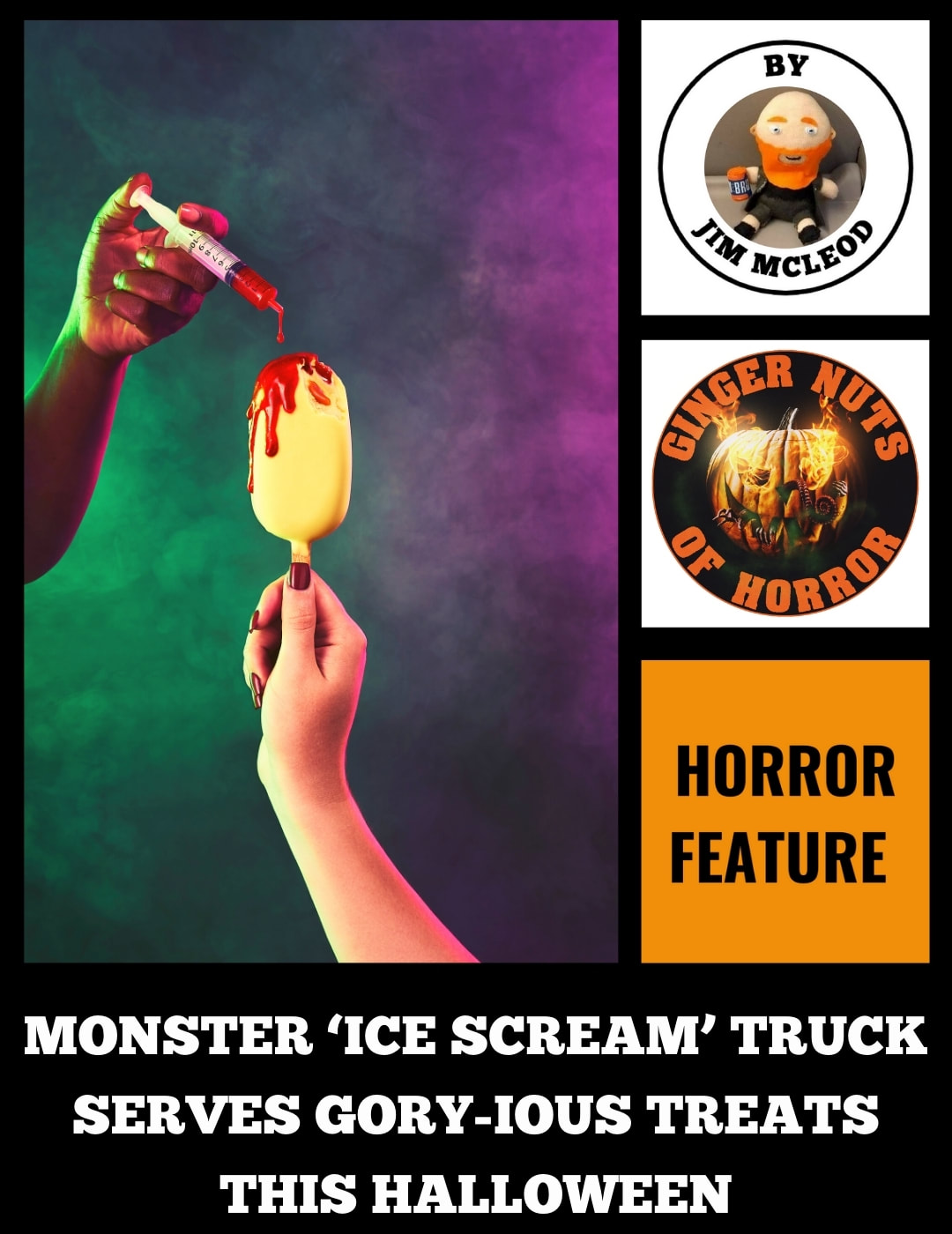 | “Our “ice scream” truck will be prowling the country this month, leaving smoky delights in its wake during the spookiest time of the year. I’d urge whisky lovers to beware though: Ardbeg Wee Beastie is a dram with quite a bite, so while it may be encased in ice cream, you’ll still need to be on your guard. The events are guaranteed to linger long in the nightmares of anyone who dares attend.” |
Whisky lovers are in for a treat this Halloween when Ardbeg’s Monster Ice Scream truck rolls into town.
Ardbeg has been called “as close to perfection as makes no difference,” by whisky connoisseurs. Proof then, that Ardbeg truly deserves its incredible reputation. It’s a whisky that’s worshipped around the world. In the past ten years, six different Ardbeg expressions have won prestigious titles including World Whisky of the Year, Scotch Whisky of the Year and World’s Best Single Malt.
The fastest way to take yourself to Islay is to uncork a bottle of Ardbeg. However, you can’t beat actually being at the Distillery, staying at Seaview Cottage and standing on Ardbeg’s pier, enveloped in fresh sea breeze and Ardbeg’s peaty aroma. They'd love to see you there in person. In the meantime, why not visit an Ardbeg Embassy, their spiritual homes stationed throughout the world...
But why wait, why not bring the spirit of Ardbeg and Halloween right to your doorstep, by either having a fabulous night out at one of their special event nights ( full listings below) or by having a
The fastest way to take yourself to Islay is to uncork a bottle of Ardbeg. However, you can’t beat actually being at the Distillery, staying at Seaview Cottage and standing on Ardbeg’s pier, enveloped in fresh sea breeze and Ardbeg’s peaty aroma. They'd love to see you there in person. In the meantime, why not visit an Ardbeg Embassy, their spiritual homes stationed throughout the world...
But why wait, why not bring the spirit of Ardbeg and Halloween right to your doorstep, by either having a fabulous night out at one of their special event nights ( full listings below) or by having a
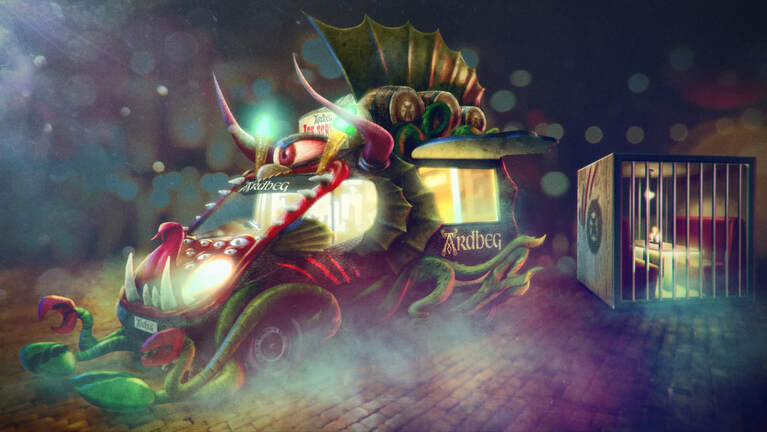
Whisky lovers are in for a treat this spooky season when Ardbeg’s latest monstrous mobile creation rolls into town.
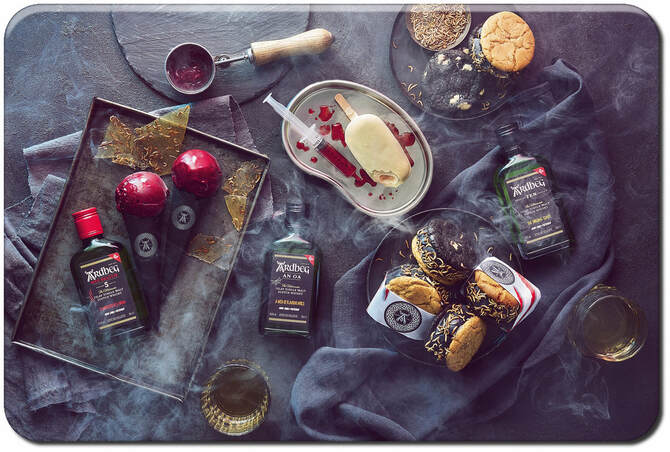
Set to materialise in London, Glasgow, and Edinburgh between 26th and 31st October, Ardbeg’s Monster Ice Scream truck is an homage to classic B-Movie beasts of the silver screen. Sporting multiple horns, tentacles and sets of beady eyes, the truck will be serving up devilish ‘Ice Screams’ featuring three of the Distillery’s smoky single malts: Ardbeg Ten, An Oa and Wee Beastie.
Set to materialise in London, Glasgow, and Edinburgh between 26th and 31st October, Ardbeg’s Monster Ice Scream truck is an homage to classic B-Movie beasts of the silver screen. Sporting multiple horns, tentacles and sets of beady eyes, the truck will be serving up devilish ‘Ice Screams’ featuring three of the Distillery’s smoky single malts: Ardbeg Ten, An Oa and Wee Beastie.
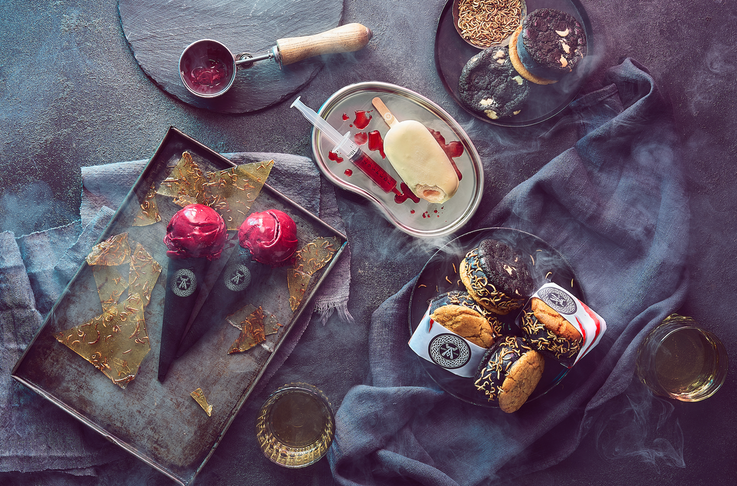
The Ardbeg ‘Ice Screams’ were devised in partnership with renowned ice cream parlour Ruby Violet, and include:
- a Cookies & Scream featuring Ardbeg Wee Beastie ice cream sandwiched between charcoal cookies, coated in (optional) crunchy mealworms
- an Ahhh, No! Bar of Lapsang Souchong ice cream with an Ardbeg An Oa caramel centre coated in white chocolate
- an Ice Cream Groan of charcoal, filled with Ardbeg Ten smoky blackcurrant ice cream, topped with sour cherries and a brittle insect-flecked shard
Tickets are available to purchase in advance via Ardbeg.com from 11th October 2021. Members of the Ardbeg Committee will receive an extra special treat as part of the tour, in the form of a voucher to redeem a complimentary serve of their choice. It’s free to join at Ardbeg.com, and anyone who signs up before 21st October will be eligible.
Listings Information
Ardbeg and The Glenmorangie Company advocate responsible drinking and suggest that drinkers savour Ardbeg whiskies in moderation and in line with recommended daily guidelines for alcohol consumption.
- What: Ardbeg’s Monster Ice Scream Truck Tour
- When: Tuesday 26th to Sunday 31st October
- Time: 2pm to 10pm
- Where:
- Tuesday 26th and Wednesday 27th October at Covent Garden Piazza, London
- Friday 29th October at Drygate Brewery, Glasgow
- Saturday 30th October at St James Quarter, Edinburgh
- Sunday 31st October at Castle Street, Edinburgh
- Cost: £10 per person, includes a 45 min experience, one ice cream and one cocktail
*Committee members must sign up by 21st October to receive complimentary serve voucher.
Ardbeg and The Glenmorangie Company advocate responsible drinking and suggest that drinkers savour Ardbeg whiskies in moderation and in line with recommended daily guidelines for alcohol consumption.
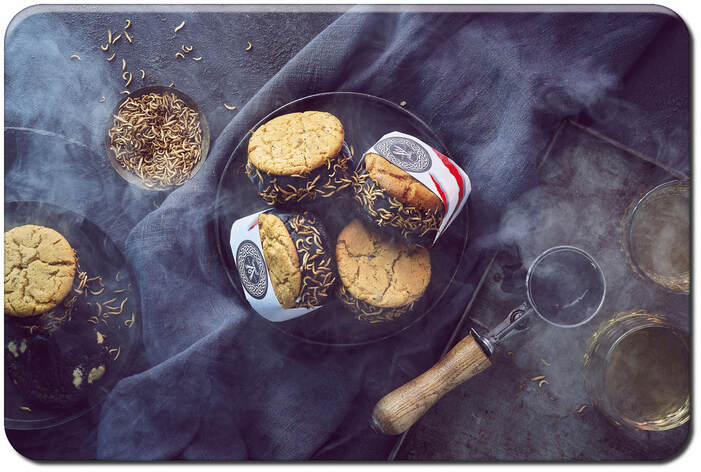
The ice creams are available to buy from the Ice Scream truck and are free for existing Ardbeg Committee Members. In addition, all three exclusive ice cream serves will be available to buy from Ruby Violet’s King’s Cross Coal Drops Yard outlet in London from Friday 22nd October until stocks last.
Visitors of the Ice Scream truck can also book an exclusive 45-minute slot in a scary Monsters of Smoke ‘cage’ and indulge in ice and cocktails. The ‘cage’ is an extension of the Ice Scream horror truck and allows visitors to experience squeamishly smoky, exclusive cocktails such as:
Tickets are available to purchase in advance via www.ardbeg.com/en-gb/ardbeg-ice-scream, and members of the Ardbeg Committee will receive a voucher for a complimentary serve of their choice. Sign up to the Committee for free at Ardbeg.com.*
Visitors of the Ice Scream truck can also book an exclusive 45-minute slot in a scary Monsters of Smoke ‘cage’ and indulge in ice and cocktails. The ‘cage’ is an extension of the Ice Scream horror truck and allows visitors to experience squeamishly smoky, exclusive cocktails such as:
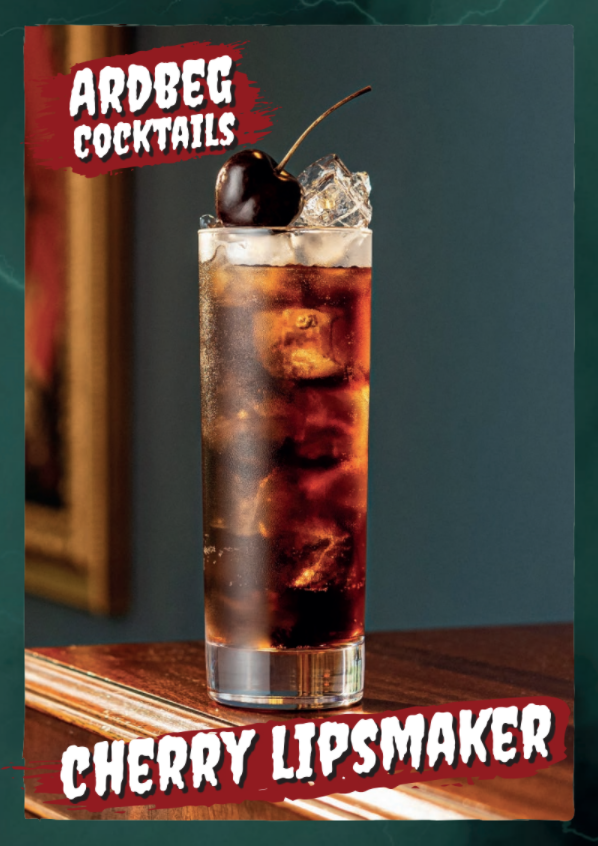
- Cherry Lipsmacker - a different slant on the old favourite whisky and cola, it summons flavours of smoky tea, syrup sweetness and treacle toffee, as cigar smoke and aniseed creep across your palate
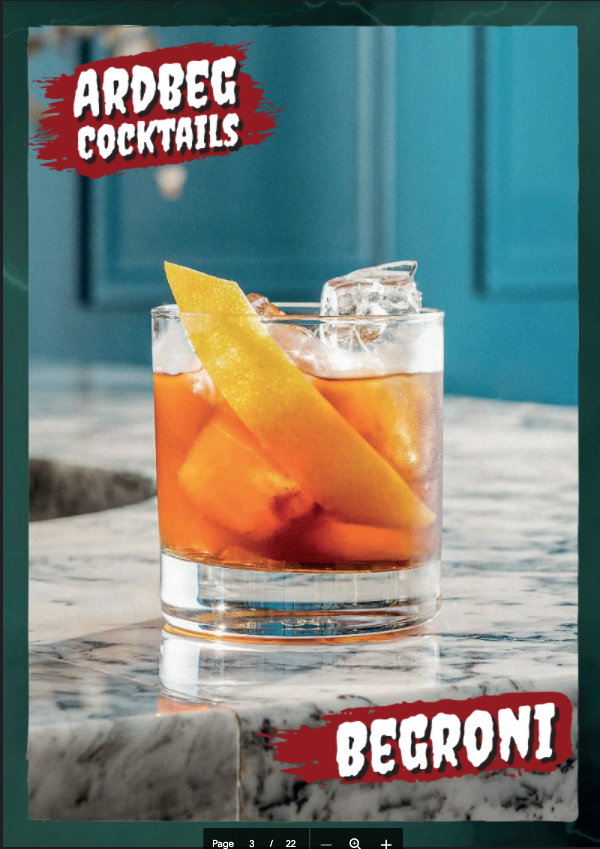
- Begroni - Herbaceous and chocolatey, it nods at the heritage of the original serve when Count Negroni requested a punchier version of his favourite Americano. Made with Ardbeg Wee Beastie, it has a smoky, spicy bite
- New fashioned - a smoky brilliance to this serve using Ardbeg Ten Years Old. Black pepper pops with cinnamon toffee, chewy peat oil and jammy blackcurrant tones for a taste that’s almost out of this world
Tickets are available to purchase in advance via www.ardbeg.com/en-gb/ardbeg-ice-scream, and members of the Ardbeg Committee will receive a voucher for a complimentary serve of their choice. Sign up to the Committee for free at Ardbeg.com.*
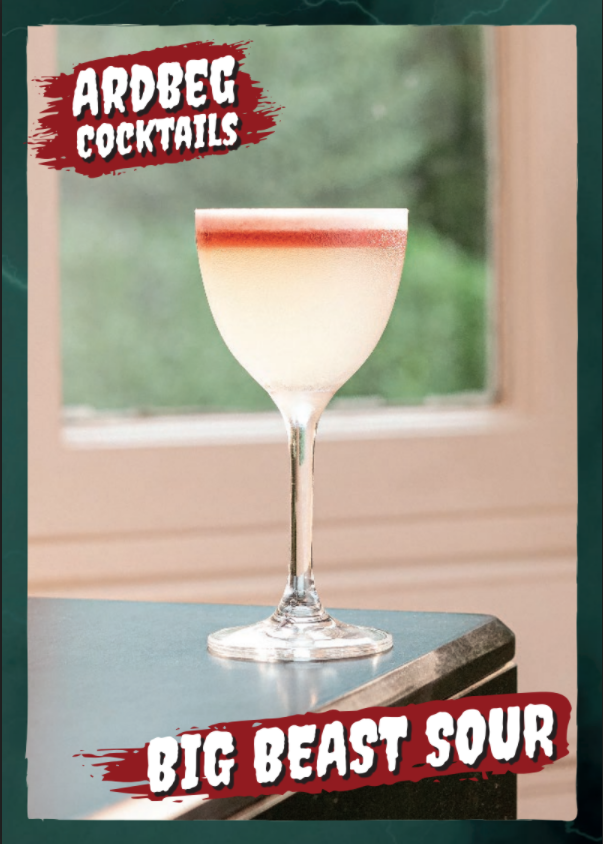
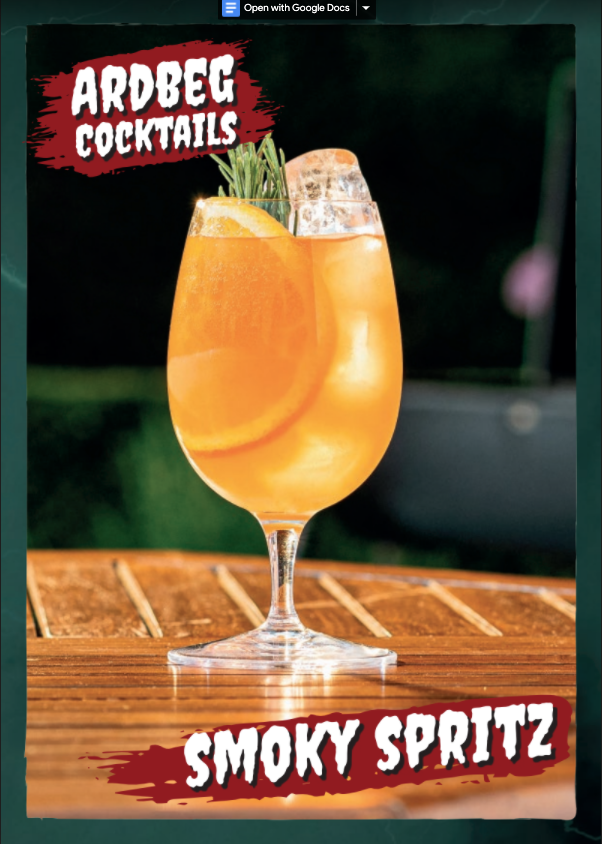
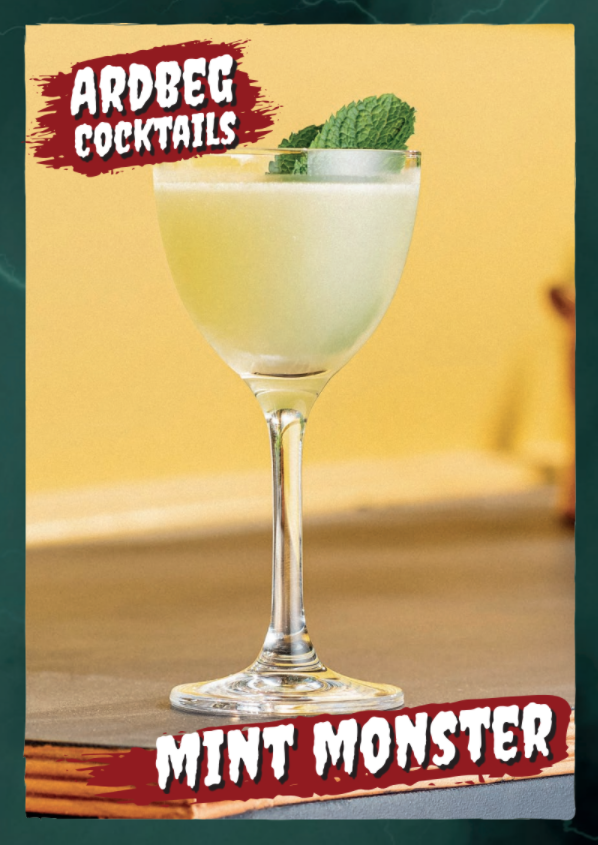
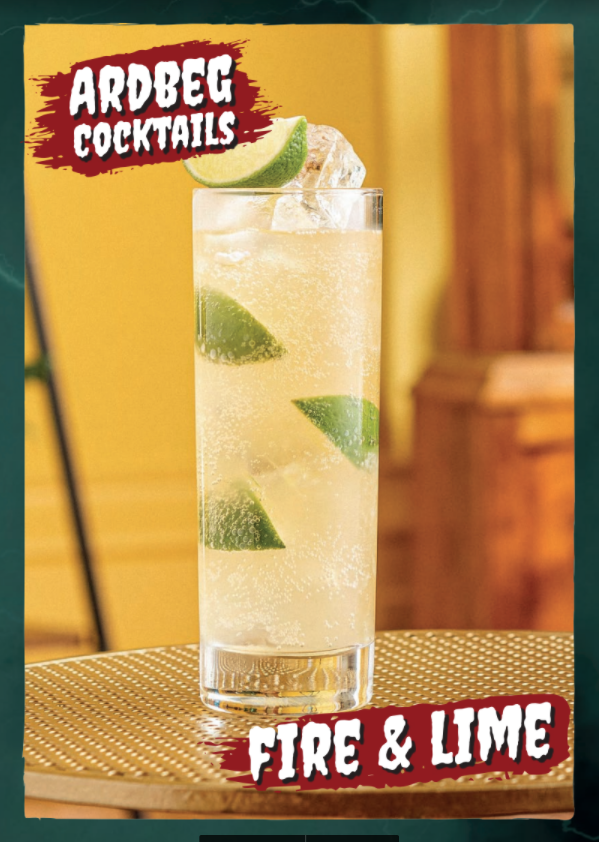
And if you can't make to these events, don't worry here is a list of cocktail recipes for you to try out at home.
  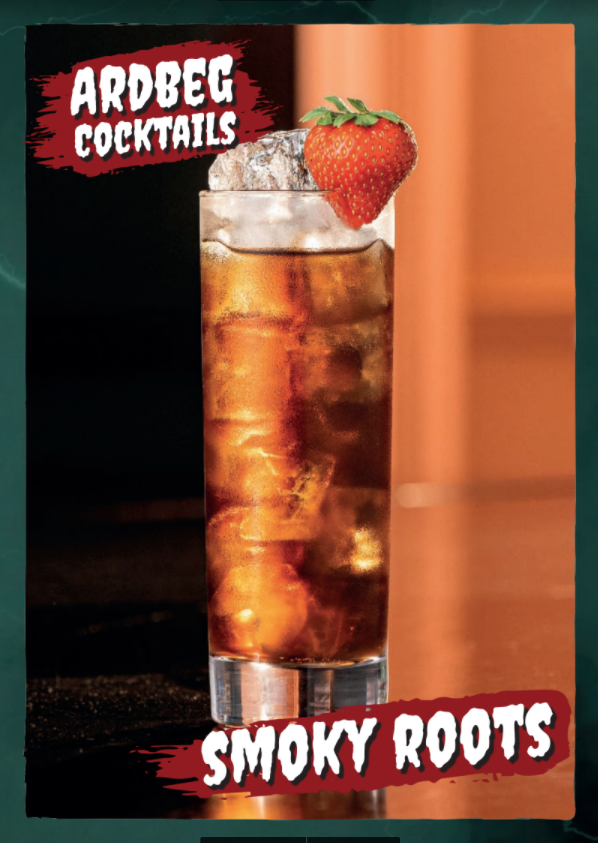 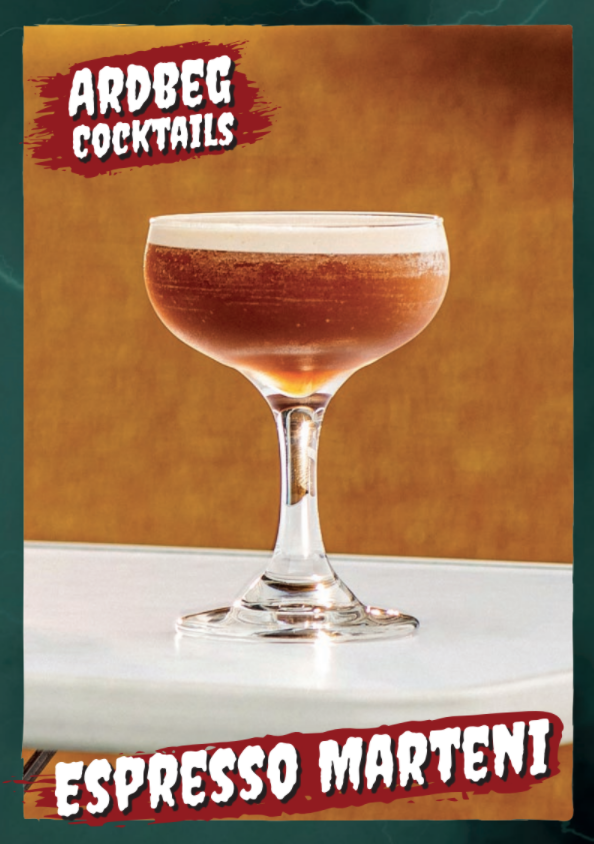 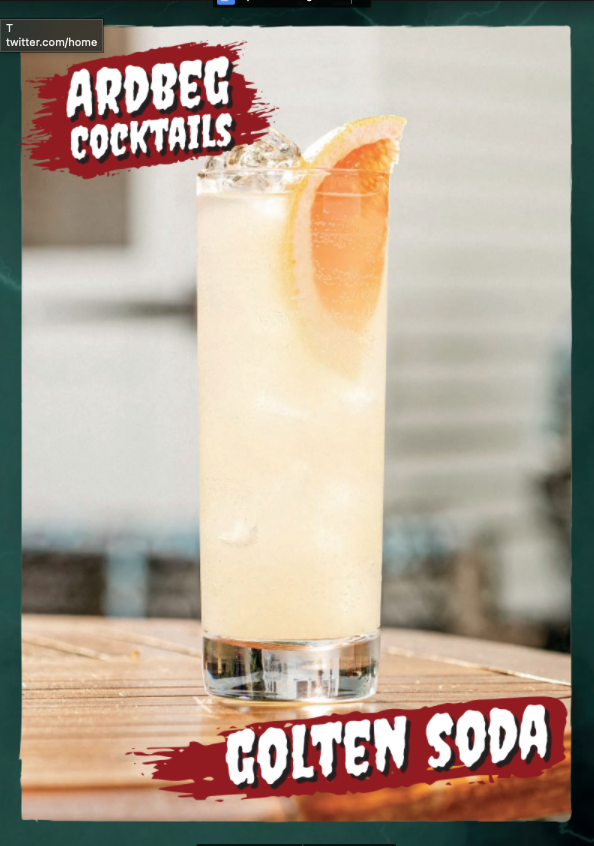 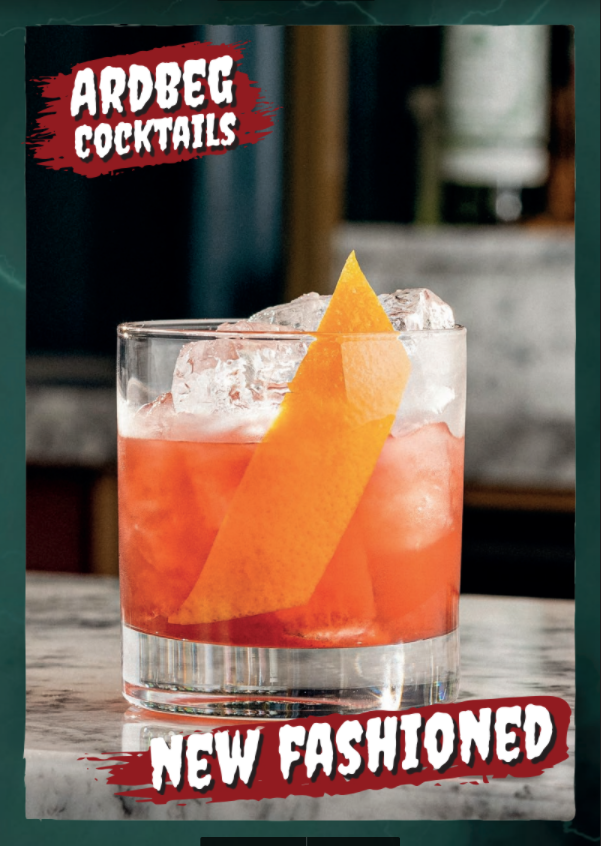     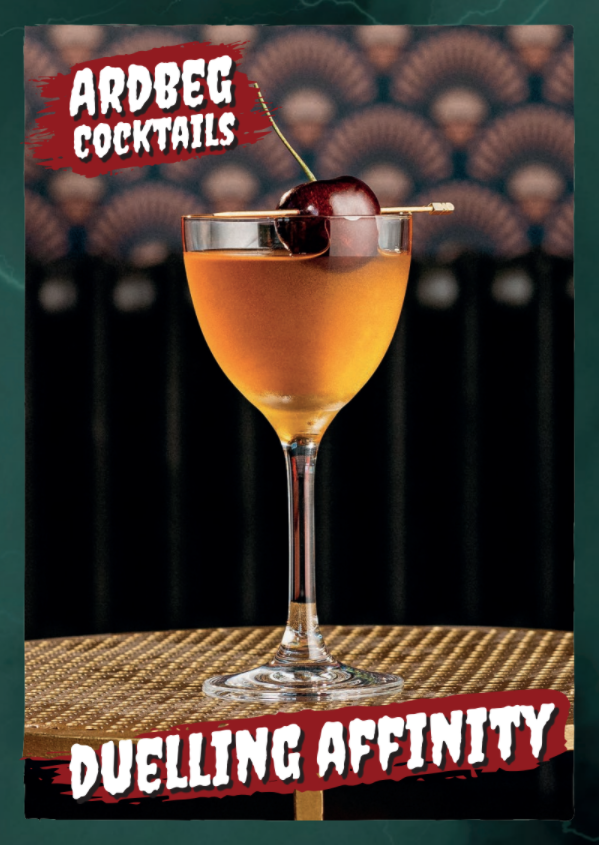 | 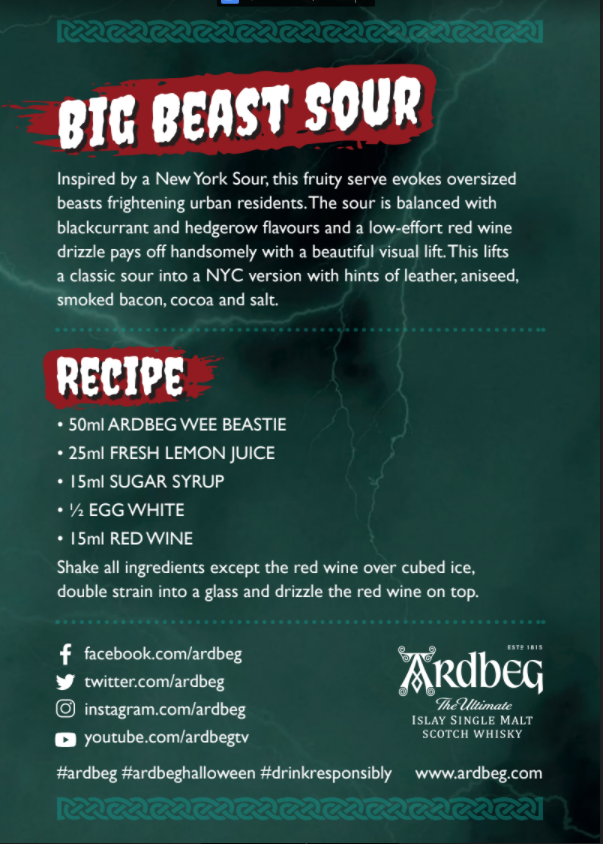 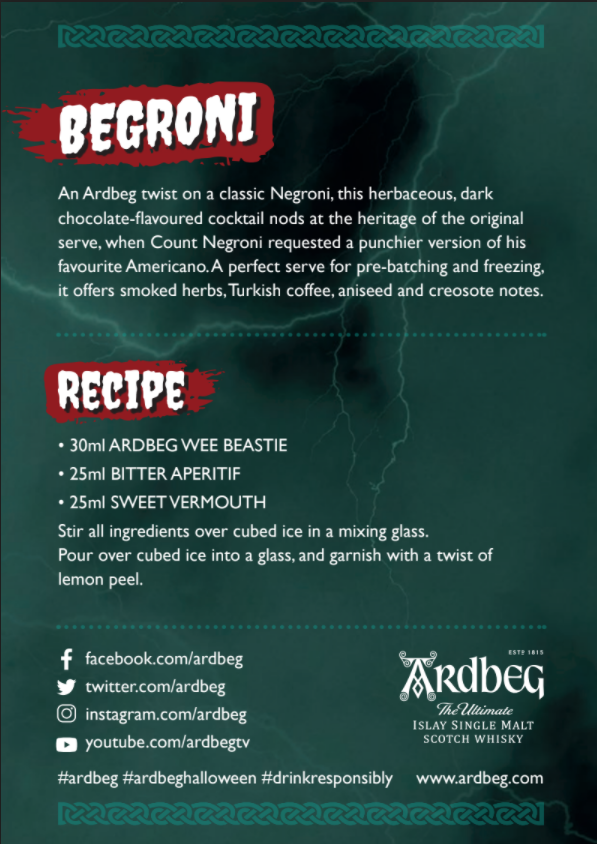 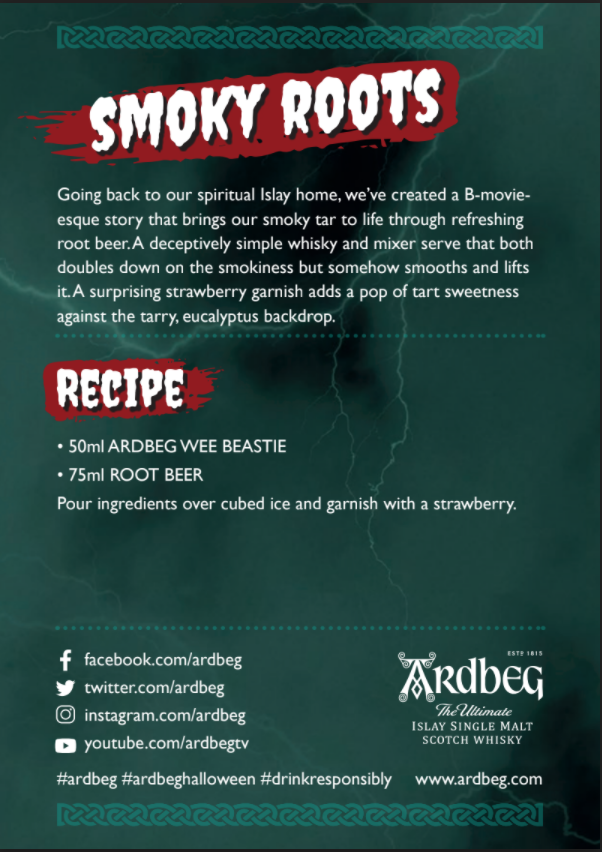 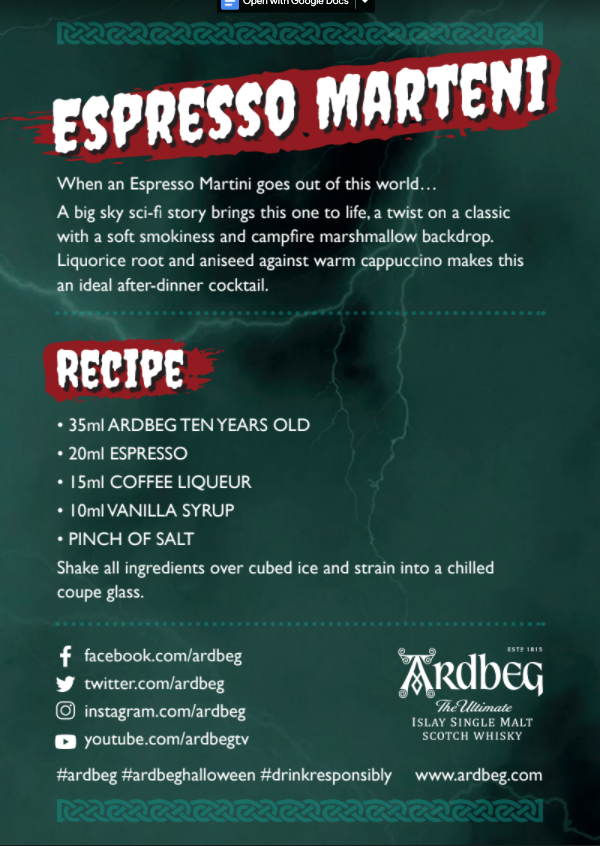 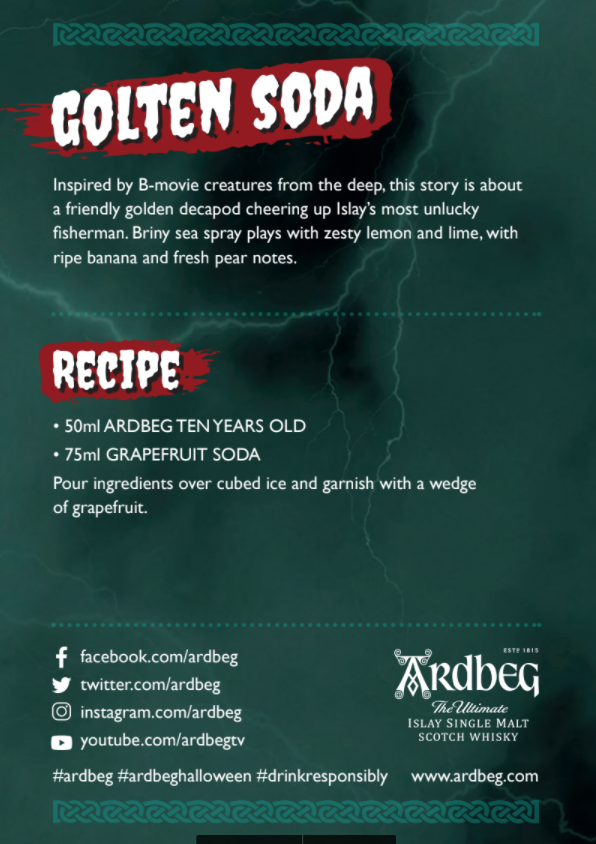 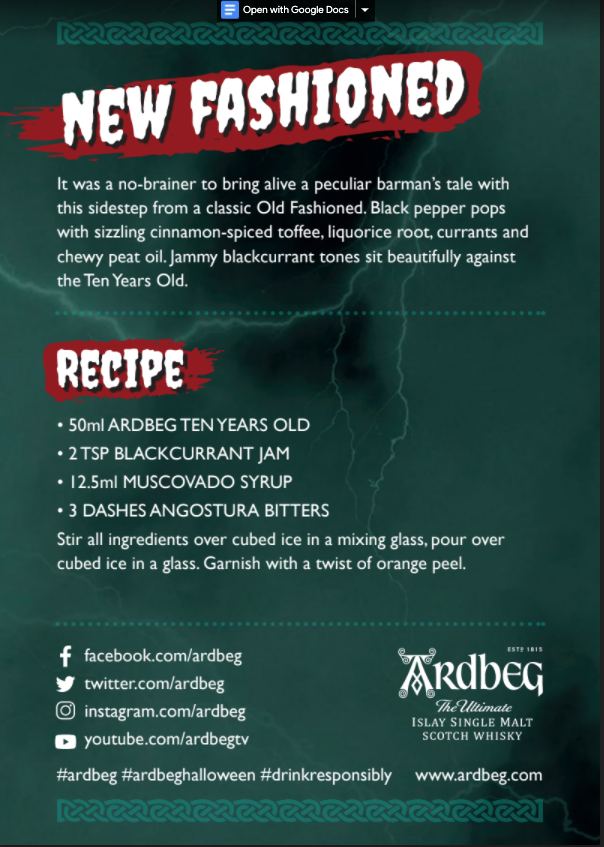 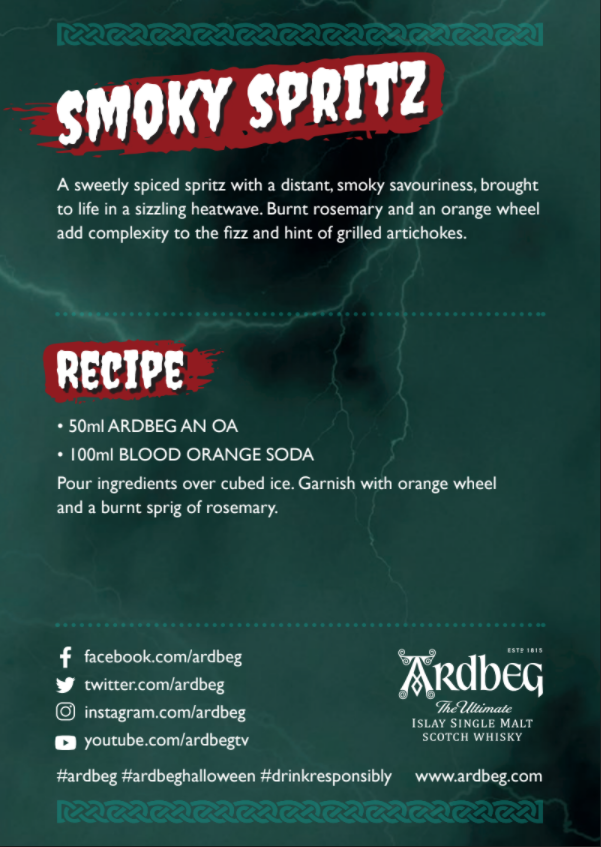 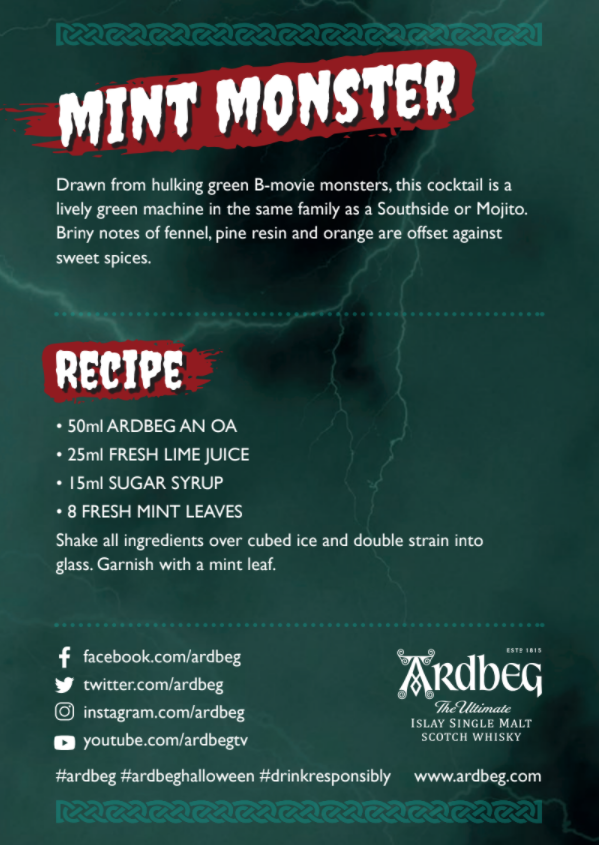 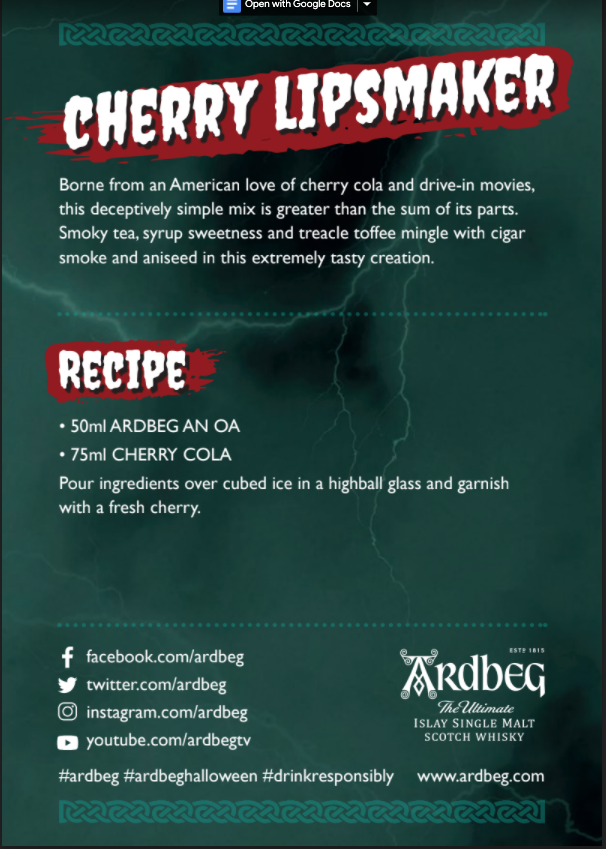 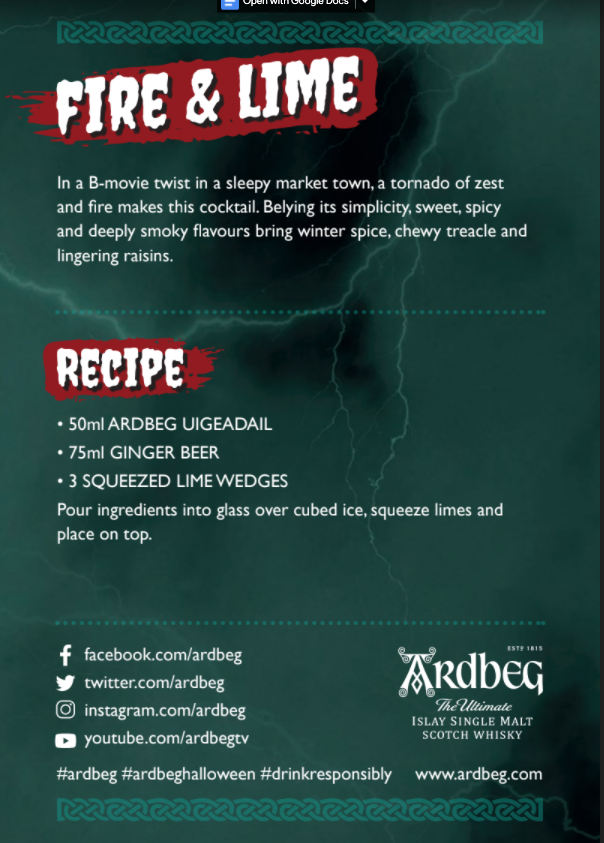 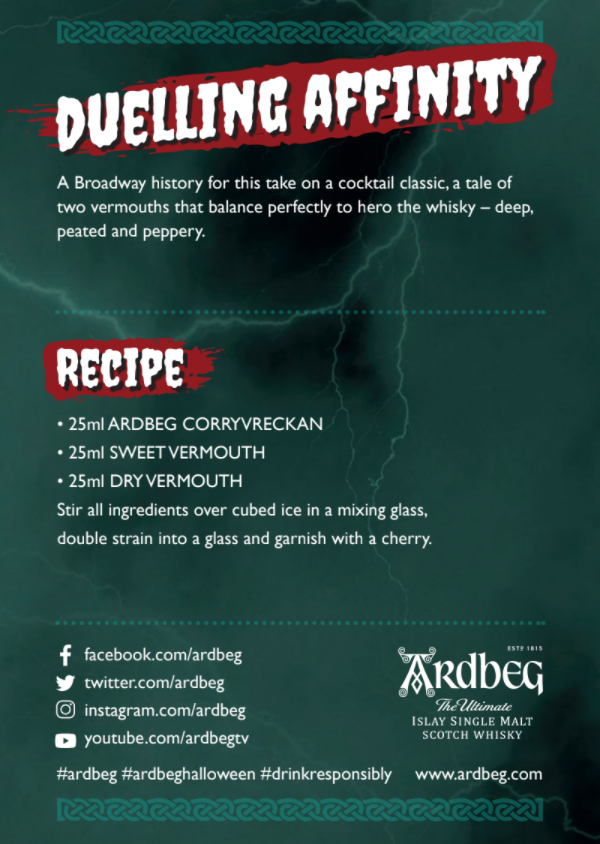 |
Ardbeg:
Ardbeg prides itself on being The Ultimate Islay Malt Whisky. Established in 1815, Ardbeg is revered by connoisseurs around the world as the peatiest, smokiest and most complex of all the Islay malts. Despite its smokiness, Ardbeg is renowned for its delicious sweetness, a phenomenon that has affectionately become known as ‘the peaty paradox’. During the 1980s and 1990s, Ardbeg suffered from an uncertain future and it was not until the brand was purchased by The Glenmorangie Company in 1997 that the Distillery was saved from extinction. Since then, the Distillery has risen like a phoenix and today Ardbeg is well established as a niche, cult malt, with a passionate following.
Responsible Drinking:
Ardbeg and The Glenmorangie Company advocate responsible drinking and suggest that drinkers savour Ardbeg whiskies in moderation and in line with recommended daily guidelines for alcohol consumption.
Ardbeg Committee:
The legacy of the whisky was safeguarded in 2000 by the formation of the Ardbeg Committee. The Committee is made up of thousands of Ardbeg followers worldwide who are keen to ensure that “the doors of Ardbeg never close again”. Today there are more than 100,000 members of the Ardbeg Committee in over 130 countries. Committee members are regularly consulted on new bottlings and expressions and are offered exclusive Committee bottlings. Members also receive invitations to special gatherings, tastings and events. The Committee is free to join at ardbeg.com/committee.
Awards:
Ardbeg is the world’s most highly awarded smoky single malt whisky. Since 2008, Ardbeg has won more than 50 gold and double gold medals in key whisky competitions. Ardbeg was twice been awarded ‘World’s Best Single Malt’ at the World Whiskies Awards (2010, 2013). At the 2014 Global Icons of Whisky Awards, Mickey Heads was voted ‘Distillery Manager of the Year’. The following year, Ardbeg’s expressions took the top three spots in Whisky Advocate magazine’s review of the best single malt Scotch whiskies under US$100. Meanwhile, both Ardbeg Corryvreckan and Ardbeg Uigeadail have been awarded gold medals at the 2016 San Francisco World Spirits Competition. In 2019, Dr Bill Lumsden was awarded Master Distiller of the Year for the third time in four years. Ardbeg 10 Years Old also won the Best Single Malt Scotch 10 Year Old at the International Whisky Competition 2019, while the Ardbeg Distillery won the Distillery of the Year 2019. In 2020, the International Whisky Competition awarded Ardbeg Corryvreckan first place for Best Single Malt Scotch, Best Single Malt Scotch (No Age Statement), Best cask Strength (Over 57% ABV), Best Peated Scotch and Best Islay Single Malt. Ardbeg Wee Beastie also earned first place for Best Single Malt Scotch Under 10 Year Old and The Ardbeg Distillery achieved another Distillery of the Year award.
The Glenmorangie Company:
The Company is one of the most renowned and innovative distillers and marketers of Scotch whisky brands worldwide and is part of Moët Hennessy, the wine and spirits division of Moët Hennessy Louis Vuitton. Headquartered in Edinburgh, Scotland, the Company produces Glenmorangie Single Highland Malt whisky and Ardbeg Single Islay Malt.
Ardbeg prides itself on being The Ultimate Islay Malt Whisky. Established in 1815, Ardbeg is revered by connoisseurs around the world as the peatiest, smokiest and most complex of all the Islay malts. Despite its smokiness, Ardbeg is renowned for its delicious sweetness, a phenomenon that has affectionately become known as ‘the peaty paradox’. During the 1980s and 1990s, Ardbeg suffered from an uncertain future and it was not until the brand was purchased by The Glenmorangie Company in 1997 that the Distillery was saved from extinction. Since then, the Distillery has risen like a phoenix and today Ardbeg is well established as a niche, cult malt, with a passionate following.
Responsible Drinking:
Ardbeg and The Glenmorangie Company advocate responsible drinking and suggest that drinkers savour Ardbeg whiskies in moderation and in line with recommended daily guidelines for alcohol consumption.
Ardbeg Committee:
The legacy of the whisky was safeguarded in 2000 by the formation of the Ardbeg Committee. The Committee is made up of thousands of Ardbeg followers worldwide who are keen to ensure that “the doors of Ardbeg never close again”. Today there are more than 100,000 members of the Ardbeg Committee in over 130 countries. Committee members are regularly consulted on new bottlings and expressions and are offered exclusive Committee bottlings. Members also receive invitations to special gatherings, tastings and events. The Committee is free to join at ardbeg.com/committee.
Awards:
Ardbeg is the world’s most highly awarded smoky single malt whisky. Since 2008, Ardbeg has won more than 50 gold and double gold medals in key whisky competitions. Ardbeg was twice been awarded ‘World’s Best Single Malt’ at the World Whiskies Awards (2010, 2013). At the 2014 Global Icons of Whisky Awards, Mickey Heads was voted ‘Distillery Manager of the Year’. The following year, Ardbeg’s expressions took the top three spots in Whisky Advocate magazine’s review of the best single malt Scotch whiskies under US$100. Meanwhile, both Ardbeg Corryvreckan and Ardbeg Uigeadail have been awarded gold medals at the 2016 San Francisco World Spirits Competition. In 2019, Dr Bill Lumsden was awarded Master Distiller of the Year for the third time in four years. Ardbeg 10 Years Old also won the Best Single Malt Scotch 10 Year Old at the International Whisky Competition 2019, while the Ardbeg Distillery won the Distillery of the Year 2019. In 2020, the International Whisky Competition awarded Ardbeg Corryvreckan first place for Best Single Malt Scotch, Best Single Malt Scotch (No Age Statement), Best cask Strength (Over 57% ABV), Best Peated Scotch and Best Islay Single Malt. Ardbeg Wee Beastie also earned first place for Best Single Malt Scotch Under 10 Year Old and The Ardbeg Distillery achieved another Distillery of the Year award.
The Glenmorangie Company:
The Company is one of the most renowned and innovative distillers and marketers of Scotch whisky brands worldwide and is part of Moët Hennessy, the wine and spirits division of Moët Hennessy Louis Vuitton. Headquartered in Edinburgh, Scotland, the Company produces Glenmorangie Single Highland Malt whisky and Ardbeg Single Islay Malt.
TODAY ON THE GINGER NUTS OF HORROR WEBSITE
[PAPERBACKS FROM HELL]
THE TRIBE BY BARI WOOD

the heart and soul of horror features
 | but the thing that freaks me out is … my bellybutton. No one can touch the bellybutton. This is because I have a deep and completely rational (yeah, you read that right) fear that that is how I will be unravelled. Think the hybrid Alien that Ripley gives birth to in Aliens 4? When it’s sucked out the window into space, one meaty strand at a time? That’s how I’m utterly certain the bellybutton body horror show is going to go |
To celebrate the release of the new anthology edited by Ellen Datlow, Ginger Nuts of Horror has invited a some of the authors featured in the the anthology to tell us about "What is Your Body Horror?" and "What is their favourite Body Horror?".
We would also like to thank Kasey Lansdale who is the publicist for the anthology, for setting up and corralling the authors for the feature. It is always wonderful to work with publicist like Kasey.
And if you haven't checked out our review of Body Shocks check it out here
We would also like to thank Kasey Lansdale who is the publicist for the anthology, for setting up and corralling the authors for the feature. It is always wonderful to work with publicist like Kasey.
And if you haven't checked out our review of Body Shocks check it out here
Seanan McGuire
"What is your body horror?" Teeth. Anything to do with teeth. I grew up in the American welfare system, and we had access to very unpleasant dentists who resented working on poor kids for free. They yelled at me so much that I became afraid of my own teeth. Teeth are terrifying. Violence toward teeth is even worse.
"What body horror do you love?" Grey Matter, by Stephen King, is one of my favorite stories of all time.
Seanan McGuire
"What is your body horror?" Teeth. Anything to do with teeth. I grew up in the American welfare system, and we had access to very unpleasant dentists who resented working on poor kids for free. They yelled at me so much that I became afraid of my own teeth. Teeth are terrifying. Violence toward teeth is even worse.
"What body horror do you love?" Grey Matter, by Stephen King, is one of my favorite stories of all time.
ED: Not sure this is appropriate, but I'm terrified of a gorgeous, sharp, brand-new bread knife I bought to replace one with a cracked handle. The reason I'm terrified? First (and only) time I used it, it slipped and cut my finger and I bled like a pig and
was worried I'd have to go to the ER to stop the bleeding. Happy ending (bleeding stopped) for me, but I put the knife back into its protector and have never used it since. I'm still using my old, cracked handle bread knife, several year later.
My favourite "body horror" movie is
Alien -I've watched it multiple times and still jump at the chest buster scene.
Pat Cadigan: In response to ‘What is your body horror?’:
I have terminal cancer. Nothing scares me. There’s nothing left to be afraid of.
(I asked if it was okay to share this and she linked me to her blog which talks about it further and candidly)
Cody Goodfellow:
I've been fortunate not to have any serious medical conditions so far, but notions of health as a function of positive mental outlook drive me to distraction, because if the body is an expression of the mind, I'm fucked and my doctor just doesn't know it yet.
A biology professor once told me that a cell goes malignant in our bodies every day, on average, and the body (almost always) stops it. With all that chaos struggling to turn into tumor fruits, the moment our minds are turned away from diligently proclaiming our fitness, the body will start destroying itself. It's enough to give one a stress-related heart attack.
In "Atwater", I tried to capture this self-perpetuating fear, as the protagonist encounters various victims of their own mental and emotional issues manifesting as surreal physical maladies, and comes to wonder what's going on inside himself...
I'd have to say my favorite body horror novel is still Blood Music by Greg Bear. It's only science fiction in the sense that it extrapolates from the frightening idea––what if a retrovirus was perfecting your body, whether you like it or not––to extremes that elude most horror novels and films. While everybody's favorite The Thing (1982) wisely stopped short of escalating beyond the isolation of Outpost 31 because the fear dissipates when it dilutes into mass action, Blood Music goes from the intimate war inside Virgil Ulam's body to the infection and alteration of the species without letting the tension go flat.
was worried I'd have to go to the ER to stop the bleeding. Happy ending (bleeding stopped) for me, but I put the knife back into its protector and have never used it since. I'm still using my old, cracked handle bread knife, several year later.
My favourite "body horror" movie is
Alien -I've watched it multiple times and still jump at the chest buster scene.
Pat Cadigan: In response to ‘What is your body horror?’:
I have terminal cancer. Nothing scares me. There’s nothing left to be afraid of.
(I asked if it was okay to share this and she linked me to her blog which talks about it further and candidly)
Cody Goodfellow:
I've been fortunate not to have any serious medical conditions so far, but notions of health as a function of positive mental outlook drive me to distraction, because if the body is an expression of the mind, I'm fucked and my doctor just doesn't know it yet.
A biology professor once told me that a cell goes malignant in our bodies every day, on average, and the body (almost always) stops it. With all that chaos struggling to turn into tumor fruits, the moment our minds are turned away from diligently proclaiming our fitness, the body will start destroying itself. It's enough to give one a stress-related heart attack.
In "Atwater", I tried to capture this self-perpetuating fear, as the protagonist encounters various victims of their own mental and emotional issues manifesting as surreal physical maladies, and comes to wonder what's going on inside himself...
I'd have to say my favorite body horror novel is still Blood Music by Greg Bear. It's only science fiction in the sense that it extrapolates from the frightening idea––what if a retrovirus was perfecting your body, whether you like it or not––to extremes that elude most horror novels and films. While everybody's favorite The Thing (1982) wisely stopped short of escalating beyond the isolation of Outpost 31 because the fear dissipates when it dilutes into mass action, Blood Music goes from the intimate war inside Virgil Ulam's body to the infection and alteration of the species without letting the tension go flat.
Angela Slatter
“What is Your Body Horror?”
Okay, so it’s not connected with my story, but it’s my personal body horror “thing”. I’ve had a couple of broken bones and some major operations that can best be described as “someone taking an angle-grinder to my body”, but the thing that freaks me out is … my bellybutton. No one can touch the bellybutton. This is because I have a deep and completely rational (yeah, you read that right) fear that that is how I will be unravelled. Think the hybrid Alien that Ripley gives birth to in Aliens 4? When it’s sucked out the window into space, one meaty strand at a time? That’s how I’m utterly certain the bellybutton body horror show is going to go …
“What is Your Body Horror Love?”
I’d have to go with a Classic and say the original Clive Barker Hellraiser. I remember seeing it the first time (probably at an inappropriately young age) and watching it through my fingers (because we all know that helps). Frank stealing his brother’s skin; then the whole end of Frank with the fishhooks and chains. Coincidentally, it’s probably the inspiration for parts of my story, “Cuckoo”. The whole inhabiting other bodies, peeling off of skin, the idea of false identity, of being betrayed when someone removes their mask (which, let’s face it, is also a bit Scooby-Doo and Old Man Withers cursing those meddling kids). Also the idea that any disguise you pull on would never fit properly, and you’d burst out of it eventually, which is why my story contains this description: “The flesh was still warm, which is best – too hard to shrug on something in full rigor – and I crammed my bulk into the small body much as one might climb into a box or a trunk to hide. A fold here, a dislocation there, a twinge of discomfort and curses when something tore, stretched just too far.”
“What is Your Body Horror?”
Okay, so it’s not connected with my story, but it’s my personal body horror “thing”. I’ve had a couple of broken bones and some major operations that can best be described as “someone taking an angle-grinder to my body”, but the thing that freaks me out is … my bellybutton. No one can touch the bellybutton. This is because I have a deep and completely rational (yeah, you read that right) fear that that is how I will be unravelled. Think the hybrid Alien that Ripley gives birth to in Aliens 4? When it’s sucked out the window into space, one meaty strand at a time? That’s how I’m utterly certain the bellybutton body horror show is going to go …
“What is Your Body Horror Love?”
I’d have to go with a Classic and say the original Clive Barker Hellraiser. I remember seeing it the first time (probably at an inappropriately young age) and watching it through my fingers (because we all know that helps). Frank stealing his brother’s skin; then the whole end of Frank with the fishhooks and chains. Coincidentally, it’s probably the inspiration for parts of my story, “Cuckoo”. The whole inhabiting other bodies, peeling off of skin, the idea of false identity, of being betrayed when someone removes their mask (which, let’s face it, is also a bit Scooby-Doo and Old Man Withers cursing those meddling kids). Also the idea that any disguise you pull on would never fit properly, and you’d burst out of it eventually, which is why my story contains this description: “The flesh was still warm, which is best – too hard to shrug on something in full rigor – and I crammed my bulk into the small body much as one might climb into a box or a trunk to hide. A fold here, a dislocation there, a twinge of discomfort and curses when something tore, stretched just too far.”
Ray Cluley
When it comes to body horror, what scares me most is the body mutating. It’s an important part of evolution, of course, necessary for any species to survive, but it can also be cancer. That scares the hell out of me. That’s my biggest real-life fear. There’s a line I remember from the TV series Hannibal (I can’t recall if it was in any of Harris’s books) where Bella Crawford explains her cancer as a cell from her liver that wandered into her lung and tried to make another liver (something like that), and isn’t that kind of biological accident frightening? Add to that the things we do to ourselves that can cause our body to turn on us, the things we eat, and drink, and smoke, the drugs we take… The idea that the body is a complex but fallible and fragile biological machine is both humbling and terrifying.
But also any mutation or transformation that dehumanises the body or causes it to devolve, that’s frightening. That’s horrifying. Kafka’s The Metamorphosis is a big one here, for me. That, and The Fly, both the 1950s version and the Cronenberg remake (can anyone talk about body horror and not mention Cronenberg?). Brundlefly is no superhero mix of human and insect, he’s a splicing accident that continues to mutate, the corruption of what is human made more and more apparent in the way his body changes. One minute, Jeff Goldblum is marvelling at his new strength and stamina, the next he’s preserving the parts of him that are falling off and puking all over his food in order to digest it properly. He loses his sense of self, and his potential greatness is wasted in becoming something so other and monstrous. That said, for all the grossness of Cronenberg’s remake, it’s the 1950s version that disturbed me most, and the ending in particular has haunted me ever since I first saw it.
My story in Body Shocks draws on all of the above. The Metamorphosis and The Fly are both clear influences (although funnily enough only the Kafka was intentional; that ending from The Fly just got caught up in there all by itself) and I use them to explore the idea of wasted potential and the loss of self. The body’s transformation, its mutation, provides the physical horror, but it’s also a representation and consequence of giving up on your dreams or being too cowardly to pursue them. Of letting them mutate and diminish into something more monotonous and mundane. There’s horror here not only in becoming something other but in becoming just like everybody else.
When it comes to body horror, what scares me most is the body mutating. It’s an important part of evolution, of course, necessary for any species to survive, but it can also be cancer. That scares the hell out of me. That’s my biggest real-life fear. There’s a line I remember from the TV series Hannibal (I can’t recall if it was in any of Harris’s books) where Bella Crawford explains her cancer as a cell from her liver that wandered into her lung and tried to make another liver (something like that), and isn’t that kind of biological accident frightening? Add to that the things we do to ourselves that can cause our body to turn on us, the things we eat, and drink, and smoke, the drugs we take… The idea that the body is a complex but fallible and fragile biological machine is both humbling and terrifying.
But also any mutation or transformation that dehumanises the body or causes it to devolve, that’s frightening. That’s horrifying. Kafka’s The Metamorphosis is a big one here, for me. That, and The Fly, both the 1950s version and the Cronenberg remake (can anyone talk about body horror and not mention Cronenberg?). Brundlefly is no superhero mix of human and insect, he’s a splicing accident that continues to mutate, the corruption of what is human made more and more apparent in the way his body changes. One minute, Jeff Goldblum is marvelling at his new strength and stamina, the next he’s preserving the parts of him that are falling off and puking all over his food in order to digest it properly. He loses his sense of self, and his potential greatness is wasted in becoming something so other and monstrous. That said, for all the grossness of Cronenberg’s remake, it’s the 1950s version that disturbed me most, and the ending in particular has haunted me ever since I first saw it.
My story in Body Shocks draws on all of the above. The Metamorphosis and The Fly are both clear influences (although funnily enough only the Kafka was intentional; that ending from The Fly just got caught up in there all by itself) and I use them to explore the idea of wasted potential and the loss of self. The body’s transformation, its mutation, provides the physical horror, but it’s also a representation and consequence of giving up on your dreams or being too cowardly to pursue them. Of letting them mutate and diminish into something more monotonous and mundane. There’s horror here not only in becoming something other but in becoming just like everybody else.
Priya Sharma
I’ve always had a fear of limbless things. As a child I was horrified by the humble worm, soil-eater, earth-turner, essential to the garden and the field . When my mother dug over her vegetable beds and brought up a knot of them, their flailing pink segmented bodies made me feel sick.
This fear extended to snakes even though I’d never seen one firsthand. I couldn’t even look at a photograph of one without my hindbrain screaming at me.
I was asked to write an original fairy tale for an anthology. My jumping off point was princesses in a tower, albeit in a modern tower block. As I tried to work in the other fairy tale tropes it stalled and so it languished while I wrote something else.
Certain stories don’t go away, or rather they don’t leave you alone. To paraphrase the legendary Pat Cadigan, one idea is a premise and two ideas make a story.
I’d heard an urban legend about someone who worked for a housing association and found a man’s bloated corpse with a pair of fang marks in his neck. It was also a story from an area not dissimilar to that of my incarcerated princess. It’s only when ideas collide that something interesting happens. I imagined something from Roald Dahl’s short story of “Poison”.
(SPOILERS)
So, I had a princess and snakes. I took out my story notes and fragments, in which my princess had to go to the villain to make a bargain. In one version she was saved by her prince. My princess yawned, not at all politely. In another, by her mother à la “The Bloody Chamber” by Angela Carter. My princess looked a bit more hopeful, so I had to ask her what she wanted.
Her own princess and that they save themselves.
Giving them the power of snakeshifting was to give them agency and autonomy in a world where their sex and sex itself was used against them as a means of control. I wanted to offer them physical power in a world where they had none.
(SPOILERS END)
To make the story work, I needed to understand my nemesis.
My experience of snakes up until that time had been limited. My parents are from India. My mother’s favourite childhood story was of her visits to an old woman she knew. She was told to sit on a chair and not to move. The old lady poured water into a saucer and they waited. A cobra slid into the room and reared up, its hood expanding. My mother held her breath. When the cobra was ready, it lowered its head and drank.
My mother swears it’s true. And that the snake only visited on a Thursday between the hours of one and two o’clock!
I like research. It throws up things that can change the course of a story, or at the least give it colour. I went to an exhibition called Sssnakes Alive at the excellent Liverpool World Museum. It seems like a minor thing as I write this, but for me it was an experience akin to the psychological technique of flooding for curing phobias. Snakes of every sort looked out at me from giant canvases; they were exquisitely rendered portraits. There were boa constrictors in tanks. There were videos from Liverpool’s School of Tropical Medicine of herpetologist’s milking venom from mambas. There was a Burmese’s python skeleton and a giant game of snakes and ladders.
I was on the edge where revulsion becomes fascination. A king cobra’s venom can kill an adult elephant in a few hours. The inland taipan’s venom is a heady mix of paralysis agent, neurotoxin, and procoagulant. It will stop you breathing while you haemorrhage and your muscles waste. The black mamba can travel at 11 kph. Pythons don’t unhinge their jaws. Instead its attached with a ligament that stretches, sometimes wide enough to swallow a crocodile.
I understand that snakes are sensitive and shy creatures. They symbolise medicine and knowledge (there’s a serpent wound around the Rod of Asclepius, Greek deity of healing and medicine). I know that their skin is dry and warm, not cold and slimy. I know all these things but I still recoil. Fear is still preprogrammed in my inherited memory somewhere. The snake is coloured for camouflage so I might inadvertently risk its wrath, or it is highly coloured signalling danger. They have venom or crushing coils, either choice a terrible death. They hunt by infrared and by smell. Their black eyes are inhuman.
The difference is that now I’d admire them. If I had to crawl along on my belly, vulnerable in the face of the world, I’d too want every possible method of defence.
###
My favourite body horror is The Beauty by Aliyah Whiteley. It’s an audacious and important piece of work. She’s never afraid to make readers feel uncomfortable. Her portrait of a post-women society goes to unexpected places, exploring gender roles, storytelling and memory.
I’ve always had a fear of limbless things. As a child I was horrified by the humble worm, soil-eater, earth-turner, essential to the garden and the field . When my mother dug over her vegetable beds and brought up a knot of them, their flailing pink segmented bodies made me feel sick.
This fear extended to snakes even though I’d never seen one firsthand. I couldn’t even look at a photograph of one without my hindbrain screaming at me.
I was asked to write an original fairy tale for an anthology. My jumping off point was princesses in a tower, albeit in a modern tower block. As I tried to work in the other fairy tale tropes it stalled and so it languished while I wrote something else.
Certain stories don’t go away, or rather they don’t leave you alone. To paraphrase the legendary Pat Cadigan, one idea is a premise and two ideas make a story.
I’d heard an urban legend about someone who worked for a housing association and found a man’s bloated corpse with a pair of fang marks in his neck. It was also a story from an area not dissimilar to that of my incarcerated princess. It’s only when ideas collide that something interesting happens. I imagined something from Roald Dahl’s short story of “Poison”.
(SPOILERS)
So, I had a princess and snakes. I took out my story notes and fragments, in which my princess had to go to the villain to make a bargain. In one version she was saved by her prince. My princess yawned, not at all politely. In another, by her mother à la “The Bloody Chamber” by Angela Carter. My princess looked a bit more hopeful, so I had to ask her what she wanted.
Her own princess and that they save themselves.
Giving them the power of snakeshifting was to give them agency and autonomy in a world where their sex and sex itself was used against them as a means of control. I wanted to offer them physical power in a world where they had none.
(SPOILERS END)
To make the story work, I needed to understand my nemesis.
My experience of snakes up until that time had been limited. My parents are from India. My mother’s favourite childhood story was of her visits to an old woman she knew. She was told to sit on a chair and not to move. The old lady poured water into a saucer and they waited. A cobra slid into the room and reared up, its hood expanding. My mother held her breath. When the cobra was ready, it lowered its head and drank.
My mother swears it’s true. And that the snake only visited on a Thursday between the hours of one and two o’clock!
I like research. It throws up things that can change the course of a story, or at the least give it colour. I went to an exhibition called Sssnakes Alive at the excellent Liverpool World Museum. It seems like a minor thing as I write this, but for me it was an experience akin to the psychological technique of flooding for curing phobias. Snakes of every sort looked out at me from giant canvases; they were exquisitely rendered portraits. There were boa constrictors in tanks. There were videos from Liverpool’s School of Tropical Medicine of herpetologist’s milking venom from mambas. There was a Burmese’s python skeleton and a giant game of snakes and ladders.
I was on the edge where revulsion becomes fascination. A king cobra’s venom can kill an adult elephant in a few hours. The inland taipan’s venom is a heady mix of paralysis agent, neurotoxin, and procoagulant. It will stop you breathing while you haemorrhage and your muscles waste. The black mamba can travel at 11 kph. Pythons don’t unhinge their jaws. Instead its attached with a ligament that stretches, sometimes wide enough to swallow a crocodile.
I understand that snakes are sensitive and shy creatures. They symbolise medicine and knowledge (there’s a serpent wound around the Rod of Asclepius, Greek deity of healing and medicine). I know that their skin is dry and warm, not cold and slimy. I know all these things but I still recoil. Fear is still preprogrammed in my inherited memory somewhere. The snake is coloured for camouflage so I might inadvertently risk its wrath, or it is highly coloured signalling danger. They have venom or crushing coils, either choice a terrible death. They hunt by infrared and by smell. Their black eyes are inhuman.
The difference is that now I’d admire them. If I had to crawl along on my belly, vulnerable in the face of the world, I’d too want every possible method of defence.
###
My favourite body horror is The Beauty by Aliyah Whiteley. It’s an audacious and important piece of work. She’s never afraid to make readers feel uncomfortable. Her portrait of a post-women society goes to unexpected places, exploring gender roles, storytelling and memory.
Tom Johnstone
'What is Your Body Horror?'
My own personal body horror, in keeping with the anthology's cover, is the eye, its vulnerability and status as evidence of consciousness, 'windows of the soul', making its absence or deadness a key aspect of the uncanny. Ocular occlusion motivated the murder committed by the narrator of Poe's 'The Tell-Tale Heart', while the trauma inflicted on Gloucester's 'vile jelly' in Shakespeare's King Lear makes metaphorical blindness viscerally literal. This fear touches me personally because, in my regular work as a gardener, I have suffered superficial but excruciatingly painful corneal abrasions from time to time.
Other body horror fears are losing control of breathing and of bodily functions more generally. Naturally, these fears become more acute the older I get! The current pandemic has also intensified the first of these, and is a source of inspiration for what may be a new sub-genre of horror fiction, one of my own contributions to this being 'Untogetherness', which explored the body horror of a fictional virus that caused flesh to grow over human airways and appeared in the anthology Corona-Nation Street (Burdizzo Books, 2020). At the time of writing, few knew about Long Covid, or other strange symptoms such as loss of taste and smell, so perhaps it's just as well I invented my own disease!
Having said that, neither of these are what my story in Body Shocks is about. Basically my young daughter gave me this story prompt: What if there was a machine which you fed a picture in, perhaps of a monster, and it somehow produced the real, live thing? Over the years, I worked on the story, and heard about emerging technological innovations like 3D printers, and meat or human organs grown artificially, which I fed into the tale of 'What I Found in the Shed'. Possibly the body horror classic it most resembles is David Cronenberg's The Fly (see below), or perhaps the grandmother of all such tales, Frankenstein, notably Bernard Rose's film version.
'What is Your Body Horror Love?'.
It's difficult to know where to start with this one. There are so many! My first literary encounters with body horror were in the Pan Book of Horror Stories series, which featured many memorably gruesome examples of the form, often in colonial settings, so often unsettling for all the wrong reasons -- in their unselfconscious racism, that is. Often framed as a cautionary tale told in the smoking room of a gentleman's club, the typical narrative sees an arrogant or foolhardy Englishman falling foul of a tribal shaman, who takes revenge using supernatural means. The classic example is Edward Lucas White's 'Lukundoo', in which an explorer is tormented by carbuncles that turn into little homunculi crawling out of his body, rather like the chest-burster in Alien, but repeatedly! The Pandaemonium blog, (pandaemonium.blogspot.com) devoted to this anthology series, says of the story 'Imagine if you can that David Cronenberg had filmed Heart of Darkness'. Another unforgettably excruciating tale is 'Boomerang' by Oscar Cook, which is one of many Pan horror tales to acquire a certain notoriety among the generation that grew up reading them.
Speaking of Cronenberg, there are few things more tragically funny than Jeff Goldblum's Brundle putting fallen bits of himself into a museum he keeps in his medicine cabinet in The Fly. A more recent movie that really got to me though was Swallow, about a woman with a compulsion to ingest increasingly outrageous objects. Something about it reminded me of the quietly terrifying Todd Haynes picture Safe, a movie that derives its body shock not from icky prosthetic effects but from Julianne Moore's mesmerising central performance.
Returning to the printed word, I do try to read outside the horror genre, but that's where I encountered one of the most insanely memorable examples of literary body horror: Irvine Welsh's Filth, parts of which are narrated by a tape worm in the gut of a corrupt police detective!
Finally, a great body horror moment I treasure from The Creeping Flesh (1973): when Peter Cushing starts cleaning the middle finger of his fossilised missing link skeleton with water, which causes veiny flesh to form on it; he then amputates the obscene-looking thing and plops it into a preserving jar.
'What is Your Body Horror?'
My own personal body horror, in keeping with the anthology's cover, is the eye, its vulnerability and status as evidence of consciousness, 'windows of the soul', making its absence or deadness a key aspect of the uncanny. Ocular occlusion motivated the murder committed by the narrator of Poe's 'The Tell-Tale Heart', while the trauma inflicted on Gloucester's 'vile jelly' in Shakespeare's King Lear makes metaphorical blindness viscerally literal. This fear touches me personally because, in my regular work as a gardener, I have suffered superficial but excruciatingly painful corneal abrasions from time to time.
Other body horror fears are losing control of breathing and of bodily functions more generally. Naturally, these fears become more acute the older I get! The current pandemic has also intensified the first of these, and is a source of inspiration for what may be a new sub-genre of horror fiction, one of my own contributions to this being 'Untogetherness', which explored the body horror of a fictional virus that caused flesh to grow over human airways and appeared in the anthology Corona-Nation Street (Burdizzo Books, 2020). At the time of writing, few knew about Long Covid, or other strange symptoms such as loss of taste and smell, so perhaps it's just as well I invented my own disease!
Having said that, neither of these are what my story in Body Shocks is about. Basically my young daughter gave me this story prompt: What if there was a machine which you fed a picture in, perhaps of a monster, and it somehow produced the real, live thing? Over the years, I worked on the story, and heard about emerging technological innovations like 3D printers, and meat or human organs grown artificially, which I fed into the tale of 'What I Found in the Shed'. Possibly the body horror classic it most resembles is David Cronenberg's The Fly (see below), or perhaps the grandmother of all such tales, Frankenstein, notably Bernard Rose's film version.
'What is Your Body Horror Love?'.
It's difficult to know where to start with this one. There are so many! My first literary encounters with body horror were in the Pan Book of Horror Stories series, which featured many memorably gruesome examples of the form, often in colonial settings, so often unsettling for all the wrong reasons -- in their unselfconscious racism, that is. Often framed as a cautionary tale told in the smoking room of a gentleman's club, the typical narrative sees an arrogant or foolhardy Englishman falling foul of a tribal shaman, who takes revenge using supernatural means. The classic example is Edward Lucas White's 'Lukundoo', in which an explorer is tormented by carbuncles that turn into little homunculi crawling out of his body, rather like the chest-burster in Alien, but repeatedly! The Pandaemonium blog, (pandaemonium.blogspot.com) devoted to this anthology series, says of the story 'Imagine if you can that David Cronenberg had filmed Heart of Darkness'. Another unforgettably excruciating tale is 'Boomerang' by Oscar Cook, which is one of many Pan horror tales to acquire a certain notoriety among the generation that grew up reading them.
Speaking of Cronenberg, there are few things more tragically funny than Jeff Goldblum's Brundle putting fallen bits of himself into a museum he keeps in his medicine cabinet in The Fly. A more recent movie that really got to me though was Swallow, about a woman with a compulsion to ingest increasingly outrageous objects. Something about it reminded me of the quietly terrifying Todd Haynes picture Safe, a movie that derives its body shock not from icky prosthetic effects but from Julianne Moore's mesmerising central performance.
Returning to the printed word, I do try to read outside the horror genre, but that's where I encountered one of the most insanely memorable examples of literary body horror: Irvine Welsh's Filth, parts of which are narrated by a tape worm in the gut of a corrupt police detective!
Finally, a great body horror moment I treasure from The Creeping Flesh (1973): when Peter Cushing starts cleaning the middle finger of his fossilised missing link skeleton with water, which causes veiny flesh to form on it; he then amputates the obscene-looking thing and plops it into a preserving jar.
Livia Llewellyn
“What is Your Body Horror”
My story, "Cinereous," is about vivisection and dissection, beheadings, and zombieism. To be honest, I'm really not concerned that any of those things will happen to me (I hope…). Of course, zombification is about disease and infection, and the possibility of the decline of your health to the point of death, which of course I've become almost pathologically afraid of – as I think many of us have become in this global pandemic. But in a way, my fear is of something that's at the moment very abstract: There are certain universal symptoms when someone is infected with COVID, but I don't know what will happen to my specific body if it does occur – it could kill me, or it could give me a manageable flu-like experience, or I could end up as a long-hauler, spending the rest of my life battling a variety of severe medical problems. Now that terrifies me – being trapped in a body that for the next 30 or so years was constantly failing me in such profound ways that essentially my entire life would be reduced to doing nothing but trying to stay alive. Which, uh, sounds a lot like being a zombie. I guess my story is quite prescient, then, apologies for that.
FYI, I also have a severe, life-long fear of broken and diseased teeth, partially due to a particularly traumatic cavity filling when I was a child (the dentist didn't use Novocain, the drilling and the pain were life-changing), and partially due to that one photo of Shane MacGowan that author Nick Mamatas posts every year on Saint Patrick's Day. It's terrifying, Google it at your own risk.
“What is Your Body Horror Love”
As much as I'll always love and promote books, especially dark fiction and horror, I have to say that my favorite body horror "works of art" are found in movies. When it's happening in front of you on a two story-high theater screen in front of several hundred screaming audience members, it really does make a greater impact. There are so many body horror movies that I love, but I think that the one that has had the most profound impact on me is David Cronenberg's Dead Ringers. It's not just that the body horror scenes are exquisitely beautiful and grotesque, it's also Jeremy Iron's (double) performance, which is operatic in its arrogance, insanity, sadism, and sorrow. What Elliott and Beverly go through (and deliberately put each other through), the levels of emotional manipulation and torture they put themselves through, is in itself a form of body horror. It's a magnificent and deeply disturbing film – if you're a fan of body horror films and haven't seen it, I can't recommend it enough.
“What is Your Body Horror”
My story, "Cinereous," is about vivisection and dissection, beheadings, and zombieism. To be honest, I'm really not concerned that any of those things will happen to me (I hope…). Of course, zombification is about disease and infection, and the possibility of the decline of your health to the point of death, which of course I've become almost pathologically afraid of – as I think many of us have become in this global pandemic. But in a way, my fear is of something that's at the moment very abstract: There are certain universal symptoms when someone is infected with COVID, but I don't know what will happen to my specific body if it does occur – it could kill me, or it could give me a manageable flu-like experience, or I could end up as a long-hauler, spending the rest of my life battling a variety of severe medical problems. Now that terrifies me – being trapped in a body that for the next 30 or so years was constantly failing me in such profound ways that essentially my entire life would be reduced to doing nothing but trying to stay alive. Which, uh, sounds a lot like being a zombie. I guess my story is quite prescient, then, apologies for that.
FYI, I also have a severe, life-long fear of broken and diseased teeth, partially due to a particularly traumatic cavity filling when I was a child (the dentist didn't use Novocain, the drilling and the pain were life-changing), and partially due to that one photo of Shane MacGowan that author Nick Mamatas posts every year on Saint Patrick's Day. It's terrifying, Google it at your own risk.
“What is Your Body Horror Love”
As much as I'll always love and promote books, especially dark fiction and horror, I have to say that my favorite body horror "works of art" are found in movies. When it's happening in front of you on a two story-high theater screen in front of several hundred screaming audience members, it really does make a greater impact. There are so many body horror movies that I love, but I think that the one that has had the most profound impact on me is David Cronenberg's Dead Ringers. It's not just that the body horror scenes are exquisitely beautiful and grotesque, it's also Jeremy Iron's (double) performance, which is operatic in its arrogance, insanity, sadism, and sorrow. What Elliott and Beverly go through (and deliberately put each other through), the levels of emotional manipulation and torture they put themselves through, is in itself a form of body horror. It's a magnificent and deeply disturbing film – if you're a fan of body horror films and haven't seen it, I can't recommend it enough.
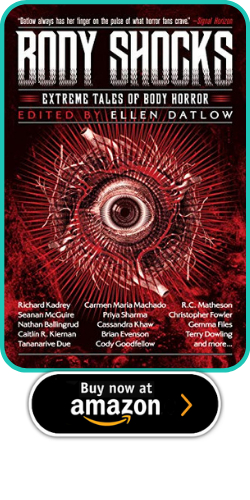
Body Shocks: Extreme Tales of Body Horror
by Ellen Datlow
“Hugo Award–winning editor Datlow (Edited By) brings together 29 spine-tingling tales of body horror to terrify even the most seasoned horror reader." --Publishers Weekly
Bestselling editor Ellen Datlow (Lovecraft’s Monsters) presents body horror at its most wide-ranging and shocking best. Discover twenty-nine intricate, twisted tales of the human body, soul, and psyche, as told by storytelling legends including Carmen Maria Machado, Richard Kadrey, Seanan McGuire, Caitlín R. Kiernan, Nathan Ballingrud, Tananarive Due, Cassandra Khaw, Christopher Fowler, and many more.
The most terrifying thing that you can possibly imagine is your own body in the hands of a monster.
Or worse, in the hands of another human being
In this definitive anthology of body horror selected by a World Horror Grandmaster, you’ll find the unthinkable and the shocking: a couture designer preparing for an exquisitely grotesque runway show; a vengeful son seeking the parent who bred him as plasma donor; a celebrity-kink brothel that inflicts plastic surgery on sex workers; and organ-harvesting doctors who dissect a living man without anesthetic.
Bestselling editor Ellen Datlow (Lovecraft’s Monsters) presents body horror at its most wide-ranging and shocking best. Discover twenty-nine intricate, twisted tales of the human body, soul, and psyche, as told by storytelling legends including Carmen Maria Machado, Richard Kadrey, Seanan McGuire, Caitlín R. Kiernan, Nathan Ballingrud, Tananarive Due, Cassandra Khaw, Christopher Fowler, and many more.
The most terrifying thing that you can possibly imagine is your own body in the hands of a monster.
Or worse, in the hands of another human being
In this definitive anthology of body horror selected by a World Horror Grandmaster, you’ll find the unthinkable and the shocking: a couture designer preparing for an exquisitely grotesque runway show; a vengeful son seeking the parent who bred him as plasma donor; a celebrity-kink brothel that inflicts plastic surgery on sex workers; and organ-harvesting doctors who dissect a living man without anesthetic.
Ellen Datlow is one of horror's quintessential, bestselling, and most acclaimed editors. She has won multiple Hugo, Bram Stoker, Locus, and Shirley Jackson awards and has received lifetime achievement awards from several organizations including the World Fantasy and World Horror Associations.She was the fiction editor of OMNI for nearly twenty years, and edited the magazines Event Horizon and Sci Fiction, and is currently a genre fiction editor at Tor.com. Her many anthologies include the long-running Year's Best Fantasy & Horror, the Best Horror of the Year series; Snow White, Blood Red; Lovecraft's Monsters; Naked City; The Monstrous; and Darkness: Two Decades of Modern Horror. Datlow lives in New York City.
Nathan Ballingrud is the author of North American Lake Monsters, The Visible Filth, and the forthcoming The Atlas of Hell . Several of his stories are in development for film and TV. He has twice won the Shirley Jackson Award. He lives somewhere in the mountains of North Carolina.
Simon Bestwick is the author of six novels, the novellas Breakwater and Angels of the Silences, four full-length short story collections, and two miniature ones. His short fiction has appeared in Black Static, The Devil and the Deep, and The London Reader and has been reprinted in The Best Horror of the Year and Best British Fantasy 2013. Four times shortlisted for the British Fantasy Award, he is married to fellow author Cate Gardner. His latest book is the collection And Cannot Come Again, recently reissued by Horrific Tales. He's usually to be found watching films, reading or writing, which keeps him out of mischief. Most of the time. Bestwick lives on the Wirral while pining for Wales.
Michael Blumlein, M.D. was an American fiction writer and a physician. Most of his writing is in or near the genres of science fiction, fantasy, and horror. His novels include The Healer, The Movement of Mountains and X, Y. He was been nominated for the World Fantasy Award and the Bram Stoker Award. His final work was the novella, Longer, which came out in 2019, a few months before he died of cancer.
Edward Bryant began writing professionally in 1968 and had more than a dozen books published, including Among the Dead, Cinnabar, Phoenix Without Ashes (with Harlan Ellison), Wyoming Sun, Particle Theory, Fetish (a novella chapbook), and The Baku: Tales of the Nuclear Age. In the beginning he was known as a science fiction writer but gradually strayed into horror and mostly remained there until his death in 2017, writing a series of sharply etched stories about Angie Black, a contemporary witch, the brilliant zombie story "A Sad Last Love at the Diner of the Damned," and other marvelous, exceedingly dark tales.
Ray Cluley is a British Fantasy Award winner with stories published in various magazines and anthologies. Some of these have been reprinted in Best of the Year volumes, Nightmares: A New Decade of Modern Horror, as well as Steve Berman's Wilde Stories: The Year's Best Gay Speculative Fiction, and Benoît Domis's Ténèbres. He has been translated into French, Polish, Hungarian, and Chinese. His short fiction is collected in Probably Monsters while a second collection will soon be looking for a home. He is currently writing for Black Library's horror imprint, as well as working on his own novel. You can find out more at www.probablymonsters.wordpress.com.
Pat Cadigan has won the Locus Award three times, the Arthur C. Clarke Award twice, the Hugo Award, and the Seiun Award. She has written twenty-one books, including one YA, two nonfiction, and several movie novelizations/media tie-ins. In December, 2014, she was diagnosed with terminal cancer and given two years to live, but she missed that deadline. Cadigan believes it's because she was put here to accomplish a certain number of things and she is now so far behind, she can never die.
Terry Dowling is one of Australia's most respected and internationally acclaimed writers of science fiction, dark fantasy, and horror, and author of the multi-award-winning Tom Rynosseros saga. The Year's Best Fantasy and Horror series featured more horror stories by Dowling in its 21-year run than by any other writer. Dowling's horror is collected in the International Horror Guild Award-winning Basic Black: Tales of Appropriate Fear, the Aurealis Award-winning An Intimate Knowledge of the Night, and The Night Shop: Tales for the Lonely Hours. Other publications include his novel, Clowns at Midnight and The Complete Rynosseros. "Toother" won the Australian Shadows Award. His homepage can be found at www.terrydowling.com.
Tananarive Due teaches Afrofuturism and Black Horror at UCLA. The American Book Award winner, British Fantasy Award winner and NAACP Image Award recipient is the author of several novels and a short story collection, Ghost Summer: Stories. She is also co-author of a civil rights memoir, Freedom in the Family: A Mother-Daughter Memoir of the Fight for Civil Rights (with her late mother, Patricia Stephens Due). In 2013 she received a Lifetime Achievement Award in the Fine Arts from the Congressional Black Caucus Foundation. She and her husband, science fiction author Steven Barnes, co-wrote an episode of The Twilight Zone for CBS All Access and Jordan Peele's Monkeypaw Productions.
Brian Evenson is the author of a dozen works of fiction, most recently the collection Song for the Unraveling of the World, a finalist for the Los Angeles Times's Ray Bradbury Prize. Other recent books include the collection A Collapse of Horses and the novella The Warren, which was a finalist for the Shirley Jackson Award. His novel Last Days won the 2010 ALA-RUSA Award for Best Horror Novel. His novel The Open Curtain was a finalist for an Edgar Award and an International Horror Guild Award. Other books include The Wavering Knife (which won the IHG Award for best story collection) and Altmann's Tongue. He is the recipient of three O. Henry Prizes, an NEA fellowship, and a Guggenheim Fellowship. He lives in Los Angeles and teaches in the Critical Studies Program at CalArts.
Gemma Files was born in England and raised in Toronto, Canada, and has been a journalist, teacher, film critic and an award-winning horror author for almost thirty years. She has published four novels, a story-cycle, three collections of short fiction, and three collections of speculative poetry; her most recent novel, Experimental Film, won both the 2015 Shirley Jackson Award for Best Novel and the 2016 Sunburst Award for Best Novel (Adult Category). She is currently working on her next book.
Christopher Fowler is the multi award-winning author of nearly fifty novels and short story collections, including the acclaimed Bryant & May mysteries. His novels include Roofworld, Spanky, The Sand Men, and Hell Train, plus two volumes of memoirs, Paperboy (winner of the Green Carnation Prize), Film Freak, and The Book of Forgotten Authors. In 2015 he won the CWA Dagger In The Library for his body of work. His latest novel is The Lonely Hour. He lives in London and Barcelona, and blogs every day at www.christopherfowler.co.uk.
Cody Goodfellow has written nine solo novels and three with New York Times bestselling author John Skipp. Two of his short fiction collections, Silent Weapons For Quiet Wars and All-Monster Action, received the Wonderland Book Award. He wrote and co-produced the short films Stay At Home Dad, and Clowntown: An Honest Mis-Stake. He has also appeared in the background on numerous TV programs, as well as videos by Anthrax and Beck. He lives in Portland, Oregon.
Lisa L. Hannett has had over seventy short stories appear in venues including Clarkesworld, Fantasy, Weird Tales, Apex, The Dark, and Year's Best anthologies in Australia, Canada, and the US. She has won four Aurealis Awards, including Best Collection for her first book, Bluegrass Symphony, which was also nominated for a World Fantasy Award. Her first novel, Lament for the Afterlife, was published in 2015. Her latest collection of short stories, Songs for Dark Seasons, came out in April 2020. You can find her online at www.lisahannett.com and on Instagram @lisalhannett.
Kij Johnson's short fiction has won the Hugo, Nebula, World Fantasy, and Sturgeon Awards, as well as the Grand Prix de l'Imaginaire. She is the associate director for the Gunn Center for the Study of Science Fiction at the University of Kansas, where she is also an associate professor. "Spar" won the Nebula Award for short story.
Tom Johnstone's fiction has appeared in various anthologies and magazines, including the Ninth, Tenth and Eleventh Black Books of Horror, Brighton--The Graphic Novel, Wicked Women, and Strange Tales V, Supernatural Tales, and Shroud Magazine. In addition he co-edited the British Fantasy Award-nominated austerity-themed anthology Horror Uncut: Tales of Social Insecurity and Economic Unease with the late Joel Lane. He lives with his partner and two children in Brighton, where he works as a gardener for the local authority. Find out more about Johnstone's fiction at: www.tomjohnstone.wordpress.com.
Richard Kadrey is the New York Times bestselling author of the Sandman Slim supernatural noir series. Sandman Slim was included in Amazon's "100 Science Fiction & Fantasy Books to Read in a Lifetime," and is in production as a feature film. Some of Kadrey's other books include The Grand Dark, The Everything Box, Hollywood Dead, and Butcher Bird. He's also written for Heavy Metal Magazine, and the comics Lucifer and Hellblazer.
Cassandra Khaw is a scriptwriter at Ubisoft Montreal. Her work can be found in places like the Magazine of Fantasy and Science Fiction, Lightspeed, and Tor.com. She has also contributed writing to games like Sunless Skies, Falcon Age, and Wasteland 3.
Caitlín R. Kiernan sold her first short story in 1993, and since then her short fiction has been collected in numerous volumes, beginning with Tales of Pain and Wonder, and including the World Fantasy Award-winning The Ape's Wife and Other Stories, and most recently The Very Best of Caitlín R. Kiernan. Her novels include The Red Tree and the Bram Stoker Award-winning The Drowning Girl: A Memoir. She lives in Birmingham, Alabama.
Livia Llewellyn's fiction has appeared in over forty anthologies and magazines and has been reprinted in multiple best-of anthologies, including The Best Horror of the Year, Year's Best Weird Fiction, and The Mammoth Book of Best New Erotica. Her short story collections Engines of Desire: Tales of Love & Other Horrors and Furnace were both nominated for the Shirley Jackson Award for Best Collection. You can find her online at www.liviallewellyn.com.
Carmen Maria Machado is the author of the bestselling memoir In the Dream House and the short story collection Her Body and Other Parties. She has won the Bard Fiction Prize, the Lambda Literary Award for Lesbian Fiction, the Brooklyn Public Library Literature Prize, the Shirley Jackson Award, and the National Book Critics Circle's John Leonard Prize. In 2018, the New York Times listed Her Body and Other Parties as a member of "The New Vanguard," one of "15 remarkable books by women that are shaping the way we read and write fiction in the 21st century." Her essays, fiction, and criticism have appeared in the New Yorker, the New York Times, Granta, Conjunctions, McSweeney's Quarterly Concern, Best American Science Fiction & Fantasy, Best American Nonrequired Reading, and elsewhere. She is the Writer in Residence at the University of Pennsylvania and lives in Philadelphia with her wife.
RC Matheson is a #1 bestselling author and screenwriter/producer the New York Times calls "a great horror writer." He has created, written, and produced acclaimed TV series, mini-series and films, including cult favorite Three O'Clock High and Stephen King's Battleground which won two Emmys. Matheson has worked with Steven Spielberg, Tobe Hooper, Nicholas Pileggi, Joe Dante, Roger Corman, Mel Brooks and many others. He has adapted novels by Dean Koontz, Whitley Strieber, Roger Zelazny, Stephen King, H.G. Wells and George R. R. Martin for film. Matheson's short stories appear in his collections, Scars And Other Distinguishing Marks, Zoopraxis, Dystopia, and 130 anthologies, including many Best of the Year volumes. His novels include Created By and The Ritual of Illusion. Matheson is a professional drummer and studied privately with CREAM's Ginger Baker.
Kirstyn McDermott has been working in the darker alleyways of speculative fiction for much of her career. Her two novels, Madigan Mine and Perfections, each won an Aurealis Award and her most recent book is Caution: Contains Small Parts, a collection of short fiction published by Twelfth Planet Press. She produced and co-hosted a literary discussion podcast, "The Writer and the Critic," for several years and now lives in Ballarat, Australia, with fellow writer Jason Nahrung and their two cats. Kirstyn is currently completing a creative writing PhD at Federation University with a research focus on re-visioned fairy tales. "Painlessness" won the Aurealis Award and the Ditmar Award. www.kirstynmcdermott.com.
Seanan McGuire lives, works, and occasionally falls into swamps in the Pacific Northwest, where she is coming to an understanding with the local frogs. She has written a ridiculous number of novels and even more short stories. Keep up with her at www.seananmcguire.com. On moonlit nights, when the stars are right, you just might find her falling into a swamp near you.Priya Sharma's fiction has appeared in Interzone, Black Static, Nightmare, The Dark and on Tor.com. She's been anthologized in several Best of anthologies by editors such as Ellen Datlow, Paula Guran and Jonathan Strahan. "Fabulous Beasts" won the British Fantasy Award for Short Fiction and was nominated for the Shirley Jackson Award. The first collection of her short fiction, All the Fabulous Beasts was published by Undertow Publications in 2018 and won the Shirley Jackson Award and the British Fantasy Award, as well as being a Locus Award finalist. Her novella Ormeshadow is available from Tor. More about her work can be found at www.priyasharmawordpress.com.
Angela Slatter is the author of the Verity Fassbinder supernatural crime series (Vigil, Corpselight, Restoration) and nine short story collections, including The Bitterwood Bible and Other Recountings. Her gothic fantasy novels, All These Murmuring Bones and Morwood, will be out from Titan in 2021 and 2022 respectively. She's won a World Fantasy Award, a British Fantasy Award, an Australian Shadows Award, and six Aurealis Awards. Her work's been translated into French, Chinese, Spanish, Japanese, Italian, Bulgarian and Russian. You can find her at www.angelaslatter.com, @AngelaSlatter on Twitter, and as @angelalslatter on Instagram for photos of food and dogs that belong to someone else.
Lucy Taylor is an award-winning author who has published seven novels and over a hundred short stories in anthologies and magazines. Her most recent work can be found in the anthologies The Big Book of Blasphemy, Cutting Edge, A Fistful of Dinosaurs, and Vagabond 001, 002, and 003. Her Stoker Award-winning novel, The Safety of Unknown Cities, was recently reprinted in German by Festa Verlag Publications and is currently being translated into Russian by Poltergeist Press. Taylor lives in the high desert outside Santa Fe, New Mexico.
Genevieve Valentine is a novelist, comic book writer, and cultural critic.
Shirley Jackson award-winner Kaaron Warren published her first short story in 1993 and has had fiction in print every year since. She has published five multi award-winning novels: Slights, Walking the Tree, Mistification, The Grief Hole and Tide of Stone, and seven short story collections, including the multi award-winning Through Splintered Walls. Her most recent novella, Into Bones Like Oil was nominated for the Stoker Award. "A Positive" won the Aurealis Award.
Alyssa Wong writes fiction, comics, and games. Her stories have won the Nebula Award, the World Fantasy Award, and the Locus Award. She was a finalist for the John W. Campbell Award for Best New Writer, and her fiction has been shortlisted for the Hugo, Bram Stoker, and Shirley Jackson Awards. Her comics credits include Marvel, Star Wars, and Adventure Time. She has also written for Overwatch and Story and Franchise Development at Blizzard Entertainment. --This text refers to an out of print or unavailable edition of this title.
TODAY ON THE GINGER NUTS OF HORROR WEBSITE
{BOOK REVIEW}
THE DEATH OF JANE LAWRENCE BY CAITLIN STARLING
{BOOK REVIEW}
THE YEAR’S BEST AFRICAN SPECULATIVE FICTION (2021)
THE HEART AND SOUL OF HORROR Features
 | Community is key when it comes to comics. Meeting other creators that are at your same level and coming up with them is something that was invaluable to me. It can be hard to explain the industry to someone who doesn’t understand it so having people around who get what’s going on can be such a relief. And having people that mutually support and uplift each other goes a long way. |
Coming Up in Comics
The comic book industry can be hard to love sometimes. But that being said, I love reading and making comics so much and believe in its ability to an accessible way to tell and absorb stories.
Community is key when it comes to comics. Meeting other creators that are at your same level and coming up with them is something that was invaluable to me. It can be hard to explain the industry to someone who doesn’t understand it so having people around who get what’s going on can be such a relief. And having people that mutually support and uplift each other goes a long way.
In addition to having a community that I could count on for support, it was also where I really started to thrive storytelling wise. In the Toronto comics community, there’s a small press publisher called TO Comix. They’re best known for their anthologies like the Toronto Comics Anthology where each volume features a wide variety of stories by an array of creators; the only stipulation is that it has to be set within Toronto. My first ever-published comic was within the fourth volume of the series, Yonge at Heart. It was a story about how my Oma came to live in Toronto and how she met my Opa. It was deeply personal and allowed me to explore my roots.
The next year, the publisher was looking for a Lead Editor to oversee the next volume of the series. I applied and wound up getting the position. I don’t think that I’d ever saw myself as becoming an editor but it quickly became something that I fell in love with. It’s rewarding in a completely different way than writing and allowed me to help others hone and refine their story concepts. It launched a new aspect of my creative career that I hadn’t imagined for myself and I loved it.
None of that would’ve been possible without the community there to help me find my voice. I went on to work on more short stories and fell in love with experimenting with different genres, methods, processes, and more. It’s notoriously hard to tell a good short story and make it satisfying…it’s even harder to do it with comics. A 10-page prose story is not the same as a 10-page comic story. It’s vastly different and requires some practice.
You have to learn to walk before you can run and the same thing goes for storytelling. Walking is the short story and learning how to craft something that is appealing to readers on a smaller scale. And running is a long form project, whether that’s doing something serialized like you’d see at Marvel or DC or a big graphic novel.
I still write short stories even though I have a few graphic novels under my belt now. Learning new techniques and testing them is far easier in smaller doses and allows me to continue to grow as a creator. That’s another thing that I think we all need to remember as we move forward: moving forward means growth and adapting to the world around you. It means adapting as a writer, a collaborator, and more. So finding new ways to reach your audience is vital to a lasting, thriving career. Nothing is a guaranteed formula for success but at the very least, I find that it helps to keep things interesting for me as I go on.
But the hustle never really stops. The community I’ve built around me is my network, support, and sounding board. We all had to hustle to find our projects, and none of it means becoming an overnight success. Comics is such a long haul medium and while again, it is so wonderful in so many ways, it has to be something you love if you want to stick with it.
The comic book industry can be hard to love sometimes. But that being said, I love reading and making comics so much and believe in its ability to an accessible way to tell and absorb stories.
Community is key when it comes to comics. Meeting other creators that are at your same level and coming up with them is something that was invaluable to me. It can be hard to explain the industry to someone who doesn’t understand it so having people around who get what’s going on can be such a relief. And having people that mutually support and uplift each other goes a long way.
In addition to having a community that I could count on for support, it was also where I really started to thrive storytelling wise. In the Toronto comics community, there’s a small press publisher called TO Comix. They’re best known for their anthologies like the Toronto Comics Anthology where each volume features a wide variety of stories by an array of creators; the only stipulation is that it has to be set within Toronto. My first ever-published comic was within the fourth volume of the series, Yonge at Heart. It was a story about how my Oma came to live in Toronto and how she met my Opa. It was deeply personal and allowed me to explore my roots.
The next year, the publisher was looking for a Lead Editor to oversee the next volume of the series. I applied and wound up getting the position. I don’t think that I’d ever saw myself as becoming an editor but it quickly became something that I fell in love with. It’s rewarding in a completely different way than writing and allowed me to help others hone and refine their story concepts. It launched a new aspect of my creative career that I hadn’t imagined for myself and I loved it.
None of that would’ve been possible without the community there to help me find my voice. I went on to work on more short stories and fell in love with experimenting with different genres, methods, processes, and more. It’s notoriously hard to tell a good short story and make it satisfying…it’s even harder to do it with comics. A 10-page prose story is not the same as a 10-page comic story. It’s vastly different and requires some practice.
You have to learn to walk before you can run and the same thing goes for storytelling. Walking is the short story and learning how to craft something that is appealing to readers on a smaller scale. And running is a long form project, whether that’s doing something serialized like you’d see at Marvel or DC or a big graphic novel.
I still write short stories even though I have a few graphic novels under my belt now. Learning new techniques and testing them is far easier in smaller doses and allows me to continue to grow as a creator. That’s another thing that I think we all need to remember as we move forward: moving forward means growth and adapting to the world around you. It means adapting as a writer, a collaborator, and more. So finding new ways to reach your audience is vital to a lasting, thriving career. Nothing is a guaranteed formula for success but at the very least, I find that it helps to keep things interesting for me as I go on.
But the hustle never really stops. The community I’ve built around me is my network, support, and sounding board. We all had to hustle to find our projects, and none of it means becoming an overnight success. Comics is such a long haul medium and while again, it is so wonderful in so many ways, it has to be something you love if you want to stick with it.
Paranorthern: And the Chaos Bunny A-Hop-Calypse
by Cooke Stephanie Cooke (Author), Costa Mari Costa (Illustrator)
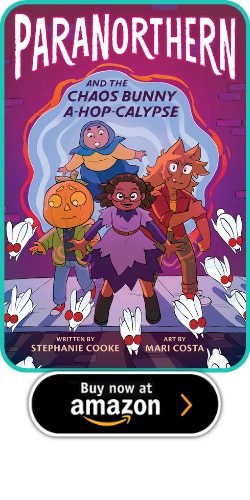
Sometimes the most powerful magic comes from our connections to our family and friends — and we just might need to harness it to kick some major bunny butt. “ParaNorthern,” (July 13, 2021, HMH Kids/Etch) is a deliciously humorous, cozy and bewitching graphic novel from Stephanie Cooke that will delight readers of all ages.
A witch named Abby and her three friends — a wolf-girl, a ghost and a pumpkinhead — band together to try and save their town from an invasion of rabid (but adorable!) chaos bunnies in this enchanting middle grade graphic novel for fans of “Making Friends,” “The Okay Witch,” and “Lumberjanes.”
It’s fall break in the supernatural town of North Haven, and young witch Abby’s plans include pitching in at her mom’s magical coffee shop, practicing her potion making and playing board games with her best friends — a pumpkinhead, a wolf-girl and a ghost.
But when Abby finds her younger sister being picked on by some speed demons, she lets out a burst of magic so strong, it opens a portal to a realm of chaos bunnies. And while these bunnies may look cute, they’re about to bring the a-hop-ocalypse (and get Abby in a cauldronful of trouble) unless she figures out a way to reverse the powerful magic she unwittingly released. What’s a witch to do?
A witch named Abby and her three friends — a wolf-girl, a ghost and a pumpkinhead — band together to try and save their town from an invasion of rabid (but adorable!) chaos bunnies in this enchanting middle grade graphic novel for fans of “Making Friends,” “The Okay Witch,” and “Lumberjanes.”
It’s fall break in the supernatural town of North Haven, and young witch Abby’s plans include pitching in at her mom’s magical coffee shop, practicing her potion making and playing board games with her best friends — a pumpkinhead, a wolf-girl and a ghost.
But when Abby finds her younger sister being picked on by some speed demons, she lets out a burst of magic so strong, it opens a portal to a realm of chaos bunnies. And while these bunnies may look cute, they’re about to bring the a-hop-ocalypse (and get Abby in a cauldronful of trouble) unless she figures out a way to reverse the powerful magic she unwittingly released. What’s a witch to do?
STEPHANIE COOKE
STEPHANIE COOKE is an award-winning writer and editor based out of Toronto. he’s a comic book fan, avid gamer, movie watcher and lover of puns. She is a purveyor of too many projects and thrives in chaos. Her writing work is featured in Mark Millar’s “Millarworld Annual,” “Wayward Sisters,” “The Secret Loves of Geek Girls,” “Toronto Comics Anthology” and more. Her debut graphic novel, “Oh My Gods!” released in January 2021 from HMH Kids, and a sequel will follow in fall 2021.
She’s also a crazy cat lady who happens to be terribly allergic to cats. As such, she settles for having just the one cat and takes a lot of allergy medication.
Follow Stephanie Cooke on social media:
Facebook | Twitter | Instagram | Goodreads | Website
She’s also a crazy cat lady who happens to be terribly allergic to cats. As such, she settles for having just the one cat and takes a lot of allergy medication.
Follow Stephanie Cooke on social media:
Facebook | Twitter | Instagram | Goodreads | Website
THE HEART AND SOUL OF HORROR FEATURES
![[THE HORROR OF HUMANITY] TINA BAKER THE WALKING TRIGGER WARNING](../../uploads/3/4/5/1/34519054/the-horror-of-humanity-tina-baker-the-walking-trigger-warning_orig.png) | And do you know what else helps? Humour. Coal black, gallows humour; the bad taste jokes made in the newsrooms where I worked as a journalist. Sometimes it’s the only way to cope. Laughing at myself is proper joyful! |
Ginger Nuts of Horror is honoured to welcome Tina Baker to the site, with what is possibly most heartfelt and powerful article we have ever had the honour to publish. Please be warned the article touches on some sensitive issues, such as domestic violence and rape. However, this is a must read article Tina lays her soul bare, in an harrowing account of some of the incidents that have driven her and shaped her as into the fabulous author she is today.
I’m a walking TRIGGER WARNING peeps. I blunder through real life mumbling ‘FFS’ and blurting out what’s inside my head and heart without editing. Unsurprisingly, this means my work contains swearing because I THINK in swearing. This has led to a few bad reviews. But it’s integral to who the characters are. Perhaps don’t buy my stuff if you don’t like swearing, and especially don’t by my book if you give it a 1-star review on Amazon because the PACKAGE WAS DAMAGED – then I will tell you to fuck right off. Twat.
Call Me Mummy, my debut novel – the tale of a woman so desperate for a child she steals one, and the woman she steals from being crucified by the press – is not Cosy Crime. It’s not only quite sweary (although loads was edited out after a debate about how much readers could take – apparently too much effing and blinding can ‘fatigue’ delicate souls who buy books), it’s also full of abuse, infertility, miscarriage, despair, fucked-up Catholicism, trolling, envy, terror, alcoholism, suicide and vicious bastards – all of which I have personally experienced. Although I failed at the suicide, obvs.
But this is fiction, folks! Like the outrageous gaslighting and outright lies spaffed by the Tories, it didn’t all happen exactly like that. For instance, I didn’t grow up on a farm, like ‘Mummy’. I grew up in sunny Coalville, in a dark era when men were men and women were grateful and we all worked down the pit. I didn’t realise it was possible to use a sentence without a swear until I went to school, but then I came home to play my favourite game, where my brother counted the ‘cunts’ and I counted the ‘fucks’ in any given conversation involving my dad, a window cleaner.
But swears aren’t horror. Silence is far more terrifying.
Here’s a slice of horror for you.
I said nothing as I lay rigid in the dark in our caravan pretending to be asleep as my mum and dad took chunks out of each other. He ripped the door off the caravan. She smashed his hand with her stiletto. When they got bored with that, they’d lay into us with ‘the belt’ – a leather dog collar with studs. I have specific memories of the buckle. I told no one. There was no one to tell.
I said nothing when:
I was abused as a kid in the swimming baths; flashed at by numerous other bastards; tied up by a ‘boyfriend’ and left hanging upside down attached to bannisters; attacked in a Greek market and turned on by a baying mob as I fought back, because I was in the wrong for wearing a short skirt; raped. (I thank I Will Destroy You for bringing the rape to my attention. I hadn’t fully realized previously that being fucked while unconscious constituted such.)
Silence is fucking dangerous.
These experiences have left me with depression, anxiety, suicidal ideation, imposter syndrome, body dysmorphia PTSD… it’s easier to just use the phrase WELL FUCKED UP.
But do you know what, boys and girls? Writing the horror – taking it by its nasty little throat and bullying it back, twisting and shaping it to punish the bastards who hurt you in fictional form – is very therapeutic. I won’t say it’s cheaper than therapy, because if you add up all the woman-hours I spend writing/eating chocolate biscuits and hating myself for not writing, that’s time I could earn more beasting people in the fitness classes I run as a day job. Press-ups and burpees also help me deal with The Rage of so many years silence. I think all writers need a star-jump break once a day. Don’t worry if you’re old. I’m old too. Just do low-impact ones.
And do you know what else helps? Humour. Coal black, gallows humour; the bad taste jokes made in the newsrooms where I worked as a journalist. Sometimes it’s the only way to cope. Laughing at myself is proper joyful!
It’s taken me decades to become a published author thanks to the internal horror. But writing has given me my voice. And, finally, THIS BITCH IS LOUD!
Please buy my book baby.
Call Me Mummy, Viper Books
Bookshops, Tesco, Asda & Amazon
Call Me Mummy, my debut novel – the tale of a woman so desperate for a child she steals one, and the woman she steals from being crucified by the press – is not Cosy Crime. It’s not only quite sweary (although loads was edited out after a debate about how much readers could take – apparently too much effing and blinding can ‘fatigue’ delicate souls who buy books), it’s also full of abuse, infertility, miscarriage, despair, fucked-up Catholicism, trolling, envy, terror, alcoholism, suicide and vicious bastards – all of which I have personally experienced. Although I failed at the suicide, obvs.
But this is fiction, folks! Like the outrageous gaslighting and outright lies spaffed by the Tories, it didn’t all happen exactly like that. For instance, I didn’t grow up on a farm, like ‘Mummy’. I grew up in sunny Coalville, in a dark era when men were men and women were grateful and we all worked down the pit. I didn’t realise it was possible to use a sentence without a swear until I went to school, but then I came home to play my favourite game, where my brother counted the ‘cunts’ and I counted the ‘fucks’ in any given conversation involving my dad, a window cleaner.
But swears aren’t horror. Silence is far more terrifying.
Here’s a slice of horror for you.
I said nothing as I lay rigid in the dark in our caravan pretending to be asleep as my mum and dad took chunks out of each other. He ripped the door off the caravan. She smashed his hand with her stiletto. When they got bored with that, they’d lay into us with ‘the belt’ – a leather dog collar with studs. I have specific memories of the buckle. I told no one. There was no one to tell.
I said nothing when:
I was abused as a kid in the swimming baths; flashed at by numerous other bastards; tied up by a ‘boyfriend’ and left hanging upside down attached to bannisters; attacked in a Greek market and turned on by a baying mob as I fought back, because I was in the wrong for wearing a short skirt; raped. (I thank I Will Destroy You for bringing the rape to my attention. I hadn’t fully realized previously that being fucked while unconscious constituted such.)
Silence is fucking dangerous.
These experiences have left me with depression, anxiety, suicidal ideation, imposter syndrome, body dysmorphia PTSD… it’s easier to just use the phrase WELL FUCKED UP.
But do you know what, boys and girls? Writing the horror – taking it by its nasty little throat and bullying it back, twisting and shaping it to punish the bastards who hurt you in fictional form – is very therapeutic. I won’t say it’s cheaper than therapy, because if you add up all the woman-hours I spend writing/eating chocolate biscuits and hating myself for not writing, that’s time I could earn more beasting people in the fitness classes I run as a day job. Press-ups and burpees also help me deal with The Rage of so many years silence. I think all writers need a star-jump break once a day. Don’t worry if you’re old. I’m old too. Just do low-impact ones.
And do you know what else helps? Humour. Coal black, gallows humour; the bad taste jokes made in the newsrooms where I worked as a journalist. Sometimes it’s the only way to cope. Laughing at myself is proper joyful!
It’s taken me decades to become a published author thanks to the internal horror. But writing has given me my voice. And, finally, THIS BITCH IS LOUD!
Please buy my book baby.
Call Me Mummy, Viper Books
Bookshops, Tesco, Asda & Amazon
*** THE #1 KINDLE BESTSELLER ***
*** A NETGALLEY BOOK OF THE MONTH ***
'Dark, heartbreaking and totally absorbing' - LORRAINE KELLY
'Brilliantly written and emotionally compulsive' - HARRIET TYCE
'A powerful and thought-provoking page turner' - KATERINA DIAMOND
________________________________________
CALL ME MUMMY. IT'LL BE BETTER IF YOU DO.
Glamorous, beautiful Mummy has everything a woman could want. Except for a daughter of her very own. So when she sees Kim - heavily pregnant, glued to her phone and ignoring her eldest child in a busy shop - she does what anyone would do. She takes her. But foul-mouthed little Tonya is not the daughter that Mummy was hoping for.
As Tonya fiercely resists Mummy's attempts to make her into the perfect child, Kim is demonised by the media as a 'scummy mummy', who deserves to have her other children taken too. Haunted by memories of her own childhood and refusing to play by the media's rules, Kim begins to spiral, turning on those who love her.
Though they are worlds apart, Mummy and Kim have more in common than they could possibly imagine. But it is five-year-old Tonya who is caught in the middle...
________________________________________
'Disturbing and distinctive, this is a book I couldn't put down' - AMANDA JENNINGS
'Tense and gripping, these characters will stay with me' - ALICE CLARK-PLATTS
'Psychologically twisty and utterly gripping' - LISA HALL
*** A NETGALLEY BOOK OF THE MONTH ***
'Dark, heartbreaking and totally absorbing' - LORRAINE KELLY
'Brilliantly written and emotionally compulsive' - HARRIET TYCE
'A powerful and thought-provoking page turner' - KATERINA DIAMOND
________________________________________
CALL ME MUMMY. IT'LL BE BETTER IF YOU DO.
Glamorous, beautiful Mummy has everything a woman could want. Except for a daughter of her very own. So when she sees Kim - heavily pregnant, glued to her phone and ignoring her eldest child in a busy shop - she does what anyone would do. She takes her. But foul-mouthed little Tonya is not the daughter that Mummy was hoping for.
As Tonya fiercely resists Mummy's attempts to make her into the perfect child, Kim is demonised by the media as a 'scummy mummy', who deserves to have her other children taken too. Haunted by memories of her own childhood and refusing to play by the media's rules, Kim begins to spiral, turning on those who love her.
Though they are worlds apart, Mummy and Kim have more in common than they could possibly imagine. But it is five-year-old Tonya who is caught in the middle...
________________________________________
'Disturbing and distinctive, this is a book I couldn't put down' - AMANDA JENNINGS
'Tense and gripping, these characters will stay with me' - ALICE CLARK-PLATTS
'Psychologically twisty and utterly gripping' - LISA HALL
TINA BAKER
Tina was brought up in a caravan after her mother, a fairground traveller, fell pregnant by a window cleaner. After leaving the bright lights of Coalville, she came to London and worked as a journalist and broadcaster for thirty years. She’s probably best known as a television critic for the BBC and GMTV, but after so many hours watching soaps gave her a widescreen bum, she got off it, lost weight and won Celebrity Fit Club. When not writing she now works as a fitness instructor. She also rescues cats, whether they want to be rescued or not. Call Me Mummy is Tina’s first novel, partly inspired by her own unsuccessful attempts to have a child. Despite the grief and disappointment of that, she hasn’t stolen one. So far.
@TinaBakerBooks on the socials
tinabaker.co.uk
for books and fitness
Please buy my book baby.
Call Me Mummy, Viper Books
Bookshops, Tesco, Asda & Amazon
https://www.amazon.co.uk/Call-Me-Mummy-absorbing-Lorraine/dp/1788165241/ref=tmm_pap_swatch_0?_encoding=UTF8&qid=1633603919&sr=8-1
tinabaker.co.uk
for books and fitness
Please buy my book baby.
Call Me Mummy, Viper Books
Bookshops, Tesco, Asda & Amazon
https://www.amazon.co.uk/Call-Me-Mummy-absorbing-Lorraine/dp/1788165241/ref=tmm_pap_swatch_0?_encoding=UTF8&qid=1633603919&sr=8-1
TODAY ON THE GINGER NUTS OF HORROR WEBSITE
[BOOK REVIEW] MAY CAUSE UNEXPLAINED OCULAR BLEEDING BY NIKOLAS P. ROBINSON
CENTAURWORLD:
A LOVECRAFTIAN BAG OF VARIOUSLY-FLAVOURED SHERBERT.
THE HEART AND SOUL OF HORROR FEATURES


Archives
April 2023
March 2023
February 2023
January 2023
December 2022
November 2022
October 2022
September 2022
August 2022
July 2022
June 2022
May 2022
April 2022
March 2022
February 2022
January 2022
December 2021
November 2021
October 2021
September 2021
August 2021
July 2021
June 2021
May 2021
April 2021
March 2021
February 2021
January 2021
December 2020
November 2020
October 2020
September 2020
August 2020
July 2020
June 2020
May 2020
April 2020
March 2020
February 2020
January 2020
December 2019
November 2019
October 2019
September 2019
August 2019
July 2019
June 2019
May 2019
April 2019
March 2019
February 2019
January 2019
December 2018
November 2018
October 2018
September 2018
August 2018
July 2018
June 2018
May 2018
April 2018
March 2018
February 2018
January 2018
December 2017
November 2017
October 2017
September 2017
August 2017
June 2017
May 2017
April 2017
March 2017
February 2017
January 2017
December 2016
November 2016
October 2016
September 2016
August 2016
July 2016
June 2016
May 2016
April 2016
March 2016
February 2016
January 2016
December 2015
November 2015
October 2015
September 2015
August 2015
July 2015
June 2015
May 2015
April 2015
March 2015
February 2015
January 2015
December 2014
November 2014
October 2014
September 2014
August 2014
July 2014
June 2014
May 2014
April 2014
March 2014
February 2014
January 2014
December 2013
October 2013
September 2013
August 2013
 RSS Feed

|

|