


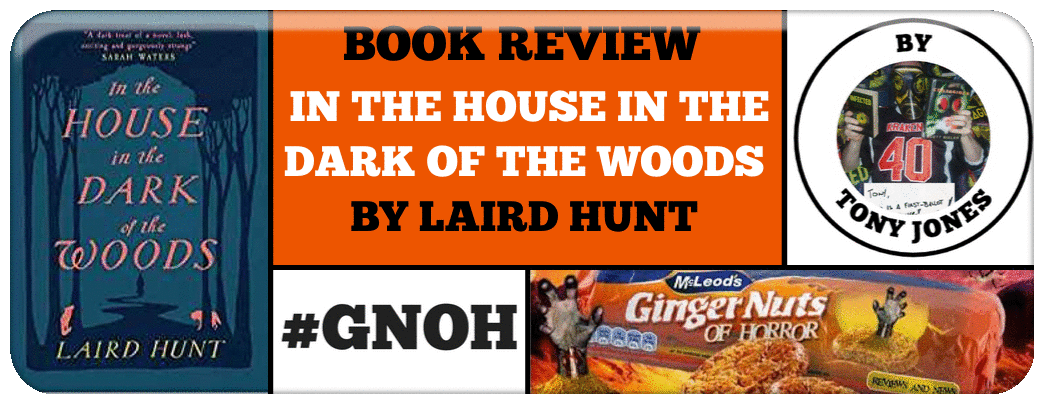
 “Once upon a time there was and there wasn't a woman who went to the woods” If you dig dark fiction which is tricky to categorise and leads the reader on a 210-page merry-go-round then Laird Hunt’s In the House in the Dark of the Woods might be the perfect choice for you. The plot is minimal, the characters distorted and it has a hallucinogenic quality which is highly stylised and deceptively simple. If this is not your brand of horror be warned; you may find this short novel to be a pretentious exercise in style over plot leaving you scratching your head by the time you reached the end, more confused by ever. This was one of those books where everything is not laid out on a plate and the reader is supposed to draw their own conclusion. I did indeed scratch my head, several times, but I still enjoyed my time with In the House in the Dark of the Woods. Or at least I think I did, it was one of those books. The minimal plot is set in the colonial period of America, New England, and concerns a law-abiding Puritan wife who goes out for a walk in the encroaching forest. Boldly, she wanders further than usual and although there are signs things are not right she continues onwards and gets incredibly lost. When it comes to the plot there is not much more to say; the woman who is sometimes referred to as ‘Goody’ (although that is not her name) then meets a succession of other people in the forest. From here on in your interpretation of the story may differ from mine; does she keep meeting the same person? Over how long a period is it set? (days, months, years or longer….) Are any of the people she meets real or is it in fact her? Does she genuinely have a husband and son? Is she paying penance for something lurking in her past? The answers to many of these questions is anybody’s guess, including mine. Good luck trying to break it all down. Much of it was just too vague for my taste. The forest was obviously haunted or cursed in some way and the underlying thread was of superstition and fear of witchcraft which was a crucial part of the story. Some details surrounding the Puritan lifestyle are dropped here and there but overall I found the vagueness and lack of historical detail to be frustrating and for the most part the story might have been set anywhere, but then again perhaps that was the point. The promotional material overhypes it slightly (doesn’t it always though?) comparing it to 20th Century masterpieces, including Angela Carter’s The Bloody Chamber, it’s a fascinating book for sure, but does not deserve to be compared to the queen of the dark literary fairy tale. Other names dropped by way of comparison include Kelly Link and Joy Williams, however, the most obvious similarity was overlooked…. The 1935 Nathaniel Hawthorne short story Young Goodman Browne, where a young man gets lost in a New England forest during Puritan times and stumbles upon a gathering of witches. Hawthorne may well have inspired this novel with his basic premise, but Laird Hunt has a wild time developing it. On her journey ‘Goody’ encounters a cast of odd characters; Captain Jane, Granny Someone and Eliza who may well symbolise something deeper and are connected to generations of different women in obscure ways. Then there is the question of good and evil, in Puritan times this was very clearly defined, however, once in the woods this becomes incredibly blurred and the flashbacks to Goody’s married life make this even more confusing, as if there is evil present then it is probably within her. I’m getting confused even writing this, ultimately I found some of this just too obscure. In the House in the Dark of the Woods is one of those marmite types of books and will probably pick up as many one-star reviews as it does five-stars. Even though it lacked serious scares it held my attention and I had a feeling from the outset it was going to be one of those ‘choose your own ending’ books. Some readers hate them, but if you fancy a dark, lyrical play on fairy tales then it is worth a closer look and you’ll zip through the 200 pages and then start questioning yourself all over again. It may well be a good choice for a book club as there is much material to chew the cud over. Tony Jones  In the House in the Dark of the Woods by Laird Hunt 'A dark treat of a novel: lush, exciting and gorgeously strange' Sarah Waters Once upon a time there was and there wasn't a woman who went to the woods. In this disorienting horror story, a young woman sets off to pick berries in the depths of the forest, but can't find her way home again. Or perhaps she has fled or abandoned her family. Or perhaps she's been kidnapped, and set loose to wander in the dense woods of the north. Alone and possibly lost, she meets another woman who offers her help. Then everything changes. On a journey that will take her through dark woods full of almost-human wolves, through a deep well wet with the screams of men, and on a living ship made of human bones, our heroine may find that the evil she flees has been inside her all along.   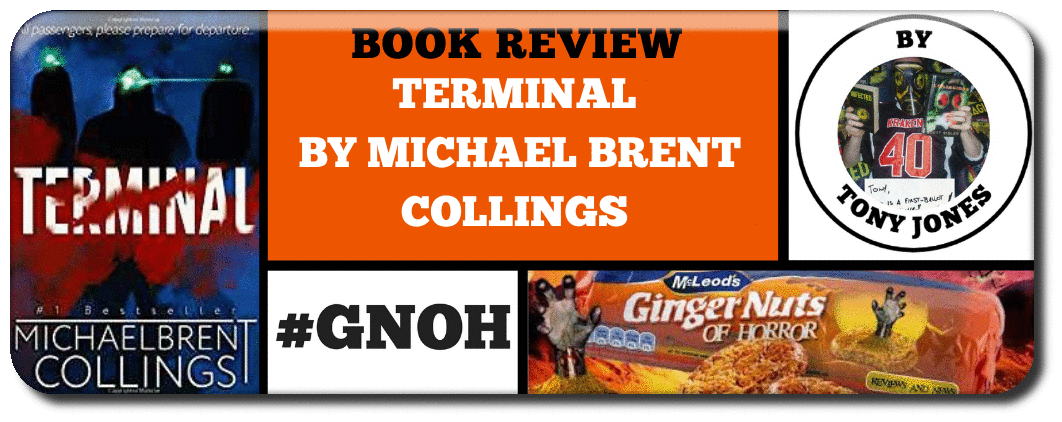 You just never know when a bus trip might be your last… Terminal opens with a prologue which introduces the ‘Watcher’, an otherworldly cosmic weird being which is about to take a very close interest in the drama unfolding in a bus terminal which is mysteriously surrounded by in impenetrable fog. Although the ‘Watcher’ pops up from time to time he (or it? or them?) is more interested in the group of people, how they react with each other, after we realise are stranded in the bus terminal. We’re quickly introduced to the group of people, none of which know each other, most are waiting for a further connection to another destination. It’s a non-descript pitstop, quickly forgotten once you’ve left it behind. Included in the mix are an old cop now working in bus security, a Mark Kay salesperson, a newlywed couple, a conman, a computer geek who seems to be on the Autism spectrum, a young woman looking for fame and a dangerous looking Mexican, who may well be a gangster. All have something to hide, not necessarily sinister, and slowly the author digs into their backstories as their crisis escalates. Terminal jumps from character to character and the reader realises they did not know the protagonists as well as they thought they did. This in itself was not a major revelation and the group were probably an average cross-section of the population. After realising the group are in a type of deadly competition I guess the reader was supposed to pick a favourite to root behind, however, I never found myself truly sympathising for any of them and felt I would have enjoyed the book more if I was cheering someone in particular on. Perhaps there were slightly too many characters to choose from? As their numbers depleted there was an inevitability to the book and although it was atmospheric in parts I found it rather one-paced. Before long everybody in the group gets an identical text message from someone called ‘The Other’ which states: “Only 1 will leave, all in favour” and they eventually twig that the dense fog (and something in it) has trapped them and that as a group only one of them will survive and that the others must unanimously agree on that person with a vote. Yeah right, as if that would happen! Of course, everybody wants to vote for themselves and the fun begins. It sounds like a ridiculous conundrum, but there are some surprises in the way it plays out. Would you sacrifice yourself for a complete stranger? Quickly someone goes in the fog and tries to escape after panicking, bites the bullet, and the rest of the group realise it is for real. Technology stops working and now a cancelled bus has been transformed into a game of life and death, the latter for most. Once the tension mounts, and the clock starts ticking, the characters all start bouncing off each other and the inner fighting escalates. Along the way you cannot help but think of Stephen King’s The Mist, The Twilight Zone, or any number of escape room scenarios or even Agatha Christie’s Ten Little Indians. Unfortunately, most of the points of references I made were also much stronger works of fiction than this. Although Terminal keeps you guessing for some of the time, has some decent twists, it never truly hit top gear for me and although I was invested enough to discover who the eventual last person standing, I was not too surprised by the outcome. There are some vague revelations regarding the Watcher(s) and their motives but there was something about the whole thing I found underwhelming. Terminal has had a lot of amazing praise in the horror community from highly respectable reviewers, but I just did not connect with it in the same way. It was creative, solidly written with a good range of characters, but it lacked the edge required to raise itself above the crowd in a horror market top-heavy with strong fiction. 3/5 Tony Jones  TERMINAL BY MICHAEL BRENT COLLINGS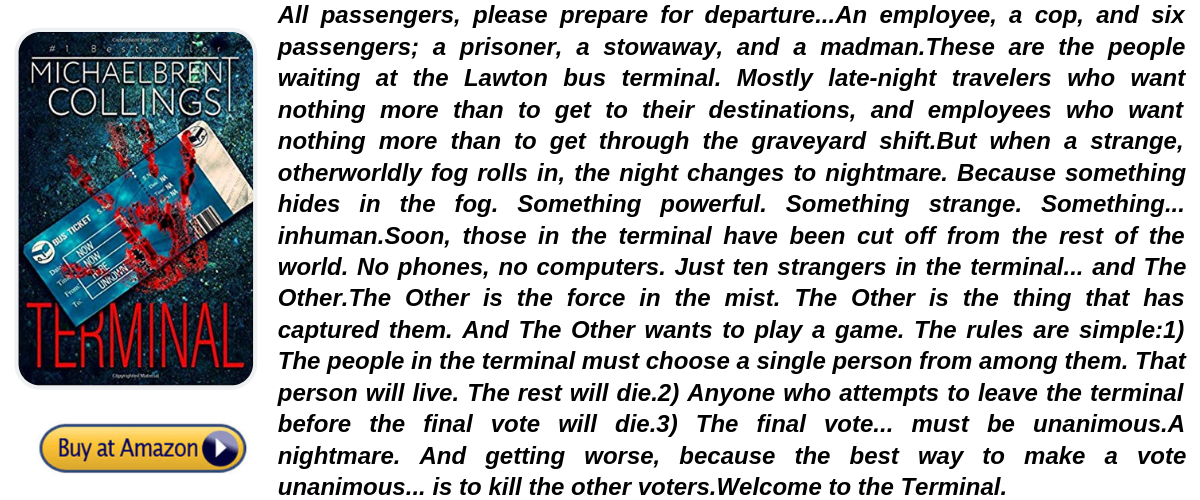  The 15 pieces within Bedtime Stories are driven by story, character, and emotion rather than by purple prose or pointless padding; The moment you crack open Russell Smeaton’s Bedtime Stories, it becomes apparent that this isn’t your average horror collection. There’s no congratulatory foreword, self-aggrandizing introduction, or overly indulgent author’s note. Turn the page and the first thing you see is a table of contents. Turn the page again and you’re onto the first story. No muss, no fuss. Of the 15 tales included here, only five run longer than ten pages. Many are half that. The whole thing runs less than 200 pages total, with the final two reserved for a short acknowledgements list and a roll-call of the book’s Kickstarter backers. Even the graphic design adopts a kind of slick minimalism that makes this look less like a collection of fiction and more like a professional software manual. At first glance, you might worry that such austerity reflects bland utilitarian writing. What it really reflects, though, is unpretentious writing. The 15 pieces within Bedtime Stories are driven by story, character, and emotion rather than by purple prose or pointless padding; these are quickly paced, no-frills page-turners that encourage you to keep reading from the moment you crack open the front cover until you reach the very end. Right off the bat, “Monday Morning” wins you over with a darkly comic slice-of-life portrait of a mid-level pencil-pusher trying to improve his love life despite the unfortunate practicalities of corporate-mandated cannibalism. Following that, “Balls” goes for a somewhat more serious Twilight Zone approach, focusing on the before and after of an unexplained apocalypse that transforms all humans into strange, stationary metal spheres. A tongue-in-cheek final line helps maintain a disarming sense of playfulness, but that only serves to make you drop your guard as “The Street” comes ripping around the corner. Beginning as a breezy Bradbury-esque snapshot of childhood nostalgia, “The Street” lures you into thinking it might be, at most, a spooky-fun story about neighborhood kids trick-or-treating and encountering a weird lady handing out Easter eggs instead of Halloween candy. Maybe there will be a mordant Edward Gorey-style punchline, you think. Then you read a line like “The creature felt the summoning pull at its bones. It followed the calling to a large garden where it found small animals that had been prepared, carefully crucified on small wooden crosses,” and your stomach drops out. Gorey? No. Gory? Yes. While “The Street” sneaks in a few touches of wry humor, this tale pulls no punches. This is Horror-with-a-capital-H; it’s violent, twisted, and grim, with a narrative that includes occultism, suicide, child murder, monstrous birth, and even references to pedophilia. “The Street” shows that while Smeaton’s authorial voice is often amiable, that same quality doesn’t always carry over to his subject matter. As if sensing the need for a palate cleanser, Bedtime Stories follows “The Street” with “Spells,” an over-before-you-know-it charmer (with a delightful undercurrent of fridge horror) about a doting father all too happy to humor his 7-year-old daughter’s attempts to do magic. “King Bryan” follows with a sweet-but-sad tribute to living, loving, and dying told from the perspective of a surprising source. Utilizing a similarly bittersweet tone, “Stoned” details the last earthly moments of a lonely beach-bum who lives in his van and spends his days getting high and surfing, all the while yearning for something he can’t quite name. Then comes “Milk.” Like “The Street” before it, this story hits you like an uppercut to the jaw. Here, a happily married couple visit a recently opened goat farm whose dairy products are becoming unusually popular with the locals. Soon enough, the wife becomes pregnant and, soon, finds that her baby has an insatiable craving for… well, you can guess. It’s hard to say more without giving away too much, so let’s just say that “Milk” reads a little like a mash-up between the 2016 film The Witch and Piers Anthony’s controversial short story “In the Barn.” What really makes this tale stand out is the choice to leave its greatest horrors unspoken. Smeaton implies more than he explicates, and even if his hints aren’t always subtle, the effect is still strong. Following that, Bedtime Stories again wisely let the air out of the room, summoning forth its first (but certainly not last) overtly Lovecraftian tale, “Spider Chords,” a winking, druggy riff on “Nyarlathotep” and “The Music of Erich Zahn.” After that, “Nine Lives” offers a thoughtful meditation on reincarnation as viewed from the perspective of a sentimental cat. “Snake Charmer” return to the HPL well for a grisly little chiller about a vaguely xenophobic white tourist investigates the serpent deity Yig within the context of India’s pungi street-performer tradition. Seemingly in retort to the old-school pulpiness of “Snake Charmer,” “These Guys” meanwhile takes a somewhat unsuccessful stab at experimental story-structure. The first half of “These Guys” unfolds via the stream-of-consciousness inner monologues of a trio of horny dudebros attending a rowdy beach party. But then the second half unceremoniously returns to a more standard third-person POV. This shift makes the whole story feel uneven and undercooked; it’s arguably one of Bedtime Stories’ few glaring missteps, detracting from an otherwise enjoyable, if slight, dalliance with Lovecraft’s Deep Ones. “The Path out of Ulthar” fares far better, adopting a romantic, dreamlike tone as it shares the final reminiscences of a frequent visitor to HPL’s fabled feline metropolis. Taking a more comical approach to the Old Gent’s legacy, “Destination R’lyeh” concerns a Cthulhu fanboy who types the watery resting place of everyone favorite’s favorite Old One into his GPS… and actually receives directions there! Finally, closing out Bedtime Stories is “Circus of Crows,” which combo-breaks the recent string of Lovecraft-centric yarns in favor of something more akin to Bradbury, albeit with a surprising streak of perversion. Here, a flock of black birds heralds the arrival of a traveling carnival to a dead-end midwest town, and a young girl finds herself drawn to its handsome ringmaster. Unfortunately, the man’s, ahem, unconventional appetites require greater sacrifice than his would-be lover realizes. All told, Bedtime Stories makes for an ideal afternoon read, one you’ll likely finish in a single sitting. That’s a testament not simply to the stories’ length, but to their effortless readability as well. These stories are short for no other reason than Smeaton knows what does and does not need to be said. There are few wasted words here. Even when Smeaton does try his hand at longer stories, his instinct towards stripping a narrative down to its most essential parts serves him well. “Milk” is a perfect example; as previously noted, “Milk” makes excellent use of suggested horrors rather than explicit ones, showing how much more a writer can achieve by not saying anything as opposed to saying too much. It’s only when Smeaton tries to embellish instead of simplify that he stumbles. “The Street,” for instance, has a tendency to switch character perspectives frequently. While this kind of omnipresent “god’s eye view” approach to narration does give the piece an enjoyably homespun vibe—it feels less like you’re reading a story and more like someone is telling you one, perhaps ‘round the proverbial campfire—it is nevertheless confusing at times. The POV switches can come so quickly that they feel jarring, and they’re sometimes all too easy to miss. What’s more, “The Street” feels like it’s building to an ending that doesn’t come until later. Or, more accurately, it feels like it ends twice. The story slightly overstays its welcome, losing momentum in the process. Arguably, it could have had a much stronger impact by ending earlier and going out with a bang. That said, despite its flaws “The Street” is still one of the best and most memorable tales in Bedtime Stories, so make of that what you will. Its grotesque nature is made all the more horrifying by virtue of the contrast between it and the tales directly preceding and following. Indeed, Smeaton’s range as a writer may be his most appealing feature. Throughout Bedtime Stories he showcases an impressive talent for flipping the script on a dime, going from fairy tales to Weird Tales without warning, occasionally within the very same piece. For a reader, that’s enticing. It keeps you guessing. More importantly, it keeps you turning those pages, eager to see whether what waits for you is a nightmare or a dream. Sometimes it’s both.    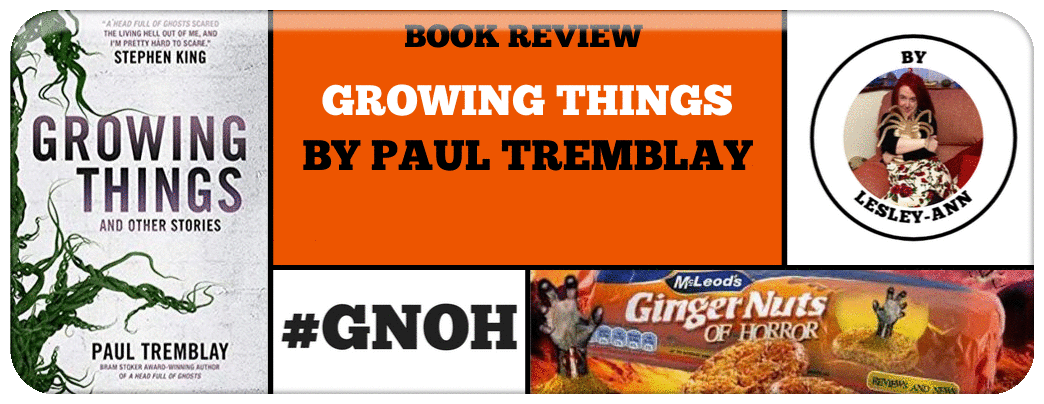  I have pondered over this book for a little while after reading it. I was torn between several thoughts – is it a work of brilliance and I’m just missing the point? Is it, as a few have since commented, apparently unfinished? Or is it named ‘Growing Things’ for a reason? I am leaning towards the latter. I felt like the stories were all unfinished in some way, it was as if they were just getting going or they were ending abruptly. After careful thought I am leaning towards the idea that they are unfinished, but for a reason. ‘Growing Things’, in the terms of our unlimited imagination. The premise of beginning stories, feeding our imaginations with the seeds of horror. Whether this is the point or not, this is what I have taken from it. The author plants an idea, nurtures it to the point of blossoming and then done… leaving us wondering. Inventing ideas of how the story continues or culminates. The writing is articulate, inventive and full of life. The style interesting. My first thought I’m ashamed to say was that this felt like a collection of ideas just thrown together. This was my reasoning for taking my time. I knew for such an established author that this would not be the case. And careful consideration I came to believe that there was more than meets the eye. I’m not going to mention any of the stories, I don’t want to give anything away or take away from anyone’s reading experience. I will say, if you want to stoke the fires of your imagination or look for some inspiration, then look no further, Growing Things is the book for you. I will say though, that first story in the book, really stuck with me. Even now I keep thinking about it, wondering what happened. For a writer, this is what you want, stories to stick with the reader, to linger at the back of their consciousness. You want them to think of you, think of your work and be keen to get the next instalment. I think the author has done a wonderful job, he has certainly peaked my interest. I may be totally wrong, as always, reading is very subjective. It’s personal to the reader, a special relationship that the author has with each individual reader. This is neither a good review or a bad review. This is just my thoughts on a collection of short tales. One I need to revisit as I imagine I will get so much more from it the second time around.  |


Archives
May 2023
|

|

|
 RSS Feed