


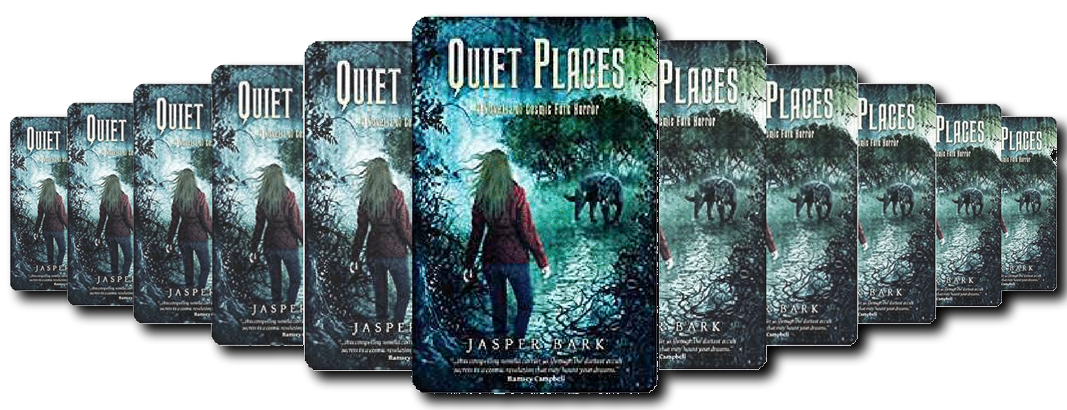
 As you’ll probably have gathered from previous reviews, I’m pretty well a confirmed Jasper Bark fan at this point. As such, when Quiet Places crossed the Gingernuts review list, I couldn’t resist grabbing it, tottering to-do list be damned. I’d heard some strange murmurings about this one - ‘No sex! No violence! Literary horror!’ - and I was very curious to see how this would play out, especially as the early press also indicated the story formed part of the Heresy series story cycle, a mythology that’s been far from bloodless so far in the Bark catalogue. Well, and okay, let’s address that first - yes, it’s fair to say this novella isn’t splatterpunk horror in the vein of, say, the gloriously deranged Stuck On You and other prime cuts collection. That said, there’s always been (a lot) more to Bark than a willingness to ‘go there’, and all the other qualities I’ve come to expect and enjoy are present and correct. Example? Achingly real characterisation. A central thread of the story involves a love story between Sally, our lead, and David, the Laird of Dunballan. It’s a relationship that evokes some past Bark stories - Bed of Crimson Joy in particular - but it’s far from a simple retread. The two characters are fascinating portraits, and the way they interact has a ring of authenticity that is, quietly, rather brilliant. Similarly, the setting of Dunballan is evoked with skill and care, the surface charms of an idyllic Scottish village subtlety underlaid with feelings of creeping claustrophobia and isolation. Similarly, there’s a lengthy story-within-a-story section in the grand tradition of Lovecraft, which traces in part the outline of the intriguing Heresy that has been a component of so much of Barks recent work, and it too is rich in a very different kind of atmosphere, evoking a past time and society with apparently effortless poise. And then there is the horror. I don’t want to give much away - ideally, really, not anything, the joy of discovery was big part of the pleasure of reading this tale, for me - but rest assured, while the lack of splatter is accurate, this one packs a punch as hard and as bleak as any of Bark’s past work, creating, by the end, an existential hellscape to rival that of the last chapter of Jim Thompson’s The Getaway. In conclusion, yes, Jasper Bark has done it again - delivered yet another slice of evocative, dark horror, peopled with flawed yet sympathetic, brilliantly realised characters, and with a black hearted mythology that feels set to grow and grow. And splatter fans, don’t let the lack of overt gore put you off picking this one up - it’s as chilling as anything Bark has so far produced. KP 3/10/17 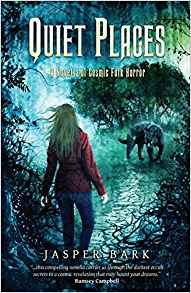 The people of Dunballan, harbour a dark secret. A secret more terrible than the Beast that stalks the dense forests of Dunballan. A secret that holds David McCavendish, last in a long line of Lairds, in its unbreakable grip. It’s down to Sally, David’s lover, to free David from the sinister clutches of the Beast. But, with the whole town against her, she must ally herself with an ancient woodland force and trace Dunballan’s secret back to its bitter origins. Those origins lie within the McCavendish family history, and a blasphemous heresy that stretches back to the beginning of time. Some truths are too terrible to face, and the darkest of these lie waiting for Sally, in the Quiet Places. Quiet Places is folk horror at its most cosmic and terrifying. Blending folklore with psychological terror, it contains stories within stories, each one leading to revelations more unsettling than the last. Revelations that will change the way you view your place in the cosmos, and haunt you, relentlessly, long after you have put down this book. Quiet Places is a novella in the Heresy Series story cycle and has been substantially rewritten and revised for this edition.   HORROR MAGAZINE REVIEW: RED ROOM
7/11/2017
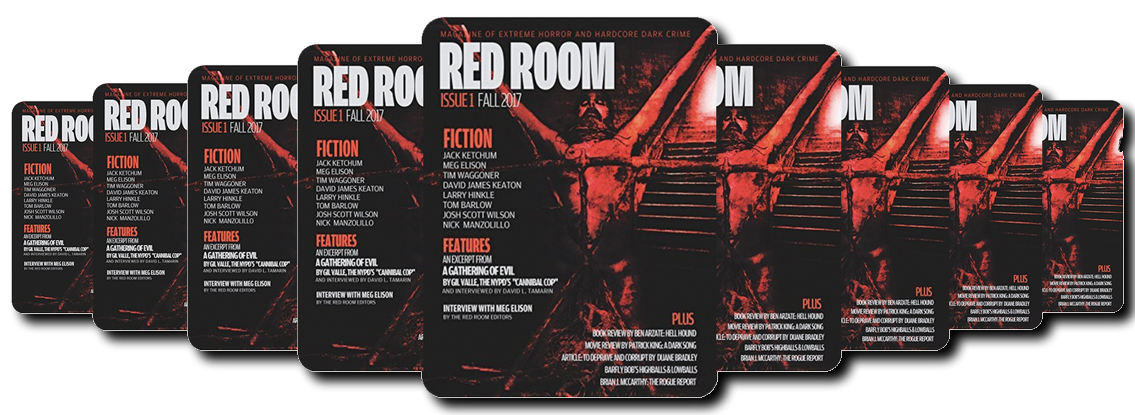 Well, this is a nasty little number. From Comet Press comes Red Room, a brand new extreme horror and dark crime magazine. While I only occasionally enjoy extreme fiction, the combination of hardcore horror and crime fiction promised by Red Room had me intrigued. Crime fiction makes me think of more “serious” work that contrasts with what I consider typical of the extreme horror genre, so I had high hopes for the stories and articles in this collection. I was not disappointed. Red Room’s debut contains exciting, surprising features and tales that make me optimistic about the journal’s future. I must admit to being unfamiliar with many of the names contained within, but I was excited by the fact that Jack Ketchum had a story, and that David L Tamarin had interviewed a notorious cop-turned-fiction-writer who was once accused, and subsequently cleared, of taking part in grisly kidnappings. Rather than describing each article and story, I will leave you to discover them yourself and just mention those that were, for me, Red Room #1’s highlights. The magazine opens with Nick Manzolillo’s excellent and disturbing tale The Phantom Video Stream. This uneasy story is about a man who discovers a secret sub-section of Netflix which offers no explanation as to its contents, and which is not referenced anywhere online. The seedy and unsettling tone of this one had me wondering how far it was going to go, and its conclusion left me grimly satisfied. Tom Barlow’s Selfie was the first of Red Room’s crime fiction tales, and I loved its rapid pace and lively style. After being conned out of his father’s life insurance policy, our protagonist Mike has no way to pay for his sister’s ongoing chemo treatment. However, lucky for Mike, he’s just learned that he has an identical twin brother who has no knowledge of Mike’s existence. His plan is ruthless and cunning – but not without its drawbacks. Jack Ketchum’s Megan’s Law is a thoroughly distressing piece of work, and is told with the author’s customary eloquence and unflinching style. Brace yourself before reading this one. The last I will mention is David L Tamarin’s aforementioned interview with Gil Valle, an ex-police officer who was arrested by the FBI and charged with conspiracy to commit kidnapping. The main evidence used against him was his use of a dark fetish/fantasy website where he discussed graphic sexual scenarios involving kidnap and cannibalism. The interview offers a glimpse into Valle’s mind, as well as the shocking events that took place after he was acquitted of all charges. It is followed by an excerpt from Valle’s upcoming novel. As well as other distasteful and thoroughly enjoyable stories, there is also an enjoyable feature on Video Nasties. Red Room is a tasty treat for anyone who likes fiction and features that leave a bad taste in the mouth. Recommended for fellow sick little monkeys.   HORROR FICTION REVIEW: BLEED BY ED KURTZ
6/11/2017
BY GEORGE ILETT ANDERSON 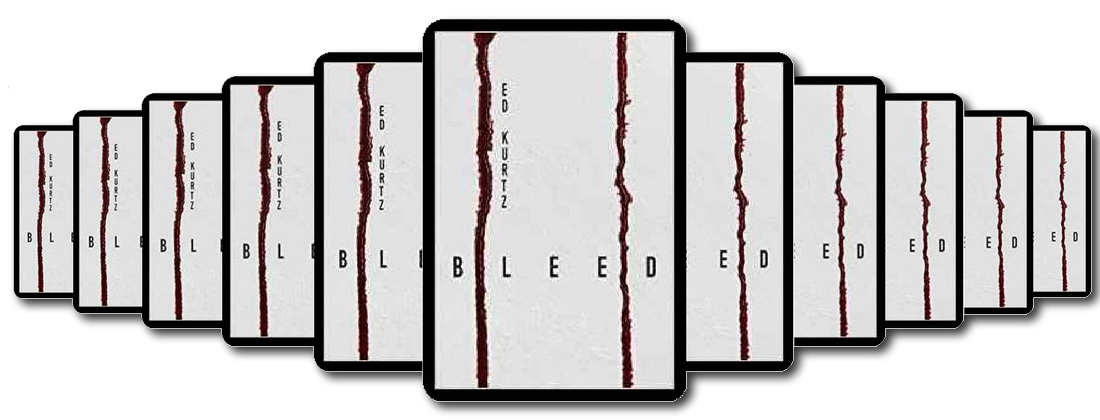 There will be Blood “Bleed” by Ed Kurtz is the second book of his that I’ve read. My first introduction to his writing was the wonderful “The Rib from which I Remake the World”; a dark novel that had this fantastically Bradbury tinged flavour running through it. By comparison, “Bleed” is an altogether different type of beast. Whereas the former felt like a dark fairytale about loss and redemption, “Bleed” is a brutal and bloody nightmare of madness, lust and obsession reminiscent of late 80s horror writing and, in particular, Clive Barker. The novel is centred on Walt Blackmore and his fixation with a small red stain. Walt has recently relocated to the country and is determined to create his own little slice of rural bliss with his fiancée, Amanda. Unfortunately for Walt, the dilapidated property in his possession has a dark and troublesome history that will have far reaching consequences on the present, turning his heaven into hell. Initially resistant to Walt’s attempts to cleanse it, the stain’s true nature is exposed and Walt falls into a whirlpool of madness, betrayal and murder. “Bleed” feels somewhat lean in places but the real meat of the novel is the dark and brutal tone of it. The book does feel like it is cut from the same cloth as horror books that I read in the late 80s, mainly those clubbed together under the sometimes erroneous “splatterpunk” moniker. I mentioned Barker earlier and his influence can be felt throughout but “Bleed” is an altogether harsher experience. This is a book that more than lives up to its title as Walt succumbs to the stain’s insatiable appetite and in doing so, sacrifices all connection to humanity. Bones are cracked, marrow is slurped and blood is copiously spattered across the page as Walt lures people into the clutches of the ravening beast within. I have to admit that when I initially finished “Bleed” I was a bit ambivalent towards it. It’s definitely one of the more brutal novels that I’ve read recently but I felt that Walt felt somewhat sketched in and vaguely defined as a person. You are never really sure who he is and this is demonstrated when he inexplicably seems to change personality within the space of a few pages. It’s a very jarring moment that completely threw me but in retrospect the ambiguity surrounding him is kind of the point; Walt feels like a predator in disguise, a wolf in sheep’s clothing who wears his disposable humanity like a mask waiting to be shed. In “Bleed”, the sins of the past haunt the present and appearances can be very, very deceptive. “Bleed” is a novel that gets under your skin and wears its influences well. It does feel almost like an American Hellraiser at times but that’s not to denigrate the quality of Kurtz’s writing, far from it. “Bleed” is a stark, brutal and unpredictable slice of extreme horror where the demons that lurk within can be ravenous and all consuming.  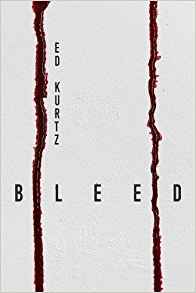 When Walt Blackmore moves into an old Gablefront house on the outskirts of a small town, things are really looking up for him—he has an adoring girlfriend, a new job, and an altogether bright future. But Walt's destiny is irreparably changed when a dark red spot appears on the ceiling in the hallway. Bit by bit the spot grows, first into a dripping blood stain and eventually into a grotesque, muttering creature. As the creature thrives, Walt finds himself more and more interested in fostering its well-being. At first he only feeds it stray animals, but this soon fails to satisfy the monster's ghastly needs. It is gradually becoming something more, and for that to happen it requires human blood and human flesh. And once Walt has crossed the line from curiosity to murder, there is no going back.  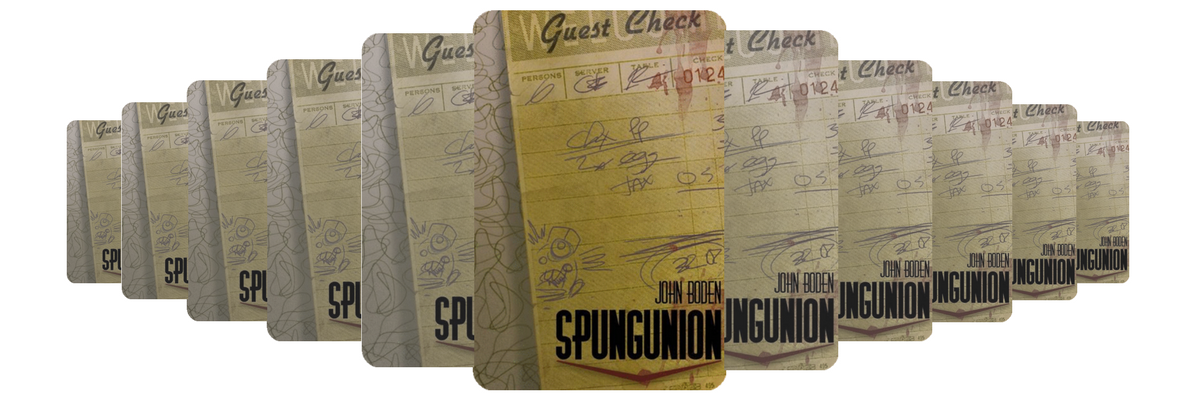 So, I consider myself very lucky to be able to call John Boden a friend. That said, my normal rules for a review apply - I only do this if I finish the book and want to write about it. I start more than I finish, and I finish more than I review. So by all means take a pinch of salt, to taste - but certainly no more than a pinch. Also, I beta read this novella. The review you are about to read is based not on that beta read, but on the uncorrected proof supplied by the publisher, which did contain some changes, and should be pretty close to the form that ends up in general circulation. Spungunion is a novella of depth, power, and dark poetry. Deke Larch, truck driver and protagonist, is a compelling character - broken with grief, yet still working, a portrait of a shattered man. The lonely trucker is a classic blue collar noir archetype, of course, but Boden imbues Deke with real humanity and character, not shying away from the broad strokes of the template, but within that using delicate touches to make him real, letting him breathe on the page. Boden manages to engage with many classic tropes without ever seeming remotely cliche, and Deke is a fine example of that. Similarly Deke’s world - the world of Spungunion - seems to exist in a liminal space between working class poverty and grime, and a grand southern gothic legend. Boden manages the tension between the two forms not by some balancing act of give and take, but rather by committing to both with full blooded intensity. The result is an intense experience, taking in grand themes of classic tragedy alongside earthy, desperate real-world struggle. The atmosphere of this novella is incredible, coiling around you like boa - and like that snake, once it has you in it’s grip, it starts to squeeze. Boden has an incredibly fluid prose style, a gift for language and metaphor that is poetic and profane all at once. The sparse dialogue rings with authenticity also, as do the people Deke meets on his quest. At it’s core, this is a quest - one of the oldest stories there is, the quest for knowledge - and Boden pays respect to that great storytelling tradition, without once compromising on his characters, or the wider setting. As a reader, I was swept along on Deke’s journey, feeling often like a ghostly passenger sat beside him as he powered through the night in his big rig. Powerfully evocative, casually mythic and pounding with urgency and desperation, Spunginion is a lucid, vivid fever dream of a journey with grief that takes us out of the blue and way into the black. It’s an incredible achievement, and, I think, a signifier of even greater things to come. KP 21/102017 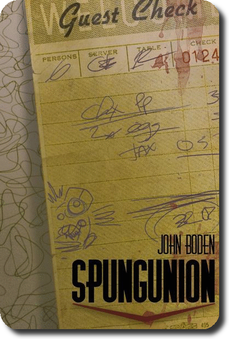 Spungunion: (pronounced: Spun-Gun-Yun) noun; 1.) a dish made from rotting road kill, usually a skunk or a opossum. The more fragrant or maggoty, the better. 2.) Something that's been on the road for a long and unfortunate time... This is the story of Deke Larch, a widowed trucker who has lost everything and is struggling to find his place in a world and the person who took it from him. That journey puts him in touch with strange characters and bizarre places. Deke had always felt like he operated on the fringe of society, but he really had no idea...his journey will teach him that monsters are interpretive and sometimes what we think we want is not what we seek at all. Spungunion is a story about grief and loss, about lonely roads and lost souls, about failure to let go and falling when you finally do. It's about livin' and dyin' and how sometimes the difference between is very slight. “This trucker’s tale of bloody revenge and harrowing self-illumination takes place in the deepest, strangest veins of the Twilight Zone’s midnight highways. Boden rolls his supernatural mystery down the blacktop surface of the road to Hell, and you’re gonna love the journey into the fire.” – Philip Fracassi, author of Behold the Void, Fragile Dreams and Altar.   THE MAGNETIC KID, JEDI SUMMERS AND SPUNGUNION: AN INTERVIEW WITH JOHN BODEN
|


Archives
May 2023
|

|

|


 RSS Feed