
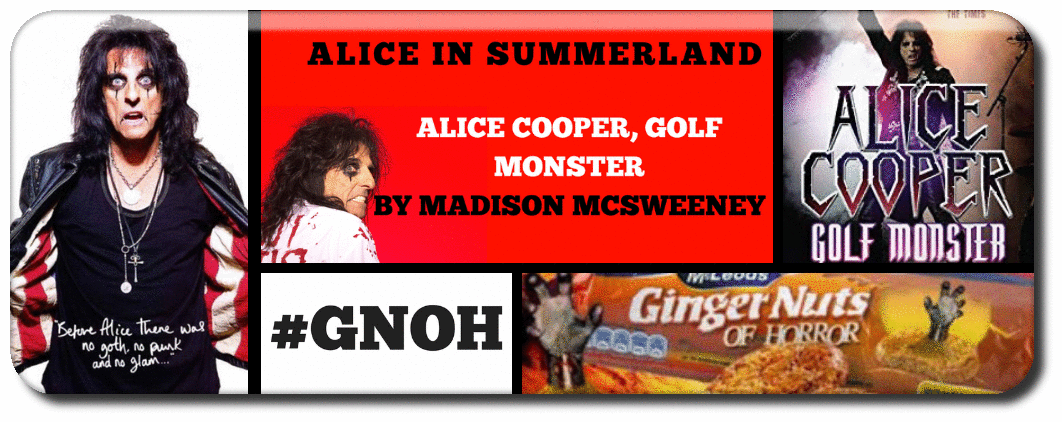
 Perhaps the most shocking thing about rock villain Alice Cooper’s 2007 autobiography is the title: Alice Cooper, Golf Monster. Yes, the pioneering shock rocker, who made a name for himself with gruesome onstage executions and macabre songs about serial killers, domestic abusers, and other sick things, is also an avid golfer – a hobby he credits with helping him kick his near-fatal dependence on alcohol. “If rock’n’roll made my life, then golf saved my life,” he writes in the book’s introduction. Accordingly, Golf Monster (co-written by Cooper – born Vincent Furnier – and music writers Keith and Kent Zimmerman) is peppered with Cooper’s reflections on the sport, as well as wild anecdotes from the weird world of rock and roll. In hindsight, Alice Cooper’s patented blend of edgy, tongue-in-cheek rock songs and shocking theatrics seems like the perfect formula for stardom. It may surprise some readers to learn that the original Alice Cooper Group began as a quintet of scrappy weirdos who were, in Cooper’s own words, “the band that everybody liked to walk out on, nothing more than a curiosity.” After migrating from Pheonix to Los Angeles, The Alice Cooper Group hob-knobbed with rock icons like The Doors and Pink Floyd while playing dismally-attended club gigs; their abrasive music and strange apparel caused the hippies to run for the hills. They were eventually signed by transgressive rock mastermind Frank Zappa, who was intrigued only because the group baffled even him. Their first album Pretties for You was a bizarre, nearly unlistenable affair; one song, Alice recalls, “was a minute and a half long with forty-two changes in it.” “Most of our early material didn’t make much sense to anybody, including ourselves,” he admits. The day before they were set to sign with Zappa, guitar legend Jimi Hendrix presented the group with a potential manager – a former probation officer with no music industry experience named Shep Gordon. As the story goes, Gordon had run into Hendrix, along with Janis Joplin and the Chambers Brothers, sitting around the pool at the hotel where Gordon was living; Hendrix asked the down-on-his-luck LA transplant if he was Jewish, and immediately suggested he manage “that kid from Pheonix” who was living in the Chambers’s basement. Unlike the predatory managers of so many other rock origin stories, Shep Gordon turned out to be instinctively shrewd and scrupulously honest. “To this day, Shep and I are still together, going on forty years, and we still don’t have a signed contract with each other. From the start, Shep was straight with me,” Cooper writes of his long-time manager, who has represented dozens of other celebrity clients since. An early Gordon achievement was securing the Alice Cooper Group a coveted spot between The Doors and John Lennon at the 1969 Toronto Rock ‘n’ Roll Revival Show – the site of an event that forever changed the band’s trajectory. By 1969, the Alice Cooper Group had experimented with some stage antics, but they weren’t yet the concert demons they would come to be. Midway through Alice Cooper’s set at the Revival, someone in the crowd threw a live chicken onto the stage. Alice, reasoning that “since chickens have wings, it could fly,” grabbed the flightless bird and threw it into the crowd, where it was promptly torn to pieces by the audience. (The book reveals that in was in fact Shep who was responsible for the chicken, a fact that had been unknown even to Alice himself. “Only now, as this book is being put together, he’s finally confessed,” Cooper reveals.) The Chicken Incident, writes Cooper, “was the beginning of national notoriety.” It also attracted the attention of Canadian producer Jack Richardson, who Gordon had been courting; despite being unimpressed with the group, Richardson decided to send his apprentice Bob Ezrin to work with them. Ezrin, a talented producer who would go on to work with KISS, Pink Floyd, and others, transformed the Alice Cooper Group from a bizarre novelty act to a genuine rock band with their own distinctive sound. “He came in (just like a great golf instructor) and, starting from the bottom to the top, he had us unlearn everything we knew and relearn it better,” raves Cooper. A series of classic albums, hit singles, and boundary-pushing gimmicks followed. At the same time as their clever song-writing was earning praise from Bob Dylan and John Lennon, the band was also pioneering a controversial stage show that was part rock concert, part macabre magic act; each set featured simulated murders and culminated in the frontman being hung or beheaded before a screaming crowd. Alice went solo in 1975 with his surreal concept album Welcome To My Nightmare, which was adapted into an elaborate stage show and a TV movie starring Vincent Price. Over the next four decades, Alice Cooper would release over a dozen albums, maintaining the character’s signature dark humour while dabbling in genres as diverse as heavy metal and new wave. Golf Monster is populated with quirky anecdotes about the countless celebrities and cult icons Cooper hung around with over the years, including performer Liza Minnelli, actress Raquel Welch (who Alice rejected for his future wife, dancer Sheryl Goddard), surrealist Salvador Dali, and comedian Groucho Marx, with whom Alice developed a very close friendship. His strangest anecdote involves a night out with flamboyant pianist Liberace, who Alice claims adopted a completely different personality as soon as the fans left the room. He also recounts a disturbing meeting with Elvis Presley, who, Alice realized, was almost completely cut off from the outside world. “How sad this man was,” Cooper reflects. “He was such a big star that he had no life.” Cooper also writes frankly about his life-threatening struggles with alcoholism. He was forced into a sanitarium after the end of his Nightmare tour and was sober for a few years before relapsing in the early 1980s. “I made four albums I hardly remember writing, recording, or touring on,” he admits. Faced with the potential dissolution of his marriage, Cooper re-entered rehab and gave up drinking permanently in 1983, after which he re-connected with his family and his faith. Some of the book’s most interesting chapters discuss Cooper’s relationship to Christianity. Cooper, who was raised in a deeply evangelical home, occasionally incorporated religious themes into his music; after returning to the church in the 1980s, he released the more explicitly Christian concept album The Last Temptation, a hard-rock morality play which he calls “one of the best records I’ve ever made.” “Ultimately, becoming a Christian became the most rebellious and risky thing I’ve ever done,” he writes, reflecting on the initially chilly reception he received when his religion became public knowledge. Cooper himself initially struggled to reconcile his shock rock alter ego with his Christian faith – however, a conversation with his pastor convinced him that one didn’t negate the other. “The idea that I’m playing society’s villain is not inconsistent with my spiritual views,” he asserts. “In fact, both Alice and I maintain that what the world needs now is a gigantic hypodermic shot of morality and common sense, and satirizing the villainy in the world just might help.” A preacher’s-kid-turned-shock-rock-villain who beat addiction; embraced religion; took up golf; and never stopped rocking, Alice Cooper has led an incredible, eclectic life. There was always more to Cooper than the murderous demon he plays convincingly onstage, and his book allows his humour, empathy, and moral convictions to shine through. Golf Monster is a briskly-paced repository of legendary stories, as well as reflections on addiction, religion, and Cooper’s musical philosophy. (And, of course, golf tips).
Comments are closed.
|


 RSS Feed

|

|