


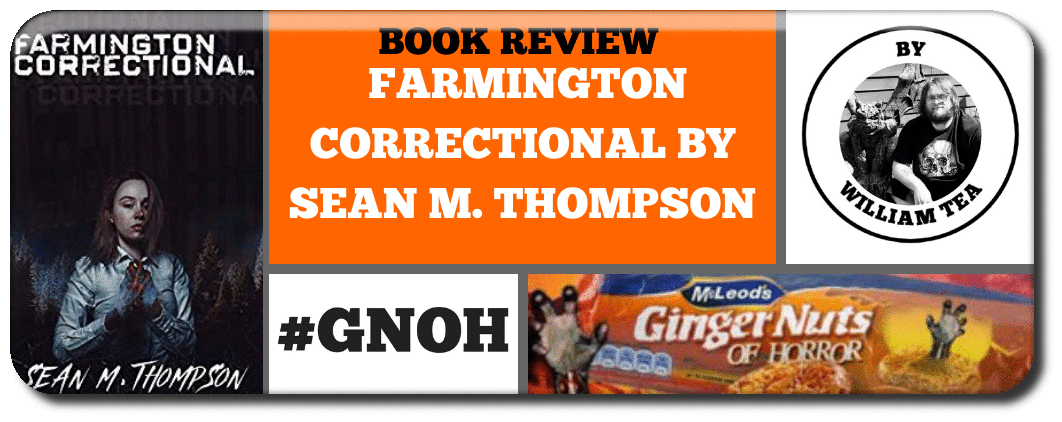
 It’s not uncommon for the incarcerated to find religion while behind bars. Isolation inspires deep reflection in some and, of course, being in an environment so predicated on ideals of sin and punishment naturally evokes fire and brimstone evangelism. Symbolically, prison is arguably the closest thing we have to the mainstream conception of hell, a place of forced penance for anyone who has been judged wicked in the eyes of those with the power to make such assessments. What must it be like to rediscover one’s faith, then, only to look around and realize one is alone among devils? Sean M. Thompson’s latest, Farmington Correctional, answers that question with a whisper of claustrophobic dread that quickly builds to a resounding howl of savage madness. The novella, out now from Planet X Publications, introduces us to Chuck McDougal, an inmate of the titular facility. Chuck is a hulk of a man who, despite his imposing stature, doesn’t seem like someone you’d expect to find in prison. He’s mellow and melancholic; even he doesn’t know what drove him to murder the man who tried to steal his car on that dark day that changed Chuck’s life forever. Has it always been inside him, such brutal wrath, buried beneath a lifetime of repression? Is this capacity for violence a curse weighing down an otherwise good man, or is it a gift to be put to service for some higher power? The only person besides Chuck who seems concerned with the answer to that question is Sarah, a social worker at the prison who is all too aware of her status as a young, attractive female separated from a couple hundred rapists, skinheads, and gang members by little more than a few metal doors and the watchful gaze of the guards. Underfunded and overcrowded, the whole place is a powder keg ready to blow. And it may have found just the spark it needs to ignite when Chuck begins hearing the voice of god in his dreams, a voice trying to prepare him for the occult conspiracy concealed behind Farmington Correctional’s altruistic mask. Thompson’s set-up is brilliant in its simplicity, and for much of its length, Farmington Correctional deftly treads the line between the supernatural and simple delusion in much the same manner as Bill Paxton’s 2001 cult film Frailty. What’s more, the author has a knack of noir-styled description which captures both his setting’s brutality and its banality. The titular prison verges on being a character itself, a gray, callous sentinel which dehumanizes its charges as much through casual indifference as through pitiless cruelty. By splitting the narrative between two perspectives, that of the inmate Chuck and the outsider Sarah, Thompson illuminates the danger Farmington Correctional poses to those on either side of its bars, in essence revealing them both to be prisoners in their own ways and, by story’s end, ultimately turning the dynamic between them on its head. An even better example of the setting-as-character concept, though, comes in the form of Whispering Pines, the forest which surrounds Farmington Correctional and which asserts an air of mystery and menace even while keeping far enough in the background so as to not overpower the book’s titular locale. Seeds planted throughout the narrative make it clear that Thompson has layers upon layers of mythology he’s not willing to pull back for us just yet. This tendency of Thompson’s to keep his cards close to chest makes Farmington Correctional a genuine page-turner, but it also weakens the book in a few areas. Being a slim, six-chapter novella means that while Farmington Correctional makes for an engaging, energetic reads, coiling taut rings of suspense into one lean, mean, rocket-powered machine, it also doesn’t give readers many chances to catch their breath. Thompson’s characters are interesting and multidimensional, but granting readers such limited access to their backstories and minimal insight into their lives outside the mechanics of the plot makes it difficult for one to fully grasp the weight of the events they’re going through. In particular, Chuck’s descent into messianic zealotry feels slightly rushed, to the point where one wonders if there were more scenes detailing the character’s gradual transformation from lost soul to angel of death that wound up on the proverbial cutting room floor. Likewise, the secrets the Whispering Pines forest holds hint at something bigger. That suggestiveness is enticing, but one can’t help wishing for just a few more solid answers (or at least hints that are a bit less vague). As it is, Farmington Correctional feels like just one part of a much larger story, one which whets the appetite for further courses, but when taken by itself may not be enough to satisfy a reader’s hunger. Individual mileage may vary. Still, as complaints go, a book which leaves readers wanting “more, more, more” is hardly an egregious one. As long as Thompson is willing to further cultivate the seeds he’s planted with Farmington Correctional, readers will likely be more than willing to get lost once again in the shadowy overgrowth of Whispering Pines. CLICK HERE TO READ OUR INTERVIEW WITH SEAN M. THOMPSON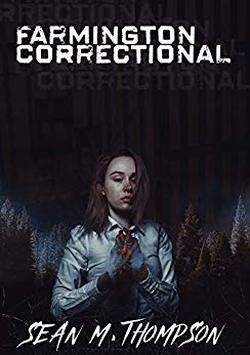 Chuck is new to Farmington Correctional, in for assaulting a man trying to steal his car. He talks with his social worker Sarah once a week, and he's started to get used to life inside. Except, he's starting to hear a voice in his head, and starting to see things. And he can't shake the sense that God wants him to kill. There's a reason the woods surrounding the prison are called Whispering Pines. Chuck, Sarah, and the rest of the prison are about to find out why.  
 Comments are closed.
|


Archives
May 2023
|

|

|


 RSS Feed