• HOME
  • CONTACT / FEATURE
  • FEATURES
  • FICTION REVIEWS
  • FILM REVIEWS
  • INTERVIEWS
  • YOUNG BLOOD
  • MY LIFE IN HORROR
  • FILM GUTTER
  • ARCHIVES
    • SPLASHES OF DARKNESS
    • THE MASTERS OF HORROR
    • THE DEVL'S MUSIC
    • HORROR BOOK REVIEWS
    • Challenge Kayleigh
    • ALICE IN SUMMERLAND
    • 13 FOR HALLOWEEN
    • FILMS THAT MATTER
    • BOOKS THAT MATTER
    • THE SCARLET GOSPELS
GINGER NUTS OF HORROR
  • HOME
  • CONTACT / FEATURE
  • FEATURES
  • FICTION REVIEWS
  • FILM REVIEWS
  • INTERVIEWS
  • YOUNG BLOOD
  • MY LIFE IN HORROR
  • FILM GUTTER
  • ARCHIVES
    • SPLASHES OF DARKNESS
    • THE MASTERS OF HORROR
    • THE DEVL'S MUSIC
    • HORROR BOOK REVIEWS
    • Challenge Kayleigh
    • ALICE IN SUMMERLAND
    • 13 FOR HALLOWEEN
    • FILMS THAT MATTER
    • BOOKS THAT MATTER
    • THE SCARLET GOSPELS
GINGER NUTS OF HORROR

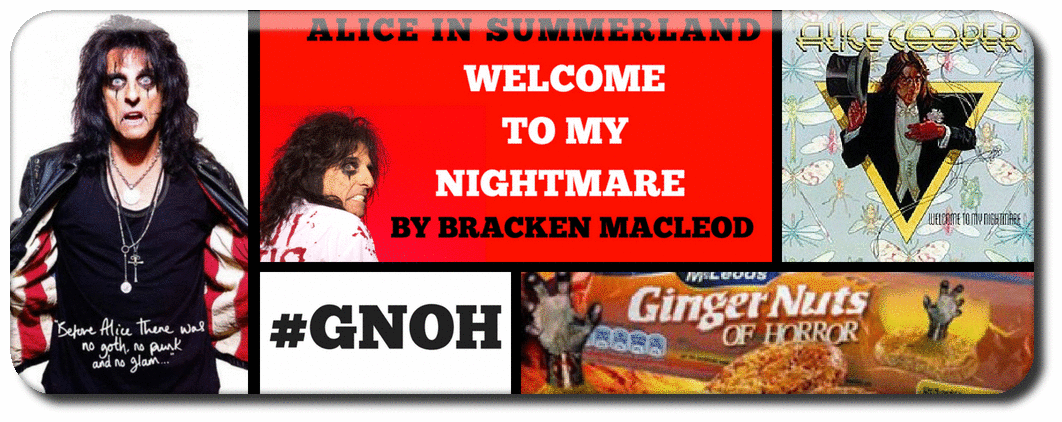
BRACKEN MACLEOD WELCOMES US TO ALICE COOPERS NIGHTMARE

27/7/2018

BY BRACKEN MACLEOD 

Picture

“I don’t like spiders, I don’t like witches, and I don’t like you!”
~Steven


1975’s Welcome to my Nightmare represents what I think of as Vincent Furnier’s full commitment to Alice Cooper as a theatrical act on his records as well as on stage. Of course, The Alice Cooper Band already had a fully realized stage show that incorporated many of the elements we tend to think of when we imagine Alice Cooper’s live act—guillotines, straightjackets, and impaled baby dolls (and was perhaps part of the reason for the band’s split)—but unlike albums like School’s Out or Love It to Death, which were wonderfully written and arranged, but still conventionally structured, Nightmare was deliberately written to play like the soundtrack to a big production. There’s more than a hint in the long instrumental breakdowns and segues between songs that tell the listener, “there’s something here you’re not seeing. Yet.” The same year the album was released, ABC aired a 90-minute television special, titled The Nightmare, showcasing every song on the album (plus “The Ballad of Dwight Fry”) and suggesting the kind of stage performance that would be delivered live (along with a couple of specially recorded alternate versions of certain tracks—more on that in a bit).
The album is thematically tied together, and while not as narratively tight a story as Pink Floyd’s The Wall, for instance, it’s undeniably a concept album. The story is simple: a boy (or perhaps a man regressed to childhood in his dreams) named Steven experiences a series of troubling nightmares culminating in a terrifying revelation upon waking. The title track is a prologue, introducing the listener to the concept. It’s catchy and clearly influenced by theater. The song as a whole straddles the kind of fusion of rock and Broadway showtune that Cooper already explored on “Gutter Cat v. The Jets.” It’s our opening fanfare to the show that follows.

Next up, though, “Devil’s Food” isn’t easy listening or all that danceable. But damn, if it doesn’t sell that this is an album of nightmares. A song about cannibalism, the lyrics communicate the anxious anticipation of Alice/Steven getting ready to cook and eat a human being. It’s aggressive and bleak. Contrasted with what precedes it, there’s not much camp here. It’s all creep. There is an alternate version of this song which appears in The Nightmare special and as a bonus track on the 2002 reissue of the album. Lyrically, it reverses the roles of eater and eaten, positioning instead of a nameless woman in Alice’s pot, him dangling above a witch’s cauldron. One imagines this change was made to satisfy network censors who couldn’t justify an unambiguous song about eating a dead woman, but could handle the fairy tale logic of witches about to cook a living boy. While the alternate lyrics and performance have a more desperate feeling, due to the lyrical content and the different (almost live) production, the original is a more effective and sinister piece overall.

The album version of “Devil’s Food” segues without a break into “The Black Widow” with a piercing scream and then a haunting monologue by horror legend, Vincent Price (that predates his appearance on Michael Jackson’s Thriller by almost a decade). Price, playing a museum curator (reimagined in the TV special as “the Spirit of the Nightmare”) lovingly describes the neurotoxic effects of black widow venom before the song launches into a raunchy stomp where Alice sings, as the titular spider, “Love me!” and is answered by a chorus of child-like voices, “Yes, we love him!” It’s grotesque and exciting and practically dripping with threat. By the third song on the album, it’s becoming a nightmare all right. “The Black Widow’descends again into a grandiose calliope melody that suggests a circus procession as much as a rock concert. Which expertly sets up the next song.
“Some Folks” is unabashedly a showtune. With blaring horns, snapping fingers, and a jaunty blues rhythm, the song begs for a choreographed dance routine. Right up until the mid-point where it takes on the signature Alice Cooper sound and a guitar screeches into a frantic section where Alice declares that he “just can’t live without it.” As a love song to addiction, it’s frenetic, celebratory, and desperately manic.

It’s the next song that stands out as an obvious hit that can exist outside of the theme of the album, but also as a foreshadowing of the second half of the record. “Only Women Bleed,” is a tender ballad about domestic violence sung from the point of view of the female partner in an emotionally and physically violent relationship. It seems like a divergent point in the concept of the album, but as the nightmare of violence plays out while the record continues, this perspective can withstand a reading also as Steven’s confession relating to his own relationship to women. Her perspective, his deeds, and his nightmare of being forced to view himself through the lens of her love. Prepare yourself. The dysfunctionality and danger of that relationship is about to play out, dear listener.

I suppose that I’d be remiss in failing to mention that facile audiences mistook the song as being about menstruation when it first came out owing to a surface-level interpretation of the title, Only Women Bleed. It’s a cultural Freudian slip inasmuch as people who thought the song was about a woman’s period are ignoring the lyrics in exactly the same way the lyrics portray the loneliness of a woman who, as Alice puts it, is on her knees begging someone, anyone, to witness her pain.

“Department of Youth” picks up next, and again it feels like a divergence from the central theme, but in the context of the songs from Side A, it stands as a brief respite from the darkness preceding it. In my mind, it also sets up Steven’s central nightmare to unfold in the last act of the album. It’s a triumphalist anthem to youthful disaffection with the world and its troubles. The song depicts a point of view that embraces naïve vitality and is content with willful ignorance of the difficulties of adulthood. My favorite part of the song comes at the very end. A children’s chorus backing Alice declares “We got the power.” Alice calls out, “And who gave it to you?” And their enthusiastic reply is, “Donny Osmond!” Though this plays on the album during the fade, and is easily missed unless you’ve really got the volume cranked, on the television special, it is played for laughs at full volume. The children declare their allegiance to Donny Osmond, and Alice, shocked and petulant, throws down his cane and storms off the set.

Following that, is the crowd favorite, “Cold Ethyl.” Another high energy song, this one is not as innocent as “Department of Youth,” depicting gleeful necrophilia that stands in contrast to the dire sounding “I Love the Dead” of Billion Dollar Babies. The song is another energetic anthem with Alice declaring his lover “refrigerator heaven,” and shivering “Oooh, sooo cold!” with tongue jammed fully into cheek. Years later, syndicated advice columnist, Ann Landers would discover the song and decry its unsuitability for children. Alice responded, and she published his letter, which reads, in part:
"Actually, 'Cold Ethyl' is just a harmless number about necrophilia. The point I want to make is that the kids are not bothered by this — their parents are. The kids see the song and gruesome antics, like with the guillotine, for exactly what it is — satire, done with a sense of humor to a rock 'n' roll beat. Kids know I am harmless. It's their parents that make me out to be some kind of a monster." SOURCE: https://goo.gl/ZTa8SP

Alice’s defense is what one would expect from him, but the allegation made by Landers and defended by Cooper is a valid subject for debate. This album came out when I was five years old. My mother played it and I loved it in every way, from carnival stomp to elegiac dirge. By the time I was slightly older, Alice had become a semi-regular guest on children’s television, appearing, as I mention in my previous article about Pretties for You, on both the Soupy Sales Show on Saturday morning and the Muppet Show (more on his other television appearances in later articles—stay tuned!). By that time his persona, to me at least, was essentially dark but harmless. No one could deny that his “gruesome antics” were aimed at kids to no small degree. But times were different, I suppose. We all thought it was just antics and fun, and by the time we were old enough to know what in the hell “Cold Ethyl’ was actually about, it was too silly to be taken seriously. It was a vaudeville act. Like much of his stage show, a magic trick where something looked dangerous, but then the assistant stepped out of the box in one piece and everyone cheered because while the horror was ersatz, the joy of having been harmlessly shocked was real.

After “Cold Ethyl”, Side B takes a dark turn with a triptych of songs: “Years Ago,” “Steven,” and “The Awakening.” These are the most traditionally conceptual songs on this concept album, following the character, Steven, though the last throes of his nightmare. Cooper sings “Years Ago” in a childlike falsetto describing how all the joyful things of his youth are gone. Musically, it’s melancholy, with an uneasy organ grinder feel, as if one might be hearing it at the same carnival Steven sings has closed years ago. Maybe only as an echo after it has closed. After adult Steven begins having a dialogue with his regressed self, and his mother begins calling in the background for him to come home, the song transitions to a piano trill deliberately reminiscent of Mike Oldfield’s haunting theme to The Exorcist. Steven’s voice has become younger and more timorous and lyrically there is a heavy implication someone is dead. He fights with himself, trying to banish what’s haunting him, and a chorus blasts in, screaming his name and increasing the tension in the piece. Broadway Alice is on full display here, using musical leitmotif and rising crescendo to amplify Steven’s anxiety. Finally, Steven has a spoken word monologue before a musical swell that communicates his desperation perfectly. “The Awakening” finishes out the triptych with a musical cue that feels right out of a horror movie. Jarring discordant notes punctuate Steven following a trail of blood out of his basement, and finding that it’s his hands that are covered in blood, and awakening to the reality that he is not the child he thought he was, and that he is a killer. His final nightmare has no resolution, as the music fades out.

Notably, in the TV special, The Nightmare, Alice shoehorns “The Ballad of Dwight Fry” into the act here, which provides part of the missing resolution left out at the end of the triptych of songs preceding it, but narratively undermines the full weight of Steven’s discovery. “Fry” is musically consistent, but lyrically off. I doubt it mattered much to audiences in the ‘70s, though. It still plays like a peek into that stage show you the album was written to be that can’t come to town soon enough. And damn, if it isn’t cool because of that.

Finally, Alice closes out the album with another rouser titled “Escape.” While the music is uplifting and high energy, the lyrics suggest that the daily persona he (he being Alice at this point, and not Steven) puts on is an escape from past trauma and present pain. It’s not a literal escape from the nightmare he’s been performing, but an anthem to coping mechanisms and denial. It’s his final sleight of hand trick to show us dysfunction dressed as success and that Steven/Alice hasn’t actually escaped anything. The nightmare continues.

Again, here The Nightmare diverges from its source material here, and after “Escape” there’s a reprise of “The Awakening” with a slightly different final verse that unequivocally puts to rest any ambiguity about whether or not anything sung about or seen was a dream or reality. It’s all a dream of Steven’s. Though—as he’s done throughout the entire special—Vincent Price reappears as the Spirit of the Nightmare to tell us that “bedrooms are only temporary sanctuaries from nightmares.” It’s his presence in the special, adding commentary throughout that makes The Nightmare rewatchable.

This is, without a doubt, my favorite Alice Cooper record. Though I enjoy much of what follows and almost all of what preceded it, this is the album that I always think of first and most fondly whenever I hear the name, Alice Cooper.
Picture
 Bracken MacLeod has survived car crashes, a near drowning, being shot at, a parachute malfunction, and the bar exam. So far, the only incident that has resulted in persistent nightmares is the bar exam. He is the author of the novels Mountain Home, Come to Dust, and Stranded, which was a finalist for the Bram Stoker Award, and a collection of short fiction, 13 Views of the Suicide Woods. He lives outside of Boston with his wife and son, where he is at work on his next novel.

CLICK HERE TO CHECK OUT BRACKEN'S BOOK ON AMAZON 


Check out the other articles from this series 

COMING SOON GINGER NUTS OF HORROR PRESENTS ALICE IN SUMMERLAND
​

 ​EASY ACTION BY WILLIAM TEA  

LOVE IT TO DEATH BY JOHN BODEN
​
SCHOOL’S OUT FOREVER BY MATTHEW WEBER

PRETTIES FOR YOU BY BRACKEN MACLEOD

LOVE IT TO DEATH BY JOHN BODEN

​
​HANGIN' WITH MR. COOPER BY CHAD LUTZKE

ALICE IN SUMERLAND: BILLION DOLLAR BABIES
​
​MUSCLE OF LOVE BY DUANE PESICE


the best horror book review website in the uk ginger nuts  Picture

BOOK REVIEW:  THROUGH THE EYES OF DOUGLAS  BY DARREN J GUEST
DARREN J GUEST IS LOOKING AT US THROUGH THE EYES OF DOUGLAS


Comments are closed.
    Picture

    Archives

    January 2019
    December 2018
    November 2018
    October 2018
    September 2018
    August 2018
    July 2018
    June 2018
    November 2017
    October 2017
    September 2017
    August 2017
    July 2017
    October 2016
    September 2016
    August 2016
    July 2016
    June 2016

    RSS Feed

    RSS Feed

https://l.facebook.com/l.php?u=https%3A%2F%2Fmybook.to%2Fdarkandlonelywater%3Ffbclid%3DIwAR1f9y1sr9kcIJyMhYqcFxqB6Cli4rZgfK51zja2Jaj6t62LFlKq-KzWKM8&h=AT0xU_MRoj0eOPAHuX5qasqYqb7vOj4TCfqarfJ7LCaFMS2AhU5E4FVfbtBAIg_dd5L96daFa00eim8KbVHfZe9KXoh-Y7wUeoWNYAEyzzSQ7gY32KxxcOkQdfU2xtPirmNbE33ocPAvPSJJcKcTrQ7j-hg
Picture