


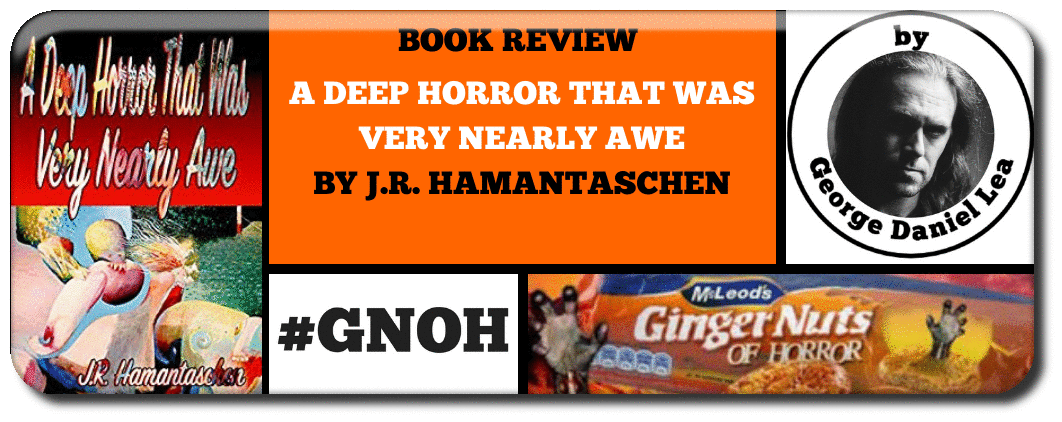
 As with J.R. Hamantaschen's previous collection, You Shall Never Know Security, the title of this collection serves as a profound promise, almost a threat, to the reader, pre-empting their reaction in a manner that begs to be fulfilled. It's a bold move on the author's part, as any reader will come to the work as a challenge, girding their loins and annealing their souls against its content, daring the work to make good on its oaths. Before we delve into whether the collection is the equal of its promise or not, one thing that immediately strikes is how removed the collection is aesthetically from its predecessor: whereas You Shall Never Know Security is a threatening and ominous work from the cover onwards, its palette consisting of grim greys, tempestuous blues and varying shadow shades, A Deep Horror That Was Very Nearly Awe is a kaleidoscopic explosion of colour, a riot of far more surreal and overtly distressing imagery that serves to shunt the reader into a particularly unsettled frame of mind. Here, rather than the deep sense of foreboding that its predecessor inspired, the reader is blasted into a far more fractious state of discomfort, the cover so kaleidoscopic, it leaves us with an abiding sense of mystery as to what the stories can possibly contain or consist of. In conspiracy with the immediately intriguing, pre-emptive title, the cover artwork provides a degree of frisson, of scintillation for the reader, that the stories within must fulfil in order to avoid disappointing. From the first instance, it's very clear that this collection is several shades removed from You Shall Never Know Security. Tonally, the stories are far more diverse and eclectic, which works entirely in the collection's favour: each piece is its own, self-contained work, so removed from its siblings as to continually refresh the palate rather than jarring or contrasting too strongly. There's an experimental quality to both the concepts and style of writing here that has to be applauded, even if the collection does, at times, perhaps stray a little too far into abstraction and doesn't quite take the time and space to flesh out its ideas (one or two of the stories end in a truncated manner, feeling as though there might have been more made of their always intriguing ideas and subjects, their often lurid and seductively wrought imagery). Here, Hamantaschen provides commentary on any number of prevalent, post-modern subjects, ranging from tribal work place dynamics (No One Cares But I Tried) to sexual politics and identity (Bleecker and Bleaker; Or, Gay For Muesli), each of the stories a witty and wry take on familiar situations or confusions, shot through with veins of often surreal, outre horror, much of which is almost incidental to the more banal, waking life dreads and terrors that occur around it. In this, Hamantaschen provides a fairly bleak, almost nihilistic contrast between the worlds of our nightmares and the drear, grey delirium of waking life: the horrors here are often pre-existing, all too familiar, born of disappointment and disease and betrayal, of politics and cruel and inhumane systems. Whereas those which are more abstract or fantastical often occur incidentally or in such a manner as to throw harsh and unflattering lights on the lives they haunt or infest. Very often, the latter are drawn with such lurid intrigue, such variously-coloured bravura, they are far more attractive and seductive than the grey worlds of plasic, dust and broken dreams the protagonists invariably inhabit. It's as though Hamantaschen is proclaiming: “Yeah, there are nightmares out there. And guess what? Nightmares are better than what we've built, better than what tradition proscribes, better than what we've come to assume and believe.” In this, the collection has a far more activist tone than You Shell Never Know Security, which generally took a recessed perspective on the events it narrated. Here, Hamantaschen often adopts an involved style and perspective, many of the stories told in the first person, as stream-of-consciousness confessionals rather than journals, which lends them an emotional immediacy and degree of grit that they might otherwise lack. The fact that the reader is often forced into the perspectives of characters that are far from likeable (Bleecker and Bleaker's Ken springs immediately to mind, as does Upon a Path Suddenly Irradiated at Some Halfway Point by Daybeams as Rich as Hers's Barbara Cromwell, who isn't profoundly antagonistic or dislikeable, but boasts a weary, defeated desperation, a myopia born of age and divorce and perpetual disappointment, in which she has come to belief that everything that occurs in her life is the result of some negative agency, as opposed to her own qualities and character) serves to intrigue rather than alienate, for the most part: it's so, so easy for stories that involve immoral, stupid, unthinking or emotionally desolate characters to become too simplistically moral or didactic. This does not occur within the pages of A Deep Horror That Was Very Nearly Awe. Instead, the writer explores who these characters are and why within the contexts of the worlds that birthed them: even some of the most grotesque and repellant garner some sympathy -or at least complexity- by story's end, and whatever reprisals they suffer are not fairy tale or finger wagging, but naturalistic. By the same token, there are often entirely innocent or incidental characters that often meet with terrible ends simply by blind chance or idiot luck, from concerned and empathetic young boys getting eviscerated by other-worldly monstrosities in a gas-station public toilet to women who happen to be too young and pretty having their minds warped and lives destroyed by a jealous but powerfully psychic workplace rival. The particular strain of amorality that runs through the work -and I cite that as a powerful, powerful positive- is attractive and intriguing in itself: no one feels particularly safe here, especially given Hamantaschen's penchant for throwing in surreal twists that often change the tone and timbre of entire stories. As the writer previously promised: we SHALL never know security, especially when reading one of his books: don't expect to come to this work and find the usual tropes and templates, because they simply don't exist: there are no “zombie stories” here, no “vampire stories,” no “haunted house” stories: this collection throws out the familiar and instead opts for a scope that wouldn't be out of place in a Dario Argento or David Lynch script: absurdity, strangeness and off-the-wall metaphysics are often the orders of the day, laced with a degree of sardonic wit that is simultaneously humorous and despairing. As commentaries on human experience, society and history, these stories are like the jokes of some bleakly amused immortal, which the reader is forced into the position of: for all of the horror, grotesquery and disturbia they contain, there's always a simmering undercurrent of wit and wry amusement, a “laughing-at-the-mushroom-cloud” quality that is sincerely redolent of our present-day political discourses and cultural conditions. What Hamantaschen has created here is not a love letter to some horror tradition, a paeon to enshrined tropes and subjects and templates, but a more ragged-edged, saw-toothed and sadistically surgical work that is intended to rip open the reader and spew its hallucinogenic venom directly into their naked and infested minds. In that, it is generally successful: the stories are often stylistically deviant, such that some of them even deliberately shift gears and status part way through, breaking the fourth wall to inform the reader that this is no way to proceed. The general success of this -often flippant- approach to storytelling depends on the proclivities of the reader: those that favour something more traditional in their media are likely to find it jarring or even frustrating. For my part, I enjoyed the disruption and change in tone the technique often signifies, the variety and sense of conspiracy that it creates with the reader: Far from treating the reader as a passive subject, Hamantaschen's work actively involves them, treating them as agents that are conspiring with him -or his characters- to create the stories or realise them in the reader's own imagination. That interactivity necessarily requires a degree of engagement that more traditional tales do not, acknowledging the reader as a thinking, conscious entity that reacts in real time, rather than something to be coaxed or coerced into feeling and thinking as the writer demands. The sheer variety of invention on display means that there will necessarily be moments where the stories aren't quite as successful as their enthusiasm or bravura titles suggest, but that is more than overriden by the flights of genuine, demented genius the collection ascends to. A work that may require approaching with consideration, given its experimental nature, its flirtation with or outright flouting of tradition and assumption, but one more than worthy of its reader's time, and that, in a sadly rare display of respect, treats them as entities capable of engaging with its ambiguities and absurdities without feeling the need to over-explain or justify them. Lastly, there are the titles. Good, sweet Baphomet, Hamntaschen has a way with titles that is enviable: they scan like lyrics from some arthouse piece of underground music, like extracts from impromptu poetry readings. Many of them, like the title of the wider collection, even presume to predict or pre-empt the reader's emotional reaction to their content: a pleasantly deviant trick that works entirely to the collection's advantage. If nothing else, if you take no other pleasure from this, then scanning the contents page should provide a sincere jolt of linguistic joy. A more than worthy successor to its predecessor, and one that demonstrates a writer growing in confidence and capability. For my part, I'm more than intrigued as to what J.R. Hamantaschen will drag screaming into reality next.  
Comments are closed.
|


Archives
May 2023
|

|

|
 RSS Feed