


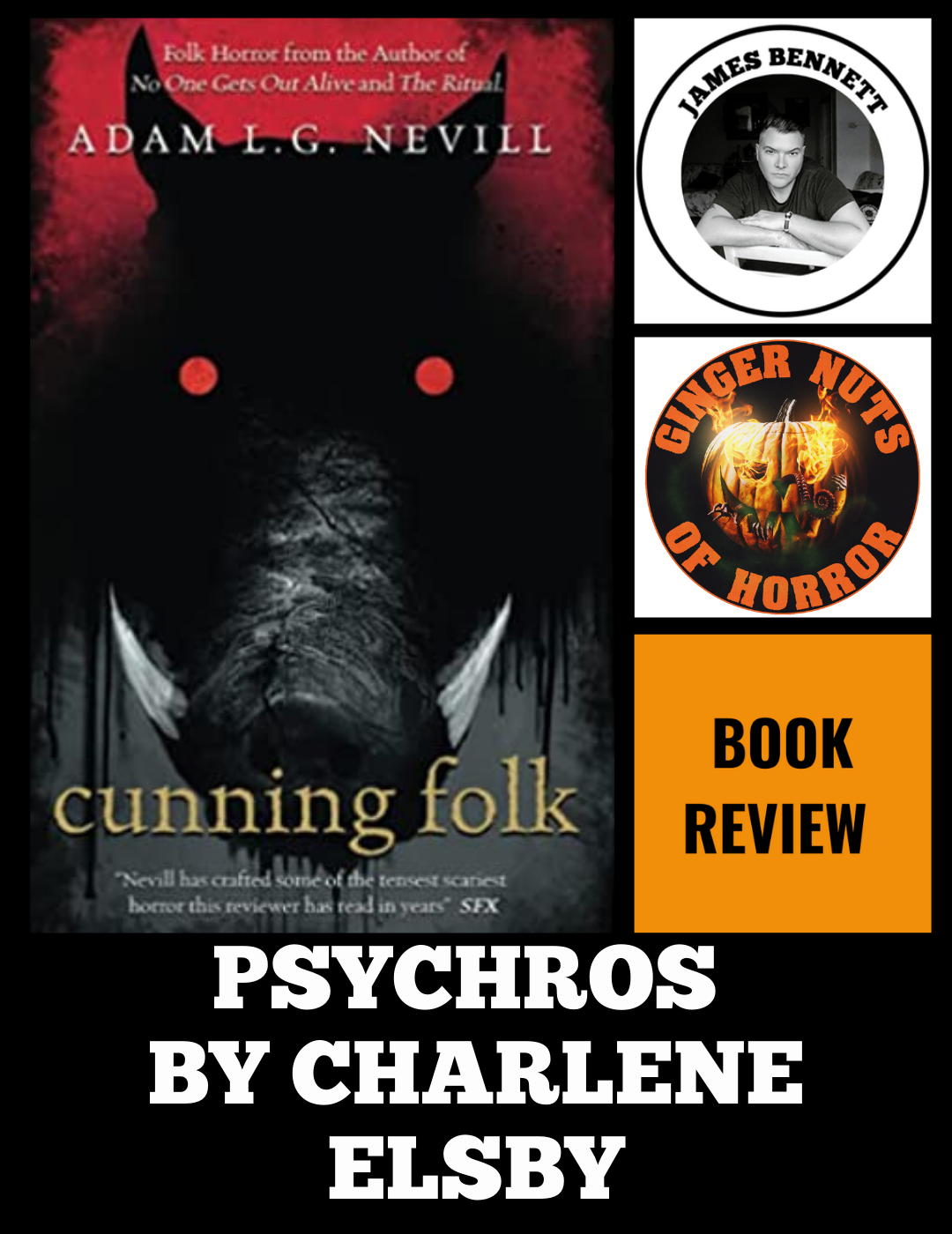
Cunning Folk: A Folk Horror Thriller by Adam Nevill Publisher : Ritual Limited (13 Sept. 2021) Language : English Paperback : 336 pages ISBN-10 : 183837891X ISBN-13 : 978-1838378912 A book review from James Bennett British Horror maven Adam Nevill (The Ritual, No One Gets Out Alive) returns to the fray with Cunning Folk, a novel that quickly shows the author has lost none of his bite. When Tom and his wife Fiona move to a rural location, they’re dreaming of a golden childhood for their small daughter, Gracey. Far from the city, with a fresh start ahead of them, the couple know they have their work cut out for them in the dilapidated house on the edge of the woods. On the one hand, it’s a potential money pit. On the other, it’s a place with a recent grisly past. With the countryside all around them and summer in the air, what could possibly go wrong? Try the neighbours. When Tom encounters the elderly couple living next door, Mr and Mrs Moot, he might be forgiven for believing it a disappointing, yet typical confrontation in a new location. Mean-spirited and unbearably condescending, the Moots’ unwelcoming attitude soon gives way to unwanted hedge cutting, slammed doors in faces and missing pets. Who are the strange visitors who pay homage next door? What lurks in the decrepit caravan parked across Tom’s drive? It’s in this petty dispute that Nevill reveals a keen eye for the small nature of some of the residents of his home country, and the first half of the book reads like a delicious and engrossing episode of Neighbours From Hell. It’s hard not to share a guilty smile at the worsening turn of events. Peppered with enough subtle weirdness to let the reader know that this is far from some mediocre backwater drama, Cunning Folk jolts as much as it sends shivers up the spine, ratcheting up the tension with exquisite aplomb. Soon enough, a vengeful Tom and his family are plunged into a nightmare of horrific proportions, with occult paraphernalia found in the garden, strange transformations seen in the woods and an ancient mound surrounded by stones emanating an ancient and malefic force… When Tom turns to local ‘wizard’ Blackwood for assistance to break the curse settling over his new home, all hell breaks loose. As the pages fly by, Cunning Folk scales to nothing less than a grand slam of modern folk horror. Sharply written, gripping and as black as sin, Adam Nevill delivers another standout novel in a career studded with them. Cunning Folk is a dark feast, serving up a sumptuous appetiser of rural conflict, a main course of escalating dread, and a toothsome dessert of shattering destruction and loss. It’s that loss, and its grim potential, that adds a moving and spine-tingling cherry on the top. Highly recommended. Cunning Folk: A Folk Horror Thriller by Adam Nevill  A compelling folk horror story of deadly rivalry and the oldest magic from the four times winner of The August Derleth Award for Best Horror Novel. No home is heaven with hell next door. Money's tight and their new home is a fixer-upper. Deep in rural South West England, with an ancient wood at the foot of the garden, Tom and his family are miles from anywhere and anyone familiar. His wife, Fiona, was never convinced that buying the money-pit at auction was a good idea. Not least because the previous owner committed suicide. Though no one can explain why. Within days of crossing the threshold, when hostilities break out with the elderly couple next door, Tom's dreams of future contentment are threatened by an escalating tit-for-tat campaign of petty damage and disruption. Increasingly isolated and tormented, Tom risks losing his home, everyone dear to him and his mind. Because, surely, only the mad would suspect that the oddballs across the hedgerow command unearthly powers. A malicious magic even older than the eerie wood and the strange barrow therein. A hallowed realm from where, he suspects, his neighbours draw a hideous power. “Nevill has crafted some of the tensest scariest horror this reviewer has read in years” SFX “Adam Nevill excels at making nightmares real” The Guardian Or purchase a copy direct from Adam Nevill by clicking here JAMES BENNETT  James Bennett is a British writer raised in Sussex and South Africa. His travels have furnished him with an abiding love of different cultures, history and mythology. His short fiction has appeared internationally and his debut novel CHASING EMBERS was shortlisted for Best Newcomer at the British Fantasy Awards 2017. TODAY ON THE GINGER NUTS OF HORROR WEBSITE HELLRAISER [13 FOR HALLOWEEN] THE HEART AND SOUL OF HORROR FICTION REVIEWSWHISPER BY CHANG YU-KO [BOOK REVIEW]
6/12/2021
Chang Yu-Ko – Whisper (2018, translated by Roddy Flagg 2021) Publisher : Honford Star (15 Oct. 2021) Language : English Paperback : 296 pages ISBN-10 : 1916277160 ISBN-13 : 978-1916277168 A book review by Jonathan Thornton “The legend of the moxina, an evil spirit which hid in the forest, was said to have developed from those stories about the Saluso. Might the creatures in those legends be a reflection of the guilt and hatred people carry with them?” Whisper is the first novel by Taiwanese writer Chang Yu-Ko to be translated into English. It is a powerful and disturbing horror novel, one that takes in Taiwanese and Japanese folklore to speak to the legacy of the Japanese wartime occupation of Taiwan and the social divides that currently shape Taiwanese culture. Intensely paced, Whisper expertly balances its cast of realistic and frequently unlikable yet compelling characters and creeping horror that rises to disturbing and visceral crescendos. The end result is a horror thriller that disturbs on both a visceral and psychological level. Once again Honford Star are to be praised for bringing this book into the English language, replete with striking cover design by Jaehoon Choi. Taipei taxi driver Wu Shih-sheng’s life is a mess. Once an electronics store manager with a happy family, he now spends his time driving round the city, wasting his money on cigarettes, booze and gambling, avoiding his estranged wife Kuo Hsiang-ying and wondering what happened to their daughter. Shi-sheng and Hsiang-ying’s grim existence is interrupted by the horrific when Hsiang-ying is lured into a nightmare vision by a mysterious voice. Shi-sheng soon learns that his wife and his life are both in danger from a malevolent spirit, and unless he can destroy the spirit’s shrine on Mount Jade both of them will be killed. Meanwhile concerned social worker Jui-yi investigates the circumstances behind Hsiang-ying’s haunting, convinced it must have a link to the legends of the moxina which she learned about whilst researching the indigenous tribes of southern Taiwan. And Hsiang-ying’s sister Kuo Chen-shan finds her perfect family life with her husband falling apart around her as she becomes taken over by a malevolent presence. It’s up to Shi-sheng and Jui-yi to solve the mystery before Shi-sheng, Hsiang-ying and Chen-shan’s time runs out. Chang expertly combines folklore and the horrific with a vividly realised modern Taiwan and well-rounded characters. All of the novel’s main characters, with the exception of Jui-yi, are incredibly damaged. Shih-sheng is arrogant and entitled and, being unable to accept the blame for how badly his life has turned out, viciously lashes out at those around him, especially his wife. Hsiang-ying is stuck in a co-dependent relationship with her abusive husband, and her sister Chen-shan is snobbish and condescending, only realising too late she has put all her self-worth into the image of being a housewife. These are deeply dysfunctional people whose lives are on the verge of collapse anyway, and the addition of the supernatural into the equation causes each of them to breakdown in various destructive ways. These sharply observed and deeply flawed characters ground Whisper in people’s lived reality, and much of the horror comes from their flaws leading them to make increasingly poor decisions. Whisper portrays a Taiwan still suffering from the scars of the Japanese occupation, and the malevolent spirit, a creature of Taiwanese mythology driven to feed on the Taiwanese people by the actions of a careless Japanese daughter of a wealthy family, perfectly symbolises how the occupation has left fault lines in modern Taiwanese society. Chang Yu-Ko explores the social climate created by Japanese colonialism, the erasure and displacement of indigenous peoples, and the inherited imbalances of social and monetary power that still exist to this day. As such, Whisper provides an excellent example of how horror can effectively explore these hidden traumas that shape societies and mould the contours of people’s lives. Chang Yu-Ko does not shirk on the scares. From horrific insectile monsters to deeply unpleasant demon-summoning, Whisper reaches uncomfortable pitches of all-out terror. These intense, hallucinogenic sequences are all the more striking for taking place within the context of the novel’s realistically described setting, from the scuzziest parts of the city of Taipei to the austere beauty of the Taiwanese countryside. A striking aspect of the novel’s construction is that, in keeping with all of its characters’ inability to communicate with each other, the reader is frequently the only person who receives all of the information. Chang increases the sense of dread by providing the reader with more information than the characters, sending them off into increasingly fraught situations missing key pieces of information. By the end, the survivors will never fully understand the full course of events that they have suffered through, but the reader gets the closure of understanding how the main plot threads link together. Intelligently constructed and full of effective scares, Whisper is an excellent example of Taiwanese horror. Chang has created an exciting and frightening read with real depth. Enthusiastic readers of horror in translation will hope that Honford Star provide us with more from Chang Yu-Ko and from Taiwanese horror writers in general. whisper |
 | With a subtle colour palette, the artist that is Simon Bestwick paints a nicely-rounded cross-section of society and frames it in terror. Through the greys of the smoke, through the filth and the ash raining down upon the city, we see red cars, red eyes, steel toecaps glowing cherry red in the heat, all making for a cloying, suitably uncomfortable effect. |




May 2023
April 2023
March 2023
February 2023
January 2023
December 2022
November 2022
October 2022
September 2022
August 2022
July 2022
June 2022
May 2022
April 2022
March 2022
February 2022
January 2022
December 2021
November 2021
October 2021
September 2021
August 2021
July 2021
June 2021
May 2021
April 2021
March 2021
February 2021
January 2021
December 2020
November 2020
October 2020
September 2020
August 2020
July 2020
June 2020
May 2020
April 2020
March 2020
February 2020
January 2020
December 2019
November 2019
October 2019
September 2019
August 2019
July 2019
June 2019
May 2019
April 2019
March 2019
February 2019
January 2019
December 2018
November 2018
October 2018
September 2018
August 2018
July 2018
June 2018
May 2018
April 2018
March 2018
February 2018
January 2018
December 2017
November 2017
October 2017
September 2017
August 2017
July 2017
June 2017
May 2017
April 2017
March 2017
February 2017
January 2017
December 2016
November 2016
October 2016
September 2016
August 2016
July 2016
June 2016
May 2016
April 2016
March 2016
February 2016
January 2016
December 2015
November 2015
October 2015
September 2015
August 2015
July 2015
June 2015
May 2015
April 2015
March 2015
February 2015
January 2015
December 2014
November 2014
October 2014
September 2014
August 2014
July 2014
June 2014
May 2014
April 2014
March 2014
February 2014
January 2014
December 2013
November 2013
October 2013
September 2013
August 2013
July 2013
June 2013
May 2013
April 2013
March 2013
February 2013
December 2012

|

|


 RSS Feed