


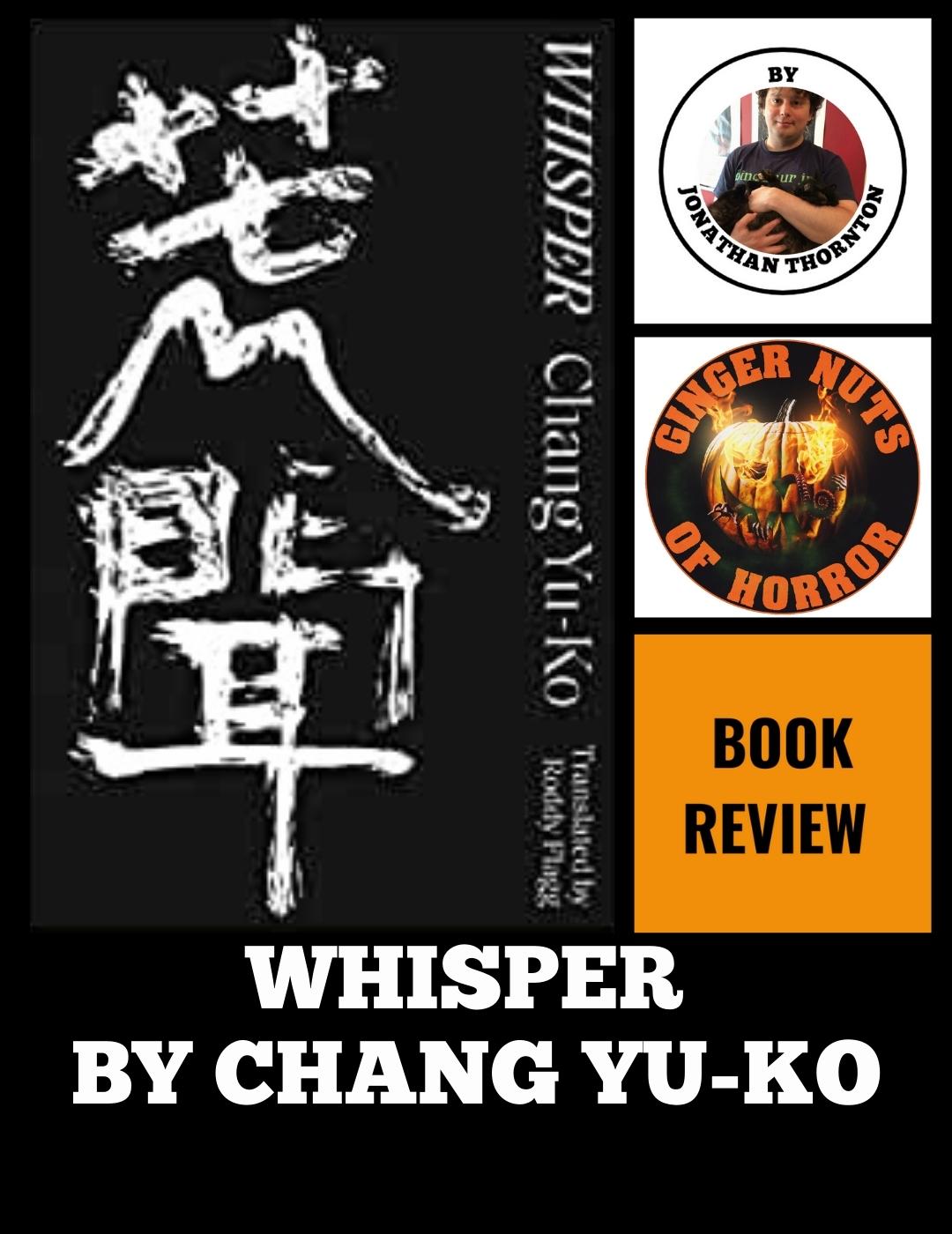
WHISPER BY CHANG YU-KO [BOOK REVIEW]
6/12/2021
Chang Yu-Ko – Whisper (2018, translated by Roddy Flagg 2021) Publisher : Honford Star (15 Oct. 2021) Language : English Paperback : 296 pages ISBN-10 : 1916277160 ISBN-13 : 978-1916277168 A book review by Jonathan Thornton “The legend of the moxina, an evil spirit which hid in the forest, was said to have developed from those stories about the Saluso. Might the creatures in those legends be a reflection of the guilt and hatred people carry with them?” Whisper is the first novel by Taiwanese writer Chang Yu-Ko to be translated into English. It is a powerful and disturbing horror novel, one that takes in Taiwanese and Japanese folklore to speak to the legacy of the Japanese wartime occupation of Taiwan and the social divides that currently shape Taiwanese culture. Intensely paced, Whisper expertly balances its cast of realistic and frequently unlikable yet compelling characters and creeping horror that rises to disturbing and visceral crescendos. The end result is a horror thriller that disturbs on both a visceral and psychological level. Once again Honford Star are to be praised for bringing this book into the English language, replete with striking cover design by Jaehoon Choi. Taipei taxi driver Wu Shih-sheng’s life is a mess. Once an electronics store manager with a happy family, he now spends his time driving round the city, wasting his money on cigarettes, booze and gambling, avoiding his estranged wife Kuo Hsiang-ying and wondering what happened to their daughter. Shi-sheng and Hsiang-ying’s grim existence is interrupted by the horrific when Hsiang-ying is lured into a nightmare vision by a mysterious voice. Shi-sheng soon learns that his wife and his life are both in danger from a malevolent spirit, and unless he can destroy the spirit’s shrine on Mount Jade both of them will be killed. Meanwhile concerned social worker Jui-yi investigates the circumstances behind Hsiang-ying’s haunting, convinced it must have a link to the legends of the moxina which she learned about whilst researching the indigenous tribes of southern Taiwan. And Hsiang-ying’s sister Kuo Chen-shan finds her perfect family life with her husband falling apart around her as she becomes taken over by a malevolent presence. It’s up to Shi-sheng and Jui-yi to solve the mystery before Shi-sheng, Hsiang-ying and Chen-shan’s time runs out. Chang expertly combines folklore and the horrific with a vividly realised modern Taiwan and well-rounded characters. All of the novel’s main characters, with the exception of Jui-yi, are incredibly damaged. Shih-sheng is arrogant and entitled and, being unable to accept the blame for how badly his life has turned out, viciously lashes out at those around him, especially his wife. Hsiang-ying is stuck in a co-dependent relationship with her abusive husband, and her sister Chen-shan is snobbish and condescending, only realising too late she has put all her self-worth into the image of being a housewife. These are deeply dysfunctional people whose lives are on the verge of collapse anyway, and the addition of the supernatural into the equation causes each of them to breakdown in various destructive ways. These sharply observed and deeply flawed characters ground Whisper in people’s lived reality, and much of the horror comes from their flaws leading them to make increasingly poor decisions. Whisper portrays a Taiwan still suffering from the scars of the Japanese occupation, and the malevolent spirit, a creature of Taiwanese mythology driven to feed on the Taiwanese people by the actions of a careless Japanese daughter of a wealthy family, perfectly symbolises how the occupation has left fault lines in modern Taiwanese society. Chang Yu-Ko explores the social climate created by Japanese colonialism, the erasure and displacement of indigenous peoples, and the inherited imbalances of social and monetary power that still exist to this day. As such, Whisper provides an excellent example of how horror can effectively explore these hidden traumas that shape societies and mould the contours of people’s lives. Chang Yu-Ko does not shirk on the scares. From horrific insectile monsters to deeply unpleasant demon-summoning, Whisper reaches uncomfortable pitches of all-out terror. These intense, hallucinogenic sequences are all the more striking for taking place within the context of the novel’s realistically described setting, from the scuzziest parts of the city of Taipei to the austere beauty of the Taiwanese countryside. A striking aspect of the novel’s construction is that, in keeping with all of its characters’ inability to communicate with each other, the reader is frequently the only person who receives all of the information. Chang increases the sense of dread by providing the reader with more information than the characters, sending them off into increasingly fraught situations missing key pieces of information. By the end, the survivors will never fully understand the full course of events that they have suffered through, but the reader gets the closure of understanding how the main plot threads link together. Intelligently constructed and full of effective scares, Whisper is an excellent example of Taiwanese horror. Chang has created an exciting and frightening read with real depth. Enthusiastic readers of horror in translation will hope that Honford Star provide us with more from Chang Yu-Ko and from Taiwanese horror writers in general. whisper |


Archives
May 2023
|

|

|


 RSS Feed