


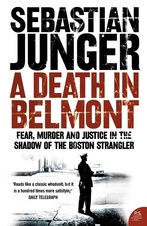
 A DEATH IN BELMONT A DEATH IN BELMONT Sebastian Junger performs a rear-naked chokehold, also known as a “blood choke,” on his readers by restricting the vital fluid to their brains in A Death in Belmont. But instead of pinching his readers’ carotid arteries, he squeezes their emotional, moral, and psychological veins in this deeply descriptive, and disturbing, work of narrative nonfiction. The series of murders highlighted in and around the City of Boston in the 60s, earmarked by increasingly dramatic staged sexual assaults and post-rape humiliations, serves as the book’s catalyst. Most readers will be shocked to discover the perverse arrangement of victims as the killer’s blueprint maintains consistency through ninety percent of the killings. One of this book’s strengths is its descriptive fact checking; Junger and his editors at W.W. Norton spared no expense in regard to their collective and expansive foot-noted road map of the Boston Strangler saga. The story’s rich treasury of details is somewhat reminiscent of Caputo’s In Cold Blood. Even as the aforesaid is a strength per my opinion, some may consider the vastness of Junger’s details a caveat. I hope not because any story firmly entrenched in the workings of the judicial system needs to be both comprehensive and meticulous in scope and sequence, especially in regard to a storyline like the Boston Strangler that has so many loopholes (pun intended). Some might consider the 1960s a hiccup of recurrent racial tensions, extreme socio-economic diversity, and religious and/or personal belief system disparity, all of which have plagued the United States since its inception, but let’s call it what it really was—life. Coupled with the backdrop of civil rights activism in the 1960s, this book highlights both the struggles of poor minority and immigrant neighborhoods, which in turn serves as a foil to well-to-do communities like Belmont, Massachusetts. Mr. Junger not only gives his readers an interesting history lesson, but he shares a unique family life stamp as one of the potential perps, Al DeSalvo, actually spent time at his childhood home, serving as a handyman to a contracting crew building a studio for his mother. Junger juxtaposes the aforementioned with a detailed account of the arrest of Roy Smith, an African-American who was arrested, tried, and convicted for the murder and rape of Bessie Goldberg, a fellow resident of the affluent Boston suburb. The story revolves around Smith and DeSalvo, both jailed as one maintains his innocence as the Boston Strangler while the other, ironically, strives to achieve the ghastly distinction. The only reservations I would extend concerning A Death in Belmont revolve around its editing. Any close reader will undoubtedly discover a handful of flagrant typos and awkward phrasing. Examples include commonplace misspellings (e.g. “thir” for their), redundancy (e.g. “so Giacoppo waited until his shift was over to drive over to 93…”), comma usage (e.g. failing to provide a comma in compound sentences: “He told Coughlin to go up the front stairs of the building and he pulled his gun and went up the back stairs.”), and apostrophe usage (e.g. plural-possessive mistake: “had to sleep under other peoples’ houses to…”) just to name a few. I can say after tweeting about a couple of the editing mistakes W.W. Norton replied via social media that they would update the files, which was admirable. But let’s call a spade a spade—these editing mistakes should have been caught long before this book ever went to both print and e-book, especially considering the reverence and devotion many readers hold toward the publishing giant W.W. Norton and Company. But getting back to better things. There is nothing Punch and Judy about this novel—it’s an intellectual and serious read, and the storyline demands one’s attention. Plus, Junger gives several powerful maxims throughout the piece. Hands down, one of my favorite quotes in the book states: “In some ways there is nothing less relevant than an old murder case. The reason it is important is this: Here is a group of people who have gathered to judge— and possibly execute— a fellow citizen. It’s the highest calling there is, the very thing that separates us from social anarchy, and it has to be done well.” Undoubtedly, this quote is an analogy for life and everything that can and should govern it. Old murder cases are cold, both literally and figuratively, and whenever a story keeps you talking about it in small circles with friends and pondering the “what ifs” while lying in bed, it’s worth a go. A cross between Helter Skelter and In Cold Blood, the terrifying reality of bad things sometimes happening to good people makes Junger’s A Death in Belmont a relevant read in 2015. Reviewed by Kurt C. Schuett
Comments are closed.
|


Archives
May 2023
|

|

|
 RSS Feed