


BOOK REVIEW: ANONYMA BY FARAH ROSE SMITH
27/3/2019
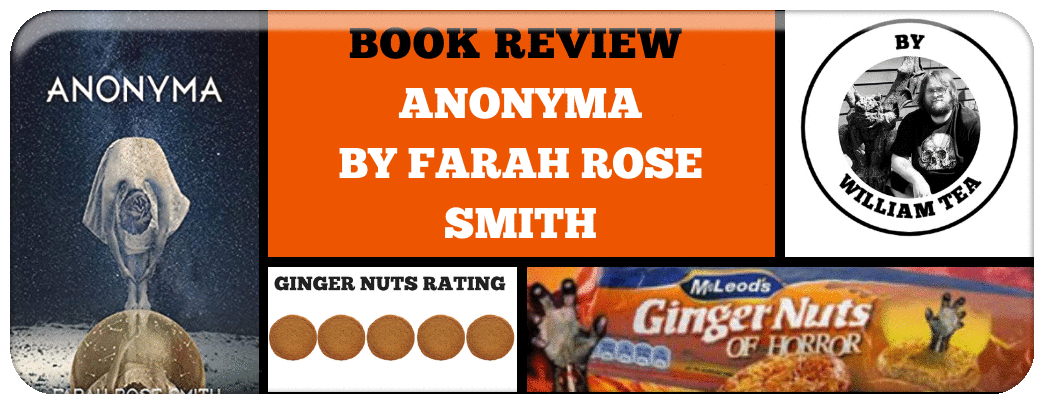 “Men write songs about girls like me, and then they kill them.” For all the vivid descriptions and poetic turns of phrase within Farah Rose Smith’s 2019 novel Anonyma—and they are legion—this line, appearing on the very first page, is chief among those that linger the longest. Why? Because of the simple, brutal truth of it. Reducing the meat of this particular book to a plot synopsis feels almost criminal. In any case, here goes: the eponymous Anonyma is part of a small circle of artists obsessed with the occult-infused philosophies of enigmatic hermit G.E Von Aurovitch. The figurehead of said circle, narcissistic celebrity renaissance-man Nicholas Bezalel, is also Anonyma’s lover—though she herself frequently wonders if what she and Bezalel have could in any way be described as “love.” In truth their relationship is poisonous, a dehumanizing grind of abuse and subjugation occasionally interrupted by fits of passionate lust; nevertheless, Anonyma struggles to see any way out except death. A sharp blade and a splash of blood later, Anonyma finds herself transported to the Afterworld, a darkly surreal realm she read about in an ancient text central to Von Aurovitch’s work. Navigating various encounters with ghouls, demons, throngs of suffering women, and the sadistic god-king known only as The Doom Artist, Anonyma confronts in death all the questions she could not answer in life. Is it too late for her to put the revelations she unearths to use, though, or is there still time for second chances? Sure, skinned down to the bare bones like that, Anonyma’s story seems plenty interesting. Smith, however, takes this skeleton and necromances it into a great, beautiful, undead beast, a monster with more mysteries tattooed onto its flesh than one might even think possible. Foremost, although Smith’s plot is powerful and engaging, her focus is less on linear, cause-and-effect, exterior storytelling and more on emotionally complex, chronally kaleidoscopic, interior storytelling. Seemingly inspired by authors of the Symbolist and Decadent movements, Smith’s style does not merely tell readers about her main character, but actually acts as an extension of said character; as Anonyma experiences different emotions, the prose reflects her mindscape. For instance, at times the text is deliberately nebulous, mirroring Anonyma’s slippery understanding of herself and her situation. Likewise, there are times when differing time periods from across Anonyma’s life seem to bleed into one another, making it difficult to decipher whether what’s on the page is supposed to be happening now or previously. It’s confusing but the effect is an evocation of the way memories similarly bleed into the present for survivors of serious trauma. The result of this approach, of course, is that Anonyma is certainly not for everyone. The difference between this and commercial genre fiction is like the difference between ambient or noise music and straight-up rock ‘n’ roll. The value here does not come from an adherence to traditional forms, but rather in the individual notes themselves, in their atmosphere and their feeling. Smith’s prose is intensely lyrical and full of striking imagery—one memorable scene takes place in a gallery of mangled female bodies encased in glass, all of them still conscious, unable to live but unable to die. There is not a single word throughout all of Anonyma’s 121 pages that doesn’t feel carefully weighed and measured. Even divorced of context, just reading individual sentences by themselves is a pleasure. Still, this is not an easy or casual read; it is, in many ways, an unapologetic challenge. Like any challenge, there will be those who relish it and those who reject it. But also like any challenge, those who see it through will find reward in the experience. Vacillating between self-reflection and self-loathing, Anonyma reads like a marriage of Thomas Ligotti’s jet-black thoughtfulness and Tanith Lee’s lush gothic fantasy, all set against a mythic, mesmerizing backdrop that calls to mind H.P. Lovecraft’s Dreamlands and Robert W. Chambers’ Carcosa. Though a slender volume, Anonyma is densely packed, a rare work that both benefits from and lends itself to numerous revisitations. In recent years, editors and publishers of weird fiction have increasingly made conscious efforts to seek out more female voices, noting that a greater diversity among authors leads to a greater diversity of ideas which likewise leads to a greater diversity of stories; the genre as a whole is therefore enriched, made more imaginative and less formulaic. Some have questioned this logic, suggesting that intentionally seeking out female-driven fiction and female-driven viewpoints is itself sexist. Good writing is good writing, after all. What does it matter who wrote it? One need only point to works like Anonyma to invalidate such arguments. Though the book meditates on a number of themes—obsession, loss, loneliness, and, ultimately, transcendence—its most meaningful ruminations are those which relate specifically to the meaning of womanhood in its various facets, from motherhood to sisterhood to daughterhood to, most vitally, pure unadorned personhood. “What is it for a young girl to see someone rotting before her? I would rear her up as though she were myself without pain, without memory, but she has horrors of her own, no doubt, even by that age. In the end, she will be as dark as me, though tougher. This is the privilege of womanhood—to be so strong and so densely hidden within that there can be nothing but endurance. There is no pleasure in such a life, or very little of it.” Make no mistake, Anonyma is as deeply feminine as it is deeply personal. No man could have written this book. What’s more, no other person could have written it but Farah Rose Smith.  The history of art is littered with Great Men and the Muses they use as stepping stones to brilliance. In this shockingly lyrical, endlessly rich and luxurious nightmare of a novel, the Muse turns. Yet, it is not so much a tale of vengeance or comeuppance as it is a heroine's journey, as Anonyma survives doomscapes almost beyond imagination and the transgressions of mere men, mere artists, survives the horrors imposed upon the feminine to rediscover her own magic and power. Anonyma, novel and narrator, holds up a dark mirror to our paradigm of art as a kind of device for reducing women to Platonic ideals while staging theophanies for men. But she also holds the mirror to herself, her sisters, even, daring to hope, a daughter. ANONYMA is a novel full of blood and love and despair and courage.   Comments are closed.
|


Archives
May 2023
|

|

|
 RSS Feed