


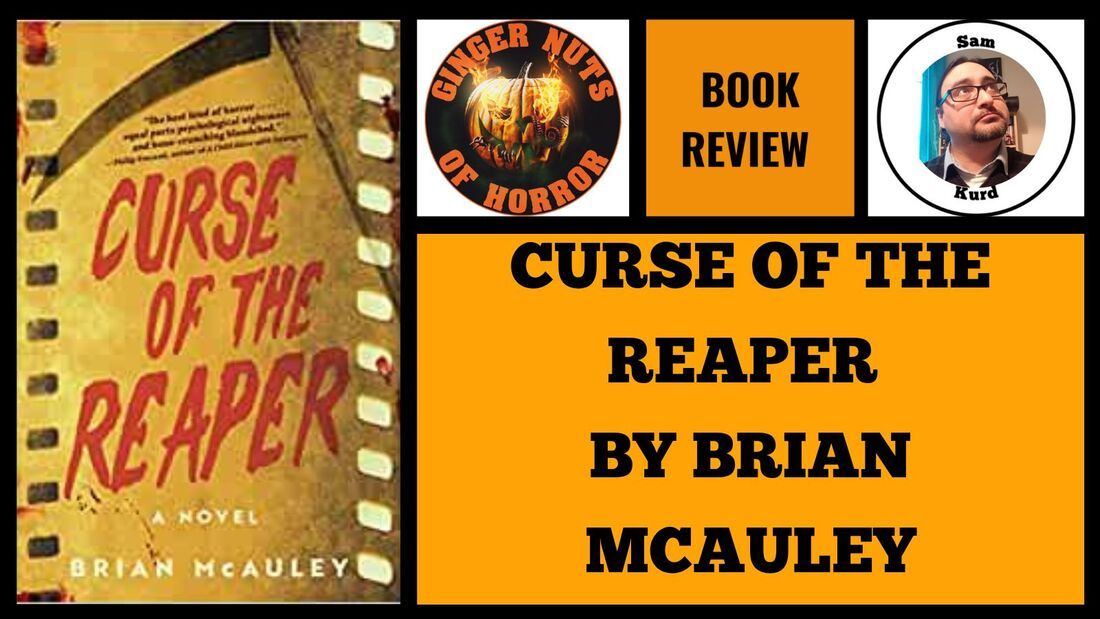
Curse of the Reaper by Brian McAuley A book review by Sam Kurd Have you ever wondered what goes through the mind of an actor who, after playing a role in a long-running franchise for decades, finds themselves replaced by a younger performer for the reboot? Robert Englund was very positive about Jackie Earle Haley in the run-up to 2010’s A Nightmare on Elm Street, but he’s a gentleman and a class act. What if he’d been prone to resentment and bitterness, seeing himself as being tossed away after years of hard work and dedication? Or worse, what if Freddy had decided to take matters into his own hands to ensure his new movie lives up to his standards? This is essentially the idea behind Curse of the Reaper, the debut novel from screenwriter Brian McAuley. Veteran character actor Howard Browning has been doing the convention circuit for years now, living off sales of merch for the long-running Reaper franchise, in which he played the titular harvest-themed slasher villain. If Jason Voorhees were an undead farmer with Freddy Kruger’s penchant for quips and Pinhead’s love of chains, then he’d be the Reaper. He’s an 80’s horror icon, beloved by fans. But the year is 2005, and you know what that means. It’s the era of Platinum Dunes and Rob Zombie, of CGI and pretty young things making the move from TV to film, banking on easy money from recognisable IPs. It’s the era of remakes, remakes everywhere. Rather than bring Howard back for the role he originated, the studio wants to replace him with up-and-coming James Dean wannabe Trevor Mane, a rising star whose struggles with addiction threaten to derail his career before he can peak. Naturally Howard isn’t pleased… and neither, it would seem, is the Reaper – Howard begins to experience hallucinations and loss of control, believing that the Reaper is acting through him, threatening to go on a murder spree if he isn’t allowed his rightful place in the movie. The two stars find themselves at odds, vying for the role and fighting hard not to succumb to their demons. But harvest time is coming, and there will be blood… The first thing that struck me about Curse is how easy a read it is. The pages practically turn themselves; in fact, I devoured about 75% of the book in one sitting. It’s so simply, economically written, without ever sacrificing imagery or emotional impact. McAuley simply knows the value of writing a nice clear sentence without reaching for the thesaurus every five minutes. I wonder if this comes from his screenwriting experience; as a screenwriter myself, I know how important it is to be visual while staying concise, to avoid any fancy tricks that take the reader out of the story. His industry knowledge serves him well here too, as Howard navigates the pitfalls of film-making and studio politics. They do say you should write what you know! Punctuating the parts of the story with excerpts from the Reaper movies is a neat device, showing us the development of the character while giving us a knowing nod and a wink as if to say “those Friday the 13th movies sure get wacky but that’s why we love em, right?”. When Howard began to experience his hallucinations and it’s revealed he was diagnosed with Alzheimer’s, I inwardly groaned and braced myself. There’s a thread of ablism that runs through horror, embodied in a trope that I like to call Mentally Ill People Are Dangerous And Will Kill You. It feels like there’s a difference between ‘this person’s sanity is on the verge of unravelling and they don’t know what’s real or not’ and ‘this very real mental condition is causing them to kill and maim’ – it’s especially galling when it’s a ‘split personality’ thing, because Dissociative Identity Disorder is something lots of people struggle with without murdering anyone at all. I don’t have DID, but as a mentally ill person myself, seeing it as a vehicle for horror tends to make me a bit uncomfortable. As a result, I spent much of the book desperately looking for clues that the Reaper is in fact a supernatural entity, given life by Howard’s devotion and the fans’ adoration. I’m happy to say plenty of clues were forthcoming, and while there’s enough ambiguity to suggest that Howard has simply become unhinged and is struggling to control his own identity, towards the end there’s ample evidence to support my preferred theory. Howard himself is an interesting and fun character to follow, despite being a stuffy and pretentious type whose inner monologue would quickly get an ‘OK Boomer’ from any teens reading. You can’t help but like him and feel for him; his passion for the role and for the art of acting is clear, and you really do root for him as he struggles against the Reaper’s dark impulses. He has more in common with his young nemesis Trevor than he realises at first, as we find out when Trevor becomes a perspective character, a move that pleasantly surprised me. Switching between the two foils is a great move and allows a greater understanding of the Reaper-as-inner-demon motif through Trevor’s struggle with addiction. Howard and Trevor are fighting the same fight, only their opponents differ (or do they?). It makes the ending (which I obviously won’t spoil here) all the more tragic. I do wish Joan and Sophie could have had more active roles in the story, but a third perspective would maybe have complicated things a little too much. We do dip into their heads a couple of times, and it’s very effective when we do. There are a few lovely quiet character moments with them, like the origin of Trevor and Sophie’s pet name ‘honeybee’ (a name which to me evokes Candyman but is entirely unrelated). Moments like that make the characters wholly human, so we worry all the more when they’re in danger. The body count is surprisingly low for much of the story, but when it does ramp up then some of the characters’ tragic ends really hit home. Personally I think one of them deserved better, but that’s veering into Spoilertown and let’s not visit there today! Curse of the Reaper is a great story well-told, zipping along at breakneck speed towards the inevitable tragic ending. It’s almost laugh-at-loud funny at times, especially in its loving digs at the state of horror films in the 2000s, but not at the expense of genuine human emotion. It doesn’t handle Howard’s mental illness disrespectfully, and though I would have liked a more explicitly supernatural explanation, it didn’t come across as exploitative. I’d definitely recommend giving Curse of the Reaper a read, especially if you’re a slasher fan and enjoy meta-horror books like We Are All Completely Fine by Daryl Gregory and Grady Hendrix’s The Final Girl Support Group. This’d fit quite comfortably on the shelf beside them. Curse of the Reaper |
 |  |


May 2023
April 2023
March 2023
February 2023
January 2023
December 2022
November 2022
October 2022
September 2022
August 2022
July 2022
June 2022
May 2022
April 2022
March 2022
February 2022
January 2022
December 2021
November 2021
October 2021
September 2021
August 2021
July 2021
June 2021
May 2021
April 2021
March 2021
February 2021
January 2021
December 2020
November 2020
October 2020
September 2020
August 2020
July 2020
June 2020
May 2020
April 2020
March 2020
February 2020
January 2020
December 2019
November 2019
October 2019
September 2019
August 2019
July 2019
June 2019
May 2019
April 2019
March 2019
February 2019
January 2019
December 2018
November 2018
October 2018
September 2018
August 2018
July 2018
June 2018
May 2018
April 2018
March 2018
February 2018
January 2018
December 2017
November 2017
October 2017
September 2017
August 2017
July 2017
June 2017
May 2017
April 2017
March 2017
February 2017
January 2017
December 2016
November 2016
October 2016
September 2016
August 2016
July 2016
June 2016
May 2016
April 2016
March 2016
February 2016
January 2016
December 2015
November 2015
October 2015
September 2015
August 2015
July 2015
June 2015
May 2015
April 2015
March 2015
February 2015
January 2015
December 2014
November 2014
October 2014
September 2014
August 2014
July 2014
June 2014
May 2014
April 2014
March 2014
February 2014
January 2014
December 2013
November 2013
October 2013
September 2013
August 2013
July 2013
June 2013
May 2013
April 2013
March 2013
February 2013
December 2012

|

|
 RSS Feed