


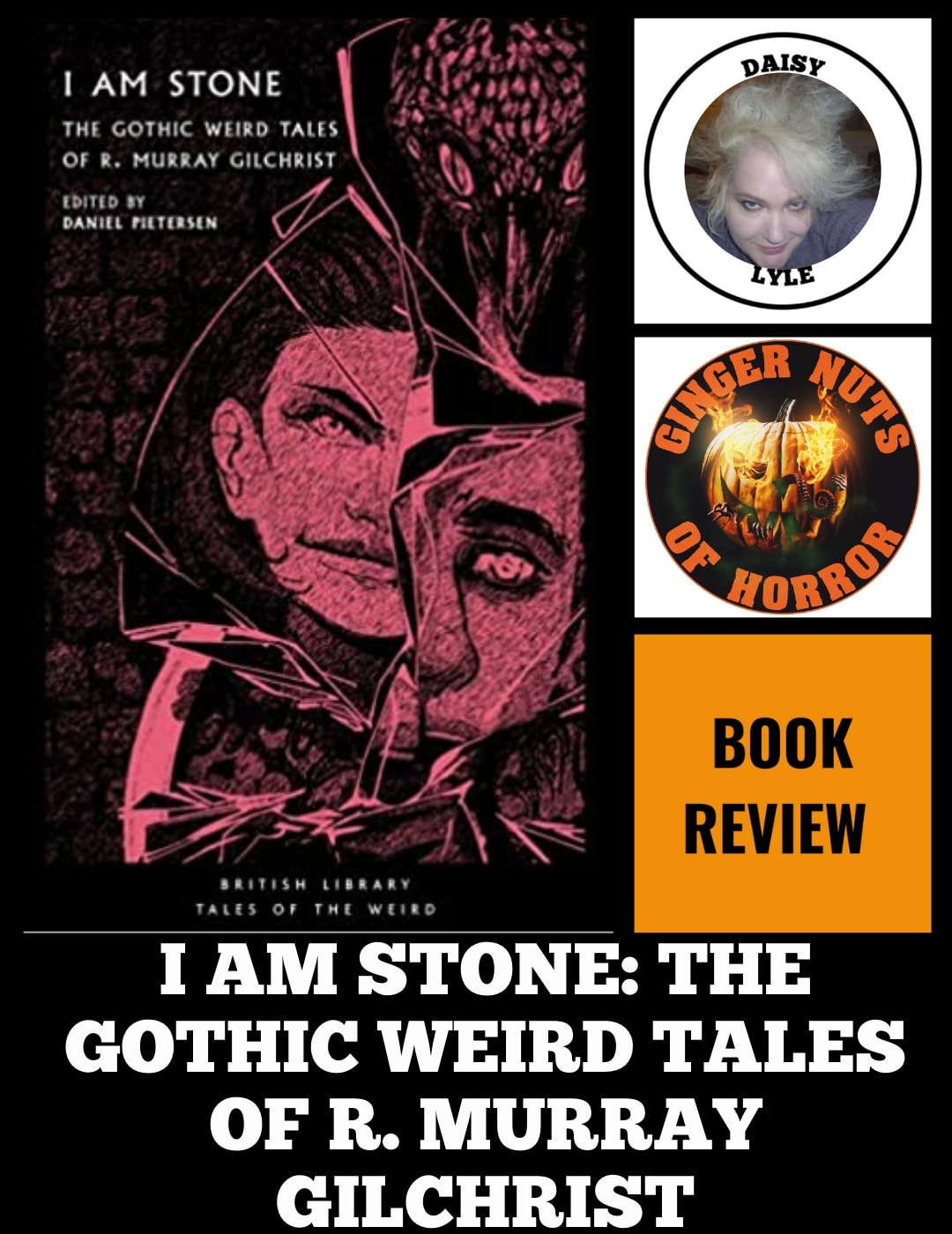
I AM STONE: THE GOTHIC WEIRD TALES OF R. MURRAY GILCHRIST BY R. MURRAY GILCHRIST & DANIEL PIETERSEN Publisher : British Library Publishing (19 Aug. 2021) Language : English Paperback : 320 pages ISBN-10 : 071235400X ISBN-13 : 978-0712354004 A book review by Daisy Lyle People talk a lot about liminality in horror and weird fiction, and there are vast riches to be mined in the borderlands, spaces between here and there prowled by strange creatures neither fish nor flesh. This often seems like a postwar trend thanks to the triumphs of writers like Robert Aickman and more recent writers like Kathe Koja or Nicholas Royle. But if you want an earlier example, for my money you can’t get much more liminal than R. Murray Gilchrist. He was a writer who not only existed on the hinge between the 19th and 20th centuries, but also, as editor Daniel Petersen points out in his informative introduction, at the “nexus” of three strands of dark fiction: gothic, decadent and weird. His best work exists at the literary equivalent of Kelvin’s thermodynamic “triple point”, a place where three phases co-exist in equilibrium. On first glance it is the gothic that most stands out. He might have been ahead of his time, but Gilchrist didn’t give a tinker’s damn about the modern world. Most of his stories are set in Ye Olden Days, a time when people dressed fancy and men went on long quests while their wives and girlfriends stayed at home, scheming their heaving bosoms off. “The Crimson Weaver” is a particularly chivalric opener, with its two reasonably pure-hearted heroes journeying through an enchanted forest in search of a woman of occult power. But it’s more like Clarke Ashton Smith’s forest of Averoigne than anything from a sanitized fairy tale, and the oddness of what the seekers eventually find sends the needle scratching right over that Hans Andersen record. This is something that happens over and over again in this collection, with traditional gothic set-ups dyed outlandish shades of decadent or twisted into the bizarre. His vampires and revenants are unconventional, and in “Night On The Moor” where a lost wanderer is given shelter from the storm by the master and lady of a very uneasy house, the perverse splendour of said lady (and her pet white deer Crystalla) makes what could have been a routine jealousy melodrama into something odder and more unsettling. And Gilchrist is very big on splendour. There may be rot and decay at the heart of it all, but that doesn’t mean you can’t enjoy it. Swathed in velvet and sable and a ton of other materials you’re unlikely to find on the racks at Top Shop like paduasoy and kerseymere, dripping with chrysolites and opals the size of kidney stones, the heroes and heroines of the stories in the first part of this collection (Dead Yet Living) are dressed to kill, and on occasion do. One story, “The Pageant of Ghosts”, is pretty much just an excuse for a fashion show with dead people on the catwalk. “The excess of beauty and perfume drugged me” he writes, and the reader should expect a considerable contact high. Gilchrist also shares the musical fascination of Decadent-inspired writers like Vernon Lee, as seen in “The Priest’s Pavan” (a charming look at the magical powers of an old score). Jewellery and music even meet in the oneiric “Dame Inowslad” when a character plays his piano with jewels placed across the strings. Barry Andrews from Shriekback once identified the piano as the apotheosis of civilized society, and so perhaps we shouldn’t be surprised by the huge amount of keyboard instruments in this collection, though most of them are harpsichords and spinnets. This might all be a bit heady for some, but there is often plenty of human interest and storytelling power beneath the glitz. The best stories in the collection provide a reading experience like being punched with a fist covered in expensive rings. And taking a punch is pretty much the only thing the ‘Useless Heroes’ who form the book’s second part are good for. Fate is ineluctable, and the chivalry of many of Gilchrist’s menfolk only goes skin deep. “The Manuscript of Francis Shackerley”, probably the best story, is a romantic but exceedingly dark tale of star-crossed lovers that is also a damning indictment of domestic violence, with a very modern feel. In fact several of the stories here are very pro-woman. It would be a stretch to call Gilchrist a feminist; many of his heroines are quite samey, a long procession of neurotic young beauties only occasionally interrupted by a mournful crone or unsavoury old witch. But as can be seen in part three (‘Of Passion and Death’) his heroines have a degree of sexual agency not common in writing of the time, and aren’t always punished for it either (as in “Dryas and Lady Greenleaf” in which the heroine gets it on with a statue while her husband is away). In tales like “The Writings of Althea Swarthmoor” and “Noble Courtesan” sex is treated with greater frankness than one would expect, and in the former story Gilchrist’s loathing of sexual hypocrisy and double standards is manifest. One of my favourites, “Sir Toby’s Wife”, can also be seen as a wry critique of arranged marriage, and I also enjoyed its more modern tone (definitely at the “weird” end of things and reminiscent of a good Edith Nesbit or Margaret Irwin chiller.) This ability to see women as complex beings serves Gilchrist well in stories of tragic love such as “The Stone Dragon” and “The Lost Mistress”, which are psychologically realistic and affecting. The sombre moorland musings of “My Friend” even offer a queer love story. The collection winds up with something a bit different. In his lifetime Gilchrist got much more traction for his slice-of-life Peak District stories than his more byzantine material, and ‘Peak Weird’ presents three little-known examples of this. “The Panicle” is a weird little two-hander based on a piece of Peak District folklore and “A Witch In The Peak” is a slightly more comic tale. These mainly serve as quaint vignettes, and there’s far too much ‘authentic’ local dialect, but you do notice that the heroines in these stories are very different from the hothouse cuties in the other material, more downhome, street-smart and bareknuckle tough. And the final story, “A Strolling Player”, is lovely. It’s quite Hardy-esque in its account of a man who, on his way to bring home his child’s coffin, gives a lift to a wandering actress who has had her life blighted by a burden of shame. The harsh landscape of the Peak District in Winter is brought wonderfully to life, and its stark beauty forms a perfect backdrop for the story. Life, Gilchrist suggests, is horrible, especially for women on the wrong side of the tracks, but love can occasionally take centre stage. Gilchrist was until now a massively out-of-print writer, and Petersen’s achievements in bringing this body of work back into the spotlight are considerable. Parts of the collection suffer from sameness of tone, and the writer’s style sometimes runs away with him (you’d better be prepared to learn a lot of old words like culver and burse and marplot, though Petersen has provided some help with the terminology.) But there are many stories that richly deserve to be remembered, and with its beautiful cover design and presentation I Am Stone is bound to succeed with lovers of late Victorian and Edwardian fiction. DAISY LYLE I Am Stone: The Gothic Weird Tales of R. Murray Gilchrist |


Archives
May 2023
|

|

|


 RSS Feed