


 “Come, Jean-Baptiste, leave them be… no good can come from books.” Jean Ray is the best-known pseudonym of Raymundus Joannes Maria de Kremer (1887-1964), a key figure in the Belgian School of the Strange. Known in French, Dutch and German circles as a pivotal voice of the Weird, it is only recently his key works are becoming available in English translation. Thanks to Wakefield Press, this new edition of the collection that earned Ray his reputation as Belgian master of the weird tale is published in an excellent translation by Scott Nicolay. Thus Anglophone connoisseurs of the Weird and its origins can finally read Ray’s iconic collection The Great Nocturnal, originally published in 1942, and get to know a name who should be on a par with Poe, Lovecraft and Blackwood. At the heart of the collection is the title novella, ‘The Great Nocturnal’, which retains all of its dark unnerving power and introduces the reader to Ray’s particular approach to the Weird. Ray finds horror and the strange in the rituals of the everyday, and the uncanniness of these stories creeps up on the reader from the mundanity of lived life. The novella follows the story of Mr. Théodule Notte, an old haberdasher who lives a dull life of routine until he discovers a book of occult secrets in his library which enables him to live in a dimension outside of time, at the price of murder. The tale features several key elements of Ray’s fiction, in the way the fantastic encroaches on the mundane, in the fascination with books and unfinished or intercalary texts, in the unreliableness of narrators and the tricks in general that stories play on their readers. These fascinations can also be seen in ‘The Seven Castles of the Sea King’, in which a young man newly released from prison gets drunk in a tavern full of sailors. His drunken ramblings and the obscure symbols he draws on the table scare the hardy sailors out of their wits, and lead to unforeseen consequences. The story in the end folds in on itself, gaining much of its power by leaving so much unexplained and the story open ended, as the quest for forbidden knowledge consumes all who are drawn to it. ‘The Phantom In The Hold’ features more drunk sailors and thoroughly unreliable narrators; the story offers a rational if gruesome explanation for its events, but by this stage the threads of rationality have been so disrupted the non-supernatural explanation itself feels out of place. ‘When Christ Walked Across the Sea’ features a protagonist whose role is to take on the mantle of doomed saviour without ever realising it. In ‘The Centipede’, three students get drunk whilst keeping a vigil on a dead woman’s house, awaiting the appearance of the psychopomp centipede who will collect the woman’s soul. However they are not all being honest with themselves or each other about what they are waiting for, and when it does manifest there is a heavier price to pay than any of them were expected. The collected stories here offer a vision of a sordid world of drunks, down and outs, sailors and thieves, who eke out a marginal existence on the edge of the world and so are more likely to fall off the edge into the uncanny. These are ordinary people down on their luck, whose harsh existence is rewarded by these occasional glimpses of another world that encroaches on ours; a double-edged reward to be sure. There is no revelation for Ray’s characters, and their encounter with these deeper truths almost invariably leads to destruction. This bleakness aligns Ray’s worldview with that of Lovecrafts, though his approach to writing and dialogue could not be more different. With their obsession with arcane lore and the gaps in between stories, the tales in The Great Nocturnal share elements with Robert W. Chambers’ iconic The King In Yellow (1895) and Arthur Machen’s more infernal stories like ‘The Great God Pan’ (1894). However there is a bleakness in Ray’s stories that are all his own. Most of The Great Nocturnal was written after Ray’s imprisonment, and during the Nazi Occupation of Belgium, and correspondingly there is a very understandable sense of nihilism and despair running through these stories, coupled with dark gallows humour, as Ray’s approach to the Weird reflects the ongoing horrors of mid-War Europe. As well as providing eloquent translations and useful explanatory notes, Scott Nicolay also provides an extensive afterword that explores the contexts of The Great Nocturnal within Ray’s other works and of Ray’s work in general that is both essential and fascinating reading for those interested in the history of Weird Fiction and eager to find out more about the place of Jean Ray’s work in it. Jean Ray embellished his autobiographical information as much as his stories, claiming to be among other colourful things an alcohol smuggler during the Prohibition. This perhaps illustrates Ray’s fascination with narratives, how we receive them, and how the figure of the unreliable narrator interacts with the reader, all of which come through in his fiction as well. 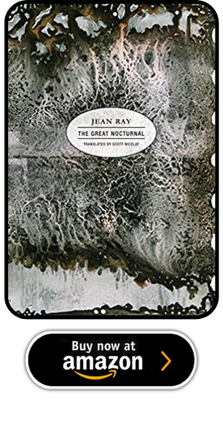 In English for the first time, the collection that launched Jean Ray's reputation as the Belgian master of the weird tale After the commercial failure of his 1931 collection of fantastical stories Cruise of Shadows, Jean Ray spent the next decade writing and publishing under other names in the stifling atmosphere of Ghent. Only in the midst of the darkest years of the Nazi Occupation of Belgium would he suddenly publish a spate of books under his earlier nom de plume. The first of these volumes was The Great Nocturnal. Published in 1942, the collection, as its subtitle indicates, consists of tales of fear and dread, but a dread evoked not by the standard tropes of horror but what had by now evolved into Ray's personal brand of fear, drawn from a specifically Belgian notion of the fantastic that lies alongside the banality of everyday life. An aging haberdasher's monotonous life opens up to a spiritual fourth dimension (and serial murder); an inebriated young man in a tavern draws cryptic symbols and mutters statements that evoke an inexplicable terror among some sailors, and, as he sobers up, himself; three students drink Finnish Kümmel and keep watch over a deceased woman's apartment, awaiting a horrific transmutation. Yet these tales are laced with a certain mordant humor that bears as much allegiance with Ambrose Bierce as Edgar Allan Poe, and toy as much with the reader's expectations as they do with their characters. Jean Ray (1887-1964) is the best known of the multiple pseudonyms of Raymundus Joannes Maria de Kremer. Alternately referred to as the "Belgian Poe" and the "Flemish Jack London," Ray authored some 6,500 texts in his lifetime, not including his own biography, which remains shrouded in legend and fiction, much of it of his own making. His alleged lives as an alcohol smuggler on Rum Row in the Prohibition Era, an executioner in Venice, a Chicago gangster, and hunter in remote jungles in fact covered over a more prosaic, albeit ruinous, existence as a manager of a literary magazine that led to a prison sentence.   the heart and soul of horror fiction review websitesComments are closed.
|


Archives
May 2023
|

|

|
 RSS Feed