


 “Nakota, who saw it first: long spider legs drawn up beneath her ugly skirt, wise mouth pursed into nothing like a smile. Sitting in my dreary third-floor flat, on a dreary thrift-shop chair, the window light behind her dull and gray as dirty fur and she alive, giving off her dark continuous sparks. Around us the remains of this day’s argument, squashed beer cans, stolen bar ashtray sloped full. “You know it,” she said, “the black-hole thing, right? In space? Big dark butthole,” and she laughed, showing those tiny teeth, fox teeth, not white and not ivory yellow either like most people’s, almost bluish as if with some undreamed-of decay beneath them. Nakota would rot differently from other people; she would be the first to admit it.” Kathe Koja’s The Cipher was first published in 1991, and made an instant impact on everyone who read it. From its unsettling, impressionistic cover art to the novel’s opening, quoted above, which drops you straight into Koja’s brilliant prose and bleak worldview, it was immediately apparent that this was something special and different. The novel launched Dell’s legendary Abyss line, which prioritised originality and innovation in Horror, just as the 80s Horror paperback boom began to sink into cliché and repetition. It won the Bram Stoker and Locus Award, and marked Koja out as a major talent in Horror. Over the intervening years, its reputation has grown as its influence has spread within and beyond the horror genre. After many years of being out of print and frustratingly difficult to get hold of, Meerkat Press are doing the world a great service by bringing The Cipher back into print, so it can disrupt, disturb and inspire a whole new generation of readers and writers. Nicholas, a failed poet, and his sometime lover Nakota discover the Funhole, a mysterious black hole of nothingness that exists in the storage room of Nicholas’s dingy rental flat. Nakota begins a series of increasingly unpleasant experiments to determine the nature of the Funhole, which distorts and mangles everything it comes into contact with – it causes insects to grow extra heads, mutates and then explodes a rat, and reanimates a dead hand. Nicholas accidentally puts his hand down the Funhole and starts developing a hole of his own on his hand, one that is expanding and weeping strange fluids. Things continue to get stranger as Nicholas, Nakota and the Funhole’s increasing band of damaged disciples are drawn deeper and deeper into something they cannot possibly hope to understand. The Cipher is bracingly bleak and nihilistic, fitting for a Horror novel where the source of terror is a manifestation of nothing itself, rather than any monster or supernatural creature. The Funhole defies explanation, a dark hole of mystery that draws these troubled characters into its destructive orbit. It is the hollowness that sits at the centre of Nicholas’ dreary existence, as he struggles to find the motivation to turn up to his job at the Video Hut, only writes his poetry when he’s blind drunk and then destroys the poems rather than face them whilst sober, fails to make any meaningful connection with Nakota or any of the other damaged weirdos they drag into their orbit. The world of the novel is grimy and grungy. Aside from the Funhole itself, the story is set in an all-too believable anonymous American town, run down and drenched in snow and rain, a world full of grimy flats, dead-end jobs and pretentious local art shows where at least the booze is free. Sex is brutish, sordid and unsatisfying, whether in Nicholas and Nakota’s desperate couplings or the degenerates renting seedy pornography from the Video Hut. The Funhole provides a focus for all this early 90s alienation. The story is told from Nicholas’ perspective, and Koja is unflinching in her portrayal of his relentless self-loathing. However, despite his complete renunciation of agency over his own life, or perhaps because of it, the Funhole chooses Nicholas as its dark messiah, the object that will suffer all its horrifying transformations and transfigurations. This is much to the chagrin of the selfish, manipulative Nakota, who has eyes only for the Funhole. In its bleak, all-consuming emptiness, she sees the culmination and rewarding of all her most nihilistic, destructive impulses. Driven and deranged, brutally unconcerned with the damage she causes to the people around her, yet utterly, resolutely certain that this communion with nothingness is all she desires, Nakota remains the novel’s most indelible character. Much of the novel focuses on her and Nicholas’ horrendously dysfunctional relationship, as he continuously fails to protect her from the darkness she is drawn into, and she surgically hacks away at his psychic wounds to get exactly what she wants from him. The Cipher is powered by Koja’s incredible and unique prose. It is immediately clear what an incredible stylist she is. From those infamous first lines, Koja’s command of voice immediately draws the reader into her character’s heads and their distorted viewpoints. Her language achieves a dark and compelling poetry that draws the reader in, describing sensation and feel as powerfully and as deftly as action and thought. Koja is capable of describing the grim realism of her character’s lives in palpable detail. As Nicholas’ sense of reality is warped and distorted by the Funhole, so her writing achieves a delirious, surrealistic intensity that marks the most powerful sequences in the book. The Funhole draws a crowd of pretentious and vapid artists to it, typified by the smug, idiotic Malcolm and his groupies. They are ghouls looking for a fix of the dark and dangerous to spice up their mundane existence who come across something too viscerally disturbing for their cheap kicks. Much of the novel focuses on the unique artistic challenge set down by the Funhole, a challenge Malcolm and his fellow failed poseurs are ill equipped to face. Everyone from the most shallow and ridiculous artist up to Nakota herself, who is best equipped to understand the Funhole, has their own pet theory as to what the Funhole is, what it symbolises, and where communion with it will lead, but in the end Koja exposes these theories as just so much bullshit. The Funhole defies theorising and explanations; the only way in which it can be engaged with is on its own terms, the full surrender that only Nicholas with his acute self-loathing and conscious lack of agency is able to give to it. The novel leaves us on the threshold of destruction or transfiguration, and asks us at the end of the day if there’s any substantial difference. By the end, the reader is as much transformed as Nicholas. The Funhole is back to warp us all into new and unrecognisable forms again; we should be grateful to have it. Review by Jonathan Thornton 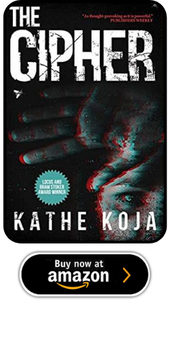 From acclaimed author Kathe Koja comes the highly anticipated paperback reissue of her award-winning horror classic The Cipher. Winner of the Bram Stoker Award and Locus Awards, finalist for the Philip K. Dick Award, and named one of io9.com's ""Top 10 Debut Science Fiction Novels That Took the World By Storm."" With a new afterword by Maryse Meijer, author of Heartbreaker and Rag. ""Black. Pure black and the sense of pulsation, especially when you look at it too closely, the sense of something not living but alive."" When a strange hole materializes in a storage room, would-be poet Nicholas, and his feral lover Nakota, allow their curiosity to lead them into the depths of terror. ""Wouldn't it be wild to go down there?"" says Nakota. Nicholas says ""We're not."" But no one is in control, and their experiments lead to obsession, violence, and a very final transformation for everyone who gets too close to the Funhole.   the heart and soul of horror fiction review websitesComments are closed.
|


Archives
May 2023
|

|

|
 RSS Feed