


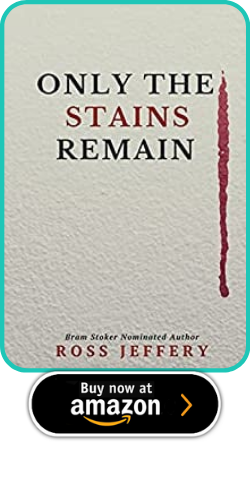
What must you truly do to kill a child? Only the Stains Remain by Ross Jeffery ASIN : B099FZ287G Publisher : Independently published (18 July 2021) Language : English Paperback : 136 pages ISBN-13 : 979-8523001307 Ross Jeffery’s Only the Stains Remain is a very tough but ultimately rewarding read, which crams considerable power and heartache into its 138 pages. In its most simplistic form, it could be described as a rape and revenge story, a trope you are much more likely to see on film than in the pages of a book. Considering its content this novella is a very lyrical story, which is neither Splatterpunk, Grindhouse, or Extreme Horror and ultimately used language which was too flowery for the content matter. Here is such an example, a rather odd way of describing the repeated child rape of two boys: “Our uncles’ appetites had matured over time as we’d been held temptingly out of reach by our mother. But with her gone, there was nothing to hold them back, and now they were ravenous and free to feast – and feast they did.” I am not too sure whether the adult survivor of child rape, reflecting back, would refer to this brutality as “free to feast” but that is fairly typical of some of the language in the book, which on numerous occasions I struggled with. A couple of the reviewers who plugged the book in the foreword compare it to Jack Ketchum and mention the “Ketchumesque prose”, I would disagree, there is nothing “Ketchumesque” about this style of writing. Ketchum nailed words to the page, Jeffrey dances around them and makes them sound pretty. These days any novel with the theme of abuse seems to be compared to Ketchum’s The Girl Next Door but in actual fact the plot is much more similar to his lesser-known Stranglehold which is about the abuse of a boy rather than a girl. I do not want to sound overly negative about Only the Strains Remain as I read it in two sittings and found the story of two abused brothers Jude and Kyle to be compulsive reading. Following losing their mother to cancer, their three abusive uncles move into the family home, Dwight, Lucius and Lenny. The men are completely foul and are presented as hillbilly caricatures, who initially abuse the elder of the brothers Kyle, who protects his younger sibling Jude from the worst of the torment. As this is a rape and revenge story (initially set in 1982) the second strand moves forward some years (it does not indicate how long) to when Jude is an adult and contemplating revenge on his three uncles and father. Written in the first person, both timelines are blended together and Jeffrey wisely keeps most of the sexual violence off-screen but does not hold back in the brutal (you may find yourself cheering) revenge part of the story, even if the violence is not glorified in any way. The scenes of the uncles predatory sidling up to young Jude were particularly unsettling and the helplessness felt by the scared child oozed from the page. This was a major strength of the book, which beautifully conveyed the psychological torment felt by the kids whenever the uncles were on the prowl, and especially if they had been drinking. Considering what goes on in this story, particularly in the way in it is framed as a revenge drama/thriller, there were too many niggling unanswered questions for my taste. Why did the boys never seem to go to school? One of the boys is abused so badly he cannot sit down, why is this abuse never picked up my anybody? Can you genuinely repeatedly burn cigarettes into children’s skin branding them and expect nobody to notice? Can you truly just bury people in your back garden or property and have no blowback? If this was some crazy type of creature feature these types of questions would be inconsequential, but in this type of story the reader has a right to answers and if not given simply come across as plot holes. The Ketchum novel I mentioned earlier, Stranglehold, does travel some of the same ground, but has no such glaring gaps in the plot. The relationship between the two brothers was a particular strength of Only the Stains Remain and some of the pain Kyle goes through to protect his brother was difficult to take and the subsequent ripple of guilt Jude feels was just as realistic. The scenes of shared tents, branding with cigarette burns and the drawn-out scenes where the uncles chuckled about what was going to happen when the lights went out “I’m going to make you a man” was deeply unsettling and I was very glad Jeffrey shied away from anything sexually graphic. The complicity of their father Abraham in the abuse was unforgivable and was not the strongest part of the story. Although reasons (or excuses) are given for his behaviour I found it very difficult to swallow how a father could quite openly turn a blind eye to his two children being repeatedly raped by close family members. Granted he is drunk most of the time, but they are not exactly subtle and I found this part of the story to be a stretch and again the reader has the right to question why he allows this to happen? Being an alcoholic who has lost his wife was just not a convincing enough excuse for myself. However, It’s worth noting that I would probably not have bothered raising this question if it was not for the fact that I found the book to be so thought provoking. Only the Stains Remain stayed me long after I had completed it and it had the potential to be developed into a much longer work. Ultimately it asks how do you kill a child? And the answer is not the physical death blow with a knife, gun or fists, but the drawn-out way in which childhoods are ended by violence, abuse and the abuse of trust, loss of innocence with the light of hope being extinguished. Only the Stains Remain is a powerful and harrowing read which asks a lot of difficult questions, of which there are no easy answers to. Read it with caution and tread very carefully. Tony Jones Only The Stains Remain |


Archives
May 2023
|

|

|


 RSS Feed