


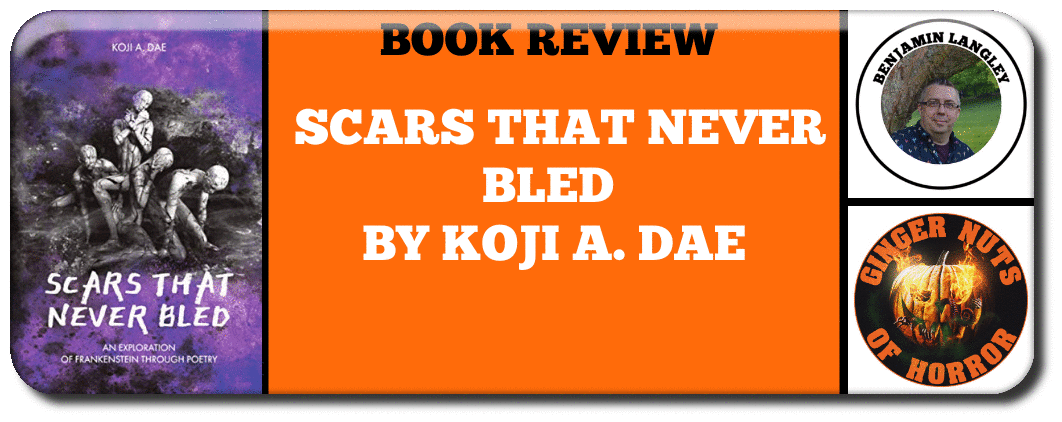
 As an exploration of Shelley’s novel, this collection is a success. It touched on ideas I’d already considered about Frankenstein, and opened my eyes to some new interpretations. Without knowledge of the text, it would be difficult to appreciate the poems in quite the same way, but as many of the themes of Frankenstein are universal and the ideas have be borrowed time and again, those with only a base knowledge of Frankenstein will find much to enjoy here. Scars That Never Bled is a collection of dark poetry by Koji A. Dae that explores the events and ideas of Mary Shelley’s Frankenstein. As Mary Shelley was inspired by the Promethean myth when writing Frankenstein, Shelley’s 1817 novel has served as inspiration for many writers in the genres of both horror and science fiction, and for good reason. Its theme of playing God, pushing the limits of human endeavour while also questioning the morality of that exploration remains relevant as mankind continues to push the boundaries of possibility. Here with her poems, Dae explores some of these ideas in a unique and individual way. The preface takes us through the poet’s relationship with Frankenstein, how she became more interested in it when she learnt Mary Shelley’s story, and how she came to formulate and arrange the poems. An original aspect of the collection is the decision to use Tarot cards to organise the poems into chapters. Tarot is something I have a limited understanding of, but each chapter explains the main ideas that card as we’re taken through the fool’s journey, in which we travel from ignorance to experience, so we start with the fool, move to the magician, and then through the high priestess, the empress, the emperor, the hierophant, before finishing with the lovers. This enables the collection to start with poems based upon the monster, before exploring Victor Frankenstein, Mary Shelley, and some of the novel’s themes. The poems are largely written in first person, sometimes directed at a second person. This helps to give each piece a personal and emotional perspective. Sometimes, when the second person is used this comes across as accusatory, and is successful when exploring some of Victor Frankenstein’s dubious choices. The poems which are tackle the creature’s story were, for me, most effective. Here the subject matter is most easily recognisable from Shelley’s work. It makes for a sensible first port of call in the exploration. The idea of desire versus reality is important here, and there is a degree of facing ourselves here, acceptance of who we are. Freedom and rights, and the lack of rights are universal themes which these poems shine a light upon and help to give sympathy to the creature. We also see development that matches the novel, with the imperative language used in the poem ‘Bride’ demonstrating the creature’s ability to use human traits such as manipulation and bargaining. At times, the imagery is a little gruesome - a ‘mangled eye’ here, and a ‘tattered cheek’ there, without it ever being graphic or the purpose of the poem. Between some of the poems are quotations from Frankenstein or from Shelley, and these help to draw focus to the idea that Dae tackles in her poems. In this way, the collection is well organised. It’s clear that Dae wants you to accompany her on this exploration of the text rather than to enforce her views on the reader. In the second part, in which we look at Victor Frankenstein as creator we start to touch more on these ideas of playing God, but it starts at a very base level, the robbing of the graves to obtain the bodies. The first poem in this section. ‘Graverobber’ make that harvesting of body parts an intimate experience, here sourcing a heart: “my fingers clutch the muscle, until memories of its rhythm, beat through its heavy chill’. In this part, the limitations of science are also explored and a question about how future generations will see the scientific advances and ideas of the current age. Once more, it’s an interesting concept. Scientists fear that their work will not stand the test of time, but of course, Victor Frankenstein doesn’t want to see his work replicated or improved upon. As we continue through the next couple of parts, the poems move further away from the events of the text itself. From the preface we see that an understanding of Mary Shelley’s life gave Dae a new appreciation of the text, and her enthusiasm for Shelley’s own story comes across here. Dae draws a parallel between Frankenstein creating the monster and Mary Shelley creating the novel. ‘Complicated’ is a favourite here: ‘obsessed with simplicity, we shove and snip our shapes, to fit constructed categories’. These lines could be about either the writing process or the selection of body parts for the creation of a monster. Much of the rest of the collection tackles themes of the novel. While my preference was for those more closely related to the events, there is still much to admire in the collection. There’s interesting poems that tackle the idea of motherhood – how the creature is born motherless and therefore never has the love, warmth and acceptance a mother would give. Ideas of playing God are also explored further, but also the rejection of responsibility after one has committed an act only Gods were deemed capable of. Most of the poems have a similar form, though there are a few that play with this, appearing different on the page. I’m glad the poet decided to explore other ideas on how to present the poem in ‘Breathing Avalanches’, ‘Shunned Consent’, and ‘A Thrill of Terror’. I couldn’t quite get to grips with what the poet was saying in these poems, but I was glad of the use of experimentation with form. As the collection moves into its last pair of chapters there’s some honesty from Dae as she tries to link her ideas to the tarot concept of the hierophant. This struggle leads to the longest poem in the collection, ‘For Want of a Friend’. It’s one that speaks of hope and redemption, and also a huge what if moment. Victor Frankenstein is posed with many choices in Frankenstein before he reaches a point of no return, and this poem mirrors that well. The final section, The Lovers, is not about love, but about knowledge and experience, but also a rejection of that. There is more tenderness in this section, exploring the ‘shadow of your curves’ and ‘the hollow of your hip’. It showcases a different side to Dae’s poems. The final poem, however, ‘When Science Couldn’t Kill Magic’ suggests that our knowledge doesn’t encompass all. It starts with the idea that science can take the magic away, ‘bunsen burners, melted away my shadow magic.’ However, that is all lost at the end in the lines ‘all explained by science, until his lips touch mine’. This final poem reflects on what we don’t yet know. It feels like an important place to leave this. Victor Frankenstein thought he could master life itself. How little he knew. As an exploration of Shelley’s novel, this collection is a success. It touched on ideas I’d already considered about Frankenstein, and opened my eyes to some new interpretations. Without knowledge of the text, it would be difficult to appreciate the poems in quite the same way, but as many of the themes of Frankenstein are universal and the ideas have be borrowed time and again, those with only a base knowledge of Frankenstein will find much to enjoy here. Review by Benjamin Langley 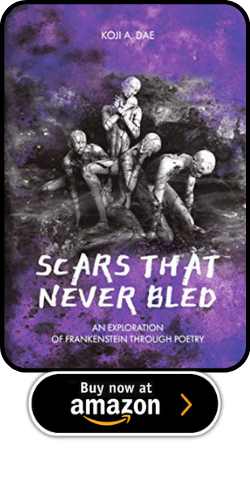 Mary Shelley's Frankenstein continues to haunt each generation. Although the story was written at the cusp of the industrial revolution, it continues to posit important questions about technology and humanity. In this book, Koji A. Dae uses poetry and tarot to explore some of the deeper questions within the classic Frankenstein archetypes. Join along to find pieces of yourself in the creature, the magician, Mary Shelley, the mother, god, nature, and the lovers. Please note: Stanza breaks may not display properly if you have a large font on your reader. Accessibility is important to me, so I created a format that allows font changes. However, if the poem does not appear to display correctly, please try a smaller font size.   Comments are closed.
|


Archives
May 2023
|

|

|
 RSS Feed