


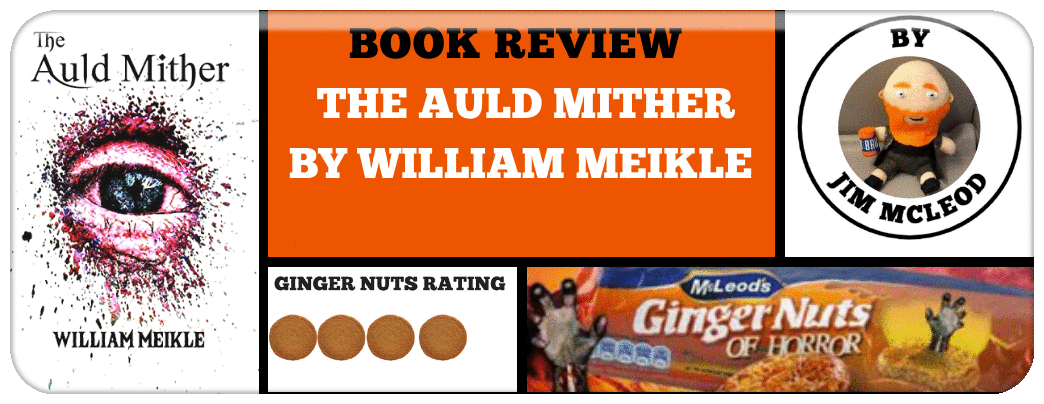
 One of the "Holy Grails" of reading a horror book is finding one that not only scares and entertains you, but one that provides a reader with that added extra value of being able to connect with either one of the characters or the story itself. It allows the reader to become fully immersed in the story, almost to the point where you feel as though you have drawn into the story by some magical narrative force. Willie Meikle's The Auld Mither (translated for those not fluent in Scots as The Old Mother), is probably the most immersed I have ever been in the story due to the way that I could connect with the narrative. Dave Duncan makes a trip back to his old family home after the mysterious death of his overbearing stoic father, the owner of a slaughterhouse specialising in the production of venison. Obviously, my family was never targeted by a Hag / Crone from Scottish folklore, but having one side of my family originating from the area in which The Auld Mither is set, as well as having a Grandfather who owned a slaughterhouse, where I spent many of my summer school holidays helping out, gave the book a more intense creep and scare factor, that will be experienced by the average reader. To put it mildly, this book scared the living crap out of me. I usually can finish a novella of this size and this quality in one comfortable sitting, but I found myself having to put the book down as the mounting sense of dread and the mind tricks that had me hearing the sound of cloven hooves clacking across our hall floor. The Auld Mither is a tightly constructed novella, with a breakneck narrative that manages to successfully combine Scottish folklore, with police procedural, and small-town life. Meikle has crafted a tale that is genuinely creepy, riffing on the plentiful myths of the Scottish Hag, ancestor deities who were generally ambivalent with regards to their interactions with human, but who were tasked with the protection of their chosen wards. The Auld Mither is best described as a rather angry version of Herne the Hunter. The The Auld Mither has decided to target the Duncan family; the reasons aren't made entirely clear as to why she has suddenly decided to do this, as the family business has been going on for decades. Meikle's depiction of her is a first class example of how to create a truly terrifying monster. He doesn't give her much in the way of motivation for her actions, other than being a protector of deer, but this adds to her power, to scare. She is a force of the wild and untamed nature of Scottish folklore. Sometimes the best monsters are just monsters. Meikle also makes good use of the fish out of water scenario for the main protagonist of the story. Dave Duncan's return to his old home, and the confrontation he feels at returning home and being reminded of a father who he had nothing in common with his handle with a sensitive hand, and links into the story perfectly. Is Dave his own man, is he a herdsman or a butcher, those questions play a critical role in the story. Setting a story in Scotland can be a difficult task, and setting one in Aberdeenshire is an even harder one. Getting that sense of a real place can be filled with pitfalls, especially where dialogue is concerned, in the hands of a lesser writer this can become a severe problem, I still looking at you Steve Alten, even after ten years of reading The Loch I haven't forgiven you. Meikle cleverly gets around this by limiting the number of characters who come from Aberdeenshire, Dave Duncan is essentially an incomer, having lived away from the are for so long, and even the DI in charge of the investigation is a new arrival to the town. Meikle gives the books a sense of place by an innovative line about how the taxi driver talks, it's subtle but it gets around the problem of filling the dialogue lines with phrases like AUCH EYE THE NOO, something which Mr Alten failed to understand. The AULD MITHER has a lean narrative. Meikle has always been a master of getting the balance between narrative economy and descriptive passages, and this book is no exception. Tightly plotted, and filled with mystery and terror this is a fantastic introduction to Meikle's brand of storytelling. My only gripe is the story ends just a little too abruptly; the story could have benefited from having a stronger sense of consequence and conclusion. But this is a minor gripe. The Auld Mither is a chilling tale of auld world clashing with the new world, with an interesting monster, and a great sense of storytelling it only serves to cement Meikle's reputation as Scotland's best horror writer THE AULD MITHER The Auld Mither, a crone-like hag with razor sharp bones for fingers, is killing off the proponents of a new abattoir in a deer farming community. And Dave Duncan seems to be next on the list. Can he figure out how to stop her? Or will he have to pay for the sins of his father?   Comments are closed.
|


Archives
May 2023
|

|

|
 RSS Feed