


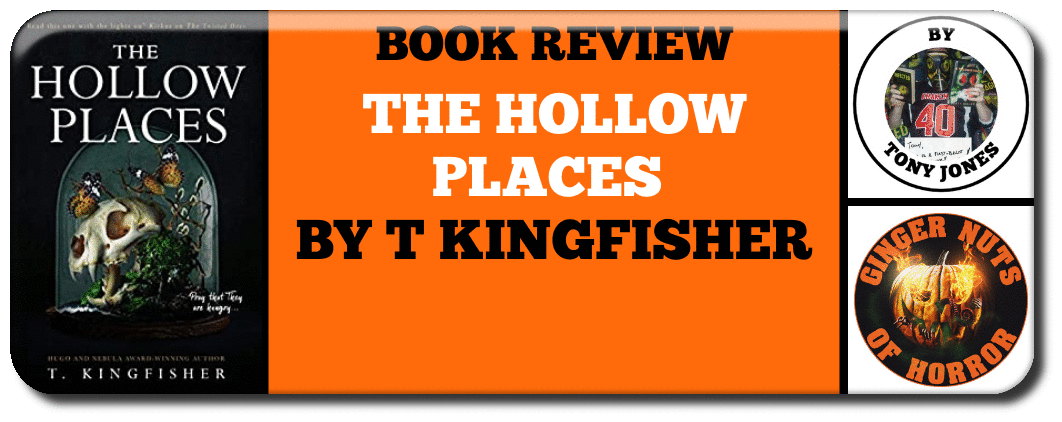
 Engaging and atmospheric blend of fantasy and horror T Kingfisher AKA Ursula Vernon builds upon the success of The Twisted Ones (2019) with a second bizarre, highly original blend of horror with dark quirky fantasy. In the literary world Ursula Vernon is probably higher profile than Kingfisher, who has authored an impressive range of children’s fantasy novels, but if her pseudonym is going to write fiction as compellingly strange as The Hollow Places then Vernon is in for a fight to be top literary dog. However, if they are anything like the wonderful two main characters, Kara, and Simon, from The Hollow Places, then they probably get on great and enjoy chilling out over a few black coffees or something stronger! Kingfisher acknowledges Algernon Blackwood’s The Willows in her endnotes as a key influence and if you enjoyed The Hollow Places then the 1906 original novella is worth tracking down for closer inspection or comparison. In the Blackwood classic two friends are taking a tour down the River Danube and are threatened by the willow-banks of the river, which apparently move around, although nothing is resolved, it points to the fact that there may be folds or rips in our world which can connect to the fourth (or other) dimensions. There is something of this in The Hollow Places, but this concept itself is nothing new and is frequently explored by other contemporary authors, such as Neil Gaiman in The Ocean at the End of the Lane, and goes all the way back to CS Lewis’s Narnia which is referenced several times in The Hollow Places. The Willows is also notable as it was regularly cited as one of HP Lovecraft’s favourite stories, which he also thought was particularly frightening, not a statement I would agree with personally. There are only three primary characters in The Hollow Places who are all equally engaging, their interactions play a major part in the success of the book. Events are narrated in the first person by 34-year-old Kara who is about to get divorced, however, her worst fear is the prospect of moving back home to live with her mother whom she does not see eye-to-eye with. Instead she if offered a job and lodgings by her favourite uncle, Earl, a kindly and elderly gentleman who owns a museum of oddities. Kara has wonderful memories of hangings out with Earl from when she was a child and helping out in his ‘Glory to God Museum of Natural Wonders, Curiosities and Taxidermy’ and jumps at the chance of returning and avoiding the judgment of her mother. Sadly, early in the plot Earl takes sick and leaves Kara in charge of the museum, for the sake of the plot this was understandable, but I was disappointed to see the old man depart as the dynamics between the pair was authentic and comfy as wearing your favourite pair of slippers. As the unassuming Earl fades from the story the barista Simon, who works in the neighbouring coffee shop enters, and plays a crucial role as the supernatural element of the story develops. Kara has known Simon for many years, without truly knowing much about him, so as things begin to get weird their friendship develops and strengthens. Considering these were the only major three characters in the book it was crucial the reader clicked with them, and I more than clicked, I loved all three and Kingfisher rounds them perfectly through Kara’s entertaining narrative voice. Whilst Kara goes through her divorce, she busies herself by starting a huge cataloguing project of the stock of the Museum of Natural Wonders which is a wonderful location for a story and if you ever visited a place like this as a kid, the memories will come flooding back. Kingfisher genuinely brings this shop of curiosities to life and considering the entire story is built around this location, this was as crucial as the convincing characters. The museum retains the quirky characteristics of Uncle Earl, who collects anything and everything weird and if folds in time really do exist which connect to other dimensions then this is the place! The plot is not necessarily the strongest element of The Hollow Places as it is rather minor and one could argue potentially underdeveloped, or ripe for further development. Kara and Simon find a small hole in the back of one of the rooms (not a wardrobe!) of the museum, they look inside and are confused by the impossible dimensions of the room it leads to, which includes a bed, an ancient corpse and a bolted door which leads to another world. CS Lewis’s Narnia is mentioned several times, this novel is rather different in that Kara and Simon do not go on a series of adventures, have to save anybody, or go on a voyage of discovery which can be common in fantasy novels with similarities instead of this. For most of the time they take baby steps into this other world and Kingfisher lets her imagination run riot in this location which has strange crossovers with our own. For example, they discover an old school bus but are unsettled by the fact that the bus is a slightly different colour and that it seems like there are children alive under the plastic which lines the seats. Slowly, things begin to get more threatening and that is the core of the story. I thought this was a great book, but if I were being hyper-critical, I would suggest that they went backwards and forwards through the hole in the wall without too much happening or major consequences slightly too often. Also, one could have argued it could have done with a bigger finish, however, the conclusion did ring tune with the rest of the rather low-key and personable tone of the book. The ending also remained faithful to the fantastical elements of the novel which was more fantasy than horror. If I recall correctly an otter popped up in Algernon Blackwood’s The Willows and in a manner of speaking an otter plays a key role in The Hollow Places also, which was a nice touch. The Hollow Places is well worth checking out, even if it is not particularly scary it convincingly blends the likes of Neil Gaiman’s Coraline and Lewis Caroll’s Alice in Wonderland with a unique horror vision which is soaked with LSD/acid (you’ll have to blame Simon for that analogy!) Highly recommended. Tony Jones Check out this fantastic guest post from T. Kingfisher here 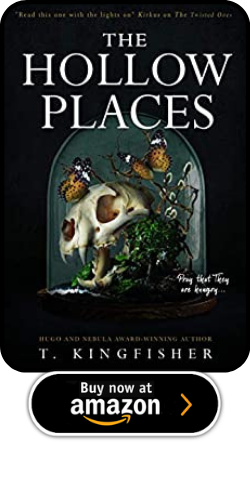 Carrot has moved into the Wonder Museum - an eclectic collection of taxidermy, shrunken heads, and Mystery Junk owned by her Uncle Earl. For Carrot, it’s not creepy at all: she grew up with it. What’s creepy is the corridor behind one of the museum walls. There’s just no space for a corridor there – or the concrete bunker, or the strange islands beyond the bunker’s doors, or the unseen things in the willow trees. Carrot has stumbled into a horrifying world, and They are watching her. Strewn among the islands are the remains of Their meals – and Their experiments. And even if she manages to make it home, she can’t stop calling Them after her…   Comments are closed.
|


Archives
May 2023
|

|

|
 RSS Feed