


 Altogether Machin’s anthology is a very successful attempt to condense a long and extraordinarily rich era of quality fiction into just nine stories, also providing a good mixture of the renowned and the less well-known. It’s highly recommended for readers who are new to the stories of the period, while also rewarding long-term fans. And in answer to my question above, yes, those inter-war stories are every bit as deserving of inclusion as the pre-war ones! As noted by Jack Sullivan in Elegant Nightmares, his now legendary study of the English ghost story, the period between 1880 and the start of WWI is often referred to as the ‘Golden Age of the Ghost Story’ due to the volume and quality of the fiction published in that time. However, James Machin’s new anthology, BRITISH WEIRD: Selected Short Fiction, 1893-1937 (Handheld Press) covers a slightly shifted window of time, starting in the Late Victorian era and ending with WWII. This tacitly makes a case for considering the inter-war writers of such stories as being on a par with the pre-war titans of British supernatural fiction, but is this claim justified? The nine stories and one essay are in chronological order. Things get off to a fairly predictable start in 1893 with ‘Man-size in Marble’ by Edith Nesbit. I say “predictable” because this is her most popular story, but I was still glad to see her here because she is to my mind the most unfairly treated female author from this era. The quality, compassion and sheer scariness of her writing deserves far more attention than she gets. This tale of a young couple’s collision with some unusual statuary is a concise classic frightener that also pulls at the heart-strings. John Buchan can certainly not be described as overlooked where his adventure fiction is concerned, but his supernatural writing is ignored to a ridiculous extent by the world at large. ‘No-Man’s-Land’ is a long story about the bloody roots of fairy mythology in the British Isles, in this case the Scottish Highlands. The first third is a bit hard-going due to the enormous amount of regional dialect involved (one of the characters is a shepherd), so much that even the abundant notes by Kate Macdonald still don’t cover it all. However, once it gets going it has the same readable, yarn-like quality of Buchan’s bestselling novels, augmented with a twist of clammy underground horror. The way the hero’s psyche buckles and warps over time in a fruitless attempt to accommodate the terrors he has witnessed is expertly done, too. At his most macho Buchan sometimes seems to look down on “damaged sensitives” (as he describes victims of shell-shock in The Dancing-Floor), but this story proves that he is capable of compassion for the mentally disturbed. Similarly, while Buchan can be dismissive of women (like many writers of the time) occasionally he will pull a really tough, competent female character out of the bag, and the shepherd’s quiet, hard-as-nails sister is definitely one of those. If you enjoyed Karl Edward Wagner’s ‘.220 Swift’ you should definitely check out ‘No-Man’s-Land’, and vice versa. There is more fun for nature-lovers in ‘The Willow’ by Algernon Blackwood, who needs no introduction to fans of sylvan or “pagan” horror. Blackwood shares Buchan’s fascination with the denizens of the country’s wild places, though Blackwood’s ghosts or elementals are often less tangible and more all-engulfing. For Blackwood, everything is permeable to the weird; there are no really safe places. Of course, the kind of lonely river island where the heroes of this story pitch camp amid a population of willow trees is particularly dangerous…This is definitely one of the more obvious inclusions in the anthology, but it’s such a pleasure to read and re-read, one of the best, most beautiful and also most unnerving evocations of the weird spirit that animates the natural world. By contrast ‘Caterpillars’ by E. F. Benson is positively chatty, at least at first, as we find our hero holidaying in a charming villa on the Italian Riviera (it often feels like Edwardian ghost story protagonists spend most of their life on holiday, recovering from some unspecified illness.) But it actually packs a very satisfactory punch of supernatural horror and is a reminder not to underestimate the dark power lurking behind the lightness of touch that made Benson so famous as a writer of comic novels. Sadly, the next writer, John Metcalfe, never got the fame he deserved, although he has been somewhat rediscovered of late. ‘The Bad Lands’ is about a man who stumbles on a very nasty ‘thin place’ between our world and another while holidaying in a South-West coastal town. This story comes from 1920 and feels very modern from a psychological point of view. The hero is frankly described as a ‘neurotic’ but his shaky mental health record reinforces the horror of his supernatural experience, rather than discrediting it. Metcalfe posits that none of us, sane or otherwise, are safe from such places: anyone could step on one of these inter-dimensional landmines at any time. Stylistically the story is superb, too, and Metcalfe shows tremendous skill in describing the malignancy of the local scenery, a deep well of horror that is no less acute for its formlessness. I love virtually everything I’ve read by Metcalfe (see here for my review of his collection The Smoking Leg: https://darkling-tales.dreamwidth.org/112222.html ) and I do hope his collections become more widely available soon. Things get more obscure with ‘Randall’s Round’ by Eleanor Scott. Although her collection of the same name was republished a few years ago (see my review here: https://darkling-tales.livejournal.com/163701.html) she remains largely unknown. While not up there with the Bensons and Nesbits, and more than a little derivative of MR James, she’s a very sound second-tier writer of antiquarian and folk horror, with the story chosen here being particularly on-trend at the moment. However, it is L.A. Lewis who represents the real dark side of the moon here. I hadn’t heard of him at all until I read this, though you can find out a fair bit about him in this intriguing review of his collection ‘Tales of the Grotesque’ And LA Lewis, on this showing, is bloody good. ‘Lost Keep’ (1934) is that rare thing, a story that serves as a moral fable while retaining the power to frighten. A forerunner of stories like Dean Koontz’ famous ‘Down in the Darkness’, it deals with an age-old theme, the corrupting effect of unbridled power, embodied here in a peculiar scale model of a castle of unknown location. There are some really nifty little plot twists here, and some of the details of the keep’s horrors are surprisingly visceral for the time. And despite having a strong moral core, it nonetheless manages to feel quite nihilistic. I am very keen to find out more about Lewis now, and the inclusion of this story is a great coup for Machin. Of course, no anthology of this kind is complete without an appearance from Arthur Machen. Machin (with an ‘i’!) has left the beaten track here, having chosen ‘N’, a later story, to represent the author. It uses one of his specialties, a framing device or prologue consisting of an urbane, curious narrator-cum-flaneur discoursing to his mates about some weird corner of London’s psychogeography. This worked well in ‘The Three Impostors’ and ‘The White People’, for instance, though ‘N’ actually has three different nested narratives, which feels like a bit much. The discourse part - which deals with dimensions that may exist alongside each other and intersect at certain points to reveal unsuspected worlds of wonder and terror - is overlong, and my attention was wilting by the time I got to the meat of the story, if you can describe something as elusive and mysterious as “meat”. However, there is still a genuine thrill of magic in this story for those who persevere, and a note of great pathos in its final account of a mentally disturbed young man who stumbles on the hidden glories of, er, Stoke Newington. The last two places at Machin’s table are both given to Mary Butts, a Westcountry Crowley-botherer and modernist whose work I wasn’t familiar with until now. Her story, ‘Mappa Mundi’, aims to do for Paris what Machen’s ‘N’ does for London, attempting to lift the lid on the occult forces that imbue the city and occasionally snatch away a curious young American or two. If you thought ‘N’ was crammed with too many oblique cultural references to forgotten things, you won’t like ‘Mappa Mundi’, and I found the first half tiresome. It’s many references to magical practice and various divinities have that slight aura of smugness characteristic of supernatural tales penned by fervent dabblers in the occult, and the coyness with which it approaches the shadowy forces at large in Paris is more often irritating than tempting. It picks up towards the end, and there isn’t any tidy over-explanation, but you’re much better off checking out Robert W Chambers’ Paris stories from his King In Yellow collection. Butts’ second contribution is a long Essay, ‘Ghosties and Ghoulies’: Uses of the Supernatural in English Fiction. I found this more interesting, as it’s written in an approachable style, covers some of my very favourite authors, and makes some good points about the differences between types of supernatural fiction. I liked her description of what a good weird tale should evoke: “not simple horror or terror at a new and generally evil world, usually invisible but interlocked with ours; we mean also a stirring, a touching of nerves not usually sensitive, an awakening to more than fear – but to something like awareness and conviction or even memory.” I also enjoyed her pithy description of MR James as “a master of plain style like plain-chant”, and her suspicion that James himself must have experienced some kind of ghostly encounter in his past is lent some weight by the contents of ‘A Vignette’, a quite recently unearthed story of his that seems to be based on a real experience from his own youth. But unlike the mainstream cultural media of today, Butts doesn’t confine her praise to James alone, and her assessment of EF Benson, John Buchan and Walter de la Mare is also sound (though she only discusses his poetry in passing). Her opinion of more recent writers such as Metcalfe, WF Harvey and the like is more qualified, as she seems to be turned off by anything too decadent or nihilistic or intense. Algernon Blackwood also comes in for a bit of criticism for being intermittently verbose and vague, which is deserved in my opinion. Butts also provides a very good takedown of the trend for smug and over-polished Celtic nationalism in weird fiction, and she also takes pains to recommend superior authors from Ireland and Scotland such as “AE” and Lady Gregory. However, her greatest scorn is rightly reserved for those authors who write ghost stories solely for the purpose of proving some point or other about the afterlife. I can’t really say more without spoiling the whole essay, but it’s a very good jumping-off point for anyone interested in getting to know the best weird fictioneers of the day. Altogether Machin’s anthology is a very successful attempt to condense a long and extraordinarily rich era of quality fiction into just nine stories, also providing a good mixture of the renowned and the less well-known. It’s highly recommended for readers who are new to the stories of the period, while also rewarding long-term fans. And in answer to my question above, yes, those inter-war stories are every bit as deserving of inclusion as the pre-war ones! 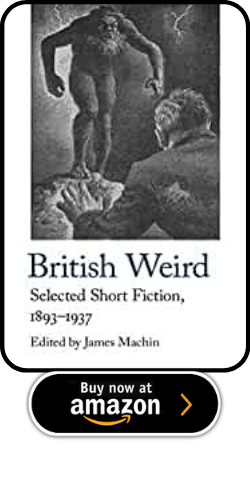 Following the success of Handheld Press's 2019 best-selling anthology Womens Weird, British Weird is a new anthology of classic Weird short fiction by British writers, first published between the 1890s and the 1930s. Embracing the famous and the undeservedly obscure, this collection - curated by James Machin, author of Palgrave Gothic's Weird Fiction in Britain, 1880-1939 - assembles stories to thrill, entertain, and chill. Featured stories include: 'Man-Size in Marble' by Edith Nesbit (1893) 'No-Man's Land', John Buchan (1900) 'The Willows', by Algernon Blackwood 'The Man Who Went Too Far', by E F Benson (1912) 'N' by Arthur Machen (1934) 'Mappa Mundi' by Mary Butts (1937) The collection also includes Mary Butts' influential essay 'Ghosties and Ghoulies' (1933), on British supernatural writing. Machin's introduction describes the background for these excellent stories in the Weird tradition, and identifies their use of peculiarly British preoccupations in supernatural short fiction.   Comments are closed.
|


Archives
May 2023
|

|

|
 RSS Feed