


DEFOE 1666 [SPLASHES OF DARKNESS]
30/11/2021
Comic-books are a medium, not a genre; they can tell any story and suit any palate. You want horror? I've got bottles of the stuff. Welcome to 'Splashes of Darkness.' 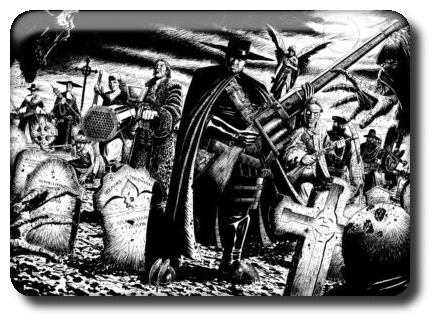 The pitch: London, 1668. It is two years since the city was devastated by the Great Fire, the inferno caused by a ‘comet’ passing over the capital. But from the ashes rose the undead, hungry for the flesh of the living. Protecting the populous are zombie hunters like Titus Defoe, ex-Leveller and now agent of the Crown. As Titus battles the zombie horde, he comes to realise that some sort of intelligence is guiding them. Along with his Brethren of the Night, he must look deep into the rotten heart of the undead capital to discover the cause of this evil canker. The taste: Welcome back, friend. I’ve a flagon of 1666 waiting for ye that will, I think, be deemed favourable. ’Tis in some ways a tried and tested formula: a civilisation under siege, drowning in waves of o’ the walking dead, yet there are significant notes o’ difference too. Here. Have a sniff. There’s more’n reeking flesh and fear to be found at the bottom o’ this draught. The base is a strong yet often unexplored historical setting, sprinkled with rusty flakes of steampunk to spice things up. Underlying it all, deeper ’n necrosis, is the squalid tang o’ poverty and injustice infecting the populace just as surely as the plague, driving their desperation – and Defoe’s determination – to cleanse the world of this sea o’ corruption. Ye might need to hold yer nose, but down it anyway. Like V for Vendetta, it’ll do you the power o’ good. Take up arms, citizen; the true enemy is revealed. 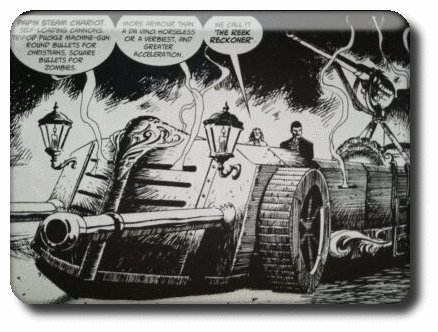 Thoughts on the comic: With an out-of-touch elite floundering to maintain power, an unstoppable disease ravaging the country indiscriminately, and a divisive class war brewing, one might be forgiven for thinking Defoe 1666 was a satire on the last couple of years. The fact that it springs from the mind of Pat Mills (creator of Charley’s War and Nemesis the Warlock) – and the pages of 2000AD (his legendarily subversive British comic) – would almost guarantee it, save for the fact that Defoe first hit the shelves in 2007. Nevertheless, this is a story which is deeply critical of the corruption power brings to both the ruling class who inherit it and the underclass who (very occasionally) manage to wrest it from their hands. On the surface of course, it’s a straight-up gore-fest, full of spectacular violence, awesome anachronistic weaponry, dark conspiracies, and alt-history zombie shenanigans. The anti-hero at the heart of it all is Defoe, a bitter brute, trying to find a spark of righteousness in a darkened world. He’s not the kind of person you warm to for his personality, more for his grit. He’s the last good man, as it were; the ronin, the wandering gunslinger, the maverick cop—brought briefly to heel, yet ready to turn on his masters if the truth points their way. 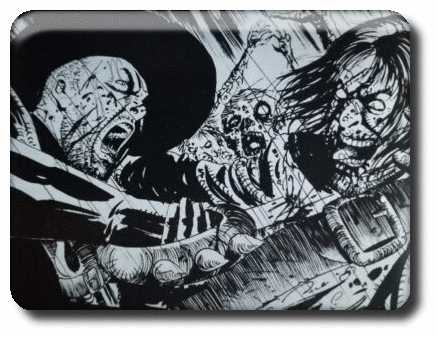 Leigh Gallagher brings Defoe vividly to life with astonishing penmanship that at times overwhelms the senses. His urban sprawls are filthy, wooden structures knotted and warped, his rain spattering or relentless, the clothing wrinkled and highly mobile, while his corpse-flesh boasts a wealth of research on states of decay. Let’s focus on the zombies for a moment more, because this story brings something new to the table: a sense of organisation, an intent that runs deeper than braaaains. Gallagher conveys it all through the tilt of a head, the line of sight, the body posture… It’s chilling. The calculation of a cunning predator. These are not your normal rotters, and this is not your normal zombie apocalypse. As we follow Defoe into the Office of Ordnance in Whitehall – the Q Branch of the day – we meet Sir Isaac Newton, his *extraordinary wig, and the scientific marvels he’s made under the tutelage of the ‘angels’. The intervention of non-human entities – both in the creation of the threat and in the means to fight it – fascinates me. Once small set of panels demonstrate that people see what they expect to see within their limited experience, so where one person sees demons in the blood on a microscope slide, another sees dragons. Are the ‘angels’ truly heavenly beings then, or aliens from another world? We don’t see them in this first volume, but we have no reason to doubt their existence. Of further interest to geeks like me are the ‘vizards’ – seen briefly from afar – who might be this world’s equivalent of **superheroes, or simply the equivalent of a Rocketeer air force using angel-inspired tech, much as the Brethren of the Night do with their steam-powered arsenal. 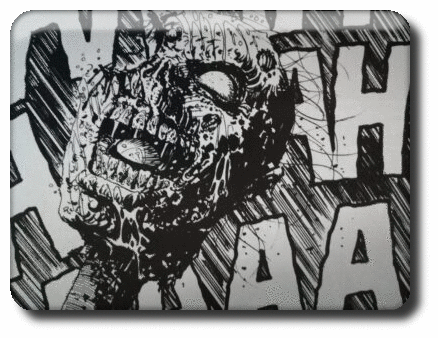 History is not forgotten. Mills has clearly done his research, slipping notes and sly references into his script to add layers and texture to Defoe’s world. Newton and Oliver Cromwell (well…Cromwell’s head) are front and centre, but cultural Easter eggs litter the text. Some will ring only faint bells whilst others clang in bold print, distracting the reader from the story. I think he can be forgiven. If you like to be educated as well as entertained, there’s fun to be had parsing out true cultural reference points from his raw imagination. If you find the habit irritating, just brush these off and move past. There’s plenty more to occupy your attention. This is a richly detailed book with a bleak but firm social conscience. The art is exquisite and gruesome, the people ugly yet full of character, and the nuggets of world-building are alluring. The first time I read it, I put the thing down feeling a little confused at the sheer volume of possibility hinted at but barely developed. A second reading (and a bit of thought) has made it all much plainer, but there is still an awful lot which remains unanswered. Who or what are the angels, what is the relationship between Cromwell, the Queen of the Zombies, and the mysterious Mene Tekel—and for that matter, what did Mene Tekel actually do? Did they enter into a bargain with the Zombie Queen, did they call the ‘comet’ down, or are they responsible for the actual raising of the dead? All I can say for sure is that I recommend Defoe to you all, and suggest you maybe pick up volume 2 at the same time. Come the end, you’ll be glad you did. * A separate life-form, practically. Gallagher must have cursed the day Mills wrote Sir Isaac into the tale. The smug bastard’s barnet must have been hell to draw once, let alone panel after panel. ** Vizard is an archaic word for a mask – and a Mask is itself a colloquial name for for a superhero. Of course, I might be overthinking this. You should totally seek out Neil Gaiman’s brilliant 1602 though, if the idea appeals. There are a few mini-series bringing Marvel’s familiar heroes to the 17th century. 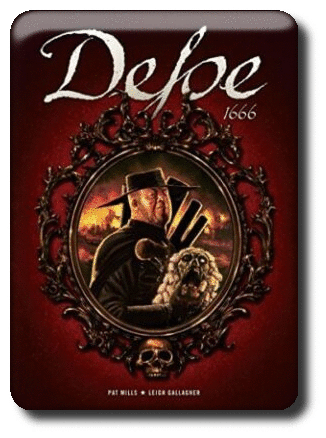 Written by Pat Mills Illustrated by Leigh Gallagher Lettered by Ellie De Ville Published by 2000AD Reporter: Dion Winton-Polak TODAY ON THE GINGER NUTS OF HORROR WEBSITE |


Archives
May 2023
|

|

|

 RSS Feed