


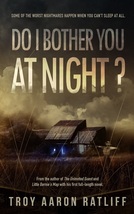
 Troy Aaron Ratliff’s Do I Bother You at Night is an achingly slow-moving novel that brings you into the lives of some very interesting, likable characters, introduces some unusual events, and then freezes everything like a fly in amber for several hundred pages before the end. Everything about it is slow, from the buildup to the conflict to the dissolution of its main character Sylvester Petersen, and by the time the conclusion finally rolls around, you’re left with a terribly ambivalent feeling about the entire novel. DIBYaN shouldn’t have been written as a horror novel, despite the somewhat horrific parts at the end (at approximately 460 pages, you have to get through a lot to get to the exciting bits). Horror elements aside, it would have been an excellent, moving piece of literary fiction, describing the travails of a man whose wife has recently committed suicide in the small town in which they live. That’s how the first nine tenths of the novel read. Long passages about Sylvester’s feelings, motivations, and thoughts take up the majority of the text; in a way, it reads like an Anne Tyler novel without the constant dry humor and bizarrely quirky characters. This is not to say that the characters are a problem with DIBYaN. On the contrary, they’re all very well-written and realistic. Ratliff obviously has great affection for them, and that affection is contagious. Nevertheless, not enough happens to any of them to justify the page length, especially when they simply drop from the narrative, one by one, until only Sylvester and his ineffectual, milquetoast antagonist are left. Between the grammatical errors and the overwriting, DIBYaN would have done better with a good editor to tighten up the story and eliminate the filler. Ratliff has an eye for description, for both internal and external dialogue, but the lack of a copyeditor made itself known fairly early on. Despite these weaknesses, DIBYaN is very well-written, with excellent descriptive power and imagination. Sylvester’s downfall is both plausible and tragic, given the circumstances, and his alienation from his few friends makes up for the lack of true conflict. In many ways, Sylvester is his own enemy; the terrible circumstances of his wife’s suicide and his reaction to it drive the novel as much as the bizarre occurrences at his farm. There were times where I wanted to give up reading, but I’m glad I stuck with it. Just remember that it’s a long road to the end.
reviewed by David DubrowClick Here for more great horror fiction reviewsComments are closed.
|


Archives
May 2023
|

|

|
 RSS Feed