


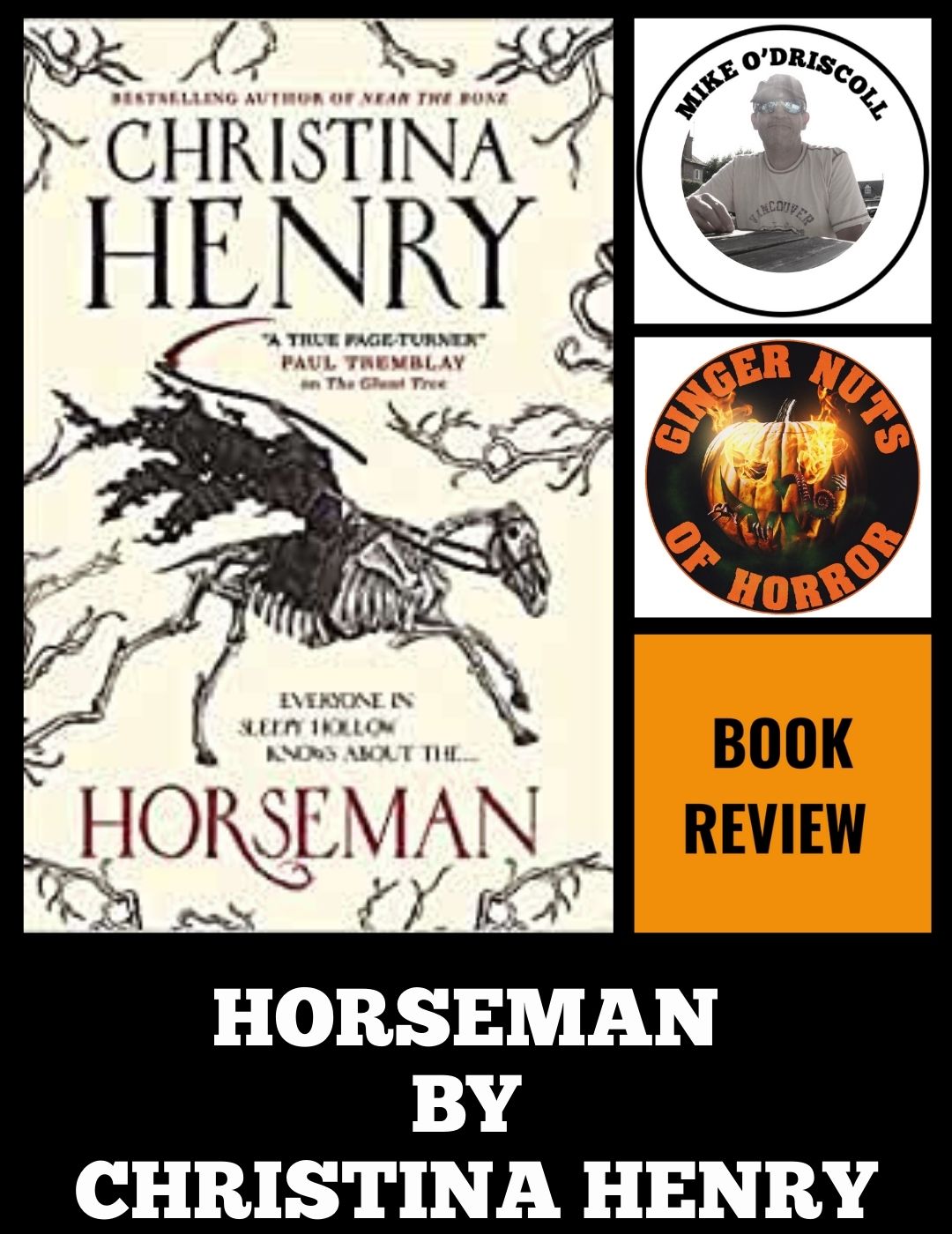
Horseman by Christina Henry Publisher : Titan Books Language : English Hardcover : 352 pages ISBN-10 : 1789095972 ISBN-13 : 978-1789095975 Though I’m unfamiliar with Henry’s work, she has built up an impressive back-catalogue of dark fantasy fiction, initially through her Black Wings series, featuring a heroine who job it is to escort souls into the afterlife. More recently, over the course of three books, she has explored the world of Lewis Carroll’s Alice tales, extrapolating from the original source material to offer a darker vision of Wonderland. Clearly, mining the world of classic children’s literature and fairy tales has proved successful for Henry, with a post-apocalyptic retelling of Red Riding Hood in The Girl in Red, and a reworking of Peter Pan in her 2017 novel The Lost Boy. And now comes Horseman, which revisits the hamlet of Sleep Hollow some thirty years or more after the events depicted in Washington Irving’s original tale. The novel is narrated by fourteen year old Bente, grandchild of Brom Bones and Katrina Van Tassel, who, whilst out re-enacting tales of the headless horsemen with a friend, discovers a child’s decapitated body in the woods near Sleepy Hollow. Animal mutilations are followed by more killings and disappearances. The main narrative charts Bente’s determination to discover who or what lies behind the savage murders which, despite parental denials, appear to be directly linked to the myth of the ghostly horseman. Interwoven with the overarching story is Bente’s struggle to assert her identity, a struggle that is foregrounded from the outset when we first encounter her as ‘Ben’, playing in the woods. It’s not until the end of the first chapter, when she returns home and is confronted by her grandmother, that we discover the truth: “You are not a boy, Bente, you are a girl, and it’s high time you started acting like one.” The conflict between Bente’s self-perception as a boy and the pressure from parents, peers and neighbours to conform to gender expectations, adds a layer of complexity to the narrative, but this is not without its problems, something I’ll return to shortly. Before doing so, I should point out that although Henry gives us a reasonably paced and at times gripping horror story, her depiction of the world of Sleepy Hollow was largely unconvincing. The speech and behaviour of many of the characters (not least Bente herself), is anachronistic, and when one encounters the people of what would have been a largely conservative and religious community, calling a young girl a ‘bitch’ and using expressions like ‘horseshit’, it jars. The novel is, I imagine, primarily aimed at the Young Adult market, and perhaps writers who write for this audience feel it is necessary to adopt a vernacular more suited to contemporary readers. I can’t say for sure but it feels as if there is a commercial imperative at work here, but to this reader at least, the practice seems patronising. Still, if you can get past that, you may find yourself caught up in the various plot strands that Henry strives to pull together. In the course of her investigations into the grisly murders, Bente, who has always been fascinated by the headless horseman, discovers the truth about her grandfather’s involvement in the legend, and also learns how and why her own parents met their deaths. Numerous obstacles are placed in her way as she draws closer to the truth—not least Katrina’s determination to hide (shield, perhaps is the better word) Bente from the reality of past events, but also the perverse and unwanted attentions of a much older, would-be suitor, hints of potential child abuse, and accusations of witchcraft—but there’s something too formulaic about it all. These disparate elements all seem to fit too neatly together, as though the author selected plot elements from a grab-bag of generic tropes. A hoary old legend manifesting as reality, ghostly apparitions, child killers, witches, creepy uncles, dark secrets—all make an appearance, as though novel was constructed by numbers. What is new, and what should have given the novel more bite, is the attention given to Bente’s struggle to forge her own identity. Yet, in focusing so much on the question of Bente’s gender, it would seem that Henry was in conflict with the constraints of the Young Adult market. Why, after all, highlight her resistance to gender norms if you’re not going to deal with many of the issues that the struggle raises? Bente spends the entirety of the story in defiance of Katrina, asserting that “no one was ever going to make me be female” and that when old enough, she was “going to cut my hair and run away and be a man in some place where no one had ever heard of me.” In her will to determine who she wants to be, she’s as much an oddball in Sleepy Hollow, as was her grandfather’s old adversary, Ichabod Crane. Like Crane, who couldn’t fit in with the insular, isolated community of Sleepy Hollow, Bente’s refusal to conform to behavioural norms, marks her as an outsider. This strand of the narrative is given as much weight as the main plot, but in doing so it raises questions, many of which remain unresolved, thus detracting from the overall story. Henry hints that Bente’s identification as male is rooted in the loss of her father when she was very young, and perhaps in Brom’s failure to accept the loss of his son, but neither rationale is convincing. Perhaps it’s connected with the affinity she feels with the Horseman, representing (at least for her) mystery, wildness and freedom, all of which she views as masculine traits. One can empathise with the spirited Bente’s desire to be free of the rigid constraints of genteel, early 19th century femininity, but given how much of the novel is devoted to her own thoughts and feelings about identifying as male, not to mention the fact that she’s taller and physically stronger than her peers, it seems inconsistent that the subject of menstruation is never mentioned. How does she feel about it, about the way her body is changing in relation to her friend Sander’s? Similarly, while violence and gore can be described in detail, the text elides any discussion of Bente’s desires. Consequently, she comes across as asexual, the focus for other characters’ feelings, whether these be honest and open (as in the case of Sander), or abusive and exploitative in the case of a much older suitor (whose advances are initially condoned by Katrina). Even in the final part of the novel, with Ben now living as an adult male, we’re still given no sense of him having any sexual feelings or desires. He tells us “I could never love someone who wanted to cage me, make me something I was not,” but gives us no real sense of wanting anything other than “to run free under the stars.” The locus of this pretty narrow and ill-defined notion of freedom is, of course, the Horseman, but the explanation that Ben offers for his existence—“The horseman had sprung from me, from my longing for something greater than the world I know”—is a pretty tepid rationale that fails to gloss over the absence that lies at the heart of who Ben really is. Given that Henry chose to make the question of gender identity central to her narrative, it feel like a missed opportunity. Mike O’Driscoll August 2021 Horseman |


Archives
May 2023
|

|

|

 RSS Feed