


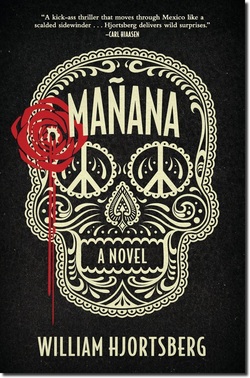
 CLICK ON IMAGE TO PURCHASE A COPY CLICK ON IMAGE TO PURCHASE A COPY A work that is so much of its genre, it is like a crystallisation of its most salient characteristics, Manana could almost be read as a template for how one constructs gritty, violent crime drama. Simultaneously its greatest strength and weakness; for those who enjoy such fare, there will likely be little better; the book is vibrant, fast paced, explicitly bleak, violent; deliciously nihilistic and amoral. There is no finger wagging judgement here; no divine or poetic justice for characters that behave in less than savoury ways (which is to say, all of them). This is an almost documentary examination of one man's descent into criminal culture's depths, beginning with a well drawn and compelling take on a classic situation: Protagonist wakes, little to no memory of the previous night (in this instance, in bed next to the corpse of a drug addict he is passingly associated with). Protagonist sets out to recover his lost memory, not to mention the wife who is mysteriously absent, along with the rogue's gallery they'd been keeping company with. From their inception, characters fulfil archetypes that most readers (certainly those familiar with this particularly hard boiled form of crime fiction) will recognise. This feels more deliberate than a lack of invention; a stylistic choice which allows the writer to explore and extol the virtues of his chosen genre, the resultant work eminently readable, throwing just enough surprises at the reader to maintain impetus and interest. Todd, the protagonist and narrative voice of the piece, is immediately recognisable as the betrayed lover; as the naïve but fast learning anti-hero, the reader immersed in his world, his thought processes, but also kept at an intriguing distance by a number of concerns and questions: is he responsible for the quiet carnage to which he wakes? Is there a killer lurking beneath his faintly bohemian facade? It is at this point that the book refers to its genre roots to drive its narrative forward: Todd sets off in pursuit after his missing wife across Mexico, the various ills and misfortunes in which he finds himself tempering him for later confrontations and revelations; an almost “coming of age” sojourn, in which all of the comforts and certainties of his comparatively clean cut existence are ripped away. Like all of the characters, Todd is more a cypher for the narrative than a particularly complex or ambiguous entity in and of himself; the nature of the story is in its colour, its immediacy and its impetus rather than in any belaboured character examination. In that, it succeeds beautifully, though there are moments when Todd's capacities for violence, ingenuity and amorality lend flavour to his character. A supporting cast of rogues, wretches, brutes and sociopaths provide opportunities and stumbling blocks throughout Todd's quest, none entirely sympathetic, the vast majority wholly (and deliberately) unpleasant, from scabrous ex-cons and drug addicts to seasoned criminals, Hjortsberg presents Todd (and, thereby, the reader) with a spectrum of human filth in which to wallow; characters that reflect a little of Todd's own; elements of which he accrues like a coral reef until his final descent into criminal abandon. Even rare moments of humanity and moral reluctance tend to be punished rather than rewarded; treated as weakness in a world where even the slightest scent of blood invites a kind of cannibalism. Barring the (few) major players in the narrative (Todd, his missing wife; antagonist Nick), most characters do not last beyond what service they provide to the story: either through intent or accident, Todd leaves behind him a trail of corpses and calamity, his general lack of remorse determined by a single-minded desire to find his wife and discover the truth about the night that saw them parted. This sequential quality is the manner in which the narrative is constructed: it moves at a rapid pace from moment to moment, scenes occurring in the manner of a movie, which the novel reflects in more than a few ways: its general briskness, its concise, highly visual language...one could easily imagine this story making a successful transition to the big screen, where it would be entirely at home. Then the setting. More than any character, any aspect of the story, the setting sings. There's almost a painterly aspect in the way that Hjortsberg captures Mexico in a manner that makes it so vivid in the reader's mind, so exquisitely detailed, from the nature of light and heat at particular hours of the day, to food, language, architecture...the reader sits on Todd's shoulder during his quest through the country, meeting the same people, experiencing the same places, eating the same food...the verisimilitude is exquisite; one of the strongest, most enduring aspects of the book. For those unfamiliar with this particular genre and the subjects around which it revolves, the book will hold little in the way of appeal; it knows its audience and it indulges them utterly, to the point whereby it doesn't particularly care whether it alienates others. That is one of its most endearing qualities, but also one that potential readers should be aware of: if you have no taste for this species of down and dirty, action-driven, guns blazing, knives flashing, vivid red drama, then you'll find nothing here. On the other hand, the prose is so concise, the imagery so lacking in ornament, that it is an extremely easy read, despite the often misanthropic bleakness of the subject matter. Again, enhancing its highly visual, cinematic quality, the story hurtles along at breakneck speed, every scene precisely pruned and bounded; each a self contained situation, that could serve as a short story in and of itself, in many instances. For those not in love with dense or long winded, prose, Hjortsberg's style is eminently approachable; concise and pragmatic, providing only what is necessary to communicate a sense of place and ethos. For some, the book may be too narrow in this regard, particularly with regards to the characters, who are, as already mentioned, generally functional in nature rather than studies or entities in and of themselves. Criticisms?; The book is perhaps a chapter or two too long; there is a point at which I felt the story should have ended; somewhat more openly and ambiguous than it does, the latter entries feeling as though it is making explicit what is already clear from implication. There are also one or two instances where those unfamiliar with the tropes and traditions of this form of fiction might question how fluidly characters shift from one state to another; how readily they cope with situations that, ostensibly, should shatter their minds. Protagonist Todd is particularly conspicuous in this regard; even in the most extreme of circumstances, he demonstrates a degree of cool and (eventual) composure that borders on the psychotic. In a longer, more character-driven work, it would have been salient to linger over these moments; to describe a more protracted, fraught period of transition. However, this is not the nature of the story or of the genres it references: it is explicitly and unambiguously hard boiled from the first instance; it wants to whisk the reader along; not mire them in tedious back story or motivational issues. Its success depends on its pace, its colour and its drama; moments of conflict manifesting physically rather than internally, expressed in the violence that (inevitably) occurs between its characters; the depths of amorality in which they find themselves. As close to a cinematic experience as it's possible to find in printed format, a love letter to crime drama; an exhilarating read. GEORGE DANIEL LEAComments are closed.
|


Archives
May 2023
|

|

|
 RSS Feed