


|
By George Ilett Anderson 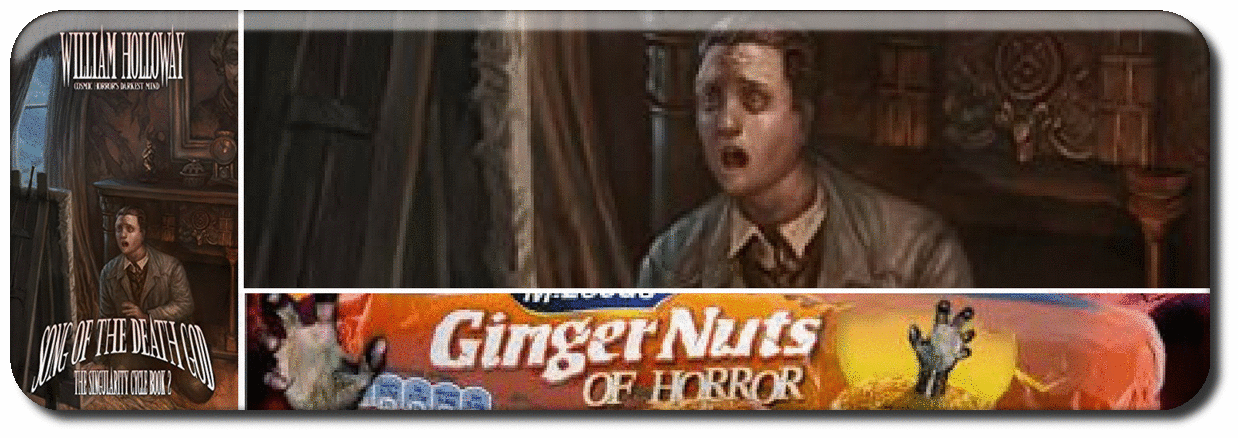 Seasons in the Abyss Out of all the different flavours and styles of horror fiction that I read, one that I invariably gravitate back towards is cosmic horror. There’s just something about that style of writing that has this almost primal tug at the subconscious, awakening long dormant thoughts about existence and fear of the unknown. It’s a feeling heightened when you come across those writers who just have this almost supernatural gift for boiling down cosmic horror to the essential salts that give it substance and form; that overwhelming sense of dread and despair at realising the stark and brutal nature of reality and your insignificance within it. On the basis of “Song of the Death God” from Horrific Tales Publishing, I’d say William Holloway is one such writer. In this, the second book of his Singularity Cycle, Holloway has crafted a wonderfully bleak and nihilistic tale of obsession and forbidden knowledge. I have to admit that initially I was expecting a direct sequel to “The Immortal Body” and the events of that book so was a bit taken aback at first read. Whereas its predecessor was a modern day tale of old gods and dark forces invading the present, this prequel jumps back to the nineteenth century to focus on the instigator of that novel’s carnage, Liche, or as he was previously known, Carsten Ernst. Carsten, born into a privileged but debauched German family is the archetypal studious son of a patriarchal family. A cold, detached and overtly analytical person, his life is irrevocably altered when he witnesses a séance with inexplicable forces at work. Determined to master powers he cannot rationally explain, Carsten commits himself to searching for the wellspring of the occult powers witnessed. An epic journey ensues that leads him to the edges of humanity and beyond as he discovers the forbidden tomes that hold the keys to life and death, The Immortal Body and Song of the Death God. After reading this novel, it’s hard not to be reminded of certain elements prevalent in the writing of H.P. Lovecraft: the irrepressible thirst for forbidden knowledge, the hints at a grand mythology and of horrors lurking just out of sight. Yet to compare “Song of the Death God” to Lovecraft would probably be of gross disservice to Holloway’s writing. Unlike Lovecraft’s florid style, Holloway’s writing has a taut sparsity to it that is excellent at creating an overwhelming sense of dread and foreboding throughout the novel. This is not by any stretch of the imagination a book filled with joie de vivre. There is a strong nihilistic streak that pulses its way throughout the novel, reflected in both the story and the characters. At its core, the novel takes a rather bleak and existential stare at the hollowness of the human spirit. From the characters on display here, Holloway gives the impression that humanity is naught but a species preoccupied with venal and debased desires, scrabbling around for the next drink, fuck or fight with which to sate its thirst. None of the key characters have much in the way of sympathetic tendencies or characteristics and act almost as real world reflections of the cold and dismissive cosmic forces that lurk in the void. Themes of alienation, manipulation and corruption of the mind and soul feature strongly in “Song of the Death God” as Carsten’s unquenchable thirst for knowledge leads him to abandon any pretext to humanity and fully embrace the occult powers of The Void where death has no dominion and flesh is a malleable tool. So, should you have a read then? I admit my review of the novel probably isn’t screaming “must read” at you but if you are a connoisseur for bleak and nihilistic doses of epic cosmic horror in the vein of Rich Hawkins “Song of the Death God” is an absolute treat. A lean and mean novel that hints at grand mythology with hearty doses of limb tearing and soul shredding horror, this book bodes extremely well for the rest of William Holloway’s Singularity Cycle.    TWISTED PUBLICATIONS NEEDS YOUR HELP
|


Archives
May 2023
|

|

|
 RSS Feed