


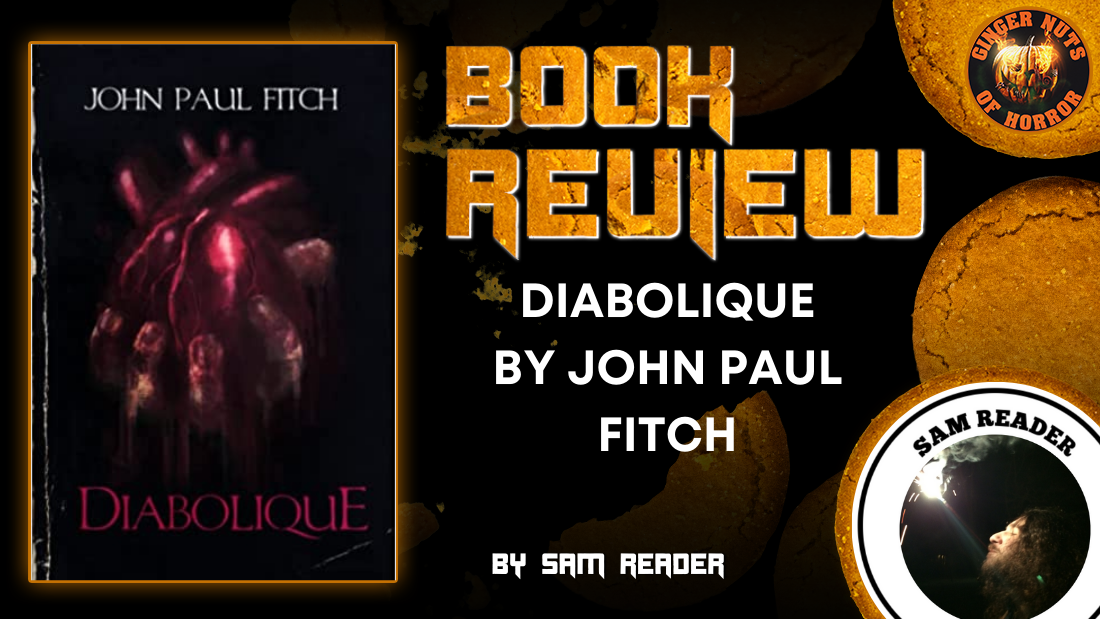
 Diabolique is a dark, malevolent, all-inclusive trip to some of the darkest places you'll find in horror, one that's absolutely essential for those who like to have their limits challenged and their boundaries pushed Diabolique by John Paul Fitch Publisher : Hybrid Sequence Media (11 Oct. 2022) Language : English Paperback : 295 pages ISBN-10 : 1513698605 ISBN-13 : 978-1513698601 A Horror Book Review by Sam Reader The scariest thing about Diabolique, the debut collection from John Paul Fitch, is how precise and all-encompassing it is. Sure, Fitch has a gift for taking some familiar premises-- a monster as a school principal, cannibal sacrifice cults, a murderous presence haunting the punks of Glasgow-- and dragging them kicking and screaming into darker and far more twisted territory, but “extremity” is a tool just like any other. Fitch's real talent is in the way he uses that extremity in exactly the right manner and the surrounding atmosphere and universe he builds around that extremity, a universe where the odds are always long, the stakes are always fatal, and by the time whatever doom awaits is right around the corner, it's often far too late. It's a twisted and disturbing collection, to be sure, but it's that total package that makes Diabolique's stories unique, upsetting, and well worth the time you'll spend traveling down their dark paths. There's something upsettingly natural about the horrors in Diabolique. Fitch's monsters are not ones that play by the “usual rules” or are swayed by the protagonists' morality, but seem offended or unconcerned with the idea that what they're doing is wrong. Many of the creatures, like the strange glowing man in “Esca Illicium” or the sickening were-creature in “Faces” are ancient, having been there longer than humans and their precious little morals even existed, and will (one assumes) be there long after humans have gone extinct. Even when the horrors aren't ancient creatures or weird cults, like in “Nip, Tuck, Zip, Pluck,” there's still a sense of order to the proceedings, that eventually the mad plastic surgeon's obsession would lead him to the grisly conclusion to the story. It makes things that much more disturbing, that Fitch created through his stories a universe where someone could walk down the wrong alley or talk to the wrong person and find themselves face to face with unspeakable, gruesome horrors, if those horrors haven't sought them out directly. Similarly, there's a sense of inescapable doom to Fitch's stories. Whether that doom is the protagonists damning themselves in a number of ways by being too blinded by their own greed or obsession to realize the jaws closing around them, the horrifying specter of something that preys on the vulnerable or those without many options, or literal inescapable doom running for local government in “Frank Swettenham Is Not Human,” it's fairly clear that for many of the characters in Fitch's stories, it's far too late. That isn't to say there aren't narrative stakes—in several stories, there's a chance to turn away (however slim) even if the poor human bastards at the center of the tale can't or won't take it, and a desperate struggle still might actually bear out-- but the feeling that the odds are very long and the world itself has stacked the deck in favor of whatever nasty thing awaits the unsuspecting do wonders to make the stories feel that much darker. Fitch doesn't need to explore the concept of inevitable doom, he merely shows it and its consequences, whether personal (infidelity going terribly wrong in “Complex”) or existential (the sadistic force that preys on punks and the underprivileged in “The Outsider”) and then stands well back. All of this atmospheric groundwork only serves to heighten Fitch's clear gift for emotional stakes, as well. With its sense of the inescapable and the idea of rules beyond those governing the human, “The Pandemonium Carnival” goes from a surreal story about a father and son visiting a carnival to a wistful but joyous tale about a father and son's last memory together, that inevitability just around the corner. “Frank Swettenham Is Not Human” becomes even more hilarious, not just due to the presence of a Lovecraftian deity, but to the sheer bafflement and resignation the characters (including the villains) express once some kind of natural order asserts itself. When “Faces” lays bare the twisted consequences for the antihero's actions and the rules he didn't realize he was playing by, it only underscores the awful images like a centenarian being breast-fed by a were-creature in the moonlight and the torture post said centenarian keeps in his backyard to tie women to, as if to rub the protagonist's face in it and go “where the hell did you think this was going?” Sure, there are shocking images aplenty in Diabolique, but it's the world they're presented in and the emotional impact that makes them disturbing. John Paul Fitch certainly has a gift for the disturbing. While not drenched in the excess that usually comes with a title labeled “transgressive,” Diabolique contains snuff films, spectral serial murderers, eldritch BDSM porn queens, psychic anglerfish that communicate through brain tumors, and that's only scratching the surface. Rather than simply set everything to overload like some of his peers, Fitch prefers to wield his sickening talent in a more precise manner. The stories in Diabolique build in their disturbance, waiting until that inescapability and emotional stakes reach a peak before revealing something awful to slam the cathartic moment of horror home. This wouldn't work nearly as well without the scenes that hit that peak being drenched in viscera and disturbance, with a specific honorable mentions going to a snuff-film scene where the description of the victim in all their imperfections and vulnerabilities ups the pathos immensely, and the opening of “Feral,” where an eviscerated deer carcass beautifully foreshadows the awful things that happen further into the story, while letting enough time elapse that the key details take a moment to come rushing back. There's a true art to creating a work of all-encompassing dread, something so precisely unnerving that even if it explores more comic or melancholic territory, or even veers into other genres, still manages to craft a level of unease. John Paul Fitch has mastered that art, through use of some wonderfully imaginative and disturbing spins on familiar stories, the construction of a hostile universe throughout his stories, and the pervasive sense (even when it's less true) of inescapable doom and insurmountable odds. Diabolique is a dark, malevolent, all-inclusive trip to some of the darkest places you'll find in horror, one that's absolutely essential for those who like to have their limits challenged and their boundaries pushed. If that includes you, or if the book even vaguely piques your interest, well, as Fitch's characters love to say about his menagerie of monsters, it's out there and waiting. All you have to do is let it in. sam reader DIABOLIQUE |


Archives
May 2023
|

|

|

 RSS Feed