


 WALLED IN WALLED IN It's always a tough thing to read and critique something written by a friend, or, at the very least, someone you know and like. I try to be as honest as possible while also bearing in mind the fact that the author might feel stung by any seemingly 'negative' comments. I'd temper this by saying that if the feedback is genuinely meant, the 'negative' comments should serve to highlight possible areas for improvement and in effect, make the author a 'better writer' (bearing in mind the subjective nature of much of this). To that end, I was asked by David if I might have a look at his novel, Walled In, which I did so as, after a quick look on Amazon, it seemed like an interesting story. At the time, I didn't know David, but we chatted online for a bit and then, in the company of a few other writers, I met him at SCARdiff 2014, where we had a bloody good weekend. It was shortly after this, that I finally got around to reading the novel... Walled In takes place mainly in and around South Wales, and details the attempts of a motley bunch of people as they try to survive and escape to safety in the aftermath of...well, it's not quite a zombie apocalypse, although this influence looms large. It's more a 28 Days later type of infection that causes people to become insanely violent. Into this landscape, we meet Ollie and Roxie, the last survivors of a Hell's Angels biker squad, and Jeff and Maria, two ordinary people who have recently met and banded together for safety. They arrive at an abandoned farmhouse in the countryside and find a young girl Amy, as she is held captive by a pretty despicable man who has killed her entire family (as detailed in the opening chapter). It quickly becomes clear that it's not just the infected that pose a danger to any survivors... First off, I will say that the idea presented here is not a bad one. Of course, it depends on your tolerance for zombie stories, something I know is wearing thin with many people, but despite its clear reliance on classics of the genre such as the films of George Romero, the aforementioned 28 Days Later and other well-known images and stories, it's not bad concept at all. There are a number of scenes that are well conceived, and one in particular that stood out for me. Having said that, there were quite a few things that pulled the book as a whole down for me. From conversations with David, I know he wrote the novel quite a few years ago, so I suspect he's addressed some of the issues I had with the writing here. One of the most common issues that I know he is aware of, was the jumping from one character's point of view to another without a clear break or indication. This happened a few times throughout the text and it can be quite a jarring experience when it does. I also found a lot the phrasing awkward and clumsy, and whilst some of this can be down to a personal style, it was happening on pretty much every page. As I said above, there's a decent, fast-paced zombie actioner here, but I was struggling with the writing far too often. Finally, and this is often a big thing for me, I felt the dialogue was quite unnatural and stilted in places. Where the main text of the story had a number of contracted words (not something that's a huge issue, but I tend to prefer a more formal approach in third person), in many of the dialogue sections, the language was very stiff and formal, not at all how people would talk. For me, part of the reading process is being able to lose yourself in the book, to almost forget you're reading words, but when awkward phrasing and stilted dialogue throw you out of it continuously, it's hugely frustrating. Slightly more subjective, I felt that the novel could have been structured differently. There's a chapter in the middle which jumps away from our regular characters to detail how the virus was created and escaped, and it's actually not a bad piece. It serves to break up the story. However, a few chapters later, there's another break to detail the journey of a couple of new characters, and while the scene itself wasn't that bad, it felt out of place and interrupted what flow was already in place. I think this would have worked better as a alternating story weaved into the main plot. My advice to David would be to read widely, both in the genre and outside of it. Look at the mechanisms other writers use to make the story and dialogue flow. Writing isn't just about getting a good idea and putting it down, it's also about the writing itself, about building scenes, creating dialogue that sounds natural and logical within the context of the story. I find observing and listening to people really helps in this regard. Also, watch great TV shows and films. Come to recognise what sounds awkward and forced, and what sounds natural, what flows well. I will finish by saying that I could still clearly see the story as it unfolded, it was simply interrupted too much by some of the phrasing and dialogue. REVIEWED BY PAUL M. FEENEY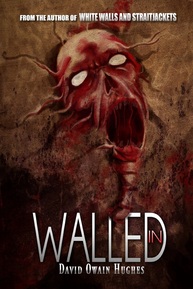 WALLED IN WALLED IN A weapon, designed 'in the dark' at an army barracks just outside of Cardiff, South Wales, has been unleashed. Intended for use against enemy troops, the chemical, comprising Bird Flu, Bovine Flu and Foot and Mouth, turns those affected into murderous lunatics for twenty-four hours before the body finally shuts down. Jeff, a mild-mannered air enthusiast, has just murdered his sick wife. He had planned for them to stay inside, to lock the place down, to wait it out. But Katherine became sick - the latest casualty of an unknown virus wiping the British population out in their thousands. TV, radio and all other means of contact to the outside world have gone. Jeff, alone, decides to make a break for the plane he has stationed at Cardiff airport. Between Jeff and freedom stands millions of infected. If only he can reach the hangar, then he'll be safe. He'll be able to fly to Scotland to reunite with his sister. Along the way, Jeff hooks up with Maria, who has been left stranded at the petrol station where she worked. They meet up with Ollie and Roxie - a pair of biker lovers who have survived the outbreak on the road. Together, their chances of survival are increased, as long as they can all just get along. It's not just the infected they will have to dodge; a dark and depraved enemy is on their trail. A foe who might just hold the key to surviving in a country gone to hell.
Comments are closed.
|


Archives
May 2023
|

|

|

 RSS Feed