


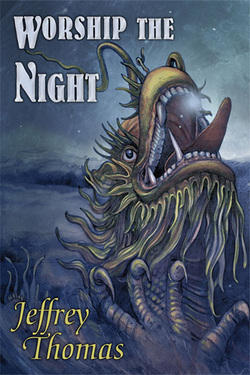
 WORSHIP THE NIGHT WORSHIP THE NIGHT The horror of horror is a one trick pony; eliciting reactions of dread, panic, revulsion, all ephemeral, passing in almost the same breath or heartbeat, leaving behind little but an aching emptiness; a silence that begs to be broken. Those works which define the genre; which others adore and seek to emulate, generally utilise the tropes, subjects and rhythms of horror to achieve something greater; to make something more of themselves (Clive Barker's Books of Blood, for example, explore any number of concepts not traditionally associated with horror, as do the works of David Cronenberg, David Lynch and Ramsey Campbell). Audiences become suggestible when shaken or disturbed from their assumptions; when exposed to things they've never experienced or imagined before. The best horror knows this and uses it, transcending any bounds or parameters that the genre might impose upon itself. Jeffrey Thomas is clearly aware of this, his collection Worship the Night consisting of tales that generally operate outside of tradition or cliché, instead providing subjects and situations of the most extreme strangeness; tales that suggest wider mythology and significance than is made explicit on the page (a rare and desirable quality, meaning that readers are not allowed to simply consume and discard the material as though it were a chocolate bar or fast food burger). This is ideas-driven horror; horror that treats its audience with a degree of respect that is sadly often lacking in the genre, engaging them intellectually as well as viscerally, exploring notions that range from suburban isolation to metaphysics, from domestic disquiet to cosmic despair. In that, there is more than echo of Lovecraft in these tales, though Thomas maintains his own particular style and ethos throughout, avoiding many of the pitfalls that those who seek to emulate Lovecraft directly fall into. In that, some of the collection's more overt technical faults are easily overlooked (there is a tendency for the prose to be somewhat arrhythmic or mechanical in its descriptions. Sometimes, this is a matter of stylistic choice, others it seems to be an error, making it difficult to discern between the two), whereas others may prove too pervasive and consistent for some (whether a matter of editing or the general writing, some stories seem to lack for punctuation, meaning that sentences have a tendency to run on in the manner of a catalogue or list of instructions). Regarding its stylistic choices, each story has its own particular nature, distinct from the rest in tone and format whilst maintaining enough in the way of common threads and themes to lend the collection coherence. Whereas some opt for a fairly standard approach, others are highly experimental, playing with reader assumption and expectation in a manner that, rather than removing them from verisimilitude, serves to intrigue enough to keep the pages turning (About the Author is a conspicuous example of this; a story that takes time to get the general gist of; which may even alienate some readers with its undermining of their assumptions and expectations, but whose experimental nature and strangeness are to be applauded in a genre so rife with codification). The collection is punctuated by a number of artworks, most of which serve to enhance the pervasive strangeness; a sense of reality not being quite solid, their style often as surreal as the prose itself, though some do feel somewhat redundant, portraying incidences rather than key images within the stories. Even so, they are a welcome addition to the collection and serve to remove it from the vast majority of its contemporaries. There are gems, here; moments of absolute brilliance, occasionally marred by over-reaching or a sense that the stories desire to be deviant and transgressive more than to be complete (again, redolent of Lovecraft). Even given those faults, the collection is worthy of note, in that it attempts and often succeeds where many lack the vision or confidence to tread. Horror as a genre needs more works like this, more writers like this, to demonstrate not only to those outside what it can potentially be, to remind those of us who are buried too deep in its entrails, too. GEORGE LEA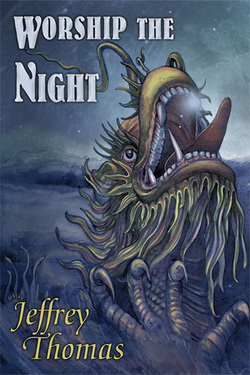 As Jeffrey Thomas says in his introduction to Worship the Night, there is “a kind of loose theme at work in these stories: the notion of deities, hereafters, or otherwheres beyond the mortal plane.”
“The Lost Family” takes place in the Hell of Thomas’ cult novel Letters From Hades, while “Counterclockwise” (set in his acclaimed milieu of Punktown) offers a glimpse into an alien belief system. “The Holy Bowl” invokes that tastiest of deities, the Flying Spaghetti Monster. “In Limbo” finds a man poised at the dismal way station between damnation and salvation. The protagonist of “About the Author” believes she has summoned tormenting entities from the netherworld. “The Strange Case of Crazy Joe Gallo” and “Children of the Dragon” pay homage to Lovecraft’s Cthulhu Mythos. Finally, the main characters of the novella “The Sea of Flesh” face evil both in our world and within a mystical alternate realm. You may be a doubting Thomas, but soon you will be a believer. In Horror. PURCHASE A COPY HERE Comments are closed.
|


Archives
May 2023
|

|

|
 RSS Feed