


I COME WITH KNIVES BY S. A. HUNT
8/3/2021
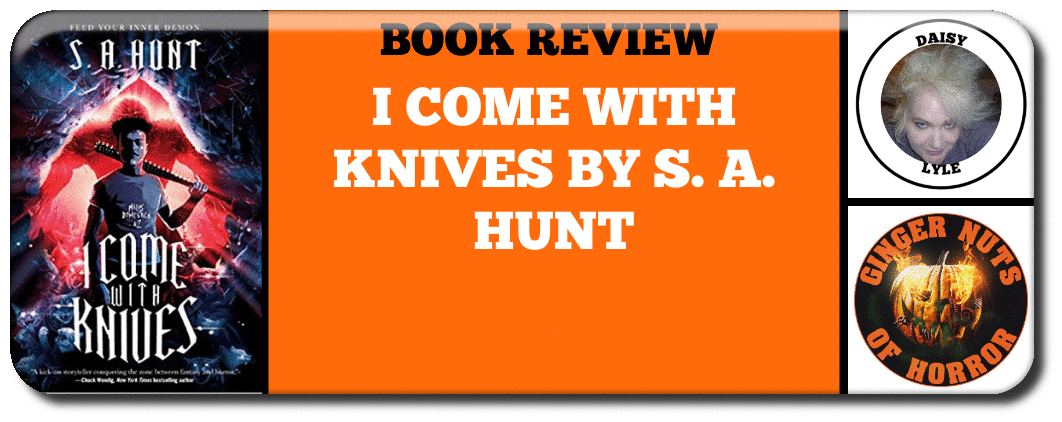 The tropes of genre can provide a useful supporting structure to a new writer, like a trellis for a climbing plant, but once you’ve gained a bit of height you have to put out a few tendrils into the unknown in order to truly flourish. I Come With Knives is the second instalment of S A Hunt’s Malus Domestica series starring Robin, a young woman whose principal interests are rage, ultraviolence and Beethoven. OK, maybe not that last bit. But A Clockwork Orange’s Alex would certainly envy Robin her job: she’s spent the first book killing witches, filming murder after murder for the delight of her army of Youtube fans. We’re not encouraged to view Robin as a psychopath, however; she’s the goodie here, propelled by a burning desire to avenge a coven that, among other things, trapped her mother in a tree and was indirectly responsible for landing her in a psychiatric facility for a chunk of her teens. She continues her vendetta through book two, aided by friends and advisers she’s picked up along the way. A few years ago I decided to watch the 70s sci-fi series Sapphire and Steel, but somehow mistook the second episode for the opening one, and ended up puzzling my way through a very confusing “first” ep starting with a long bout of violent and unexplained poltergeist activity (which I idiotically chalked down to a bold experiment with narrative structure.) Beginning the Malus Domestica series on the second book is a very similar experience. It kicks off with a head-spinning chain of events involving dimension-bending, illusion and mental dissolution, and then, just as you’re starting to get your bearings, skips to a completely different time and place. The inter-dimensional stuff settles down eventually, but there is very little recapitulation of the events in book one, and no real attempt to remind us who the characters are. When you do manage to catch up, I Come With Knives is actually very traditional urban fantasy. There is the usual crowd of demons, sorcerers, zombies, and the human (or human-ish) characters are mostly recognizable types: swish guys who look like elves, grizzled mentors, hair-dye goth chicks, wisecracking kids, cackling gloating baddies, and at the centre of it all, a pretty tomboy heroine with the kind of personality admiringly described in words ending in “-ass”. I did note that there seem to be more black people than usual in the cast, and I don’t think I’ve seen police brutality feature much in this type of book before, but apart from that it’s very standard fare. Of course, a carnival of clichés can be enjoyable as long as the characters come to life and are kept busy. And the novel is certainly full of sound and fury, with plenty of ducking, diving, maiming, killing, and a body count spiralling well into the thousands if you count the hordes of felines disposed of in its pages. Ultimately, though, it doesn’t really matter how many old women you bump off and how many cats you shove face-first into a garbage shredder, you’re not going to engage the reader if the characters aren’t convincing. None of Hunts’ crew really did it for me, though of course that may be partly because all the vital work of character development was done in Book 1. Other flaws are harder to overlook. Although the novel boasts two disabled characters there is nonetheless a nasty vein of something very much like body fascism running through the book, especially as regards the older female characters. One of the witches is enormously fat, can’t eat without smearing food over her mouth, has a bedroom stacked with filthy plates and – surprise! eventually turns into a ravening pig-demon. In this scene and elsewhere, characteristics of normal female ageing - stretch-marks, sagging “hippie” breasts etc. – are woven into descriptions in order to make the witches seem even more revolting and unpleasant. And crucially, this doesn’t happen with any of the male characters. Now, I normally like to read several books by a writer before accusing them of this kind of misogyny – for all I know, Book 1 could be packed to bursting with vomit-inducing descriptions of older male characters’ saggy ballbags and receding hairlines, and Hunt could be merely restoring the balance here. But even if you ignore the sexual politics, the fat stuff in this book undermines one of its best features. Robin has spent a good part of her youth on anti-psychotics, and Hunt makes an honest, largely unsensational attempt to depict the journey of a young person with a psychotic mental illness through the US mental health system. I was delighted, for example, to see Robin mentioning a medication that’s currently in widespread use (Abilify) instead of something ancient or the hack writers’ universal lunacy cure, lithium. But if there’s one thing many antipsychotics make you do, it’s gain weight. Vast, hideously unfair amounts of weight that can take years to shed, even after you stop taking the drugs and do the fancy diets and the gym and all that virtuous stuff. So the cheering effect this novel could have on, say, a schizophrenic reader struggling with Olanzapine bloat, is badly soured by that depiction of hulking Teresa and her bout of swine fever. Then again, maybe such readers should just pull their socks up, stop whining and embrace the keto diet that another character ends up on (it’s treated as a heart-warming sign of personal growth.) “But Daisy!” my non-existent readers cry. “Is there anything about this novel that you actually like?” Well, yes as a matter of fact. There are definitely times when it seems that Hunt is writing from the heart and not just doling out empty hackwork. Although characterization isn’t one of the novel’s strong points, Robin does develop; she’s allowed to have a decent romantic relationship with a guy who isn’t a total bell-end, and I particularly liked the way she is portrayed as a self-defining individual who is able to rise above her family background. In a literary genre absolutely rancid with genetic determinism – it often feels like you’re nobody in fantasy fiction unless you can trace your lineage back to a werefox that came over on the Mayflower – this should be celebrated wherever it occurs. Robin’s evolving, uneasy relationship with her mother is also the most engrossing part of the book. There are some good jokes and the obligatory showdown-in-an-incongruous-location (a comic shop) is amusing. The outbursts of police brutality are properly upsetting, and one compelling scene by a very unusual lake makes use of America’s lax environmental regulations in a memorable and atmospheric way. And who needs Beethoven when you’ve got two references to Queen? Style-wise, the novel is okay; Hunt has a couple of habits I don’t care for (the worst one being the tendency to write “CRACK!”, “BOOM!” etc. whenever there is a loud sound) and some unfortunate turns of phrase (whoever let “toothy canines” make it to print must be badly overworked.) But there are also some very good turns of phrase – Hunt has a knack for describing weather events in an original and elegant way, for instance, their authorial voice shining most brightly in the lulls between events. The book’s wolf-pack character dynamics, heaps of dead cats and rafts of nice juicy bones are sure to guarantee Hunt literary immortality if ever dogs learn how to read, but even if that glorious day never comes around, I reckon Hunt could still become a good writer for human consumption if they ease off on the stereotypes. The tropes of genre can provide a useful supporting structure to a new writer, like a trellis for a climbing plant, but once you’ve gained a bit of height you have to put out a few tendrils into the unknown in order to truly flourish. 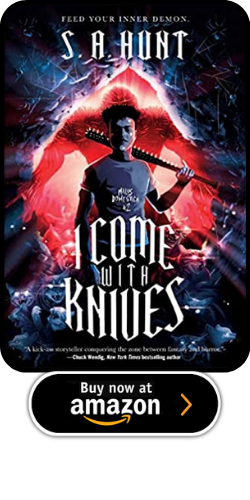 Chilling Adventures of Sabrina meets Joe Hill in S. A. Hunt's I Come with Knives, a horror-tinged action-adventure about a punk YouTuber on a mission to hunt witches, one vid at a time Robin - now armed with new knowledge about mysterious demon terrorizing her around town, the support of her friends, and the assistance of her old witch-hunter mentor - plots to confront the Lazenbury coven and destroy them once and for all. Meanwhile, a dangerous serial killer only known as The Serpent is abducting and killing Blackfield residents. An elusive order of magicians known as the Dogs of Odysseus also show up with Robin in their sights. Robin must handle these new threats on top of the menace from the Lazenbury coven, but a secret about Robin's past may throw all of her plans into jeopardy. The Malus Domestica series #1: Burn the Dark #2: I Come with Knives    Comments are closed.
|


Archives
May 2023
|

|

|
 RSS Feed