


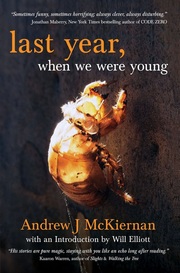
 Short story collections are excellent mediums for a writer to demonstrate their capabilities; most of us cut our teeth on the format, experimenting with more focused and concise forms before expanding into more concerted and expansive works. There are various tricks and techniques one can use to lend such collections degrees of coherence; consistent themes or images; running threads or characters that turn up in each tale. Others take a more “scatter-shot” approach, shifting subject, tone and style from story to story; a means of demonstrating breadth as well as technical capacity. All approaches have their benefits and deficits; whereas the more focused work might feel more coherent and rhythmic, it also falls into danger of repetition; retreading only recently disturbed ground. The more patchwork piece, on the other hand, provides more in the way of variety; the possibility of enticing a wider range of readers, but also results in a less cohesive and flowing whole. Andrew J. Mckiernan's Last Year, When We Were Young sits somewhere between the two; a collection loosely comprised beneath consistent themes of regret; of lost chances and opportunity, but so diverse in style, subject and overall tone, that it is somewhat easy to lose the thread; each story standing more or less in isolation from the rest, meaning that there is often a sense of whip-lash from one to the next. Here, tragedian ghost-stories sit shoulder to shoulder with steam-punk romances, alternative history pieces; dark fantasy sifting into science fiction, the writing equally comfortable regardless of genre, often demonstrating a degree of knowledge that is enviable (take the steam-punk romance, Calliope, as an example; the story takes place against the backdrop of an alternative history; one in which science and technology have evolved along subtly different paths, altering the shape of culture and politics in the process. The narrative is littered with pithy nods to established history; events, persons, cultural artefacts, none of which are redundant or obtrusive, but which serve both to demonstrate the writer's comprehension of the subject matter and enhance verisimilitude). Stylistically speaking, the work as a whole is difficult to quantify, given that each story is so different in tone, subject and structure; each its own, particular work, and therefore something that must be assessed in and of itself, rather than with reference to the wider whole. This also means that the engagement and enjoyment of individual readers will be similarly inconsistent; whereas one tale may appeal hugely in terms of both style and subject, the next may be frictionless or alienating, owing to its marked removal from what has come before. This also emphasises the aforementioned issues concerning transition; finishing one tale and immediately moving on to the next is often jarring; third person, past tense immediately giving way to first person, present; supernatural subjects of ghosts, monsters and magic sifting into science fiction, psychological explorations. The tone and general ethos of each story also differ markedly, save that each revolves around particular tragedies; decisions made in haste or passion that result in atrocity. The manner in which the collection is read therefore becomes salient to its enjoyment; taken piecemeal, with a period of removal and digestion between each story, it becomes much easier to appreciate them in and of themselves; the obvious polish of the prose (barring the occasional lapse into over-emphasis or explanation), the clean and crisp conception of each tale; their general elegance and rhythm. Attempted to consume in a glut, or more than one at a time, the resultant whip lash tends to colour or dilute one's enjoyment of what might otherwise be extremely engaging and well crafted works. A considered eat, then; one that requires certain contexts to appreciate fully, but which some may find too varied and inconsistent; too much of an experiment. REVIEWED BY GEORGE DANIEL LEA 'Last Year, When We Were Young' brings together 16 tales that defy conventions of genre and style, every one with an edge sharper than a razor and darker than a night on Neptune.
From the darkly hilarious 'All the Clowns in Clowntown', to the heart-breaking and disturbing title story, this debut collection from multi-award nominated author and illustrator Andrew McKiernan pulls no punches. "McKiernan is a magician. He performs magic tricks in every story, spinning us around, making us believe one thing before showing us we were wrong all along. His stories are pure magic, staying with you like an echo long after reading." -- Kaaron Warren, author of 'Slights' and 'Walking the Tree' 11/2/2015 04:21:31
Thank you for such a considered review, George. Very much appreciated! Comments are closed.
|


Archives
May 2023
|

|

|

 RSS Feed