


 Ennes draws on their experience as a student of medicine to describe their characters’ appearances in microscopic detail, giving them a lifelike believability. “Leech” blends elements of horror and science fiction, making it perfect for fans of both. Leech by Hiron Ennes Publisher : Tor; Main Market edition (14 Sept. 2023) Language : English Paperback : 336 pages ISBN-10 : 1529073626 ISBN-13 : 978-1529073621 A Horror Book Review by Ryan Tan In “Leech”, a physician arrives at the Chateau de Verdira to look after the baron who lives there. The first two-thirds of the novel are told from the point-of-view of a parasite controlling the physician’s mind and body. This parasite, called The Institute, controls multiple hosts around the world, with the ability to relay information from a host in one location to a host in another. The Institute, in other words, can communicate with itself across space. The last third of the novel alternates between the points-of-view of Émile, the chateau’s houseboy, and Simone, the physician, who is liberated from The Institute’s control by another parasite called Pseudomycota. Hiron Ennes skilfully incorporates the element of surprise into their creation of horror. One of the most terrifying scenes, the birth of the baron’s grandson, subverts the reader’s expectations not once, but twice. Firstly, Pseudomycota makes an appearance after the narrator sees the baby’s hair, assumes it to be Pseudomycota, and mistakenly panics. Prior to this scene, we experienced a false alarm where the narrator mistook the baron’s granddaughters for a “monstrous tangle of Pseudomycota” entering the room. We shared the narrator’s relief when they realised the truth, such that when a similar false alarm occurs during the grandson’s birth, we let our guards down, expecting a period of “immunity” following the deceptive scare. Instead, Pseudomycota takes us and the narrator by surprise. Furthermore, it arrives after Hélène, the baron’s daughter-in-law, complains of a “boil” in her head, just as she did in a previous scene, in which the narrator examined her body and found nothing wrong. Like the boy who cried wolf, she is established as dishonest, and so when she complains a second time, we do not trust her. Pseudomycota punishes us for these assumptions. I love the fact that this punishment is concentrated in a single instant, rather than dispersed throughout the novel. Like the merciless predator it is, Pseudomycota does not give us a chance to learn from our mistake. I find it interesting that so many of the characters exist in liminal spaces. The bedridden baron exists between life and death; not even The Institute, with its extensive body of medical knowledge, knows approximately when he will die. His twin daughters are literally stuck to each other because one twin’s hair gets tangled in the other’s. This makes them half-human, half-monster, especially with their peculiar habit of completing each other’s sentences, as though they share the same brain. “For years I have attempted to pick apart [the twins’] minds in every sense but the literal,” writes The Institute, “and they have evaded explanation or diagnosis.” Likewise, Pseudomycota is resistant to categorisation: The Institute conducts rigorous tests on it, but never reaches a conclusion about its nature. Indeed, its very appearance is ambiguous. Its “tendrils” evoke a climbing plant, but its “little black arms wriggling and grasping at my shoe” conjure a vivid image of a spider. Besides these characters, Émile exhibits liminality because he belongs to a race of humans called the Montish, who are born with a tail. He is also liminal because the baron’s son, Didier, sexually harasses him, forcing him to disappear as a means of self-protection. He narrates in the second person: “The closer [Didier] came to your skin, the farther you fled from it. Though you did not intend to, you had mastered the art of stepping outside yourself, of removing Émile and letting someone else slip into his place.” In Didier’s presence, Émile is not, and can never be, fully himself. I think this liminality validates Simone’s ambiguous identity. In the middle of a chapter, she suddenly takes over as the narrator, asserting: “I know I am not The Institute. I know that no matter what it tried to do to me, I am still, somehow, myself.” We do not know how long she has been herself; we only know when she realises that she is herself. In fact, Simone retains the ability to detect The Institute’s hosts, as though a part of her still belongs to The Institute. Therefore, she is part human, part parasite, and may have been this way since the beginning. In other words, both her past and present identities are uncertain. While I was initially bothered by this opaqueness, I find it much more acceptable in the context of so many other characters exhibiting their own liminality. After all, when everyone else is surrounded by an air of mystery, Simone’s unknowability does not seem out of place. Ennes might have made liminality pervasive for this reason. As a queer author, they could also be implying that no one is fully male or female, especially since Simone’s body is genderless. Ennes draws on their experience as a student of medicine to describe their characters’ appearances in microscopic detail, giving them a lifelike believability. “Leech” blends elements of horror and science fiction, making it perfect for fans of both. LEECH BY HIRON ENNEs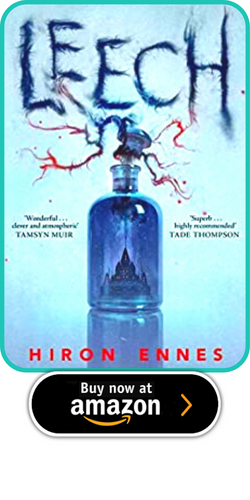 'Unique and utterly assured, I will follow this writer anywhere' – Gillian Flynn, author of Gone Girl In the baron’s icebound castle, a parasite is spreading . . . In an isolated chateau, as far north as north goes, the baron’s doctor has died. The Interprovincial Medical Institute sends out a replacement. But when the new physician investigates the cause of death, which appears to be suicide, there’s a mystery to solve. It seems the good doctor was hosting a parasite. Yet this should have been impossible, as the physician was already possessed – by the Institute. The Institute is here to help humanity, to cure and to cut, to cradle and protect the species from the horrors their ancestors unleashed. For hundreds of years, it has taken root in young minds and shaped them into doctors, replacing every human practitioner of medicine. But now there’s competition. For in the baron’s icebound castle, already a pit of secrets and lies, the parasite is spreading . . . These two enemies will make war within the battlefield of the body. Whichever wins, will humanity lose again? Leech by Hiron Ennes is an atmospheric Gothic triumph, perfect for fans of Jeff VanderMeer and Silvia Moreno-Garcia. ‘A wonderful new entry to Gothic science fiction, impeccably clever and atmospheric. Think Wuthering Heights . . . with worms!’ – Tamsyn Muir, author of Gideon the Ninth Featured in The Times Best Sci-Fi Books 2022 Ryan Tan Ryan Tan studies English Literature at the National University of Singapore. His fiction has appeared in Cold Signal, Bone Parade, and Bristol Noir. check out today's horror book review below the heart and soul of horror fiction review websitesComments are closed.
|


Archives
May 2023
|

|

|
 RSS Feed