


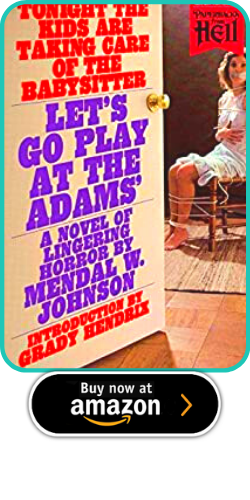
Let’s Go Play At The Adams’ by Mendal W. Johnson Publisher : Valancourt Books (10 Mar. 2020) Language : English Paperback : 280 pages ISBN-10 : 1948405539 ISBN-13 : 978-1948405539 A Paperbacks from Hell book review by Richard Martin Horror was doing big business in the bookstores in the 1960s. This was largely thanks to gothic literature which promised gentle tales of haunted manors and melancholy spirits on their covers. Things took a more devilish turn towards the end of the decade with the release of ‘Rosemary’s Baby’ in 1967, followed by William Peter Blatty’s ‘The Exorcist’ and Thomas Tryon’s ‘The Other in 1971, but the real fun began in 1974 with the release of two books that would open the floodgate for pulp horror. Jaws (Peter Benchley) and The Rats (James Herbert) proved that there was an appetite out there for books that weren’t ashamed to be all-out horror. The publishing industry took note and throughout the 1970s and 1980s, companies such as Zebra, Tor and Pinnacle published a seemingly endless supply of books promising unspeakable terrors and sporting covers that had to be seen to be believed. Sometimes the content was great, other times… not so much, but one thing that you could always be guaranteed was a fun and entertaining read. By the mid-90s, horror paperbacks were seemingly out, and thrillers were in. Gone were the lurid covers of skeletons, evil dolls, creepy kids and flesh hungry critters. The horror was still there, it just wasn’t marketed as such, treated like a shameful secret. As titles fell quickly out of print, many of the horror authors and their work became increasingly forgotten by all but the most avid fans and collectors. Enter Will Errickson, Grady Hendrix and ‘Paperbacks From Hell’. In 2017 Hendrix and Errickson released their seminal love letter to the horror paperbacks of a bygone era, shining a light on some long-forgotten classics and renewing interest in the mass market horror paperbacks of the 1970s and 80s. Not content to simply share their passion for these oft maligned but much missed books, thanks to their partnership with Valancourt Books, we are being treated to new reprints of the best of these decades-old, forgotten gems. To date, thirteen reprints have been published (with a fourteenth on the way), retaining the original cover art and boasting brand new and insightful introductions from Hendrix and Errickson. In this series I’ll be reading each and every one and posting articles at Ginger Nuts of Horror looking back at the best books two decades of horror has to offer. Of the thirteen books that currently make up Valancourt’s Paperbacks From Hell series, ‘Let’s Go Play At The Adams’ was the one I was most anticipating. It was one of the few I already had a passing awareness of, largely due to its infamous reputation, aided by its scarcity (the book had been long since out of print prior to Valancourt’s intervention and secondary market copies would regularly fetch hundreds of dollars) and the enigmatic author (Let’s Go Play At The Adams’ was Johnson’s only book, and little is known about the author himself), not to mention subject matter. It is a book a great many horror fans are aware of but, until now, not one many have had the opportunity to actually read. Supposedly based on the real-life case of the Sylvia Likens murder (which was also the basis for Jack Ketchum’s equally notorious ‘The Girl Next Door’), ‘Let's Go Play At The Adams’ tell the story of Barbera, who is hired to babysit for two young children while their parents are away on holiday. What seems to be an easy job to set aside some money for her studies soon turns into a nightmare as, with the help of the local children, the pair enact a plan to keep Barbera prisoner and subject her to a week of terrifying tortures and lurid indignities. For a book with such difficult subject matter, it is not as explicit as you may expect. Johnson is far more interested in exploring how the actions of the children affect Barbera mentally, rather than physically, not to mention exploring the thought processes of the children who are committing these acts. Mileage may vary but, personally, I found this approach far more disturbing. There is a lot of complexity and nuance to the reasons why each of the children have decided to act on their plan and it is genuinely unsettling to see how easily things escalate from a ‘game’ to something far more sinister. That isn’t to say that the book doesn’t get graphic when the need arises, but it rarely details events as they happen, but rather recounts them retrospectively from a particular character’s perspective. While this may take the edge off in regards to the violence, it is used very effectively to humanise it. The reader is always very aware of the consequences of the violence because it is always presented by how either the person inflicting it or one having it inflicted upon them, experienced it. The philosophical approach may put some readers off, but it is undeniably effective if you are prepared for a more psychological and less action-packed story. The cast are also not painted simply as a bunch of ‘evil’ kids. Some of them demonstrate serious apprehension and regret at how far things ultimately go, whereas others relish the opportunity to push limits and take pleasure in the pain they are inflicting. In other cases (particularly with the youngest) there seems to be a lack of appreciation and understanding of the real-world consequences of what they are doing, and it’s never made clear if they truly understand that what they are doing has gone way past being a ‘game’. The characters who stuck with me the most, however, are the ones who acted with indifference. They were neither keen to take things further nor were they concerned when things ultimately escalate. These aren’t characters it is easy to relate to and, for me, that is what made them scary. The brilliance of making the antagonists children is that we never truly know why they do what they do because they are too young to either understand or articulate the why themselves and that makes the book all the more unsettling. As for Barbera herself, she is an interesting character to follow because, more than any of the children, she has an arc to her story, as she goes through fear, bargaining, frustration and, ultimately, acceptance as she descends slowly but surely into madness. What is most striking about these sections spent with her is that it isn’t the big things that get to her (and there are some pretty unpleasant things that she has to endure) but an accumulation of dozens of small things, whether that be her frustration at being unable to engage meaningfully with the children, the tightness of her bonds, or even understanding why any of this is happening to her. It is harrowing to read about the mindset of somebody who has had all basic human needs removed entirely, and seeing what that does to them mentally. Comparisons to Jack Ketchum’s ‘The Girl Next Door’ are hard to avoid, not just because of the subject matter, but also the writing. Johnson shares a sparse and blunt writing style with Ketchum that compliments the material. If anything, Johnson’s book is the bleaker of the two, because while ‘The Girl Next Door’ is largely told through the eyes of a likeable and (largely) innocent character, ‘Let’s Go Play At The Adams’ only has two perspectives, that of perpetrator and victim. Both are incredibly potent and affecting works, but Johnson’s book is by far the most pessimistic. Let's Go Play At The Adams is a tough book to rate. It isn’t an enjoyable or entertaining read, and nor is it meant to be. It is also not a book I would ever read again, largely because I know it is one that will stay with me long after I’ve finished it, making a revisit to the bleak and hostile world Johnson created redundant. It is a book that will absolutely provoke a strong reaction from any reader who picks it up. Whether that reaction be disgust, shock, sadness or frustration depends on the reader, but it is a rare book that can almost guarantee to leave a lasting impression. What struck me after reading it is what a tragedy it is that this proved to be his one and only novel (the author passed away a few years following publication). Based on this book alone, one wonders what the horror community missed out on. Join me next time when I’ll be sharing my thoughts on The Pack by David Fisher. If you’d like to read along with this series and want to pick up copies of the books, or learn more about Valancourts’ Paperbacks From Hell line, visit their site at www.valancourtbooks.com/paperbacksfromhell Let's Go Play at the Adams' (Paperbacks from Hell) Paperback |


Archives
May 2023
|

|

|


 RSS Feed