


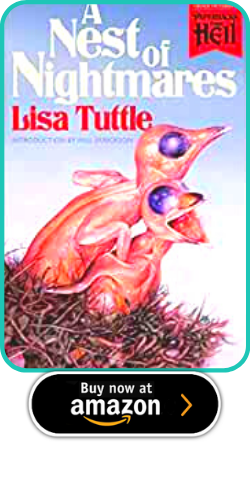
Nest of Nightmares by Lisa Tuttle Publisher : Valancourt Books (7 Jan. 2020) Language : English Paperback : 240 pages ISBN-10 : 1948405679 ISBN-13 : 978-1948405676 A Paperbacks from Hell review by Richard Martin Horror was doing big business in the bookstores in the 1960s. This was largely thanks to gothic literature which promised gentle tales of haunted manors and melancholy spirits on their covers. Things took a more devilish turn towards the end of the decade with the release of ‘Rosemary’s Baby’ in 1967, followed by William Peter Blatty’s ‘The Exorcist’ and Thomas Tryon’s ‘The Other in 1971, but the real fun began in 1974 with the release of two books that would open the floodgate for pulp horror. Jaws (Peter Benchley) and The Rats (James Herbert) proved that there was an appetite out there for books that weren’t ashamed to be all-out horror. The publishing industry took note and throughout the 1970s and 1980s, companies such as Zebra, Tor and Pinnacle published a seemingly endless supply of books promising unspeakable terrors and sporting covers that had to be seen to be believed. Sometimes the content was great, other times… not so much, but one thing that you could always be guaranteed was a fun and entertaining read. By the mid-90s, horror paperbacks were seemingly out, and thrillers were in. Gone were the lurid covers of skeletons, evil dolls, creepy kids and flesh hungry critters. The horror was still there, it just wasn’t marketed as such, treated like a shameful secret. As titles fell quickly out of print, many of the horror authors and their work became increasingly forgotten by all but the most avid fans and collectors. Enter Will Errickson, Grady Hendrix and ‘Paperbacks From Hell’. In 2017 Hendrix and Errickson released their seminal love letter to the horror paperbacks of a bygone era, shining a light on some long-forgotten classics and renewing interest in the mass market horror paperbacks of the 1970s and 80s. Not content to simply share their passion for these oft maligned but much missed books, thanks to their partnership with Valancourt Books, we are being treated to new reprints of the best of these decades-old, forgotten gems. To date, thirteen reprints have been published (with a fourteenth on the way), retaining the original cover art and boasting brand new and insightful introductions from Hendrix and Errickson. In this series I’ll be reading each and every one and posting articles at Ginger Nuts of Horror looking back at the best books two decades of horror has to offer. I am a huge fan of short story collections and the horror genre does them better than anyone. Horror is so well suited to the short, sharp shock of a good short story, especially ones with a killer premise and a sting in the tail. The genre is so full of acclaimed collections (Night Shift, Books of Blood, Ghost Stories of an Antiquary, the list is endless) that it’s a wonder they aren’t more prevalent, particularly in the mass market. I was excited, therefore, to find the next in Valancourt’s Paperback From Hell line was not only a short story collection (and one sporting hands down the best cover in the series) but one by an author I hadn’t previously read. Lisa Tuttle is currently be best known as a YA and Sci-Fi author (her debut novel was co-authored with none other than George RR Martin) and was already an established and well-known author by 1986 (having her first short story sale fifteen years prior), when her debut short story collection was released. Yet she features twice in the Paperback From Hell line (her 1983 novel ‘Familiar Spirit’ is book twelve). Reading ‘A Nest of Nightmares’, it is easy to see why, because Tuttle has an incredible knack for a memorable and hard-hitting horror story. Boasting thirteen terrifying tales, ‘A Nest of Nightmares’ often features female protagonists and ranges from ghost stories, creature features, to more psychological or thought-provoking subject matter. While the range varies, each story is unpredictable, memorable, and worthy of individual note, so in a change to the usual format of these reviews, I’ll be looking at each story individually. The opening story is the brilliantly titled ‘Bug House’ (Tuttle has some great titles in this collection), which starts proceedings off strongly. Telling the story of a woman visiting the broken-down home of her ageing aunt, Tuttle builds up some seriously creepy tension before a low-key body horror finale, the implications of which are far more disturbing than the actual events of the story, which are wisely kept largely ambiguous. Another contender for the best title goes to ‘Dollburger’, which is a fun cautionary tale that reads like a particularly bizarre and unsettling episode of ‘The Twilight Zone’. When a father tries to discourage his young daughter from leaving her toys out by claiming that people break into homes at night to steal unwanted dolls in order to make dollburgers to eat, little does he know that there may be more truth to his lie than he initially thought. After two stories that either hint at, or overtly lean into the supernatural, ‘Community Property’ delivers something far more down to earth, and infinitely more upsetting. This story of a couple going through a divorce who go to extreme lengths to decide who gets to keep the family pet may not be my favourite story in the collection, but it’s definitely one that I won’t soon forget. One of the collections longest stories is ‘Flying to Byzantium’. Given it features a female sci-fi writer as its protagonist, I wondered when reading this one how much of it may be autobiographical. Equal parts black humour and insightful character work, this was less overtly ‘horror’ than many of the collections other stories, but thanks to a great premise and a fun cast, it holds its own against its scarier companions. Speaking of scary, ‘Treading the Maze’ is one of the books more chilling entries, giving off strong ‘Wicker Man’ vibes with a folk horror short about a young couple visiting a historic landmark in rural England. Tuttle avoids the expected cliché ending with something more subtle, refusing to give away all the answers and making it all the more effective for being partially left to the reader’s imagination. ‘The Horse Lord’ (see, great titles!) was one of my favourite stories of the collection, part ghost story and part urban legend, about a demon horse that has cursed a family home. It isn’t groundbreakingly original, but it weaves a familiar tale with great skill, throwing in enough original twists to make it stick in the mind. One thing that you notice quickly when reading ‘A Nest of Nightmares’ is that the author does not pull any punches, and ‘The Other Mother’ is a great example of that. What starts like a fantasy story grounded by a family drama subplot goes to some surprisingly dark places by the final page and even though many of the book’s stories are hardly tame, it still came as quite a shock just how quickly this story shifted to something far darker than initially expected. Another common theme throughout the book is taking a relatable subject matter (here, the breakdown of a relationship) and putting a horrific spin on it. Tuttle definitely favours the ‘ordinary people in extraordinary situations’ school of storytelling and ‘Need’ shows the consequences of a selfish decision, using the suggestion of the supernatural to accentuate the point being made. Another of my favourites was ‘The Memory of Wood’, and this story more than any other is a great example of the culmination of all the things Tuttle uses with great effect (Ordinary people, often women, confronted with the supernatural, an element of ambiguity, hints at some very dark subject matter). This story begins with a married couple purchasing an antique wooden chest at a yard sale, which their infant son begins to take an unhealthy interest in. This is one of the books most suspenseful stories and the ending goes far beyond what you expect it might. If I were forced to pick a favourite story in the collection, ‘A Friend In Need’ would likely be it. It is a more low-key story than many of the others, and a lot of the horror comes not from what happens, but from the implications of it. It is a truly unique premise, perfectly paced and executed for maximum impact and one that will ensure you never think of imaginary friends in the same way again. ‘Stranger in the House’ (Tuttle’s first short story sale) reads very differently from many other stories in this collection, changing between past and present throughout to deliver a more subtle and indirect tale compared to most of the other stories in the collection. It is interesting to read a story first published almost fifteen years before this book was released that still shows all the early hallmarks of the themes that carry through into the author’s more recent work. Where most of the books various protagonists tend to be largely sympathetic and relatable, ‘Sun City’ does things a little differently and gives us a pretty reprehensible, racist and embittered divorcee who gets a violent comeuppance thanks to a Mexican deity. This story was an interesting change of pace and one of the books more unpredictable offerings. The collection closes with ‘The Nest’. Thematically apt, given it shares most in common with the book's opening story. When two sisters move into a remote old house together, one sister’s increasingly erratic behaviour becomes a cause of great concern, causing them both to examine their relationship. Don’t expect any easy answers with this story, which has a fantastic ending, effective because it goes for a low-key and character-driven moment. A great way to close things out. A Nest of Nightmares is an all killer, no filler collection of stories stuffed with unique ideas, leaving just enough to the reader's imagination to put your own personal stamp on the reading experience. This may have been my first time reading Lisa Tuttle but with ‘Familiar Spirit’ still to read, I’m very glad it’s not my last. Join me next time when I’ll be sharing my thoughts on the infamous ‘Let’s Go Play At The Adams’ by Mendal W. Johnson. If you’d like to read along with this series and want to pick up copies of the books, or learn more about Valancourts’ Paperbacks From Hell line, visit their site at www.valancourtbooks.com/paperbacksfromhell A Nest of Nightmares |


Archives
May 2023
|

|

|


 RSS Feed