


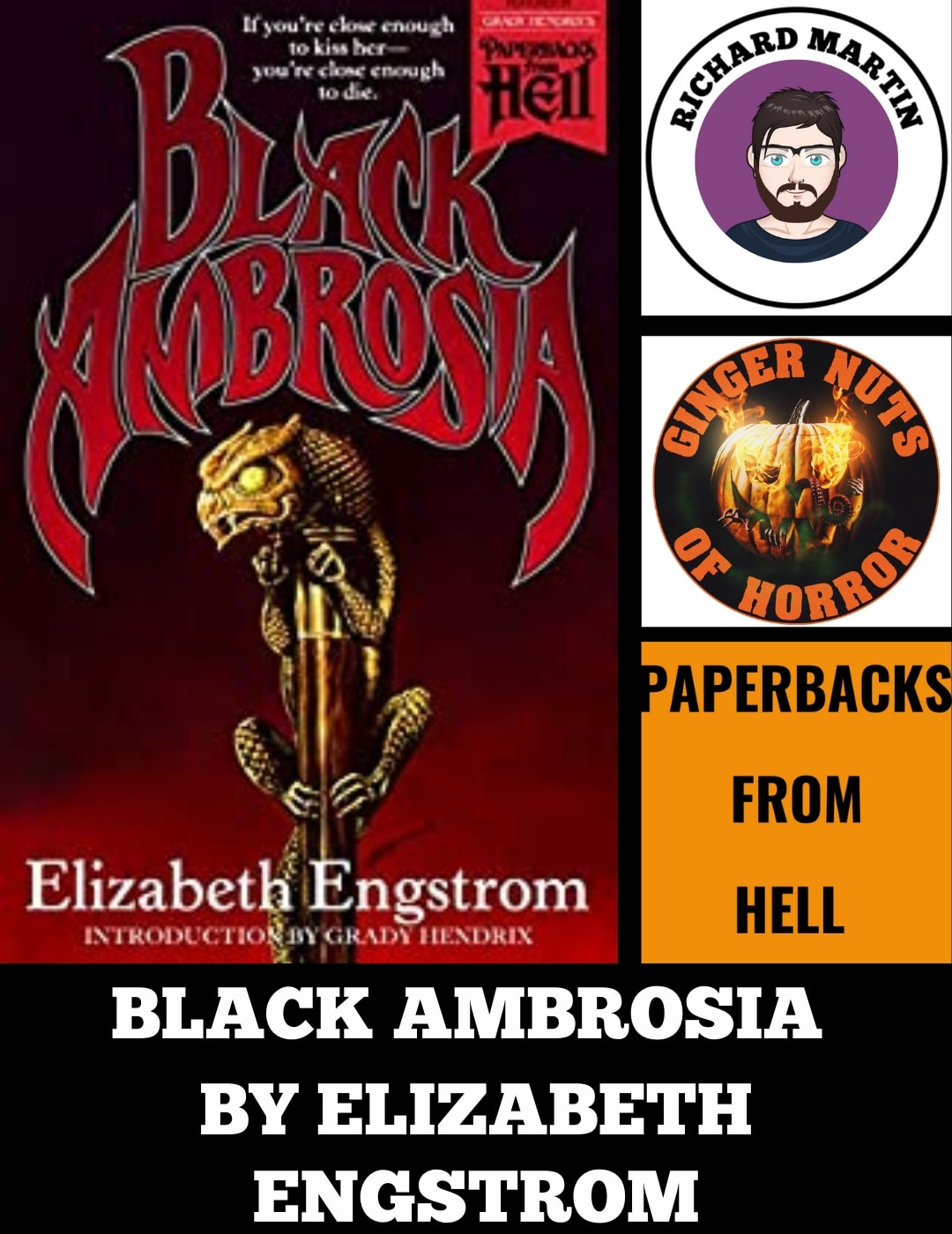
Black Ambrosia by Elizabeth Engstrom Publisher : Valancourt Books (1 Oct. 2019) Language : English Paperback : 270 pages ISBN-10 : 1948405504 ISBN-13 : 978-1948405508 A Paperbacks from Hell review by Richard Martin Horror was doing big business in the bookstores in the 1960s. This was largely thanks to gothic literature which promised gentle tales of haunted manors and melancholy spirits on their covers. Things took a more devilish turn towards the end of the decade with the release of ‘Rosemary’s Baby’ in 1967, followed by William Peter Blatty’s ‘The Exorcist’ and Thomas Tryon’s ‘The Other in 1971, but the real fun began in 1974 with the release of two books that would open the floodgate for pulp horror. Jaws (Peter Benchley) and The Rats (James Herbert) proved that there was an appetite out there for books that weren’t ashamed to be all-out horror. The publishing industry took note and throughout the 1970s and 1980s, companies such as Zebra, Tor and Pinnacle published a seemingly endless supply of books promising unspeakable terrors and sporting covers that had to be seen to be believed. Sometimes the content was great, other times… not so much, but one thing that you could always be guaranteed was a fun and entertaining read. By the mid-90s, horror paperbacks were seemingly out, and thrillers were in. Gone were the lurid covers of skeletons, evil dolls, creepy kids and flesh hungry critters. The horror was still there, it just wasn’t marketed as such, treated like a shameful secret. As titles fell quickly out of print, many of the horror authors and their work became increasingly forgotten by all but the most avid fans and collectors. Enter Will Errickson, Grady Hendrix and ‘Paperbacks From Hell’. In 2017 Hendrix and Errickson released their seminal love letter to the horror paperbacks of a bygone era, shining a light on some long-forgotten classics and renewing interest in the mass market horror paperbacks of the 1970s and 80s. Not content to simply share their passion for these oft maligned but much missed books, thanks to their partnership with Valancourt Books, we are being treated to new reprints of the best of these decades-old, forgotten gems. To date, thirteen reprints have been published (with a fourteenth on the way), retaining the original cover art and boasting brand new and insightful introductions from Hendrix and Errickson. In this series I’ll be reading each and every one and posting articles at Ginger Nuts of Horror looking back at the best books two decades of horror has to offer. I’ll confess upfront, that I wasn’t terribly excited to get to this book in my readthrough of Valencourt’s recent reprints. Nothing to do with the author herself (‘When Darkness Loves Us’, is an absolute must-read), but rather the subject matter. Vampires. ‘Black Ambrosia’ is Enstrom’s debut novel, and second published book after ‘When Darkness Loves Us’. Released in 1988 (the same year that Anne Rice released her second ‘Interview With A Vampire’ sequel, ‘The Queen of the Damned’), this was at a time when vampires were doing big business, both on-screen and on the page. The late 70s had seen Anne Rice release the seminal ‘Interview With a Vampire’ just a year after the king of horror himself had released Salems Lot. Big releases like ‘The Hunger’ and ‘Fevre Dream’ going into the 1980s, not to mention a plethora of successful movies (‘Lost Boys’, ‘Near Dark’, ‘Fright Night’, to name just a few) kept the vampire in the limelight and Black Ambrosia came along at the tail end of the decade where the vampire was big business. I’ve never been a particularly big fan of vampire literature, particularly novels of this era, which often leaned more to the gothic tradition. Anne Rice’s ‘The Queen of the Damned’, which was released the same year, reached number 1 on the New York Times bestseller list. It’s easy to see why there were so many imitators. While ‘Black Ambrosia’ does owe a debt to the work of Anne Rice (the way the narrative voice is used is very similar) the similarities end there. Black Ambrosia tells the story of Angelina, a teenage girl who loses her mother and is left to live with her stepfather. She soon leaves home and embarks on a cross country journey. Effectively homeless, it’s not long until she finds people all too willing to take advantage of her vulnerability. After a potentially dangerous encounter, she discovers within herself a power she has never tapped into before, one that will give her a thirst for blood and a preference for the night. Never staying in one place too long, she becomes stronger and bolder with each confrontation, while she is hunted relentlessly by a figure from her past. I’m a sucker for an unreliable narrator, and Angelina is a great example. Black Ambrosia isn’t especially graphic or violent and is more of a slow burn character study, where the reader is being told the story from the perspective of someone with a tenuous grasp on reality. With each passing chapter, that grasp lessens and it remains unclear for large portions of the book how much of what Angelina is telling us is real, fiction, or something in between. To counter this, Engstrom uses a device that is somewhat inspired. Each chapter ends with a different character adding to the story, often providing an account of the same events Angelina has just recounted, but from their own perspective. It’s incredibly well utilised, particularly early on, and really helps to sell the notion that the facts as presented by our narrator are not necessarily a fair reflection of the book’s events. The books ambiguity may frustrate some readers, but I believe it’s one of its biggest strengths. Almost nothing we’re told by Angelina throughout the story can be taken at face value. Even without the different perspectives that refute her version of events, the things she tells us don’t always add up, and it makes for a fascinating read, in the same vein of Shirley Jackson’s classic ‘We Have Always Lived in the Castle’. There are enough hints throughout to get a picture of some version of the truth, but a lot can be left open to each individual readers interpretation. Even the additional perspectives sprinkled in can’t necessarily be relied upon, as some characters are given plenty of motivation to lie, or at least only offer a partial truth, and while this level of ambiguity may not be for everyone, it at least offers a unique reading experience that different readers can, and will, interpret in different ways. I would have argued that the question of whether or not Angelina really is a vampire is pretty definitively answered by the end of the book after my initial readthrough, but skimming over the book again now for this review, I’m not so sure… As effective and unique as the set-up is, the story does begin to feel a little repetitive as we get into the midway point. The closing section of each chapter that tells the story from a different character’s perspective begins to focus almost exclusively on one particular character. Not a particularly engaging one either and, perhaps most damningly, one that isn’t actually with Angelina throughout most of the story. This results in the previously effective switch in perspective ceasing to add a great deal to the story, and the plot loses its forward momentum and becomes a series of set pieces until things get back on track for the (admittedly excellent) finale. The real travesty is that we stop seeing Angelina’s actions through another (perhaps more reliable) characters eyes and the book loses one of its most interesting and defining features for a significant portion of its page count. Part psychological character study, part cross country vampire epic, ‘Black Ambrosia’ is a unique take on vampire mythology. It reads like Anne Rice by way of Shirley Jackson, a story where the lead character becomes a vampire almost by sheer force of will. It is a bold choice to make your lead character someone who has succumbed to insanity, her behaviour and thought processes becoming increasingly erratic as the story progresses, and it is a gripping and utterly fascinating read, flaws and all. Join me next time when I’ll be sharing my thoughts on Nightblood by T. Chris Martindale. If you’d like to read along with this series and want to pick up copies of the books, or learn more about Valancourts’ Paperbacks From Hell line, visit their site at www.valancourtbooks.com/paperbacksfromhell Black Ambrosia (Paperbacks from Hell) |


Archives
May 2023
|

|

|


 RSS Feed