• HOME
  • CONTACT / FEATURE
  • FEATURES
  • FICTION REVIEWS
  • FILM REVIEWS
  • INTERVIEWS
  • YOUNG BLOOD
  • MY LIFE IN HORROR
  • FILM GUTTER
  • ARCHIVES
    • SPLASHES OF DARKNESS
    • THE MASTERS OF HORROR
    • THE DEVL'S MUSIC
    • HORROR BOOK REVIEWS
    • Challenge Kayleigh
    • ALICE IN SUMMERLAND
    • 13 FOR HALLOWEEN
    • FILMS THAT MATTER
    • BOOKS THAT MATTER
    • THE SCARLET GOSPELS
GINGER NUTS OF HORROR
  • HOME
  • CONTACT / FEATURE
  • FEATURES
  • FICTION REVIEWS
  • FILM REVIEWS
  • INTERVIEWS
  • YOUNG BLOOD
  • MY LIFE IN HORROR
  • FILM GUTTER
  • ARCHIVES
    • SPLASHES OF DARKNESS
    • THE MASTERS OF HORROR
    • THE DEVL'S MUSIC
    • HORROR BOOK REVIEWS
    • Challenge Kayleigh
    • ALICE IN SUMMERLAND
    • 13 FOR HALLOWEEN
    • FILMS THAT MATTER
    • BOOKS THAT MATTER
    • THE SCARLET GOSPELS
GINGER NUTS OF HORROR
horror review website ginger nuts of horror website
Picture

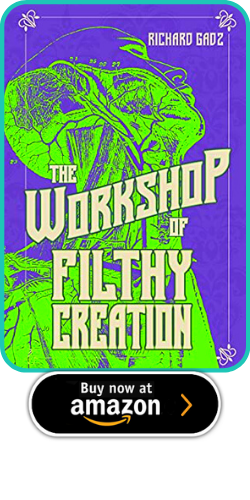
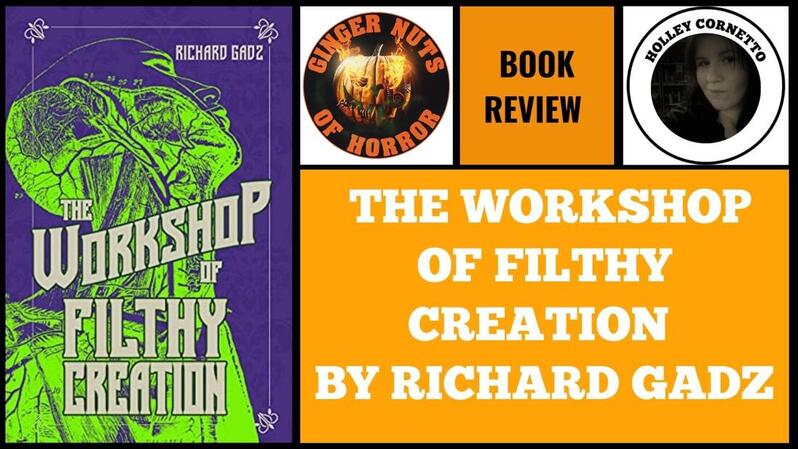
Book Review: The Workshop of Filthy Creation by Richard Gadz

2/2/2022
Picture
Book Review: The Workshop of Filthy Creation by Richard Gadz
A book review by Holley Cornetto
The Workshop of Filthy Creation is a historical horror fiction novel that pays homage to the genre’s roots. Set in London in the 1870s, this book provides a sense of history and atmosphere, making it a worthy tribute to Shelley’s masterpiece.

Wilhem von Frakken has discovered the means to create artificial regenerative human flesh. His creation is embodied in Maria, serving as this novel’s parallel of Frankenstein’s monster from the original. Maria is self-aware, at first not knowing the full extent of what she is – and is not. Like most women of the era, Maria is little more than a pawn, whose fate is not within her own power to control.

Like many classic works of genre fiction, this story explores what it means to be human. Is it self-awareness? A conscience? Is it a soul? What is the precise line at which a being can be considered human? Along with this larger philosophical conundrum, Gadz provides plenty of horror, mystery, and gore throughout the telling of the story.

Whether you enjoy more subdued Gothic horror, suspense, body horror rife with gore, or thought provoking ethical and moral dilemmas, this book has something for you. While I personally found the earlier chapters a little slow to start, the story did eventually pick up, and made the build up worth it. Gadz not only highlights questions about humanity, but questions about society, inequity, and exploitation. The highlight of the book, for this reader, was the beautifully detailed setting of Victorian London. Descriptions of homes, museums, hospitals, and people were rendered with painstaking attention to historical detail.
​
Recommended for fans of Frankenstein, Gothic horror, historical horror, and atmospheric novels with a distinct sense of time and place.

The Workshop of Filthy Creation 
by Richard Gadz  

Picture
"The Workshop of Filthy Creation is a remarkable book, visceral and philosophical in equal measure. The perfect combination of big ideas and a rattling good yarn. Hell of a read." - James Kinsley, author of Playtime's Over

In the autumn of 1879, an intelligent, artificially-created being—outwardly a young woman called Maria—arrives in London under the protection of biologist Professor George Hobson. Hobson gathers a few close friends and reveals her existence, explaining that she is the final result of a research programme undertaken by a dynasty of unethical scientists, the von Frakkens—all now dead.

Unknown to Hobson, one of his friends, Jabez Pell, is linked to an underground scientific organisation, the Promethean Society. Set up in the early 1800s, its aim is to conquer death by whatever means possible. Pell immediately recognises the potential that Maria's regenerative abilities can offer to the Prometheans – but after his attempt to kidnap her turns deadly, Maria goes on the run.

Maria finds herself at the heart of raging controversy: some want her jailed, some want her dead, and some want to peel the flesh from her bones. Worse, she is now hunted not only by members of the Prometheans but also by the police—and her creator Wilhelm von Frakken, who, as it turns out, is alive (in a sense).

Thrilling and evocative, fantastical and grotesque, The Workshop of Filthy Creation uses a Frankenstein-ian thread to stitch together elements of real scientific history with the darkest parts of Victorian London and speculation on the nature of human life.

​TODAY ON THE GINGER NUTS OF HORROR WEBSITE ​

SUSAN LIEN WHIGHAM TAKES A TRIP DOWN MULHOLLAND DRIVE

Picture

the heart and soul of horror fiction reviews

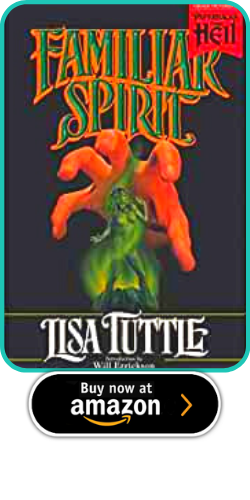
Paperbacks from Hell: Familiar Spirit by Lisa Tuttle

1/2/2022
HORROR BOOK REVIEW PAPERBACKS FROM HELL- FAMILIAR SPIRIT BY LISA TUTTLE
Horror was doing big business in the bookstores in the 1960s. This was largely thanks to gothic literature which promised gentle tales of haunted manors and melancholy spirits on their covers. Things took a more devilish turn towards the end of the decade with the release of ‘Rosemary’s Baby’ in 1967, followed by William Peter Blatty’s ‘The Exorcist’ and Thomas Tryon’s ‘The Other in 1971, but the real fun began in 1974 with the release of two books that would open the floodgate for pulp horror.

Jaws (Peter Benchley) and The Rats (James Herbert) proved that there was an appetite out there for books that weren’t ashamed to be all-out horror. The publishing industry took note and throughout the 1970s and 1980s, companies such as Zebra, Tor and Pinnacle published a seemingly endless supply of books promising unspeakable terrors and sporting covers that had to be seen to be believed. Sometimes the content was great, other times… not so much, but one thing that you could always be guaranteed was a fun and entertaining read.

By the mid-90s, horror paperbacks were seemingly out, and thrillers were in. Gone were the lurid covers of skeletons, evil dolls, creepy kids and flesh hungry critters. The horror was still there, it just wasn’t marketed as such, treated like a shameful secret. As titles fell quickly out of print, many of the horror authors and their work became increasingly forgotten by all but the most avid fans and collectors.

Enter Will Errickson, Grady Hendrix and ‘Paperbacks From Hell’.

In 2017 Hendrix and Errickson released their seminal love letter to the horror paperbacks of a bygone era, shining a light on some long-forgotten classics and renewing interest in the mass market horror paperbacks of the 1970s and 80s. Not content to simply share their passion for these oft maligned but much missed books, thanks to their partnership with Valancourt Books, we are being treated to new reprints of the best of these decades-old, forgotten gems.

To date, fourteen reprints have been published, retaining the original cover art and boasting brand new and insightful introductions from Hendrix and Errickson. In this series I’ll be reading each and every one and posting articles at Ginger Nuts of Horror looking back at the best books two decades of horror has to offer.
​
It wasn’t too long ago that I posted my five-star review of Lisa Tuttle’s’ short story collection ‘A Nest of Nightmares’ as part of this series. That stellar collection was my first-time reading Lisa Tuttle and, as I mentioned in the review itself, left me with sky-high expectations for this, her first published horror novel. Familiar Spirit embraces some of the themes she touches on in ‘A Nest of Nightmares’, whether that be the breakdown of a relationship (‘Need’, ‘The Nest’), helplessness against an outside force (‘The Other Mother’, ‘The Horse Lord’) or placing an ordinary, female lead character in extraordinary supernatural peril (pretty much all of them) and digs a little deeper.

Sarah is a graduate student who, up until recently, had been sharing an apartment with her long-term boyfriend, Brian. The dissolution of their relationship once Sarah discovers Brian has been unfaithful is quick, but painful and Sarah rushes to find a suitable place to live.

The large, weathered house on the edge of town seems too good to be true at first. It offers peace and quiet and more space than she knows what to do with, and the rent is unbelievable. The opportunity is so good that she ignores the warning signs. The creepy former tenant who avoids her questions and seems too eager for Sarah to move in, the odd symbols drawn on the floors, and the horrific nightmares she suffers as soon as she’s settled. The longer Sarah stays the more she begins to feel as if her mind is not her own. She no longer recognises her own thoughts and cannot rationally explain her increasingly erratic and unpredictable actions. As she looks deeper into the house’s history, she finds answers in the form of grisly murder and black magic. Will the answers come too late for Sarah to save her sanity, and her soul?

Novels about possession were in plentiful supply on horror stands in the Paperbacks From Hell era, particularly in the 1970s following the breakout success of ‘The Exorcist’ (William Peter Blatty) and ‘The Entity’ (Frank De Felitta), which spawned numerous (and often lesser) copycats. By the time Familiar Spirit came along in 1983 it was a fairly packed marketplace for this kind of book. I was glad (but not altogether surprised) to find that Tuttle delivers a strongly written book with enough surprises to set it apart from the crowd.

The back cover copy promises that Sarah’s possession will fill her with “screaming horror one moment, and relentless, burning pleasure the next”, so plenty of sex and horror seems to be on the menu, and I can confirm that Tuttle doesn’t skimp in either department. The books prologue is a harrowing read, with plenty of blood and violence, while also being incredibly effective from a psychological perspective. In fact, later scenes struggle to live up to the dozen or so opening pages, so effective are they. Tuttle is far from prudish with the sex scenes either, which are as plentiful as they are explicit.

When Sarah first meets Valerie, the young woman who first unleashes the entity in the book’s prologue, she has driven up to show her round the now vacant house in a new Ferrari. Which raises some interesting questions that you rarely see in possession novels, namely, is it really all downside and no benefit? In the opening pages the (then) unseen presence inhabiting Valerie says “there is much I can do for you, many benefits that can be gained by accepting my presence in your body”. Given we next see her in a brand-new sports car, there may be something to that. Sadly, it’s touched upon a few times but never fully explored.

As the novel goes on and we get to learn more about this seemingly malevolent entity, the story starts to go into more unexpected and interesting directions, separating itself from the plethora of other demonic possession novels on the stands at the time. The reveal of what is trapped in the house and possessing whoever enters it doesn’t come until later, and it was one I wasn’t expecting, and perhaps sheds a slightly different light on what precedes this revelation. There is a lengthy section of exposition in the form of a diary around the midway point, taking us back around fifty years into the past and giving an origin story of sorts that increases the stakes in the present day. In a lesser book, this side track may have felt jarring or out of place, but in Tuttle’s hands it actually proves to be a highlight, telling an entertaining and self-contained story that adds to Sarahs own, which is just getting started.
​
Familiar Spirit is an interesting spin on the demon possession genre and one that boasts a more well-rounded cast of characters than you would typically expect for the sub-genre. It’ll terrify and titillate in equal measure and leave you with the burning question “If I were possessed by a demon, what luxury car would I ask for”?
        
Join me next time when I’ll be sharing my thoughts on The Auctioneer by Joan Samson If you’d like to read along with this series and want to pick up copies of the books, or learn more about Valancourts’ Paperbacks From Hell line, visit their site at www.valancourtbooks.com/paperbacksfromhell


FAMILIAR SPIRIT BY LISA TUTTLE​

Picture
THE BIG OLD HOUSE WAS PERFECT FOR SARAH
Now that her life with Brian was over, she would have a home of her own. She could begin again.
But something was waiting for Sarah in her new house, waiting to welcome her, to make her feel at home. Something was waiting for Sarah in the night with golden eyes that glowed and burned, commanding her obedience, demanding her soul, promising her ... 
Sarah tried to escape the power, but night after night it drew her back, filling her with screaming horror one moment, and relentless, burning pleasure the next.
Sarah tried to escape the house, to fight the evil. But she came back. She will always come back. Because now Sarah is never alone ...
This reissue of Lisa Tuttle’s first novel Familiar Spirit (1983) features the classic cover art by Lee MacLeod and a new introduction by Will Errickson.

TODAY ON THE GINGER NUTS OF HORROR WEBSITE ​

JASON OFFUTT SAYS DON’T BE AFRAID OF THE DARK, BUT DON'T BELIEVE HIM HE MIGHT BE ONE OF THEM

Picture

THE HEART AND SOUL OF HORROR BOOK REVIEWS

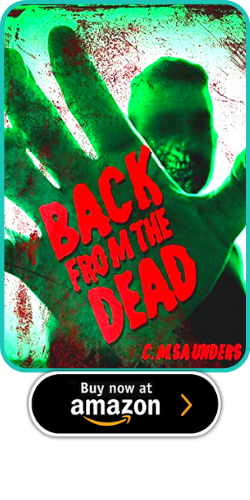
BOOK REVIEW: BACK FROM THE DEAD BY CM SAUNDERS

31/1/2022
HORROR BOOK REVIEW BACK FROM THE DEAD BY CM SAUNDERS
Back From The Dead by CM Saunders
Review by David Watkins
A collection of zombie fiction from British journalist and dark fiction writer C.M. Saunders


Okay, so zombies. Done to death (haha) or room for more? Since the explosion in zombie stuff at around the late noughties, largely due to the success of The Walking Dead tv show, but also helped by the far superior comic and The Rising by Brian Keene, it seems everyone and their dog has had a go at a zombie story. However, for every Tim Lebbon Coldbrook, we get a seemingly infinite number of utter dross stories. I am by no means an expert on zombie fiction, so feel free to mention your favourites in the comments or on Twitter, but I’m just setting my stall out.

Following the excruciating Army Of The Dead in the summer, this landed on my review pile. Can Saunders re-invigorate a genre I’m pretty tired of? The answer to that is yes and no, so here we go.

The first story is Dead Of Night  and has a couple camping out under the stars where they really shouldn’t. Que much mayhem as zombie confederate soldiers attack. It’s not a bad story by any stretch, but it is far too long and contain a few eye roll moments (such as how injured Nick gets, but continues running around). It’s also more of a ghost story than zombie.

Plague Pit has a Welsh (bonus marks) teenager stumbling across a chapel and unwittingly unleashing -  well, no spoilers, but you can probably guess. As with the first story, this could have been shaved more to tighten it up, but it’s still an okay story. Felt like more of an ‘oh-oh I’ve accidentally summoned an ancient evil’ than zombie.

Human Waste starts an upswing in the quality of the stories, but again is guilty of being a little overlong. As a result I worked out what was going on long before the end. Still good fun though!

My favourite story came next. Till Death Do Us Part is about a lovely old couple trying to survive the end of days. Best in the collection, although Roadkill gives it a run for its money. This one has two ‘private’ ambulance drivers picking up, well, something (take a guess). It has a really strong sense of place and character but it ends with a whimper rather than the bang you think you’re going to get.

The final story, Dead Men Don’t Bleed, read like a homage to Chandler and other hard-boiled noir fiction. It’s good, and pretty horrible when you peel back the layers, and has some sections of effective horror and creepiness in there. Unfortunately, it has one of the most blatant typos in the book (“The man of God lay his emancipated frame…”) and highlights the need for a little more editorial pruning to get to a more effective collection.

So, in summary, this is not a bad collection - far from it, and I really enjoyed it. I would question Saunders’ decision to collect and market these as zombie fiction though. To me they seem to be more ghosts, or demons, or just plain old people being nasty to each other. Perhaps selling this as a zombie collection is selling it short. You’re not getting Romero style shamblers here, and there’s very little ‘end of the world apocalypse’ stuff the genre relies upon. You may be disappointed if that’s what you’re expecting.

Back From The Dead by CM Saunders

Picture
A collection of zombie fiction from British journalist and dark fiction writer C.M. Saunders, featuring two complete novellas alongside short stories previously published in the likes of Morpheus Tales and Crimson Streets, plus a brand-new novelette. Also includes an exclusive introduction and artwork by the award-winning Greg Chapman.

Praise for the stories in this book:

“This is very well written and not to ruin anything but the ending is amazing! Definitely check this one out. I am now a fan!”
(Dead of Night)
“C. M. Saunders does a fine job here with these long-lost Confederate dead in the North Carolina Piedmont. He manages a winning balance between gory horror and interpersonal relationship, between splatter and genuine human emotions.”
(Dead of Night)
“It's a zombie story with an original twist that I appreciated. It's well written, flows nicely, and both of the (live) characters are well developed and believable. Let's face it - The woods are a creepy place even in the daylight sometimes and thanks to CM Saunders I won't be camping anytime soon.”


Picture

My bio
David Watkins lives in Devon in the UK with his wife, two sons, dog, cat and two turtles. He is unsure of his place in the pecking order: probably somewhere between the cat and the turtles.

He has currently released three novels: The Original's Return, The Original's Retribution and The Devil's Inn. Each book is well rated and reviewed on Amazon and beyond.

His most recent release is Rhitta Gawr, part of the Short Sharp Shocks series.

Coming next year... The Exeter Incident from D&T Publishing

"...gut twisting scenes...” 4* Joe X Young, Gingernuts of Horror
"..a damn entertaining read.." - DLS Reviews
"Watkins writes with a real flow for tension." - Steve Stred, Kendall Reviews
"Great horror! I couldn't put the book down" 4.5*, Pamela Kinney, Ismellsheep.com

He hates referring to himself in the third person, but no-one else is going to write this for him.
​

David can be found on Twitter so drop by and say hello @joshfishkins, where you'll find him ranting about horror, the British education system and Welsh rugby, but not usually at the same time.

TODAY ON THE GINGER NUTS OF HORROR WEBSITE ​

NOSETOUCH PRESS TO RELEASE A SECOND COY HALL NOVEL, THE HANGMAN FEEDS THE JACKAL: A GOTHIC WESTERN

THE STORY THAT TERRIFIED ME AS A CHILD AND ULTIMATELY HELPED MAKE ME THE WRITER I AM TODAY BY MATT WESOLOWSKI

Picture

THE HEART AND SOUL OF HORROR BOOK REVIEWS

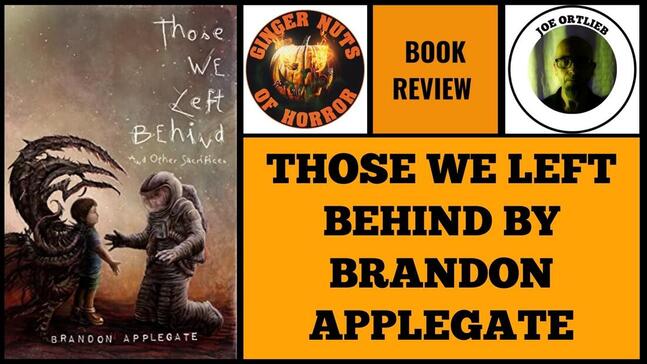
BOOK REVIEW: THOSE WE LEFT BEHIND BY BRANDON APPLEGATE

28/1/2022
Picture

A good collection of short stories.  So should I do each story like I've seen done? Those who have read my reviews know thats just not me. So....

For a debut collection of shorts, this one should be read. Yes not every story is a home run, but the ones that are wow. I enjoyed all of them so there where no bad reads.

The ones I really liked were tea party, kids are creepy little things. Just like elevator.
If Brandon ever does a whole book based on the last days of the old man be sure I'm going to read it. By far my favorite.

Like I said there are others I enjoyed.  So I feel this is a collection that's worth checking out....go order it.

​Review by Joe Ortlieb

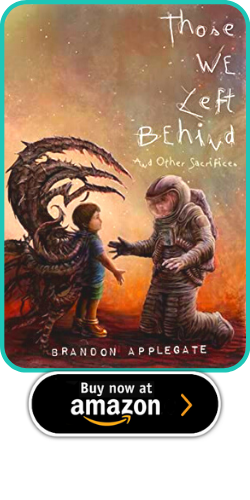
Those We Left Behind: And Other Sacrifices 
by Brandon Applegate

Picture
“In Applegate's stunning debut, family horrors get a fresh coat of the blackest, bleakest paint, but a deep compassion shines through the darkness. These stories will make your heart race and ache in equal measure.”
— Eric Raglin, author of Nightmare Yearnings

A bedtime story has unspeakable consequences. A walk in the woods introduces a father to his daughter’s horrifying new friends. A bit of trash in the shower drain leads to a surreal fight for survival. In this collection that ranges from magical fantasy to blood-spattered horror, Brandon Applegate guides you on a journey through the darkest, most tragic corners of his imagination. From the surface of Mars to the supposed safety of a child's bedroom, his stories will remind you that “it’s not a sacrifice if it doesn’t hurt.”

TODAY ON THE GINGER NUTS OF HORROR WEBSITE ​

DAVID SODERGREN  IS SUFFERING FROM SATAN'S BURNOUTS

Picture

THE HEART AND SOUL OF HORROR book REVIEWS

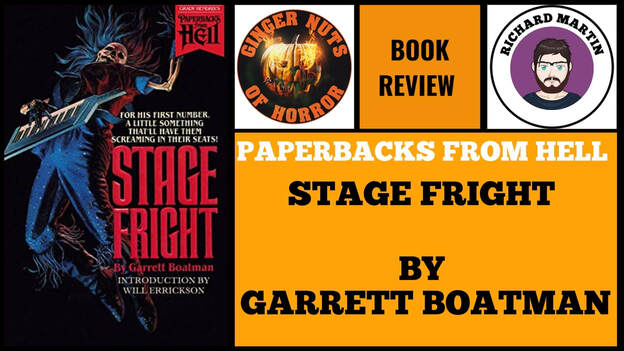
PAPERBACKS FROM HELL: STAGE FRIGHT BY GARRETT BOATMAN

25/1/2022
Picture
Stage Fright may be more of an acquired taste than some of the more crowd pleasing, straightforward books of the 1980s horror paperback boom, but if you can forgive the fact that there isn’t a single keytar wielding skeleton to be found in its pages, you’ll discover a wholly unique melding of madcap ideas and disparate genres that, despite all logic, work together fantastically as a cohesive whole.
Horror was doing big business in the bookstores in the 1960s. This was largely thanks to gothic literature which promised gentle tales of haunted manors and melancholy spirits on their covers. Things took a more devilish turn towards the end of the decade with the release of ‘Rosemary’s Baby’ in 1967, followed by William Peter Blatty’s ‘The Exorcist’ and Thomas Tryon’s ‘The Other in 1971, but the real fun began in 1974 with the release of two books that would open the floodgate for pulp horror.

Jaws (Peter Benchley) and The Rats (James Herbert) proved that there was an appetite out there for books that weren’t ashamed to be all-out horror. The publishing industry took note and throughout the 1970s and 1980s, companies such as Zebra, Tor and Pinnacle published a seemingly endless supply of books promising unspeakable terrors and sporting covers that had to be seen to be believed. Sometimes the content was great, other times… not so much, but one thing that you could always be guaranteed was a fun and entertaining read.

By the mid-90s, horror paperbacks were seemingly out, and thrillers were in. Gone were the lurid covers of skeletons, evil dolls, creepy kids and flesh hungry critters. The horror was still there, it just wasn’t marketed as such, treated like a shameful secret. As titles fell quickly out of print, many of the horror authors and their work became increasingly forgotten by all but the most avid fans and collectors.

Enter Will Errickson, Grady Hendrix and ‘Paperbacks From Hell’.

In 2017 Hendrix and Errickson released their seminal love letter to the horror paperbacks of a bygone era, shining a light on some long-forgotten classics and renewing interest in the mass market horror paperbacks of the 1970s and 80s. Not content to simply share their passion for these oft maligned but much missed books, thanks to their partnership with Valancourt Books, we are being treated to new reprints of the best of these decades-old, forgotten gems.

To date, fourteen reprints have been published, retaining the original cover art and boasting brand new and insightful introductions from Hendrix and Errickson. In this series I’ll be reading each and every one and posting articles at Ginger Nuts of Horror looking back at the best books two decades of horror has to offer.
​
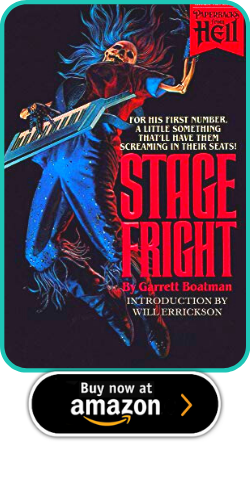
One of the things I love most about horror paperbacks from this era is the cover art. The best of them are gloriously over the top, cartoonishly lurid, often colourful and bloody, and usually boasting either a skeleton, a creepy doll, or a vicious looking creature (ideally, some kind of mix of the three). Stage Fright sports a great example of these silly but lovingly crafted covers, with a skeleton decked in full glam rock regalia, head tossed back, arm raised in salute as it plays what is doubtless an epic keytar solo with one leather gloved hand. It is weird, ridiculous and absolutely brilliant. The question is, does it actually reflect the content of the book? Well… sort of.

The back cover blurb for Stage Fright suggests an altogether different book to the one we actually get, without telling any outright lies. Promises of “Biker gangs of decomposing corpses” riding the highways of America, or “Horror movie monsters” who “burst from late night TV screens to turn their viewers into victims” are, strictly speaking, delivered upon, but it does suggest a more bombastic and action-packed spectacle of a book than we actually get (at least, to begin with). This isn’t a criticism, but rather a warning to temper expectations. ‘Stage Fright’ does have its fair share of big set scenes and monsters, but their appearances tend to be short lived (with one notable exception, but we’ll get to that later). Where the blurb suggests a ‘Heavy Metal’ inspired epic with a grindhouse movie sensibility, what we actually get is something more unexpected. Better described as a psychedelic horror fantasy with a punk rock ethos and a dash of sci-fi for good measure, ‘Stage Fright’ is a truly unusual book, ones that is more focused on addiction, technology and fame than it is zombie bikers and movie monsters.

Set in the far-flung future of 1996, the entertainment industry has been revolutionised by the invention of dreamies; a new form of movie beamed directly into the minds of its audience. Izzy Stark is the undisputed King of the Dreamies. His work is more cerebral, more ground breaking and more disturbing than anyone else working in the field, bar none. He is a modern rock n roll superstar, beloved by millions of fans.

Quentin Hughes, a former childhood friend turned journalist is given a life changing opportunity to pen Izzy’s autobiography, he relishes the chance to make a name for himself. When Izzy begins to grow more distant, disappearing for days at a time, he says he is working on something new. Something so big that it will go down in history as the greatest production ever staged. Izzy’s dreamies have always felt so real. This time, it may be too real.

You’d be hard-pressed to find a Paperback From Hell with a more offbeat and unconventional premise than Stage Fright, which features a rock star/film-maker hybrid who uses MDIT (microwave dream-imaging transmitter) technology to beam movies created from his dreams into the minds of a live audience. The books narrative drive revolves around Izzy’s experimentation with the blood of schizophrenics (still with me?) to create more vivid and delirious dreamies. It’s a set-up as creative as it is ingenious, as it allows the author to explore addiction through his lead character, grounding the story in something relatable, whilst also using the premise of the dreamie to go as big and bold as his imagination can go while staying true to the story being told.

Boatman peppers the story with faux historical facts about the birth of the technology behind dreamies, going on tangents about inventors and early pioneers. I thoroughly enjoyed these occasional but very welcome side tracks into world building which would feel out of place or jarring in a lesser work. The textbook style delivery, formal yet conversational, is worlds away from the frantic, nightmarish descriptions of the dreamies themselves and the two different styles are like having breakfast for dinner. It shouldn’t work, but it does.

Lest I paint ‘Stage Fright’ as overly serious, I should probably put pulp horror fans at ease. The books opening hints at some of the mayhem to come, with its gloopy, rotten prose about rotting zombies dredging themselves up from river beds to feast on the living, but that is nothing in comparison to the grand finale. Given the story is about a persons dreams being made a reality, Boatman has absolutely free reign to go as big and crazy as possible and he sure does deliver. You could not hope to read a more insane, blood-soaked blast of pure creativity and it’s a very memorable ending to a very unique book.
​
Stage Fright may be more of an acquired taste than some of the more crowd pleasing, straightforward books of the 1980s horror paperback boom, but if you can forgive the fact that there isn’t a single keytar wielding skeleton to be found in its pages, you’ll discover a wholly unique melding of madcap ideas and disparate genres that, despite all logic, work together fantastically as a cohesive whole.
        
Join me next time when I’ll be sharing my thoughts on Familiar Spirit by Lisa Tuttle If you’d like to read along with this series and want to pick up copies of the books, or learn more about Valancourts’ Paperbacks From Hell line, visit their site at www.valancourtbooks.com/paperbacksfromhell

By Richard Martin 

STAGE FRIGHT BY GARRETT BOATMAN

Picture
​Out of the darkness of the fetid Hudson River, the undead rose to eat their victims alive....

Horror-movie monsters burst from late-night TV screens — to turn their viewers into victims.

Biker gangs of decomposing corpses rode the highways of America, on the hunt for unsuspecting motorists....

Take a front seat in the baddest nightmare in town. Superstar Izzy Stark has the power to make your dreams — and nightmares — come true. He's the master of disaster, the guru of gore, the doctor of doom, the duke of death and destruction -- and you can't escape this command performance.

This first-ever reprint of Garrett Boatman's rare '80s paperback horror gem Stage Fright (1988) features a new introduction by Will Errickson and the original cover art.

TODAY ON THE GINGER NUTS OF HORROR WEBSITE ​

BOOK REVIEW: ALL THE WHITE SPACES BY ALLY WILKES​

Picture

THE HEART AND SOUL OF HORROR REVIEWS

BOOK REVIEW: ALL THE WHITE SPACES BY ALLY WILKES​

25/1/2022
Picture
​A stranded Antarctic exploration crew have
more to fear that the deadly weather
If you are after a wintery and atmospheric read to cuddle up to with a nice hot cup of cocoa (or something stronger) then All The White Spaces, the debut novel of Ally Wilkes, is an arduous journey worth undertaking. Predominately set in the Antarctic and surrounding regions south of the Falkland Islands, the author does a fine job of bringing this desolate region to life, coupled with the daily threats nature brings. She also weaves a fascinating supernatural story around a group of sailor explorers who get stranded in the middle of nowhere who realise the bad weather, which is only going to get worse, is not the only danger. I guarantee by the time you are halfway through this meaty atmospheric 600 pager you will be feeling the same frostbite the characters are beginning to suffer from.


The story is set during a incredible period in history, shortly after the end of the First World War, where the spectre of the trenches is never far away with many of the characters damaged by loss, impacted by shellshock or haunted by atrocities they caused or had inflicted upon themselves. This was one of the most effective themes of All The White Spaces, the war never dominated the story, but bubbled away in the background as the haunted characters struggling to move on with their lives. Or if they were running away, was there any further away places to hide than Antarctica? Everybody has ghosts lurking in their pasts and in this absorbing story they are more than metaphorical.


The novel begins in 2018 with a powerful sequence when teenage girl Jo and her mother open a letter which reveals that both her elder brothers, whom she hero worshipped, were dead. With her family broken, the young woman dreams of escape and exploration, and within a few pages is stowed away on a ship destined for the Southern Hemisphere aided by family friend Harry, who served with her brothers. Her final destination is the expeditionary ship of her hero, the world-famous explorer, James “Australis” Randall and the opportunity of starting her life again, almost from scratch.


From the moment Jo Morgan stows away she becomes known as Jonathan and going forward is continually referred to as a man, with the novel written in the first person. I know nothing of how trans-men lived in this period of history but found it difficult to swallow how easily Jo/Jonathan hid the fact that she was a biological woman, considering the fact that she would be living in very close quarters with men for very long periods. All The White Spaces does not particularly make gender a major issue of the story, and perhaps it should have done more with it, things like (not) shaving are explained away with cursory mentions. It only genuinely comes up with Harry’s attraction to Jo/Jonathan, but as the novel is written in the first person, Jo/Jonathan sees himself as a man and in his own eyes is living as his true gender and is having the adventures which he would have been almost certainly denied as a woman. As the novel moved on I kept expecting this to play a significant part in the plot but it never did and considering it was 600-pages this was strange. The gender issue had the potential to make All The White Spaces different from other exploration novels instead it seems to duck the issue failing to merit this complex issue the page time it deserved.


It is hard to talk about All The White Spaces without referencing the Dan Simmons masterpiece The Terror and it would be unfair to compare a debut novelist with one of the most revered novels of the last twenty years. However, comparisons are inevitable and although Ally Wilkes falls short of the 944-page stone-cold classic she can hold her head high, as even though she covers much of the same frozen ground (but different Polar regions) her novel is equally atmospheric, has a great collection of characters, an exceptional eye for detail and manoeuvres her supernatural story in a completely different direction. Her creation has more in common with the paranoia in John Carpenter’s The Thing than the snow beast in the Dan Simmons novel.     


Whilst The Terror has multiple story strands and more than one voyage to justify its huge page length, All The White Spaces has one narrative and one character voice and could have done with shedding some of its 600-pages. After a point it became repetitive, with the characters snowbound and stuck in the middle of nowhere, with even the supernatural entity’s appearance becoming slightly samey. To be brutal, not enough happened to justify such a girthy page length and a very good ghost story became lost somewhere in the Antarctic snow. Some of the promotional material make interesting comparisons to Michelle Paver’s Thin Air, another snowbound ghost story, the difference being the Paver story is a lean 200-pages. I am not saying for a moment this novel needs to shed 400-pages, but it was just too long for what the final product merited.


Building a convincing ghost story against the backdrop of the golden age of polar exploration was a clever idea and was beautifully executed with the shadow of the First World War adding even more potence with its long and painful shadow. I loved the way that as disaster struck in the frozen Weddell Sea the sailors were seeking a German ship which disappeared earlier, knowing full well that the Germans might not realise that the war was over and could potentially attack them. The cabin fever which comes with the isolation and slowly developing supernatural story laced with paranoia was also skilfully handled as the sailors all begin to see their own ghosts and manifestations of guilt. This was not the horrific beast of The Terror, but instead was a much more personal horror which preyed on their deepest desires and fears.


The strengths of All The White Spaces greatly outweigh any issues and the novel provides many points to debate, particularly how the gender issue is presented, and I am sure some readers will disagree with my earlier assumptions. For a debut attempt this was a very ambitious novel and I will be interested to see whether Ally Wilkes sticks with horror rooted in historical periods, as there is definitely a market for it, as Alma Katsu as shown, when it is delivered as authentically as this.


Tony Jones

ALL THE WHITE SPACES ALLY WILKES​​

Picture
A vivid ghost story exploring identity, gender and selfhood, set against the backdrop of the golden age of polar exploration. Perfect for fans of Philip Pullman’s Northern Lights and Michelle Paver’s Thin Air.

In the wake of the First World War, Jonathan Morgan stows away on an Antarctic expedition, determined to find his rightful place in the world of men. Aboard the expeditionary ship of his hero, the world-famous explorer James “Australis” Randall, Jonathan may live as his true self―and true gender―and have the adventures he has always been denied. But not all is smooth sailing: the war casts its long shadow over them all, and grief, guilt, and mistrust skulk among the explorers.

When disaster strikes in Antarctica’s frozen Weddell Sea, the men must take to the land and overwinter somewhere which immediately seems both eerie and wrong; a place not marked on any of their part-drawn maps of the vast white continent. Now completely isolated, Randall’s expedition has no ability to contact the outside world. And no one is coming to rescue them.

In the freezing darkness of the Polar night, where the aurora creeps across the sky, something terrible has been waiting to lure them out into its deadly landscape…
​
As the harsh Antarctic winter descends, this supernatural force will prey on their deepest desires and deepest fears to pick them off one by one. It is up to Jonathan to overcome his own ghosts before he and the expedition are utterly destroyed.

TODAY ON THE GINGER NUTS OF HORROR WEBSITE ​

PAPERBACKS FROM HELL: STAGE FRIGHT BY GARRETT BOATMAN

Picture

THE HEART AND SOUL OF HORROR REVIEWS

BOOK REVIEW: THE BEYOND STORIES INSPIRED BY THE LUCIO FULCI DEATH TRILOGY CURATED BY RAFFAELE PEZZELLA

24/1/2022
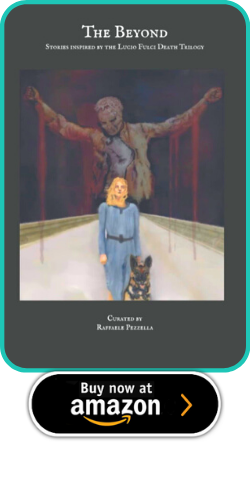
THE BEYOND,  STORIES INSPIRED BY THE LUCIO FULCI DEATH TRILOGY   CURATED BY RAFFAELE PEZZELLA
Lucio Fulci (1927-1996) was a versatile movie director, nowadays mostly remembered for his horror films, especially the so-called “Gates of Hell trilogy”: City of the Living Dead, The Beyond ,The House by the Cemetery.


The present volume, curated by Raffaele Pezzella, assembles eleven brand new stories inspired by the atmospheres of the Fulci films without being imitations of the plots and the characters featured therein.
Among the various contributions some are especially worth mentioning.


“ Terror at the Harriet Kingston Motel” by Glynn Owen Barrass is a darkly atmospheric tale where horrors erupt from the fog at a secluded motel in the middle of the night, while “The Evocation of Ansell Jeffers” by Sarah Walter features Fulci himself and a man who collaborated with him to create the infamous ( and famous) trilogy.


In the violent “ Lost in Hell on the way to Victory” by J. Edwin Buja past events which took place in Sicily in 1943 ,when allies experienced supernatural horrors, still linger at the present time.


My favourite story is “ Last Rites” by David Allen Voyles, a terrifying tale of graphic horror where the dead arise from their graves to invade people’s houses and to bring about havoc and destruction.

​
Other contributors to the volume are BE Dantalion, Richard Alan Scott, Andrew Coulthard, John Chadwick, Michael Housel, D Agranoff & A Trevino, Nora B Peevy.


Even if you’re not familiar with Fulci’s horror movies, you’ll find in this book many opportunities to feel some shivers or to be downright scared.


The Beyond. Stories Inspired by the Lucio Fulci Death Trilogy: Curated by Raffaele Pezzella 

Picture
Stories by: Glynn Owen Barrass, Andrew Coulthard, Richard Alan Scott, Sarah Walker, J. Edwin Buja, David Agranoff, Anthony Trevino, Michael Housel, John Chadwick, David Voyles, Nora Peevy, B.E. Dantalion. Second volume by Eighth Tower Publications, in a series of anthologies revolving around genre writers and artists who set the parameters and frameworks of the kind of tales that we prefer to read (the first volume was dedicated to HP Lovecraft). Here you will find another varied selection of interpretations inspired by the Gates of Hell film trilogy by the Italian legendary director Lucio Fulci. Many authors do elaborate on themes explicated in the movies, but there are an equal number that only take the barest of essentials from Fulci’s works and go off tangentially instead. You will find two tales in which the film features, both in very different ways: Sarah Walker’s ‘The Evocation of Ansell Jeffers’ and Andrew Coulthard’s ‘The Seventh Gate’. Some stories such as Michael Housel’s ‘Summer Urges’ hint at the threat of the living dead (simultaneously using characters and tropes from the film City of the Living Dead, but only in passing), while John Edwin Buja’s wartime-set ‘Lost in Hell on the Way to Victory’ similarly uses the living dead motif and mentions the Gates of Hell but otherwise makes no reference to anything from the films. More proscribed tomes lie at the heart of both John Chadwick’s ‘The Book of Belman’ (Chadwick’s own creation The Book of Belman) and B.E. Dantalion’ ‘The Black Hole (Robert Bloch’s De Vermis Mysteriis). Of course, other stories feature hordes of our favourite brain-munchers running amok, like Glynn Owen Barrass’ ‘Terror at the Harriet Kingston Motel’ and Nora B. Peevy’s darkly comedic ‘The Witch of Fox Point’, which features a cast of memorable characters including a plucky teenager who, along with her witch grandmother and the ghost of a young girl, battle against a veritable swarm of the undead (and zombie cows) in order to save the world. In Richard Alan Scott’s ‘Son of No one’, a real-life event that terrorised New York in the seventies is given an unsettling twist, setting the tale against a palpable sense of genuine fear and panic that really was felt by people at the time, told by a native of NYC in a way that creates a sense of reality that only serves to heighten the unfolding nightmare. David Voyles’ ‘Last Rites’ has its own blackly humorous moments in a well-observed tale set in a typical English town. Music plays a central role in David Agranoff and Anthony Trevino’s nightmarish ‘Scoring The Season of the Unnamed’, So we invite you to barricade yourself into your house, black out the windows, set a fire in the grate, turn on a dim light by which to read, stockpile some weapons perhaps, and settle yourself into a comfortable chair and let these eleven tales of terror accompany you into the small hours of the night.

TODAY ON THE GINGER NUTS OF HORROR WEBSITE ​

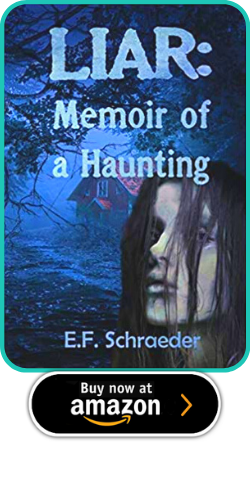
BOOK REVIEW: LIAR: MEMOIR OF A HAUNTING BY E.F. SCHRAEDER

Picture

THE HEART AND SOUL OF HORROR REVIEWS

book review: LIAR: MEMOIR OF A HAUNTING BY E.F. SCHRAEDER

24/1/2022
LIAR: MEMOIR OF A HAUNTING BY E.F. SCHRAEDER
Liar: Memoir of a Haunting 
by E.F. Schraeder


Publisher ‏ : ‎ Omnium Gatherum Media (21 Feb. 2021)
Language ‏ : ‎ English
Paperback ‏ : ‎ 187 pages
ISBN-10 ‏ : ‎ 1949054349
ISBN-13 ‏ : ‎ 978-1949054347

A book review by Ben Walker


​I do love an effective title, and this one hits pretty hard, a stark accusation followed by a description of the contents that had me wondering: who survived or experienced that titular haunting, and why would they lie about it?


As it turns out, that strong title does a lot of heavy lifting throughout E.F. Schraeder's first novella. You might go in expecting a typical haunted house story, but it soon proves itself to be more complex. Taking its time setting up the characters of Rainey and Alex during their search for a home, eventually we follow Rainey into Sugar House as her relationship with Alex continues at a distance. Along the way, some wonderfully written moments and evocative descriptions are scattered in to suggest unease, but it's the character drama which shines through most. And this is where we come back to that title. There's a degree of wariness to be felt as you start reading Rainey's retelling of events, and later, those of other characters. After all, someone is apparently lying. So with every page turn, as relatable and human as both women are, you do have to wonder how much of what you're being told actually happened.


This being a memoir, there's also a lot of introspection, which contributes to the overall feeling of uncertainty, but also means the pacing is quite slow. Rather than there being a gradual build to a decisive finale, there's a constant ebb and flow of everyday life interrupted by unusual events and intrusive thoughts. Some of the spookier events are kept at arm's length, occasionally eliciting a shiver, but not always sustaining the terror. Unsettling is the best word for it, but again, those doubts concerning the reliability of narrator tend to take the edge off. You're always left wondering whether certain things really took place. That said, those which are found to be true tug at the nerves long after the final chapter.


The story itself eventually switches gears – and perspectives – but not before muddying the waters slightly with the discovery of someone else's journal. There's a tipping point before this which teases out some troubling moments, obscured within a log of another kind. In the second half of the story, you start with the hope that some kind of truth will reveal itself, before things take a troubling turn and the weirdness ramps up. It's a read that requires and rewards patience, with the author throwing in quite a few styles and techniques to throw you off guard.


As for the titular haunting, it's a very personal one; instead of the creaking doors and mysterious apparitions you might picture when someone says they've been haunted, this is instead an exploration of Rainey's mind, and how it's affected by a number of factors, from discrimination to self-doubt and more. The whole story feels very personal in fact, and as the afterword explains, some events were inspired by real-life hardships faced by the LGBTQIA+ community, which rings true throughout the narrative, and makes for difficult reading at times.


And difficult – or better yet, challenging – is the best way I can summarise this book. You have to come to your own conclusions, put the pieces together of what's true and what's not, even when the truth is apparently offered up to you. Approach it with your wits about you, and you're in for an intriguing read.

Liar: Memoir of a Haunting Paperback 
by E.F. Schraeder 

Picture
Who doesn’t crave a little escape? Dreaming of small town life and rural charm, Alex and Rainey find a deal on an old rustic home they can’t resist. But soon after Rainey moves, her preoccupation with weird local history and the complications of living alone in the woods take a toll. Alex worries that the long nights and growing isolation are driving her stir crazy. When the Sugar House is damaged and Rainey goes missing, Alex doesn’t know where to turn. Was it a storm, vandals, or something worse? What happened at the Sugar House? The only thing worse than wondering is finding out.

TODAY ON THE GINGER NUTS OF HORROR WEBSITE ​

BOOK REVIEW: THE BEYOND STORIES INSPIRED BY THE LUCIO FULCI DEATH TRILOGY CURATED BY RAFFAELE PEZZELLA

Picture

THE HEART AND SOUL OF HORROR FICTION REVIEWS ​

Previous
Forward
    Picture
    Picture

    RSS Feed

    Archives

    May 2023
    April 2023
    March 2023
    February 2023
    January 2023
    December 2022
    November 2022
    October 2022
    September 2022
    August 2022
    July 2022
    June 2022
    May 2022
    April 2022
    March 2022
    February 2022
    January 2022
    December 2021
    November 2021
    October 2021
    September 2021
    August 2021
    July 2021
    June 2021
    May 2021
    April 2021
    March 2021
    February 2021
    January 2021
    December 2020
    November 2020
    October 2020
    September 2020
    August 2020
    July 2020
    June 2020
    May 2020
    April 2020
    March 2020
    February 2020
    January 2020
    December 2019
    November 2019
    October 2019
    September 2019
    August 2019
    July 2019
    June 2019
    May 2019
    April 2019
    March 2019
    February 2019
    January 2019
    December 2018
    November 2018
    October 2018
    September 2018
    August 2018
    July 2018
    June 2018
    May 2018
    April 2018
    March 2018
    February 2018
    January 2018
    December 2017
    November 2017
    October 2017
    September 2017
    August 2017
    July 2017
    June 2017
    May 2017
    April 2017
    March 2017
    February 2017
    January 2017
    December 2016
    November 2016
    October 2016
    September 2016
    August 2016
    July 2016
    June 2016
    May 2016
    April 2016
    March 2016
    February 2016
    January 2016
    December 2015
    November 2015
    October 2015
    September 2015
    August 2015
    July 2015
    June 2015
    May 2015
    April 2015
    March 2015
    February 2015
    January 2015
    December 2014
    November 2014
    October 2014
    September 2014
    August 2014
    July 2014
    June 2014
    May 2014
    April 2014
    March 2014
    February 2014
    January 2014
    December 2013
    November 2013
    October 2013
    September 2013
    August 2013
    July 2013
    June 2013
    May 2013
    April 2013
    March 2013
    February 2013
    December 2012

https://l.facebook.com/l.php?u=https%3A%2F%2Fmybook.to%2Fdarkandlonelywater%3Ffbclid%3DIwAR1f9y1sr9kcIJyMhYqcFxqB6Cli4rZgfK51zja2Jaj6t62LFlKq-KzWKM8&h=AT0xU_MRoj0eOPAHuX5qasqYqb7vOj4TCfqarfJ7LCaFMS2AhU5E4FVfbtBAIg_dd5L96daFa00eim8KbVHfZe9KXoh-Y7wUeoWNYAEyzzSQ7gY32KxxcOkQdfU2xtPirmNbE33ocPAvPSJJcKcTrQ7j-hg
Picture