


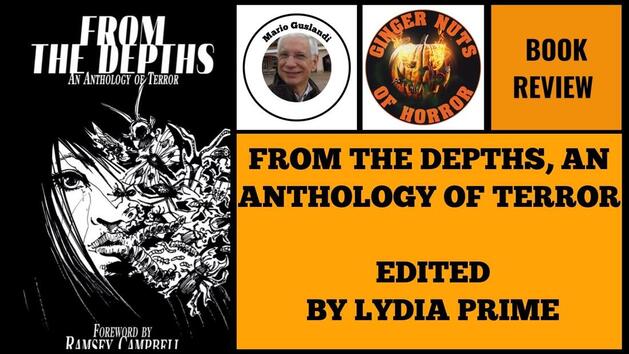
 Graced by an insightful Introduction by British horror icon Ramsey Campbell, this anthology assembles thirteen short stories and a little poem. The quality of the included tales is mostly high and Campbell’s introductory remarks are actually a sort of a commentary on the single stories themselves, so I will just focus on my own favourite and I will give a collective honorable mention to the other authors. “ Instinct” by Catherine McCarthy is an offbeat, complex tale of graphic violence where events of the past come back to haunt a man living with a bad conscience. Sonora Taylor contributes “ Meet Me in the Cemetery”, a macabre story of love and death where nothing is as it seems, while Jill Girardi pens” The Roiling” a disturbing SF piece depicting a world dominated by nasty amphibians. In “ Weeds” by Elizabeth Black - a mix of horror and SF- strange dandelions and toxic pesticides exert terrible effects on the human body. “ The House of Legion” by Mark Allan Gunnells is a strong, vivid story about an exorcism with an unexpected twist in the tail. To me the best story in the book is “ Missing Pieces” by Josh Darling, an exceptional piece of fiction where baffled policemen try to find the culprit of a series of recurring violent murders. Other contributors are Brandon Scott, Lydia Prime, Nicholas Catron, Joshua Marsella, Alexander Shedd, Bobbie Lee, Marie Lanza and RL Burwick. FROM THE DEPTHS, AN ANTHOLOGY OF TERROR EDITED BY LYDIA PRIME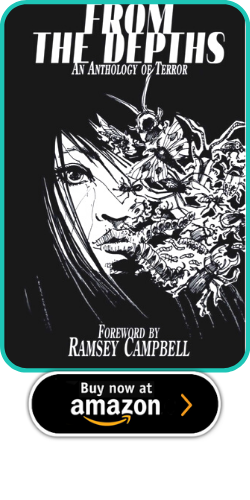 Fourteen horror authors were asked to dig deep within themselves and bring forth the story that best represents their dark art. Dive in and find what lurks in the murky depths of a writer's mind.. With foreword by the Master of Horror, Ramsey Campbell Edited by Lydia Prime TODAY ON THE GINGER NUTS OF HORROR WEBSITE FILM GUTTER REVIEWS: GROWING UP WITH I SPIT ON YOUR GRAVE (2019) THE HEART AND SOUL OF HORROR FICTION REVIEWS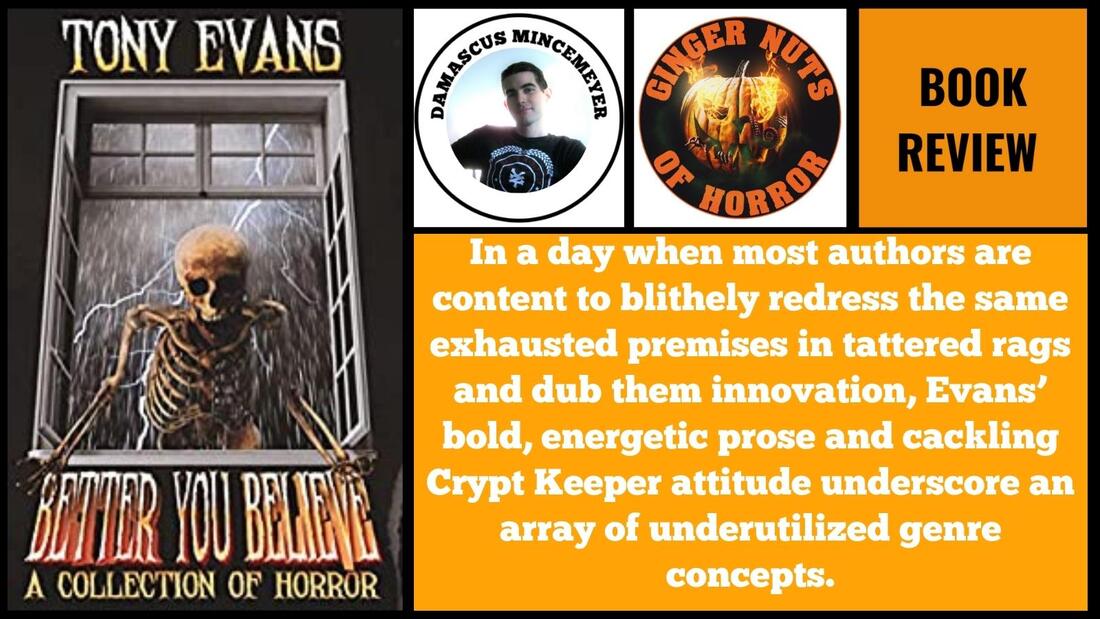 BOOK REVIEW: BETTER YOU BELIEVE by TONY EVANS Dark Holler Press, 204 Pages, Available now on Amazon in eBook and paperback Review by Damascus Mincemeyer “The oldest and strongest emotion of mankind is fear, and the oldest and strongest kind of fear is fear of the unknown.” H.P. Lovecraft Horror stories, it has been contended, were likely the first types of tales created and told by humans. For primitive, cave-dwelling bands isolated in an unknowable, hostile world not of their making, surrounded daily by pain and terror and death, recounting ghastly events--both real and elaborately imagined--served to process their harsh surroundings in a way that not only entertained, but educated. Do not venture into the valley over the next ridge, one aged Neanderthal says to the disbelieving youths of his tribe. If you do, you shall never return. The valley may be only a malarial mosquito-infested quagmire, and his warning prone to be ignored by the brash and foolhardy if he doesn’t elaborate: You shall never return because that valley is haunted by ghosts eager for you to join their swampy grave! Some of the best examples of modern horror retain those admonitory notes of ancient days, and in short fiction, especially, that essence remains undiminished. It’s in that spirit that author Tony Evans and Dark Holler Press re-releases Better You Believe, a collection of fourteen short stories that firmly establishes him as a modern master of the classic campfire yarn. Initially published in 2018 and deeply steeped in the folklore of the rural American Southeast, each tale is accompanied by notes revealing the regional origins of the unique and often disturbing scenarios contained within. The father who tells his son ‘A Bedtime Story’ is the reader’s introduction to both the book’s dark-and-stormy-night atmosphere and the nightmarish legend of Bloody Bones. A man lost in a blizzard finds himself at the mercy of a malevolent crone with an unusual assortment in ‘A Collection of Souls’, while witty banter between the stranded city-slicker protagonists livens a bizarre encounter with the titular object in ‘The Donkey Tree’. Creepers crawl in ‘Katsaridaphobia’, a portrait of one man’s psychosis-induced insect infestation (or is it?), while the confined mine-shaft setting of ‘Black Damp’ offers a disquieting claustrophobic counter-punch. The collection’s second half kicks off with the clever ‘Devil’s Night’, which accentuates Evans’ oft-displayed fascination with role-reversal. A chilling synthesis of mourning parents, a power outage, a freaked-out teenager and an oblong pine box set up ‘Blood Sacrifice’, and ‘Grandma’s House’ offers a spooky slice of body-snatching terror evocative of Stephen King’s classic “Gramma’ episode of the revived 1980’s Twilight Zone series. Evans’ background as a wildlife biologist informs the shape-shifting amphibious monstrosity in ‘Grampus’, while Latin American lore, bullying and revenge intertwine in the easily relatable ‘Trouble Dolls’. The wittily self-referential ‘Family Curse’ brings the volume to a skin-crawling (and skin-tearing) culmination when teenage sisters learn their parents, and perhaps they, aren’t as human as once believed. There’s an unabashed enthusiasm for pure storytelling in Evans’s rustic fables; tales lurk within tales like Russian dolls, each more intricately patterned and unnerving than the last, and for sheer palpable alarm, three cast dangerous dagger-like shadows upon their literary kin. Racial injustice and retribution lie at the heart of both ‘An Infestation of Rats’, which pits an unpleasantly prejudiced protagonist against a voodoo loa, and ‘The Woodsman’, a vicious narrative of Native American spectral reckoning abetted by wry character interaction. Yet it is ‘A Storm of Crows’ that unleashes the darkest of frights; with its blacker-than-midnight depiction of the black arts and an ever-escalating dread, witchcraft of the most unholy kind punishes a simple man’s transgressions with one of the most uncompromising and nihilistic finales in recent genre memory and serves as the harrowing seed for Evans’ novel, Sour. A rare, pleasant cohesion exists beneath the surface of Better You Believe; recurrent motifs present themselves, giving weight to themes that for other authors would be mislaid in a random clutter of content. An impassioned disdain for inequality and animal cruelty consistently arises, as does the subject of trespass and its consequence. Far beyond any other topic, however, lies the repeated emphasis on family in all of its myriad forms. Like Lovecraft long before him, Evans showcases with striking clarity the hereditary ties that bind generations--for good and ill--and details how events long past can, and often do, reverberate through history to affect the present in unimaginable ways. The folkloric roots of each story, too, unveil hope that the seemingly distant times of yore when humanity was connected to its myths more intimately than our current technological age allows may not be as lost as many may so casually assume. In a day when most authors are content to blithely redress the same exhausted premises in tattered rags and dub them innovation, Evans’ bold, energetic prose and cackling Crypt Keeper attitude underscore an array of underutilized genre concepts. Coupled with a beautifully macabre sense of artistic visual design, those elements elevate this collection to a vital top tier of modern independent horror strongly deserving of appreciation by any fan seeking fiction uncontaminated by pretense, posturing or pandering, and it’s these qualities that earn Better You Believe the full 5 (out of 5) on my Fang Scale. Better you believe this is one book worth reading. Just wait for a dark and stormy night. Better You Believe: A Collection of Horror |
 | Wetmore’s pleasant conversational style is anything but dry and dusty, and there aren’t too many of those dreadful puns the subject of cannibalism always seems to bring out in writers and reviewers. |


May 2023
April 2023
March 2023
February 2023
January 2023
December 2022
November 2022
October 2022
September 2022
August 2022
July 2022
June 2022
May 2022
April 2022
March 2022
February 2022
January 2022
December 2021
November 2021
October 2021
September 2021
August 2021
July 2021
June 2021
May 2021
April 2021
March 2021
February 2021
January 2021
December 2020
November 2020
October 2020
September 2020
August 2020
July 2020
June 2020
May 2020
April 2020
March 2020
February 2020
January 2020
December 2019
November 2019
October 2019
September 2019
August 2019
July 2019
June 2019
May 2019
April 2019
March 2019
February 2019
January 2019
December 2018
November 2018
October 2018
September 2018
August 2018
July 2018
June 2018
May 2018
April 2018
March 2018
February 2018
January 2018
December 2017
November 2017
October 2017
September 2017
August 2017
July 2017
June 2017
May 2017
April 2017
March 2017
February 2017
January 2017
December 2016
November 2016
October 2016
September 2016
August 2016
July 2016
June 2016
May 2016
April 2016
March 2016
February 2016
January 2016
December 2015
November 2015
October 2015
September 2015
August 2015
July 2015
June 2015
May 2015
April 2015
March 2015
February 2015
January 2015
December 2014
November 2014
October 2014
September 2014
August 2014
July 2014
June 2014
May 2014
April 2014
March 2014
February 2014
January 2014
December 2013
November 2013
October 2013
September 2013
August 2013
July 2013
June 2013
May 2013
April 2013
March 2013
February 2013
December 2012

|

|


 RSS Feed