


 Resident Evil can mean a lot of things based on how old you are. You could have grown up with the PlayStation original, the countless sequels and spinoffs, the movie franchises and the other mediums the horror classic has staggered towards. Essentially, it is a title that is now infamous for being a horror classic and its influence has only grown alongside the people that its scared. In Boss Fight Books’ latest release, Philip J Reed takes a look at the horror that terrified him as a child, and how it feels revisiting it when he’s not scared so easily. Reed provides a confident and detailed history of the game that will welcome people who have never played it before and inform those that stayed up all night playing it, whose knowledge of the zombies and Spencer Mansion is part of their DNA. There’s a summary of the plot, woven in with Reed’s personal experiences with the game, tying it to his childhood and homelife. Reed mixes the two well, it never feels too much like a memoir and the reader is aware of the personal significance that this title has for him, which makes them just more invested to find out more about the game. It’s also a more difficult task to talk about than you’d think, with multiple sequels, a film franchise, alternate titles in Japan and story continuity, Reed does a fantastic job at keeping the focus on this one game (other than speaking about the Remake), only referencing other titles to prove his point or to contrast. While it would be nice to hear the story of these films and the development of future games, that can be another authors job, as Reed certainly had his hands full with this title. The book excels with Reed’s research into the live action cutscenes that were filmed for Resident Evil. While as a sentence it doesn’t sound like a thrilling exploration, the end result is catching up with people, some of whom didn’t even know that the game had gone on to become such a worldwide phenomenon, here Reed manages to capture the development of the game, the differences in the East and West, the artists struggle and enough humour so that most readers will go back to Youtube to watch the cutscene again and again. Reed himself is wonderfully aware of how dated it all is, and how nostalgia can protect things from aging like vinegar. Like most books written about specific video games, if you’re not a fan, or at least have some understanding or interest in Resident Evil or game development, this may not entice you too much, especially the parts about the walkthrough of the game, but if you do have a fraction of an interest, reading this will be like catching up with a friend over a beer. The only thing is, though, that you wouldn’t feel safe walking home at night because now all you can think about is zombies. Oh, and while you are walking home, don’t even think about stopping at that mansion in the middle of the woods, because you know the flawed and beautiful truth about how Spencer Mansion and its monsters came to be there.  Now a sprawling video game franchise, Resident Evil has kept us on the edge of our seats for decades with its tried-and-true brand of jump scares, zombie action, and biological horror. But even decades after its release, we can’t stop revisiting the original’s thrills, chills, and sometimes unintentional spills. Pop culture writer and horror cinephile Philip J Reed takes dead aim at 1996’s Resident Evil, the game that named and defined the genre we now call “survival horror.” While examining Resident Evil’s influences from the worlds of film, literature, and video games alike, Reed’s love letter to horror examines how the game’s groundbreaking design and its atmospheric fixed-cam cinematography work to thrill and terrify players—and why that terror may even be good for you. Featuring a foreword from Troma Entertainment legend Lloyd Kaufman and new interviews with the game’s voice actors and its live-action cast, the book serves as the master of unlocking the behind-the-scenes secrets of Resident Evil, and shows how even a game filled with the most laughable dialogue can still scare the pants off of you.  Jay Slayton-Joslin is the author of Sequelland: A Story of Dreams and Screams (Clash Books, 2020) and Kicking Prose (KUBOA, 2014). Jay graduated with a BA in American Literature with Creative Writing from the University of East Anglia and a MA in Creative Writing from the University of Surrey. He lives in Leeds, England. Find out more about Jay by checking out his website here 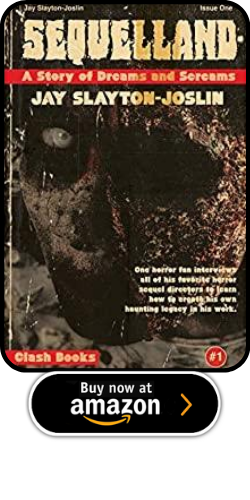 In the back alley of HOLLYWOOD lies SEQUELLAND, where directors and creatives get the chance to do what they love, not necessarily in the conditions that they love. Jay Slayton-Joslin, a writer and horror fan, experiencing his own existential crisis takes a direct approach exploring his childhood filled with direct to DVD horror sequels, interviewing those who created the sequels to iconic franchises feel upon looking back on them. The story of people who tried to do what they loved, filled with pride, regret, and resolution.It’s… SEQUELLAND: A STORY OF DREAMS AND SCREAMS. “Jay Slayton-Joslin delivers rare and insightful peeks into the world of Hollywood’s most battle-scarred foot soldiers. Whether legionnaires, barbarians or berserkers, these filmmakers weave their war-stories with equal measures of cynicism, idealism and candor. Less a series of interviews than informal conversations one might have on a hot afternoon over whisky shots in the Mitchum-booth at Boardners. Engaging, compelling fun.”Daniel Knauf, Creator of Carnivale Interviews with: Uwe Boll, John Skipp, Jeff Burr, Adam Marcus, Ernie Barbarash, Peter Webber, Mary Lambert, Kevin Yagher, Zack Lipovsky, Katt Shea, and Kevin Greutert.   Comments are closed.
|


Archives
May 2023
|

|

|
 RSS Feed