


REVIVAL BY STEPHEN KING
4/8/2015
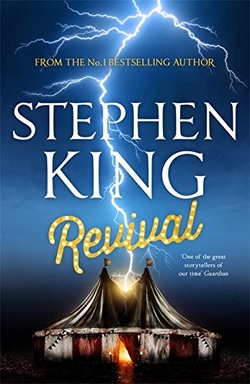 CLICK TO PURCHASE CLICK TO PURCHASE Most folk who know me, know I've been an almost constant reader - and fan - of Stephen King's work. I couldn't tell you what my first encounter with his work was (well, his written work - we'd been watching the films since we were 9, 10. For some reason, when I was a kid, we never got hit by the whole 'video nasty' hysteria and were pretty much allowed to watch anything we wanted), as I devoured any of his books I could get my hands on with a passion once I got my adult library card in the hallowed year of 1991. I do know that some of those early exposures would have been IT, Misery, Skeleton Crew, Christine, 'Salem's Lot and more. And I loved it all.... Up until recently, I could have counted on one hand the stuff I didn't like - Firestarter and a couple of stories in Night Shift that I was probably too young to fully appreciate. Lately, I could add Cell, Duma Key, Lisey's Story, most of the collection Just After Sunset, and the last two Dark Tower books. I struggled with these for a number of reasons, chiefly - in the case of Duma Key and Lisey's Story - with the suspicion that King was skating around the meat of the stories with a lot of hugely unnecessary prose and scenes. I think this was an attempt to appear more literary, which is mad because I think he's always been a literary writer, at least as far as loose definitions go (even when I haven't liked the story, I've always found his writing polished and engaging. I've seen one writer describe his work as 'amateur', which just made me laugh in a resigned way, especially as their own output is sorely lacking on that front. I think if you can't distinguish between 'good' writing and 'bad' - with a smidgeon of subjectivity, of course - you're probably not going to be aware enough to write well yourself). Look at stories like The Body, or Shawshank; or any number of those in his short collections. I think the only thing that stops people from recognising this, is the continuing, ludicrous attitude that genre cannot be literary. But I digress. I got back on with King when Full Dark, No Stars came out, really enjoyed Under The Dome, then was blown away - completely and utterly, like no book had for a long, long time - by 11/22/63. Since then, I've enjoyed most of his work to one degree or another. Which brings me to Revival... The story is the 'confession' of Jamie Morton, who recounts his life from when he was a small lad living with a large family in a typical small Stephen King town in Maine. This is where he first meets Charlie Jacobs, who comes to the town as a pastor with his wife and toddler son. They are welcomed into the community and people come to love them, not least the children, who are fascinated by Jacobs's interest in electricity. For Jamie, this fascination becomes something more when Jacobs heals Jamie's brother with what he calls 'secret electricity'. Then, tragedy strikes and Jacobs leaves the town after giving a sermon in which he rails at god, claiming it's all nonsense. Thereafter, the story follows Jaime at various points in his life, as he progresses through the years. We have his first love, his music career, his dalliance with drugs and, at various intersections, he meets with Jacobs again and again - seeing the man's obsession with his secret electricity grow - until it culminates in one fateful experiment. I have to admit, I really struggled with this novel. I started reading it a couple months ago, and had to put it aside for a few weeks as I was only managing a handful of pages now and again. I think my biggest issue with it is, it feels like the book is too big for the story. In that, it would have been, in my opinion, far better as a novella - compact, concise and impactful Instead, we have long, meandering passages that really don't seem to add anything of significance to the story. I also felt mild annoyance at the main character/narrator, something which rarely happens to me. I don't read stories for the characters, and I certainly don't need to identify with them or 'like' them (if you do, that's fair enough, but I think you're missing out on some great books with largely unsympathetic character-types and if you do mark a book down for an unlikeable character, you're kind of missing the point...), but now and again, I find one that pushes my irritation button. Jamie continually refers to Jacobs as his 'fifth business' (a term which apparently means change agent, nemesis, antagonist); in fact, we are given this information before the book eve starts, on the blurb. And yet, despite Jacobs's obsessions, despite his roles as both carnival fraud and revivalist preacher, I never get the impression that he's a bad person. Maybe that's intentional, but it makes me dislike Jamie's constant assertion that Jacobs is a bad man, who is essentially the villain of the piece. I think, personally, this would have worked better in third person following Jaime. In first person, we are with him and stuff like this creates a barrier for me somewhat. I also felt that for a book that has been - fairly or not - touted as a great example of cosmic horror, it really seemed lacking in this. The rare instances of anything eerie or otherworldly - visions seen in a revival tent, mention of supposed banned books by The Vatican - felt out of place, shoehorned in and awkward. For me, a story of cosmic horror either needs to be infused with that sense, or builds up to it slowly and inexorably, neither of which happened here for me. Other, smaller, more insignificant things bugged me; the constant mention of 'limp fish' handshakes that ALL musicians apparently have. I've met a lot of musicians, I play guitar myself, and I've never encountered this handshake phenomenon. Then there's the assertion that you never fall in love with someone as hard as you did as a teenager; sadly, I can tell you that's bullshit. I've done it. These might seem like utter irrelevancies, but for me, part of fiction is putting in 'truths' (as much as anything can be a truth) and when I read stuff that I just think is clearly not true, it jars me from the story. There are some good points - it's very well written, as expected, though a slight over-reliance on passive voice (not something that usually bothers me, but when it's every other sentence, it does become wearing). There are some real stand-out scenes for me - including one where Jacobs is plying his trade at a carnival (in fact, I believe it's the carnival/fairground that Joyland takes place in, though I've yet to read that novel), putting young women into a huge projected picture through use of his 'secret electricity'. Ultimately though, I felt there were a lot of missed opportunities here. What could have been a meditation on faith - how it can lift us up, but also sell us lies and corrupt us, twist our perceptions - and also a treatise on the nature of growing old, looming death and time slipping away from us (which would also have made the ending more impactful for me), feels instead like a meandering memoir with little real interest or insight, almost again like King is merely skating around the real story. Perhaps just my impressions and a wee bit unfair, but I do think the novel could have been far more impactful and interesting. Not terrible, but certainly not up there with my favourites. On to the next one, though. Purchase a copy here PAUL M. FEENEY4/8/2015 10:29:04
I agree with just about every point you've made here. Just wanted to jump in and add the definition of "fifth business," from the book of the same name by Robertson Davies. I had read this series (The Deptford Trilogy) shortly before reading Revival, so it miffed me a fair bit seeing it misused over and over in Revival.
Kit Power
4/8/2015 11:29:29
Man am I glad I wasn't the only one... You totally nailed this one for me, on pretty much every level. Good work.
Paul M. Feeney
4/8/2015 12:37:35
Cheers guys. I appreciate this is mostly a point of view and many folk seemed to really like this one, but I just couldn't get on with what I felt were massive wasted opportunities. As I've said on a thread on Kit's wall, I also felt that there were many scenes which happened 'off-stage', events which were significant and important and yet had only a few lines to divulge them. Instead of the deeply affecting death of Jamie's sister, instead we have pages and pages of Jamie's times on stage, or his rather dull dalliance with Bree. Comments are closed.
|


Archives
May 2023
|

|

|
 RSS Feed