


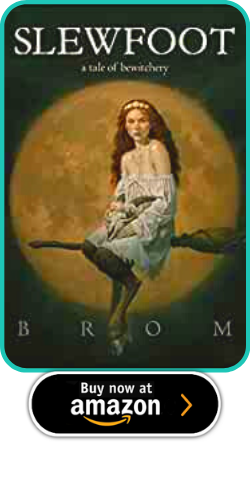
Slewfoot: a Tale of Bewitchery by Brom Publisher : Tor Nightfire Language : English Hardcover : 320 pages ISBN-10 : 125062200X ISBN-13 : 978-1250622006 A Book Review by Tony Jones Back in 1666 darkness awakens amongst a group of Puritan Christians Gerald Brom, generally known in the literary world as the singular ‘Brom’, weaves a fascinating tale of magic, mystery, and all-round self-indulgent weirdness in his latest novel Slewfoot. For those of you unfamiliar with the term ‘Slewfoot’, it is one of many names historically given to the Devil and ‘Old Nic’ lurks in the background of this odd story, even if he rather confused for most of the time. That was part of the charm of this story, I was not entirely sure how I was supposed to feel about the darker characters. Technically the demons are traditionally the ‘bad guys’ in fiction, but in its own way Slewfoot oddly turns this fact on its head and they are considerably more likable that the stiff-collared Puritan dudes! Set in Sutton Village, a remote area of Colonial New England Connecticut, in 1666, a group of very zealous Puritan Christians live in an isolated village and hunt for demons under every rock, each trying to be ‘purer’ than their neighbours. Brom paints a vivid picture of how difficult life was in this time, with things made even worse by the fact that the guy next door may well report you to the church for doing something dodgy (like reading a book which was not the Bible!) or showing an inch of flesh from above the ankle. For Sunday church services the congregation listened to three long winded preachers on the bounce and those who had missed the midweek service had to kneel throughout the entirely of the three sermons. Painful stuff! These villagers were an incredibly unlikable bunch and one wonders how they would have fitted in Nathaniel Hawthorne’s Young Goodman Browne or even worse, Netflix’s Fear Street Part 3: 1666 which are both set in the same type of community and with similar goings on. You have to wonder about the state of the humanly souls of good Christian men who looked forward with good cheer to a juicy torturing followed by a jolly hanging! The main character Abitha steals the show and once you have spent some time with her you might wonder why she ever married the rather simpleton Puritan man Edward. Sadly, in those days women had little choice and could be seen but not heard in the Puritan world (in actual fact Abitha was sold by her drunken father). Straightaway the reader realises that Abitha is the brains in the marriage and she rails ever so slightly against the Puritan way of life. She is also somewhat of an outsider and is shunned by the other villagers as she has inherited the same herbal skills (‘devilry’ to many) of her dead mother. Edward is a real weakling and is bullied by his oaf of a brother Wallace, with a key part of the plot built around who owns the two farms the different families live on. Abitha pulls the strings in the background, but at the same time knows she could easily end up in the stocks for speaking out of turn. Is Abitha a good Puritan woman? That is one of the many fascinating and ambiguous questions Slewfoot asks. What is evil is another question Brom asks of the reader. And there are no easy answers coming from either the Puritan side with their cruel rigid rules, contrasting with the ancient awakening dark forces in the encroaching forest. The novel does not make any particular moral judgments and the reader can decide themselves what ‘evil’ truly is and whether it applies to what lurks in the forest, or whether it is actually more elemental or a blur between the two. Most of the characters are portrayed as very black and white, with the brother Wallace for example, being a very unlikable Puritan caricature, which no readers are going to side with, with the rest of the village pretty much as ghastly. If you know what happened in the Salem Witch Trials of 1692 or anything about Matthew Hopkins made famous by the cult film Witchfinder General then you will have a good idea of the direction in which Slewfoot heads. Although it does not hold any surprises, it meanders in its own time, is rather seductive and beautifully written with descriptions of the Puritan lifestyle and the supernatural entities of the highest quality. Further into the novel events move through the gears with some brutal torture scenes before a very wild finish which may well have you cheering to the rooftops! This terrifying tale of bewitchery also features many of Brom’s own haunting paintings, fully immersing readers in this wild and unforgiving fairy tale world. Slewfoot had the feel of an early American novel and much of your enjoyment of it will depend on how you connect with Abitha and how she deals with the trials thrown in her direction. Sure, she was head strong and iron willed in a world dominated by men, but on the other hand when her ‘Adam and Eve’ moment arrives she appeared to be as gullible as a five-year-old. But many of the best characters in literature are full of contradictions and the same could be said for ‘Samson’ who although he tested my patience at times was very amiable for a demon. Slewfoot is dark, and the story is very painful with the reader feeling the isolation of Abitha as circumstances moves against her. In turn it was a hauntingly beautiful, slightly frustrating in parts, blend of horror, fantasy, historical fiction, and a harrowing tale of revenge. Brom has a certain swagger to his writing and it really blossoms in Slewfoot. Tony Jones Slewfoot: A Tale of Bewitchery |


Archives
May 2023
|

|

|
![SLEWFOOT: A TALE OF BEWITCHERY BY BROM [BOOK REVIEW]](../uploads/3/4/5/1/34519054/horror-fiction-review-slewfoot-a-tale-of-bewitchery-by-brom-book-review_orig.jpg)

 RSS Feed