


A Nation is a society united by a delusion about its ancestry and by common hatred of its neighbours. – [Dean William Ralph Inge] Comic-books are a medium, not a genre; they can tell any story and suit any palate. You want horror? I've got bottles of the stuff. Welcome to 'Splashes of Darkness.' 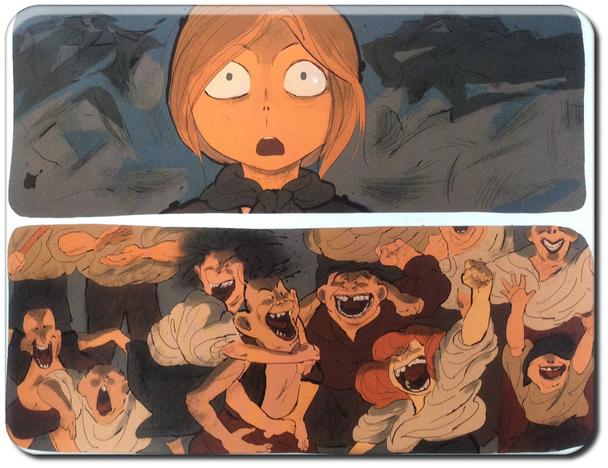 The Hartlepool Monkey is a fruit punchbowl, innocently sat out at the pub barbecue amongst the squashes and pop on the kids’ table. There’s something different about it, though: something…off about the colour. Most of the children who drink from it are giggling, but others seem changed somehow. A little more thoughtful, perhaps; a little blue. Wait a minute. Is this on the right table? Has some scamp slipped a little something extra into it, maybe? Cautiously, you take a sip… There are people with certain attitudes, events that unfold around us almost daily, where you almost have to laugh or you’d cry: where tragedy cleaves so close to comedy they become all but indistinguishable. Wilfrid Lupano and Jérémie Moreau stride that tightrope over despair’s abyss with supreme confidence in their humorous retelling of The Hartlepool Monkey. Factual details are sparse, but the legend goes that the people of Hartlepool once hanged a monkey, believing it to be a French spy. Upon this slender thread of history the creative team build a multi-layered masterpiece that explores the mechanics of nationalism, the horror of mob mentality, and what hopes we may have for a civilised future. 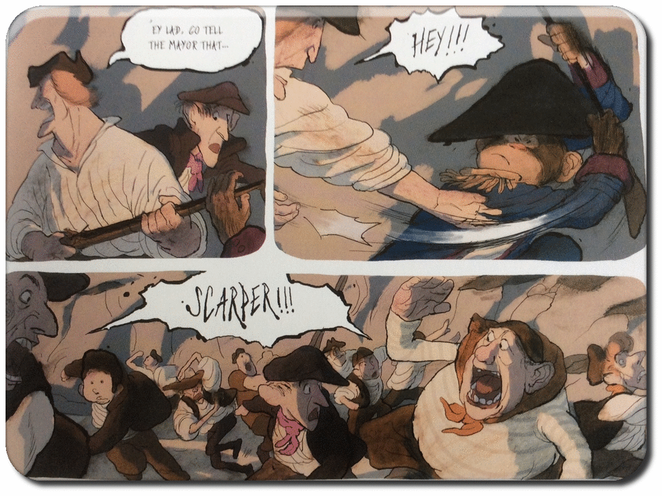 The Hartlepool Monkey is that rarest of beasts, a truly all-ages comic. I found it enjoyable to read on every level and was quietly delighted by what it had to say. It is a mischievous book, energetic and troublesome. It may appear to be poking fun at British stupidity but, despite its Gallic provenance, the project remains even-handed throughout. As the writer stated in an interview with Forbidden Planet, he just wanted to write a satire about extreme nationalist behaviours from the point of view of the ordinary people. It could have happened in France with an English monkey, (as far as a monkey can have a nationality). The story demonstrates how easy it is to hate someone you’ve never seen before, and about whom you hardly know anything. The imagery reflects this intent beautifully with its cast of grotesques leaping straight from the pages of Punch. It’s beautifully hideous stuff, full of flying spittle and the vinegar of irony. 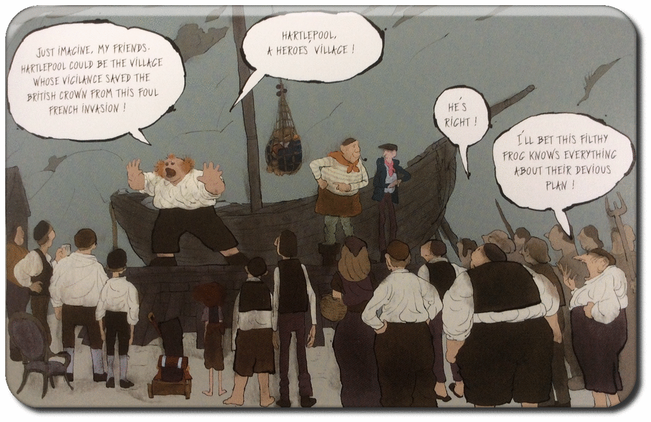 What impressed me the most is the manner in which the legend is brought to life. Forget exposition, thought bubbles and narrative captions; these are master tale-spinners at work. It reads more like a slice of life than a history lesson, using everyday language and familiar behaviours. We simply have to accept what is placed before us, building up an understanding of events from the action and conversations as they unfold. Lupano gives us two sets of characters to follow: the adults, egging each other on with jingoistic fears, and the children, caught up in the thrill of events yet unable to fully comprehend them. Who were these ordinary people though, what could have led them to be so appallingly stupid? Crucially, are we really so far removed from them? While the children fall into natural new friendships with the strangers in their midst, the grown-ups become ever more hysterical in the build-up to the farcical lynching. Lupano handles the dual narratives effortlessly, using the generation gap to reveal the adults hypocrisy and demonstrate how thoughtlessly we foist follies upon our offspring. There is something of the danse macabre in the book, structurally and thematically speaking. Each step is simple and easy to follow, yet together they form a complex pattern which is at once light-hearted in tone and grimly inevitable in its direction. 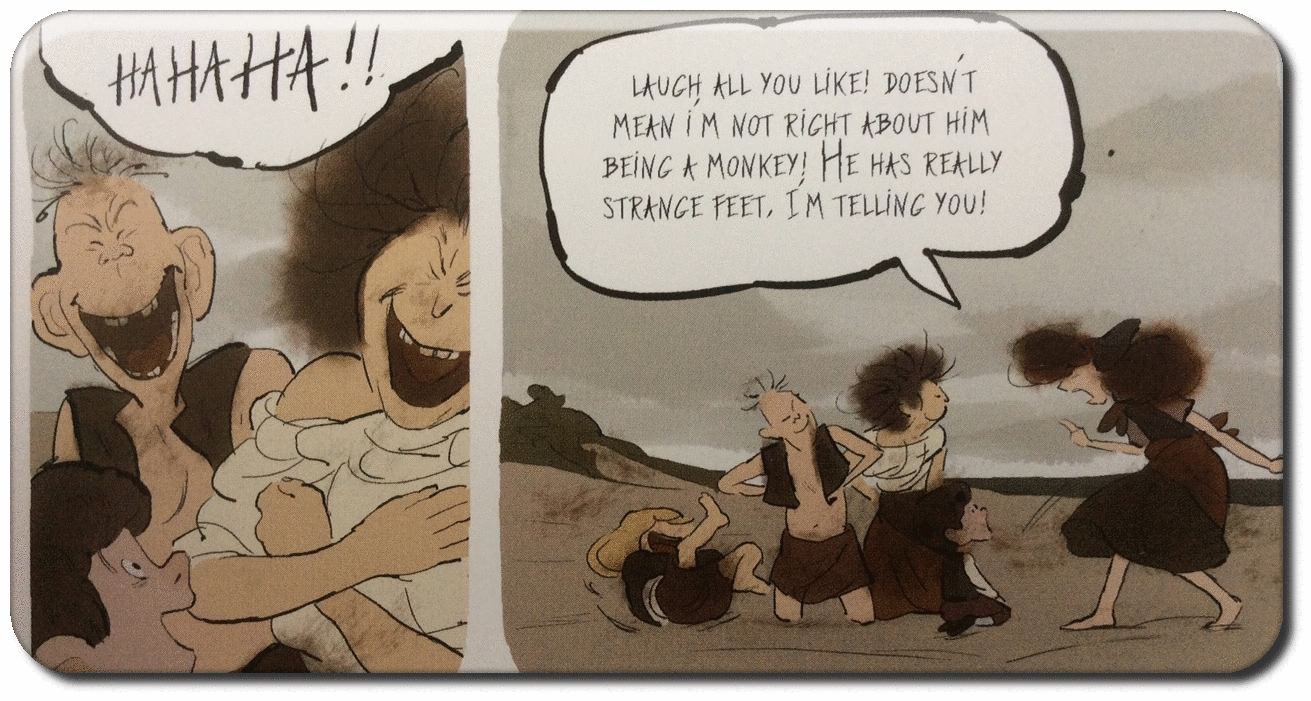 Moreau’s artwork feels to me like a mongrel blend of Quentin Blake and Raymond Briggs – adorably warped, scratchy, warm and chock full of nervous energy. Everybody is plug ugly, with the exception of Philip, Melody and Charlie – the children who offer us the greatest hope for the future with their thoughtful intelligence and warmth – and this is surely no coincidence. Neither is the fact that so many of the Hartlepuddlian rabble-rousers look distinctly simian themselves, skewering them with their own prejudices. Who are the real beasts? The fact that the monkey had been dressed in a French uniform, and has been trained to march like a soldier for the amusement of its Captain, only adds to the pitch-black hilarity. 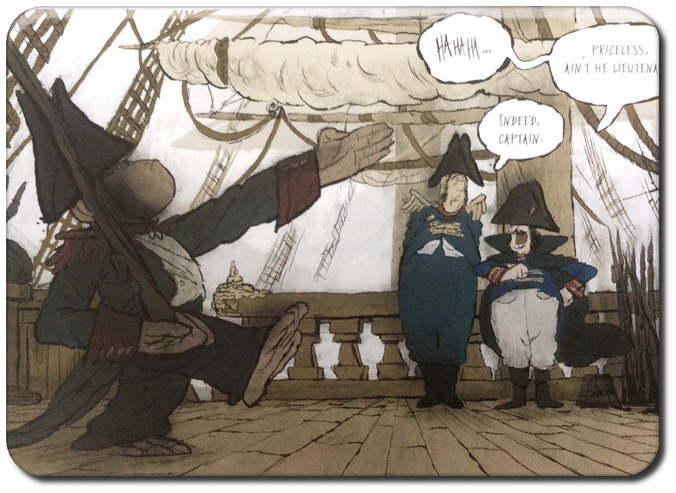 The art here bear a greater weight of the story-telling than I am used to in my comic-reading experience (though this is far from a silent book), and this collaborative method works tremendously well. In some instances action scenes are unveiled in a manner that lets you engage more, filling in the deafening storm or artful oration with your own imaginations; silence is also used to help the reader see things from the perspective of the innocent monkey, to whom speech is a meaningless abstraction; while yet other panels are simply there to help pace out the narrative, set a scene or evoke a certain mood. The rounded-off panels and slightly chaotic layouts subtly defy the hard-edged strictures of the medium and help develop the fundamental theme that the barriers we surround ourselves with are artificial, preventing us from seeing the real world—though I may well be spiralling up my own arse here. The point is, the creators know what they’re doing, they are working collaboratively towards that aim, and they’re bloody good at their jobs. It is a genuine pleasure to read, and I cannot recommend it enough. Now, I mentioned Raymond Briggs back there and I just want to take a moment to compare The Hartlepool Monkey to one of his finest. When The Wind Blows had a similar remit of tackling monstrous truths through satirical horror, humour and the perspective of everyday people. It was hugely important in its day for stirring public debate about nuclear weapons across the generations, and it still resonates powerfully with its readers today. However, to my mind The Hartlepool Monkey is a far more accessible work. 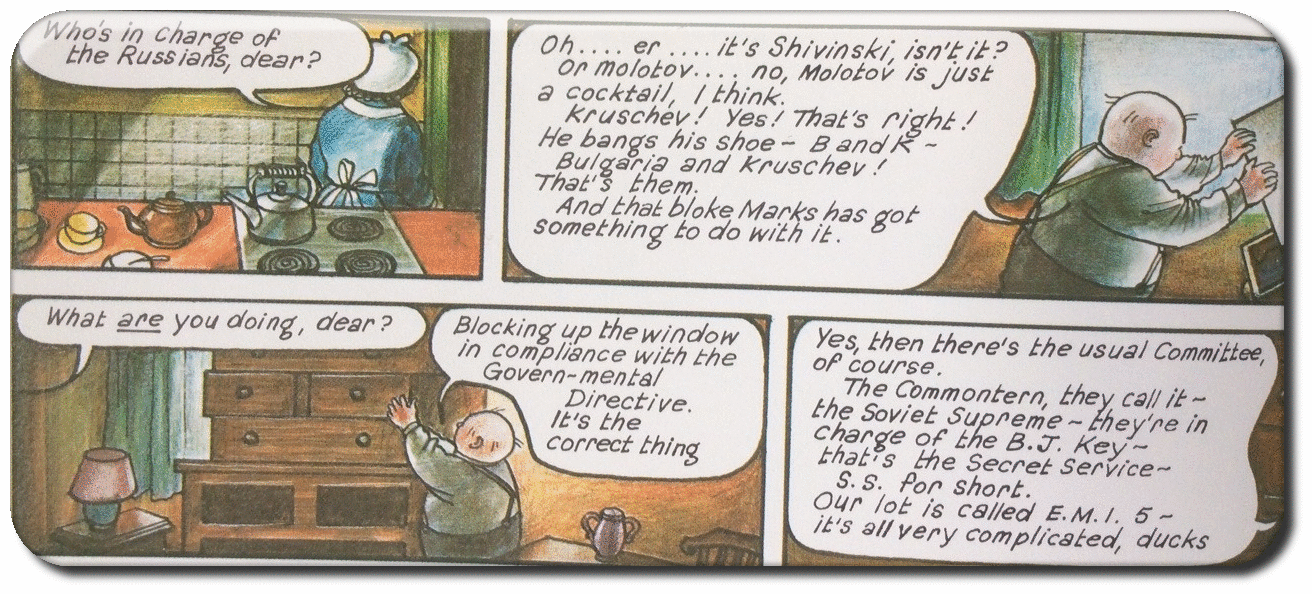 It talks about big subjects but it does so in a way that everyday people can really get to grips with. It scales Nationalism down to simple tribalism: whether it be denigrating the French, looking down on the nearest town down the coast, or making the new kid play ‘the Frenchies’ just because he’s not from around here. It has a simplicity of language, a broadness of applicability and, more importantly, contains a diverse cast of recognisable people with different opinions. 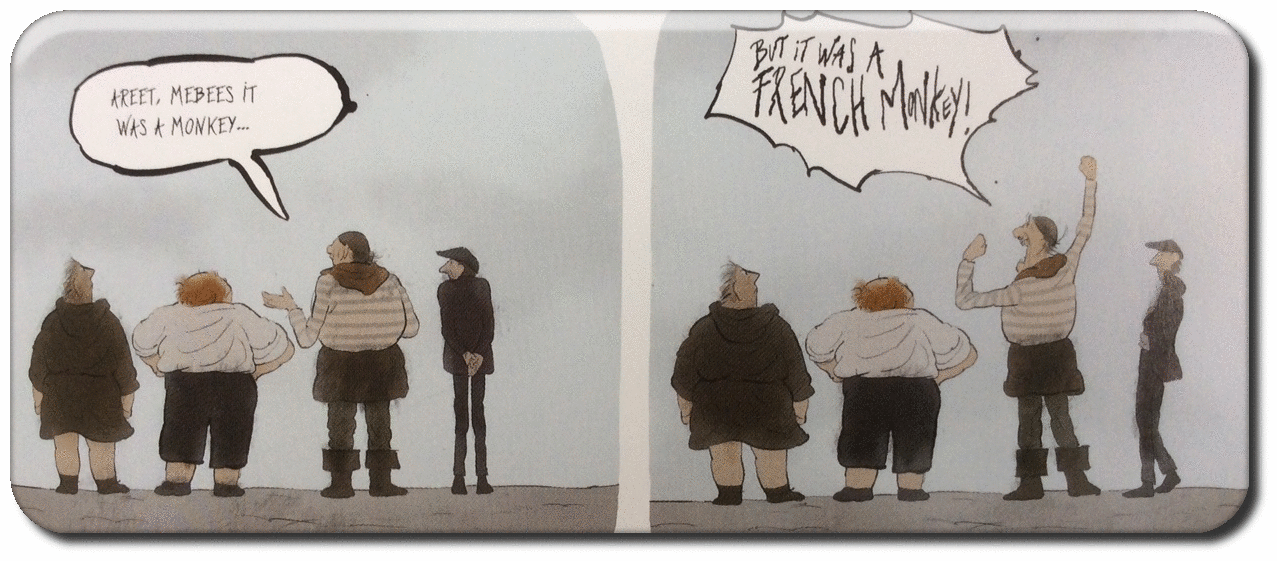 Where Wind bombards you with information, Monkey gives you an example; where Wind scares you, Monkey makes you angry, makes you want to shake people out of the dark ages and embrace the future—ever more applicable in these days of hard-right populist governance, Brexit, and the so-called War on Terror, where hate-mongers constantly try to scare us into shunning the outsider. If you are trying to find new ways to engage your class at school, spark interesting discussions with your family, or just want a damn good read, then The Hartlepool Monkey should be top of your list. 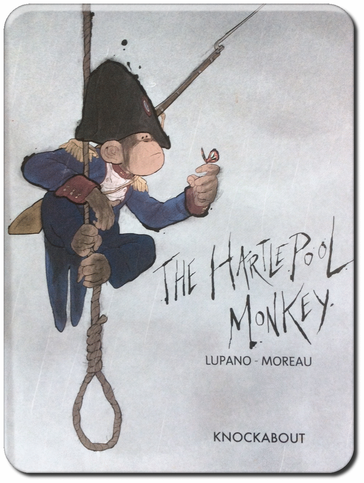 Written by Wilfrid Lupano Illustrated by Jérémie Moreau Published by Knockabout Comics Available via eBay Reviewer: Dion Winton-Polak Reading experience: 5/5 TODAY ON THE GINGER NUTS OF HORROR WEBSITE[YOUNG BLOOD LIBRARY] |


Archives
May 2023
|

|

|


 RSS Feed