


 Cannibalism is the new norm in brutal tale of ‘special meat’ Tender is the Flesh was first published in Argentina (Cadaver Exquisito) back in 2017 but did not arrive in translation under earlier this year, but it was worth the wait, as it completely blew me away. Without doubt this grim tale was one of the most striking novels I have ever read and will not be easily forgotten. Considering the theme of the story is cannibalism it does not read like a traditional horror novel and has strong literary fiction elements. Cannibalism is one of those ‘yuck’ taboo subjects and rarely have I come across a book which is 100% based around this unpleasant concept, dealing with it in such an objective and matter-of-fact manner. There are plenty of very violent horror novels which feature this sort of thing, such as Jack Ketchum’s Off Season, but Tender is the Flesh is a different kettle of fish in that even though it is not particularly violent, it is more shocking that Extreme Horror titles which carry the scary ‘warning’ stickers. The concept behind the story was incredibly clever; a virus (GGB) makes consuming animals dangerous as their flesh has become deadly to humans. As a result, international governments pass a law which, under certain conditions, allows the harvesting of human flesh and after this ‘Transition’ it becomes common place and the taboo is conveniently forgotten. This basic concept, and the world Agustine Bazterrica builds around it is the bloody beating heart of the novel (‘I wonder what a human heart tastes like?’ and other such thoughts are common-place amongst the characters?) When I read Kim Stanley Robinson’s Red Mars in the 1990s it was so realistic (about the colonisation of Mars) that reviewers commented that the author had transported far into the future and then documented what really happened. Tender is the Flesh is identical, if our future holds cannibalism as a means of survival, the ‘civilised’ way of achieving the goal is in this book. Like Cody T Luff’s Ration (2019) this is a terrifying, but totally believable dystopian vision of the future. However, it is only dystopian if you are the ‘special meat’. I must also applaud Sarah Moses for a truly outstanding translation which was so seamlessly smooth I would never have imagined it was not originally in English, with the only giveaway being the South American sounding names. As I said, cannibalism is a taboo subject which is rarely tackled head on, although if you read Joseph D’Lacey’s cult classic Meat, then you are on the right track. There are numerous similarities regarding the dehumanisation of the ‘meat’ which is called ‘special meat’ in this story with different parts of the anatomy being called ‘special tenderloin’, ‘special cutlets’ and lots of other fancy names. Also, in the quite stunning D’Lacey story there are studs (called bulls) and both novels have the vocal chords of the ‘meat’ removed to further dehumanise them. I am not implying Tender of the Flesh has copied Meat, but the similarities continued with the fact that sex with the ‘meat’ was punishable by death, in that the perpetrator ends up being processed as a future meal. Both books were, in that respect, very similar. If you are after a novel to make your skin crawl, then this novel nails it, partially because some of the plot is portrayed something akin to reading non-fiction, especially the sequences within the processing centre where main character Marcos takes potential employees on a tour of the facility. The reader piggybacks on this tour of horrors and we find out that every piece of the human body (including the body hair) has a use with the author repeatedly dropping horrifying bombs which did not get any lighter as the story moved on. In the Breeding Centres the female ‘special meat’ have their arms and legs cut-off to prevent them trying to abort their babies and there is also a new trend in which limbs of ‘special meat’ are removed whilst still alive, as this apparently enhances the flavour (you can find You Tube tutorials on how to do this!) Many of these facts are, almost casually, dropped into the plot in passing, making it even more pulverising effective. The story is made darker (if that is possible) by the fact that the main character Marcos runs a factory that raises and slaughters humans and is intimately involved with every stage of production. However, things take a different turn when he is given a specimen of the finest quality (Generation Pure) and he leaves her tied up in his barn whilst he deals with his father who has dementia and a sister he does not does not see eye-to-eye with. Can he change? Does he want change? Or is he completely desensitised to it all? This is the main thrust of the story. Nothing is what is seems and be prepared for an abrupt, but totally shocking, ending. I guarantee you will not forget it quickly. One imagines the author is making a point about the way animals are treated in battery farms and processing factories and the fact that we are not that far from the chopping block if we continue to waste natural resources, as Marcos says “in the end, meat is meat, it doesn’t matter where it’s from”. Maybe he is right. I hope not. One of the most striking releases of 2020 and although it is not strictly a horror novel or genre fiction it deserves to find an audience. To call this book speculative fiction is a scary thought, but who knows…. Highly recommended and one of the standout novels of 2020 (even if it first came out in 2017). Tony Jones 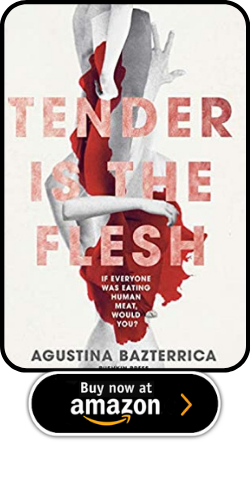 'This book will pull you in, take hold, and not let go until you reach the final page perhaps for longer than that. Without a doubt, my favourite read of this year' Christina Dalcher, author of VOX 'What a compelling, terrible beauty this novel is. My heart was breaking even as my skin was crawling' Lisa McInerney, author of The Glorious Heresies It all happened so quickly. First, animals became infected with the virus and their meat became poisonous. Then, governments initiated the Transition. Now, 'special meat' - human meat - is legal. Marcos is in the business of slaughtering humans only no one calls them that. He works with numbers, consignments, processing. One day, he's given a gift to seal a deal: a specimen of the finest quality. He leaves her in his barn, tied up, a problem to be disposed of later. But the specimen haunts Marcos. Her trembling body, her eyes that watch him, that seem to understand. And soon, he becomes tortured by what has been lost - and what might still be saved...   the heart and soul of horror ficion reviewsComments are closed.
|


Archives
May 2023
|

|

|
 RSS Feed