• HOME
  • CONTACT / FEATURE
  • FEATURES
  • FICTION REVIEWS
  • FILM REVIEWS
  • INTERVIEWS
  • YOUNG BLOOD
  • MY LIFE IN HORROR
  • FILM GUTTER
  • ARCHIVES
    • SPLASHES OF DARKNESS
    • THE MASTERS OF HORROR
    • THE DEVL'S MUSIC
    • HORROR BOOK REVIEWS
    • Challenge Kayleigh
    • ALICE IN SUMMERLAND
    • 13 FOR HALLOWEEN
    • FILMS THAT MATTER
    • BOOKS THAT MATTER
    • THE SCARLET GOSPELS
GINGER NUTS OF HORROR
  • HOME
  • CONTACT / FEATURE
  • FEATURES
  • FICTION REVIEWS
  • FILM REVIEWS
  • INTERVIEWS
  • YOUNG BLOOD
  • MY LIFE IN HORROR
  • FILM GUTTER
  • ARCHIVES
    • SPLASHES OF DARKNESS
    • THE MASTERS OF HORROR
    • THE DEVL'S MUSIC
    • HORROR BOOK REVIEWS
    • Challenge Kayleigh
    • ALICE IN SUMMERLAND
    • 13 FOR HALLOWEEN
    • FILMS THAT MATTER
    • BOOKS THAT MATTER
    • THE SCARLET GOSPELS
GINGER NUTS OF HORROR
horror review website ginger nuts of horror website
Picture

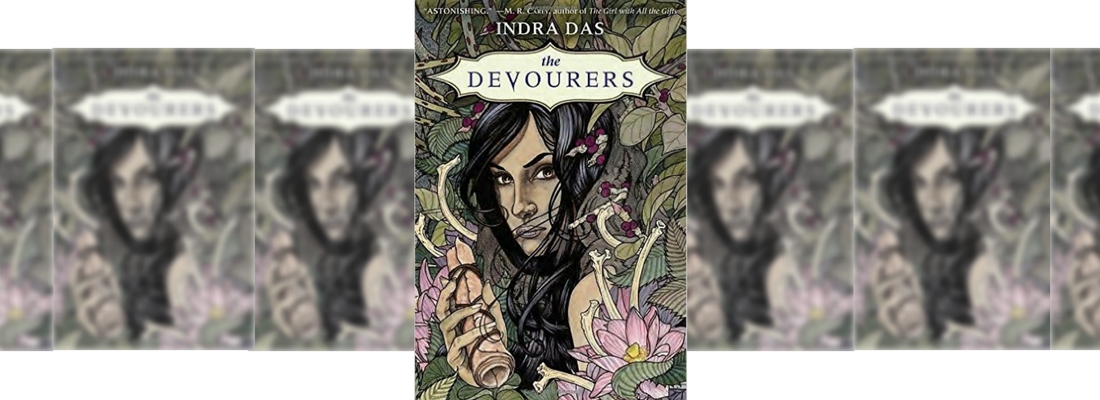
The Devourers BY ​Indra Das

16/8/2016
the devourers by Indra Das book review  Picture

Del Rey Books  (12 July 2016)
320 pages


Shapeshifters are found in the mythology and folklore of many different cultures around the world, from the Japanese obake to the Celtic selkie. In the context of Western Horror, we are most familiar with the werewolf. In his debut novel The Devourers (2016), Indra Das combines tropes of werewolf mythology with the rakshasas, shapeshifting demons from Hindu mythology, creating a fresh take on the shapeshifter theme. Drawing as much from Norse and Hindu mythology as from American Werewolf In London, the novel brings new life to a familiar monster. However this is far from the only thing that makes The Devourers unique. Weaving multiple stories between India in the present day and in the seventeenth century, Das' novel is steeped in the history and setting of India. It is committed to exploring the humanity of its monsters, even as it explores the fallout of their monstrous acts on their human victims. It dissects the way women are frequently cast as victims in Horror, as well as exploring the societal difficulties facing women in seventeenth century India. But beyond all of this, The Devourers is striking because of Das' exquisite prose, which is lyrical and poetic even as he describes the most horrible and frightening things, making the book a powerful and unforgettable read.

 
The Devourers tells the story of Alok, a lonely college professor who, one December evening in Kolkata, meets a mysterious stranger who tells him that he is half werewolf. The stranger tells Alok a fantastical tale, leaving Alok so keen to hear the rest of the story that he agrees to transcribe two ancient scrolls, originally written on human skin. The scrolls tell the story of Fenrir, a werewolf from the frozen North of Europe who travels with his pack to India, and Cyrah, the young Muslim woman who Fenrir rapes in order to produce a child, who then joins with one of the monsters from Fenrir's pack to track him down and make him answer for his transgression. As Alok relives the lives of the stranger's parents through the transcribed scrolls, he finds himself more and more drawn away from the mundanity of his everyday life and towards the stranger.
 
An immediate part of what makes The Devourers such an intoxicating read is the power and beauty of Das' prose. His writing is elegant and poetic, with a hallucinogenic intensity that sometimes crosses over into the nightmarish. His descriptions of shapeshifters fighting in the abandoned ruins of Fatehpur Sikri, or of a race through the wilderness on the back of a monster – experienced by Cyrah blindfolded – approach a dreamlike, surreal grandeur. The book is full of not just incredible sights but sounds, feelings, odours, putting the reader viscerally in the action. Das also has a gift for describing the most disgusting scenes imaginable, such as a pack of werewolves feasting on a human corpse in excruciating detail, in the most beautiful, lyrical language. This juxtaposition makes the novel's horrifying scenes more strikingly memorable, and enables Das to express the view from inside the mind of a monster.
 
However for the Horror to land correctly, the story must be recognisably rooted in the real. The Devourers is rooted in the history of India. Fenrir and Cyrah inhabit the Mughal Empire under Shah Jahan, and witness the Taj Mahal under construction and the gardens around the Yamuna river, while Alok and the stranger live in 21st century India after it has gained its independence from the British Empire. Das creates a vividly realised India, both in the present day and in the past, exploring how the country and its culture have changed over time. As Alok spends more time talking to the stranger, the stranger's memories of the past make it clear that he has lived through the intervening history, his perspective providing the link of continued experience through the massive changes the country has undergone over that time.
 
Much of the exploration of the historical period happens in Cyrah's story. While Fenrir is an ancient monster unmoored from human experiences of time and culture, Cyrah is a poor Muslim woman living in the Mughal Empire. Until she is raped by Fenrir, she lives a life defined by the pressures and restrictions her society places on poor, unmarried women with no family. She lives an itinerant lifestyle, selling her body for money in the larger towns to support herself, the only friend and constant in her life her mother who lead a similar life until her death. Through her perspective we are shown a window into the life of the disenfranchised of the Murghal Empire. Hers is a voice all too frequently overlooked in fiction.
 
However Cyrah's voice is also that of the traditional victim in many Horror stories, a woman subjected to sexual violence at the hands of a monster, so the monster can use her as a vessel to reproduce. Alok points out to the stranger after he has read Fenrir's story what a problematic and overused trope it is. So Das then provides us with the story from Cyrah's point of view, in which the  rape is portrayed from her perspective. The book seriously explores it as the horrific violation it is, and then goes on to show Cyrah taking back her own agency, as she teams up with Gevaudan, the last survivor of Fenrir's pack, to track Fenrir down and make him answer for what he's done to her. Cyrah's experiences with the shapeshifters exiles her from human society. Having seen Gevaudan's second form and survived, ridden on the back of monsters and witnessed their terrible battles, she has become something more than human herself, becoming the living avatar of Banbibi, guardian of the forests in the Sundarbans, and living wild with the rakshasas.
 
The shapeshifters have two forms, one human and one monster. For all that they see themselves as superior to humans, Fenrir, Gevaudan and the stranger all have very human sides, as well as their animalistic side. They are liminal creatures, trapped between two worlds, and thus permanently outsiders. This is reflected in the book's characters, all of whom are outsiders in multiple ways. Fenrir is exiled from his pack because his rape of Cyrah is taboo – he has treated a human in a way other than as prey. The stranger hints that he too has had a similar experience. Gevaudan becomes exiled as well when he spares Fenrir's life which is forfeit by his transgression. Cyrah, because of her gender and her social status, is already an outsider in her own society before she discovers shapeshifters. The stranger, as a half human half werewolf, is exiled from his pack.
 
This is perhaps most interestingly explored in the book's outlook on gender and sexuality, explicitly in terms of Alok and the stranger and their relationship. From the very beginning, there is an implied sexual element to their interactions, from Alok's descriptions of the stranger's striking androgenous beauty to the highly charged visions he shares with him to get him hooked to his story. This only increases as the two characters get to know each other more and spend more time with each other while Alok transcribes the scrolls. We eventually learn that both of them are bisexual, Alok's relationship with his ex-fiancée and his family having disintegrated because of this. Alok's and the stranger's mutable sexuality is an echo of the dual nature of the werewolves, a hidden part of their lives in their conservative surroundings that they are forced to hide from acquaintances.
 
The Devourers is also a book about transcendence. The novel is full of scenes of bloody and painful rebirth, from the werewolf tribes ritualistically tearing off their skin and burning it as a sacrifice to the stranger rebuilding his body after being exiled from his tribe. This is reflected in the ritual of eating the corpse fire, by which the shapeshifters eat the souls of their victims, allowing their victims to live a second life within the mind of their killer. The shapeshifters are also able to change their human form to physically replace one of their victims in this way as well. In this way, the stranger is able to carry the essence of both Fenrir and Cyrah, something Alok winds up doing himself through the medium of their recorded story. Through this Das explores the relationship between story and identity; one of the ways in which we claim our identity is by the stories we tell about ourselves. By experiencing other people's stories, we are able to transcend our own identities and to inhabit other perspectives than our own. The Devourers is both a tribute to this and an example of how powerful an experience this can be when done well.
 
Picture
Picture
Picture

Comments are closed.
    Picture
    Picture

    RSS Feed

    Archives

    May 2023
    April 2023
    March 2023
    February 2023
    January 2023
    December 2022
    November 2022
    October 2022
    September 2022
    August 2022
    July 2022
    June 2022
    May 2022
    April 2022
    March 2022
    February 2022
    January 2022
    December 2021
    November 2021
    October 2021
    September 2021
    August 2021
    July 2021
    June 2021
    May 2021
    April 2021
    March 2021
    February 2021
    January 2021
    December 2020
    November 2020
    October 2020
    September 2020
    August 2020
    July 2020
    June 2020
    May 2020
    April 2020
    March 2020
    February 2020
    January 2020
    December 2019
    November 2019
    October 2019
    September 2019
    August 2019
    July 2019
    June 2019
    May 2019
    April 2019
    March 2019
    February 2019
    January 2019
    December 2018
    November 2018
    October 2018
    September 2018
    August 2018
    July 2018
    June 2018
    May 2018
    April 2018
    March 2018
    February 2018
    January 2018
    December 2017
    November 2017
    October 2017
    September 2017
    August 2017
    July 2017
    June 2017
    May 2017
    April 2017
    March 2017
    February 2017
    January 2017
    December 2016
    November 2016
    October 2016
    September 2016
    August 2016
    July 2016
    June 2016
    May 2016
    April 2016
    March 2016
    February 2016
    January 2016
    December 2015
    November 2015
    October 2015
    September 2015
    August 2015
    July 2015
    June 2015
    May 2015
    April 2015
    March 2015
    February 2015
    January 2015
    December 2014
    November 2014
    October 2014
    September 2014
    August 2014
    July 2014
    June 2014
    May 2014
    April 2014
    March 2014
    February 2014
    January 2014
    December 2013
    November 2013
    October 2013
    September 2013
    August 2013
    July 2013
    June 2013
    May 2013
    April 2013
    March 2013
    February 2013
    December 2012

https://l.facebook.com/l.php?u=https%3A%2F%2Fmybook.to%2Fdarkandlonelywater%3Ffbclid%3DIwAR1f9y1sr9kcIJyMhYqcFxqB6Cli4rZgfK51zja2Jaj6t62LFlKq-KzWKM8&h=AT0xU_MRoj0eOPAHuX5qasqYqb7vOj4TCfqarfJ7LCaFMS2AhU5E4FVfbtBAIg_dd5L96daFa00eim8KbVHfZe9KXoh-Y7wUeoWNYAEyzzSQ7gY32KxxcOkQdfU2xtPirmNbE33ocPAvPSJJcKcTrQ7j-hg
Picture