


THE FIREMAN BY JOE HILL
30/3/2016
that claustrophobia, and that inevitability of explosive violence that makes even relatively sedate sequences read with pace and weight. 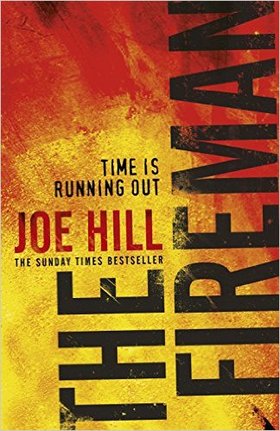 click to purchase click to purchase My prior familiarity with Joe Hill is his short fiction - 20th Century Ghosts, By the Silver Water of Lake Champlain, and In The Tall Grass, a brilliantly vicious novella he co-wrote with his dad, Stephen King. I’ve enjoyed them all immensely, and think 20th Century Ghosts is the strongest single author short story collection I have read in a very, very long time, but a combination of mixed reviews of his novel length work, combined with a To Be Read pile that is starting to exert its own gravitational pull, means that The Fireman is the first of his novels that I’ve read. And so far, it is hands down the best novel I have read in 2016. It’s been a while since a novel grabbed me this hard by the neck, and even longer since one managed to put me through such a level of constant dread and foreboding. The last time I can immediately recall is Lord Of The Flies - a novel that this book has more than a passing relationship with. This is a novel that works well on virtually every level, from the conceptual to the sentence by sentence prose. Joe Hill has spoken about his unease with zombie fiction, because, in his words ‘the [financial] 1% are the survivors - they’re the ones with the guns, the supplies, the forts. WE’RE the zombies’. And so, in The Fireman, we’re invited to identify and sympathise with the infected. It helps that they’re not zombies, of course - fun though that might have been - but rather infected with a fungus which creates rather striking gold and black tattoo like markings on the skin, with the only slightly unfortunate side effect being that once infected, heavy negative emotion (anger, fear etc.) will cause you to spontaneously combust. Hilarity ensues. The story of the slow collapse of society is told through the eyes of Harper, a school nurse who later volunteers at the local hospital during the initial stages of the breakout. Harper is simply one of my favourite protagonists of recent years - she is smart, funny, capable, empathic, strong, and utterly human. She is an unapologetically wonderful character and yet (for my money) a million miles away from being a Mary Sue - she is also vulnerable, often frightened, and is constantly walking a tightrope between her basic faith in human decency, and the realities of the world as society collapses around her. There are many powerful and important themes explored in this novel - the multitude of ways that fear and ignorance can lead to violence, the terrifying seesaw of power dynamics in tight-knit group survival situations, toxic masculinity and how it can infect otherwise honorable men, as well as give monsters justification for their worst excesses. It’s also in many ways a novel about faith, one that explores both the extraordinary uplifting and binding qualities of religious belief, and also it’s darker side - dogma, intolerance of deviant thought, and authoritarianism. I can't fairly describe any of this as subtle - it’s far too powerful a piece for that, and Harper too aware a lead character - but it is lucid, nuanced, and plays fairly with all sides of the argument. But far more important than any of that, it’s just a bloody superb story, in damn near every way. The extended cast - heroes, villains, and all points in-between - are brilliantly and economically drawn, and you feel you know them well in a very short space of time. As noted earlier there is also a sustained level of dread that permeates the entire proceeding, and which led to almost unbearable tension at points. Again I find myself recalling Lord Of The Flies, even 1984 - that claustrophobia, and that inevitability of explosive violence that makes even relatively sedate sequences read with pace and weight. For King fans, there are some interesting moments - there’s a couple of Dark Tower references, for instance, and some of the characters share names (and characteristics) with the cast of King’s own apocalypse novel, The Stand, and there’s no way that’s a coincidence - but this is far, far more than a simple homage or pastiche. For starters, you could never have read a King novel and none of these references would stick out at all, and it wouldn’t matter a damn, it’s still an absolute firecracker of a novel. But more importantly, Joe Hill is simply a towering talent in his own right, if this novel and 20th Century Ghosts are fair representations of his work. Sure, King’s influence is there, but I’d argue in the horror genre at this point, King’s presence is essentially like Hendrix’s is to guitar - you either take the influence or react against it, but you can't ignore it. The point is, this is not a Stephen King novel. It’s a Joe Hill novel. And the level of talent on display in this glorious, powerful, gut wrenching epic-in-novel-form marks Joe Hill out as an author or rare distinction and quality, with no qualifiers or caveats needed. I ended up dreaming about this godamn book, and I can’t remember the last time a work of fiction engaged me that strongly. This novel is an absolute tour-de-force, and Joe Hill is clearly a major talent. Best novel of 2016? It’ll take some fucking beating, I can tell you that. KIT POWER
Comments are closed.
|


Archives
May 2023
|

|

|
 RSS Feed