


 Those seeking something more standard and traditional in their horror fiction may be surprised by The Hobgoblin of Little Minds, given how weighty the ideas and ambiguous the concepts that it plays with, but those who ache for work that demonstrates what the genre is capable of in terms of elevating our discourses will devour this with lycanthropic delight. There is a certain species of emergent horror that emphasises a particular tradition: i.e. the non-literal, the metaphorical reflection, the waking nightmare. These stories invite their readers into a liminal space between waking conditions and the subconscious realm; a state in which every sublimated dread, every simmering neurosis, is made manifest in monsters and spectres, where we might confront that which most disturbs and unsettles us, and even come to terms with it, should we prove brave enough. This is precisely the place where Mark Matthews intends to take us in his writing; a jagged, fractured playground of traumas and abuses, of confusions and disappointments where there are no simple rites or spells of exorcism, where it isn't quite so simple as driving a stake through the vampire's heart or a silver bullet through the werewolf's breast. Instead, here the horrors of the waking are also the horrors of nightmares; what remains confined to the abstract in our waking lives takes on shape and animus through the abuses of science and the shattered souls of humanity. Matthews has a peculiar quality for taking the most foetid subject matter; the darkest, most grotesquely morbid clay, and shaping poetry out of it. In his novel, The Hobgoblin of Little Minds, the most abhorrent of abuses -whilst in no way celebrated or extolled- become unwitting gateways to metamorphosis; through trauma, through pain, characters are wounded and opened up, made receptive to more ancient and atavistic selves -that the facilitators of these transformations call essential-, that may or may not be preferable to the dazed and bleating lamb-conditions in which we sustain from day to day. This is a story of broken lives. Of abused and shattered minds. Of souls driven to the edge of mania and beyond by a world that seemingly delights in their torment. There is no attempt to balance or equivocate over that; no hollow justifications. Only the portrait of a world that slowly bakes in its rot and shit; a dirty, cruel and hostile place in which innocence is no defence, rather an invitation to be preyed upon. Do not expect this to be an easy read or the kind of story you can simply set down and walk away from; Matthews has no intention of allowing that. Even the most incidental scenes and transitional moments are charged with sensory significance; association so pungent and poetically drawn, the reader can taste it. This is emphasised beyond measure in moments of extremis, which the story contains more than its fair share of: Emulating the mental conditions of its characters, the story buffets the reader with scenes of epehemeral domesticity; moments of quiescence that, even as they are drawn, begin to crack and dissolve. This is where the truth of humanity lies, the book seems to say; in those wounds, in those cracks, where we are real to one another, even if that reality is a terrible and grotesque thing. Here, mental illness is almost a null concept; there are different shades and states of mind in operation, some of which are necessarily fractured and unhappy; inconstant and extreme, which contrast wildly -and conflict violently- with those who maintain some stable delusion of who and what they are. Note that, far from demonising mentall illness or drawing some child's crayon scrawl of it, Matthews dives deep into the phenomena, exploring its every ambiguity, from the crushing depths of depression and suicidal despair to the delirious distortions of schizophrenic hallucination, here the mind itself becomes the core subject; the story an autopsy of what informs this most essential element of who and what we are, what factors shape and sculpt it, and even how it can transcend our every assumption thereof, in its most unanchored, precarious condition. Here, the liminal transformations that are part and parcel of horror become metaphors for altered states of mind, the story not allowing its readers the turgid simplicity of moral absolutism in that regard (don't expect these “werewolves” to be the monsters of the piece; there's already enough patent monstrosity in the every day, the degrees of casual abuse we accept as part and parcel of culture, the story states). Rather, those “afflicted” with the synthetic curse that translates their outer selves to a reflection of the essential inner are presented with the most sympathy and complexity, whereas those that walk in the daylight with smiling human masks are -violently- revealed and excoriated. Part of the core appeal of the story is the contrast it drawers between the mythological, night-time realm of its “monsters” and the daylit human world, neither of which are wholly welcoming or hostile, but which manifest their own uncertainties, mysteries and ambiguities. It's clear which side of this particular dichotomy Matthews falls, but he doesn't allow himself the luxury of utterly demonising one or the other. Instead, the story demonstrates without didactism that there is enough monstrosity in the world human beings have created to fill entire histories, whereas the blood-and-hunger, twilight realm of the liminal and lycanthropic is often a place of revelations, albeit ones won only through the gory sacrifice of former selves. Self and its shedding are key themes, here; whilst some characters suffer physical transformations as a result of the abuses they experience (transformations that are noticably lycanthropic, yet also removed from the proscriptions and mythological limitations that tradition implies; Matthews is consistently conscious of simplicity and narrowness in his work, refusing to submit to either of them, meaning that the transformations experienced here are both exultant and horrific; matters of imposition, agony and violation, but also revelation, freedom and transcendence), each and every one of them, from the most incidental to the most significant, experiences some form of abstract transition. Their worlds and every assumption thereof are undone by what they witness, experience and suffer. The concept of family is a recurrent theme; the ambiguity of that notion and the relationships that comprise it; here, love and fear occur in the same instance with regards to the same individuals. Abuse and neglect and loss originate from the same sources as love and affection and support. Matthews is particularly adroit at refusing to demonise his characters, painting them in all of their imperfections without hesitation but also without rancour. If anything, the only characters for whom there is a degree of contempt in this book are those who promise some form of false salvation for genuine ills, and use that leverage to exercise temporal abuses upon the most vulnerable in society (there is a sub-plot involving an evangelical pastor that is of particular note in this regard. Even there, Matthews takes time to draw the character AS a character; not some slathering monster -ironic, given the entities he is contrasted to-, but as a deeply flawed, petty and absurd man who has concocted his own “house of cards” justifications and self-mythologisation for what he does). The book is singularly impressive in the elegance with which it draws extremely complex, recognisably human characters; even those that initially appear to be derived from certain archetypes -Doctor Zita, for example, who may be regarded as something of an antagonist, though even that feels too restrictive- are later provided representation in entirely other contexts, which lend credence and complexity to what might have been perceived as wholesale abuses earlier. The book's protagonists are profoundly ambiguous; characters whose psychological conditions, whose internal separation from the common herd of humanity, is lent external expression through a battery of experimental psychology and genetic manipulations, allowing them to become the very “monsters” that society at large is so intent on portraying them as. Even before their descents -or transcendence, depending on how you want to read it- into abomination, they are characters who defeat easy description and reference to existing archetypes; often portrayed through the perspectives of others -many of whom have been victims of their periodic descents into paranoia, schizophrenic delusion and even unwitting violence-, they are simultaneously vessels of fear and hope; artefacts of disturbance and profound affection. It's a central irony of the text that, more often than not, those characters chosen for Doctor Zita's transformative “treatment” are the most noticably human and even humane of any. In them is encapsulated the manifold flaws and imperfections of humanity, rendered into a kind of chemical mythology by the abuses of those who have some strange species of Utopianism at heart. At no point is Doctor Zita consciously cruel or monstrous; if anything, she retains her own moral stance in the face of actions that might be otherwise considered the epitome of sadism (a particularly harrowing and graphic sequence which portrays the slow metamorphosis -both physical and psychological- of the novel's protagonists, along with the pregnancy and birth of the child they sire, concludes in what might be one of the emotionally most jagged and tortuous instances). This is emblematic of the consideration that has gone into every character, every scene in the book; it impressively refuses to rely on horror cliches or tropes, even those that it does broach so profoundly lampooned and dissected, they are recognisable only as symbolism and impication (the aforementioned lycanthropic subjects and beats of the story might have otherwise been well-trodden ground, but Matthews's removal of them from their gothic roots and the shapes they have evolved into in the post-modern world serves to rewrite them utterly, making them metaphorical reflections of psychological conditions and subjective human experience). This is horror in the most post-modern sense; work that takes the familiar and has the audacity to reconfigure it with reference to shifting cultural contexts and requirements. There is barely a character here who is not hopelessly lost within themselves; who isn't an anxious, contradictory bag of uncertainties and existential crises. In that, Matthews shows us what horror fiction is capable of; that, in defiance of trend or fashion or assumption, it can serve to elevate certain coversations into heretofore unconsidered arenas. Subjectivity and internal psychology are key to appreciating just how deep Matthews goes with this story; whilst, given its horror roots, it inevitably has moments of incredible violence, visceral horror, pain and gore, none of those are prurient or without weight; in the tradition of Clive Barker et al, Matthews takes those sequences and makes art out of them, their extreme natures serving to shunt both the characters involved and the reader into alien and unknown states of mind; conditions of emotion and pliability by which new considerations necessarily flower and take root. Not only are the characters themselves often liminal, but so is the world itself; through their perceptions, reality becomes a protean feast, a shifting playground of horrors and posssibilities, of hellscapes and Edens, none of which are permanent or unambiguous in themselves, but which serve as the settings whereby transformation takes place. Whilst the story is rooted deeply in a visceral reality that any one of us will be familiar with -there is a noticably Marxist reading of the story one might make, given that its protagonists are largely under-privileged, often destitute and desolate, whilst the more antagonistic amongst them tend towards the bourgeois influential-, there is also a metaphysical dimension that runs throughout, pulsing just beneath the surface of the narrative, that often requires moments of extremity, violence or duress to break through. In that, Matthews takes what might otherwise be considered mental “illness” and refutes the simplicity of such an application; rather, the characters all evince their own idiosyncratic psychologies which, in turn, shape the world they perceive, and through which they carry the reader. From protagonist Kori's trembling ambiguity regarding her Father and her own highly problematic past with him to the child Lillith's drug-induced, dreaming naivete which explodes into atavistic appetite when those parameters are torn from her, each and every character is provided their own voice, their own unique perspective, and is often as considered and understandable in their responses as any other. The conflict of agenda and intention here is a profound source of distress, as it's easy to see why characters like Doctor Zita behave the way they do, when we have some insight into their backgrounds. Likewise, there is no flinching with regards to the human trauma they inflict in pursuit of those goals; every instance of suffering and loss and despair is drawn in exquisite detail, leaving the reader under no delusion as to the horrors that are occurring here. The story is not some parable of centrism on these matters; there is a clear and overt side on which Matthews himself comes down, and it is always that of the oppressed and the abused, no matter how Utopian or understandable the philosophies of their abusers, no matter how disjointed their psychological states during moments of eruption. Matthews maintains a healthy skepticism and mistrust of institutions and proscribed power structures throughout; those who exercise some measure of “authority” over their fellow human beings are often undone by what Doctor Zita unleashes (not least of which the woman herself) in her efforts to shunt humanity out of its post-modern malaise and into a condition that will rewrite what constitutes the species. In purely technical terms, Matthews maintains prose that is simultaneously precise and punchy but that also often exhibits a certain poetic flare; often, images and perceptions are drawn in dreaming, hallucinogenic terms that puts the reader in mind of the films of Dario Argento, in which the banal becomes mythic, every day settings and experiences are rendered as drug-fugue or dreaming escapades where magic is waiting to erupt and miracles might be born. It's an extremely difficult exercise to balance both qualities in the same body of text, but Matthews manages it with aplomb. Those seeking something more standard and traditional in their horror fiction may be surprised by The Hobgoblin of Little Minds, given how weighty the ideas and ambiguous the concepts that it plays with, but those who ache for work that demonstrates what the genre is capable of in terms of elevating our discourses will devour this with lycanthropic delight. 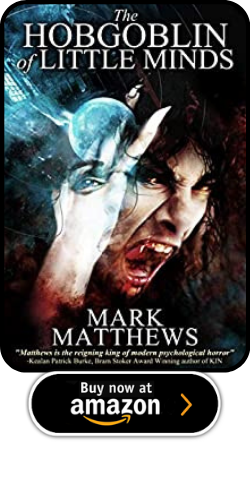 "This impeccably well-wrought fable proves what many of us have known for quite some time: Mark Matthews is the reigning king of modern psychological horror." ~KEALAN PATRICK BURKE, Bram Stoker Award-winning author of KIN Kori Persephone Driscoe suffered through her dad's mental illness. All she wanted was for him to get better, but instead he disappeared. Kori trespasses into the abandoned Northville Psychiatric Hospital, the last place her dad was treated, seeking solace and traces of his memory. What she finds instead is something no longer human living deep in the underground tunnels. During the last days of the hospital, a roque psychiatrist had been manipulating the mood swings of the mentally ill, transforming patients into savage, manic creatures who seek justice by the light of the full moon. When the creatures hunt for prey, only an escaped patient and her beloved child can help Kori survive--but they better act fast, because the creatures want blood, Kori wants to save her dad, and the whole hospital is about to be blown to pieces and bury Kori alive.   Comments are closed.
|


Archives
May 2023
|

|

|
 RSS Feed