


 You don’t need little ol’ me to tell you The Madness of Dr. Caligari is a top-notch anthology, do you? As of this writing, it’s been nominated for a Shirley Jackson Award, for starters. Besides that, it’s got Joe Pulver’s name on it, and that damn near says it all. Besides being a gifted weird fiction writer himself, Pulver is one hell of an anthologist, most notably putting together such attention-grabbing compilations as the Robert W. Chambers tribute A Season in Carcosa and the Thomas Ligotti tribute The Grimscribe’s Puppets. The subject at the heart of his latest anthology? Robert Wiene’s 1920 German Expressionist silent film masterpiece The Cabinet of Dr. Caligari, of course. Through a shadowy, angular aesthetic, the film tells the story of a somnambulist driven to murder by the machinations of a carnival hypnotist. Or maybe it tells the story of a delusional asylum inmate who envisions himself a valiant hero opposing the dastardly plots of his scheming doctor. Or maybe… It’s no wonder that a film as deeply layered and abstruse as The Cabinet of Dr. Caligari would provide fertile ground for storytellers to find inspiration. The rightfully legendary Ramsey Campbell sets the stage with “The Words Between,” in which an elderly retiree taking a college film course struggles to write a paper on Wiene’s movie, while elusive thoughts erode his peace of mind and the world around him distorts at the edge of his vision. A straightforward tale of slow-burn psychosis marred only by a few hokey, half-hearted jabs at “oversensitive” university culture, it’s a nice primer for the rest of the anthology, touching on themes of obsession, confusion, exhaustion, and irreality. Next, Damien Angelica Walters tackles the terror of lost identity with “Take a Walk in the Night, My Love,” which sees a woman sleepwalking through memories that may not be her own. This one seethes with sadness and sensate sensuality. Rhys Hughes’ “Confessions of a Medicated Lurker,” meanwhile, gibbers madly. Apropos, as its narrator is a physician driven even crazier than his patients by the geometric eccentricities of his village’s architecture. All his evil acts pale in comparison, though, to the real-life atrocity that is conversion therapy, as viciously critiqued in Robert Levy’s simply titled “Conversion,” a timely, stomach-churning update to Caligari’s motifs of abusive power and forced conformity. Cruel as it is, the story proves a highlight. The titular locale of Maura McHugh’s “A Rebellious House” is no less than the interior of the human mind, transformed into a battleground as a catatonic woman silently resists the increasingly theatrical treatments her doctor devises. Seeming to take inspiration not just from Caligari, but also from the Georges Méliès silent film A Trip to the Moon and H.P. Lovecraft’s Randolph Carter stories, David Nickle’s “The Long Dream” introduces us to a man who swears his true home is on the lunar surface, and that the world his therapists try to convince him is real is anything but. Wedged in between the high-concept horror of both Nickle’s tale and the Richard Gavin story to come, Janice Lee’s “Eyes Looking” is a short and simple exploration of guilt, with an asylum inmate gradually crumbling under the weight of an infinity of accumulated regrets. Following it, the impact of Gavin’s “Breathing Black Angles” is even more intense. It’s a mythic narrative set in a totalitarian, misogynistic near-future wherein the halls of a madhouse become the last refuge for sanity in an insane world. A prescient piece for our current alt-right era, it makes excellent use of Caligari’s otherwise underutilized political subtext. Another highlight. Misogyny resurfaces as a theme in the subsequent “Somnambule” by S.P. Miskowski. Despite its quirky structure—like Wiene’s film, this one is a story inside of a story inside of a story—Miskowski’s tale, about a harried housewife trying to appease her abusive husband by visiting a hypnotist to help her quit smoking, proves effective. It strings you along with many smaller real-world evils before delivering a genuine gutpunch of an ending. Nathan Carson’s “The Projection Booth” brings a welcome change of pace, introducing the psychedelic influence of Dr. Caligari 3000, the in-name-only 1989 “sequel” from notorious surrealist/pornographer Rinse Dream. The celluloid-thin barrier between reality and fantasy burns away when a lovelorn stoner starts tripping balls during a screening of the film at his local funeral home-cum-arthouse cinema. After the credits roll, he’s forced to face the sins that cost him the love of his life. Yet another anthology highlight, “The Projection Booth” sizzles with charisma and color. Two fairy tales follow, one dressed in the robes of science fiction, the other in more traditional fantasy garb. First, in “The Mayor of Ephemera,” Jeffrey Thomas imagines a time when technology has progressed to such a degree that mankind can meet all of its needs, even life-sustaining ones, without the slightest conscious effort, and so retreats into an endless dream-filled slumber. Until, that is, one person does what no one else has: He wakes up. Then, in Nadia Bulkin’s “Et Spiritus Sancti” an executed traitor’s failed bid for the crown leaves a kingdom squabbling over who else might be a conspirator, as the traitor manipulates his enemies from beyond the grave. Both tales stretch the Caligari connection thin, but they’re nonetheless enjoyable on their own merits. Returning to a decidedly more grounded setting—1940s California—Orrin Grey’s “Blackstone: A Hollywood Gothic” is a pulpy spookshow chiller about a pair of screenwriters investigating murders on the set of a Poverty Row b-movie. With his usual dry sense of humor, Grey delivers something that has been sorely missing from this largely grim anthology. That is, he delivers a sense of fun. Doing that, while also exploring some interesting parallels between the mythology of Caligari and traditional Haitian zombie folklore, makes “Blackstone” another highlight. Sticking with the subject of show business, Reggie Oliver’s “The Ballet of Dr. Caligari” centers around a struggling composer commissioned to write new music for an aloof and enigmatic choreographer obsessed with a comatose ballerina. Meticulously paced and peopled with vivid characters, this one builds up an engaging sense of mystery only to wind up slightly deflated by a rushed ending. A bit more consistent is “Bellmer’s Bride, or the Game of the Doll,” by Cody Goodfellow. Its beginning is as harsh as its climax is twisted. It features an SS lieutenant pursuing a mesmerist who once helped encode subliminal messages into WWII propaganda—all the better to turn the Hitler Youth into frenzied killing machines. An erotic grotesquerie that fully exploits the sadomasochistic overtones of Nazi iconography, not to mention the enduring legend of the so-called “Borghild Project,” this psychosexual/sociopolitical story of war both without and within stands tall as a definite highlight. It’s a hard act to follow, but Michael Griffin holds his own with “The Insomniac Who Slept Forever,” a haunting, grief-wracked tale about a restless man willing to undergo experimental therapy to help him sleep, only to find the realm of his dreams equally as vast and lonely as the wasteland of his waking life. Keeping the focus on the inner mind, Paul Tremblay’s “Further Questions for the Somnambulist” walls readers up in the dimly lit chambers of a slumbering fortune-teller’s skull. Minimalist use of text and unorthodox formatting puts us in the eye of a cyclone of whispers, a rambling litany of anxieties that finally boils down to the one question we all want to ask, and the one answer we don’t want to hear. Tremblay packs alot of punch into a very small package with this one. Next we shift from understated mortal dread to dense, Kafkaesque bizarro. Michael Cisco’s “The Righteousness of Conical Men” is a noir detective story set in an alternate reality where life is a movie and jagged, geometric cities are run by editors and therapists, and where the murder of an outlaw hypnotist sends a former patient in search of answers. Outré as that may be, it is Molly Tanzer’s “That Nature Which Peers Out in Sleep” which proves the anthology’s most surprising inclusion. It’s not horror, sci-fi, fantasy, bizarro, or weird fiction. It’s not sullen or nihilistic. Instead, it’s upbeat and charming. An earnest, touching, sex-positive love story about two misfits who bond over mutual interests: film theory, Greek food, and kinky sex. Another highlight to add to the list. For Daniel Mills’ “A Sleeping Life,” it’s not so much the story that demands your attention, but the craft in its telling. Elevated by a fragmentary structure and rich, beautiful imagery, this is a poignant account of a young somnambulist who sleepwalks through most of his life, catching only brief glimpses of the world around him as he is manipulated by a conga line of unscrupulous souls. The same kind of unscrupulous souls see an opportunity and take it, no matter what the cost, in John Langan’s “To See, To Be Seen.” Set against the all-too-relatable backdrop of the subprime mortgage crisis, it sees a crew of movers cleaning out a repossessed house, only to find a huge collection of vintage movie props, one of which just so happens to be Caligari’s cabinet. For one of them, stepping into the cabinet means peering into a whole other world, but as terrifying as the creatures who dwell there are, it’s hard to top man’s own inhumanity to man. Finally, Gemma Files’ “Caligarism” brings the anthology to a close with a face-melting flourish. Pulver, it seems, has saved the best for last. Files weaves Caligari’s real-life production history, as well as various critics’ interpretations of the film, into a delirious, existential narrative that pits three women—a student writing a thesis on the film, her roommate, and her roommate’s psychiatrist—against each other, and against the very fabric of reality. Calling “Caligarism” a highlight would be underselling it. It’s a highlight among highlights. Outside Wiene’s cinematic progenitor, this might just be the definitive Caligari story. Indeed, Files’ story seems dead-set on encompassing the entirety of the movie’s themes in just a few pages, drawing from damn near every other angles from which the subject has already been approached, before then bringing the whole lot together under one roof. The “roof” in this case? A harrowing inquiry into not just “what is real? But into what “real” even is. While there is a bit of repetition throughout The Madness of Dr. Caligari—we’ve got enough diabolical doctors and paranoid patients here to fill every last office and cell of Arkham Sanitarium twice over—the stories in this book stand as a testament to the power of Wiene’s silent film classic, the versatility of its vision, and the innumerable great authors currently giving life to the genre fiction community. If nothing else, The Madness of Dr. Caligari stands as proof of what I said at the start of this review: Pulver knows how to put together one crackerjack anthology. I’m already rubbing my hands together in anticipation of the next one.  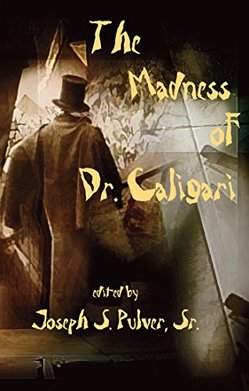 22 of today's top weird fictioneers have been challenged for these tales, inspired by the 1920 uber classic The Cabinet of Dr Caligari. In this kaleidoscopic selection of stories everything is to be questioned: is all authority merely abuse? Are we all hypnotized all the time? Asleep and dreaming? Is psychotherapy,merely sadism? Do our memories lie? Who are we, really? What is real; what is magick; what is delusion? What is love?... and how could we ever know the difference? Joe Pulver (award-winning editor of The Grimscribe's Puppets, Cassilda's Song, A Season in Carcosa and others) presents us with these unsettling thoughts and images,in tales which will by turns disturb, frighten, enlighten, perhaps even disgust readers-- but will surely never lull you into ceasing to look over your shoulder to see who-- or what, is creeping up behind... and to wonder  Comments are closed.
|


Archives
May 2023
|

|

|
 RSS Feed