


 For many of us, death is scary and shocking, even surreal. For Gonzalo, it’s the family business. After a lonely childhood among the caskets of his parents’ funeral home, Gonzalo, the protagonist of Andrew J. Stone’s first novella The Mortuary Monster, has become a bitter man. Unable to connect with the living, his only companions are the buried dead. That’s not just a poetic metaphor. It’s quite literal: Gonzalo’s only friends are walking, talking, rotting corpses. Though they make their homes deep in cemetery soil, they can come and go as they please. At least, so long as their coffins aren’t sealed permanently from the other side. The dearly departed aren’t merely Gonzalo’s friends, however. They’re lovers too. When he unexpectedly finds himself father to a baby that is half-human and half-cadaver, he becomes determined to give his son the life he himself never had, whether the boy wants it or not. An absurd, ghoulish riff on Neil Gaiman’s novel The Graveyard Book and Michele Soavi’s film Cemetery Man, spliced with the sly spookshow sleaze of an E.C. comic, The Mortuary Monster announces Stone’s arrival on the literary scene with a morbid flourish. An energetic, effortless read, the novel glides along at a swift pace with straightforward, occasionally eccentric prose. Though at times a bit too straightforward—such a matter-of-fact approach often keeps genuine emotion just out of arm’s reach—the rawness of Stone’s writing style is balanced out by a colorful cast of characters and the dreamlike fairy-tale atmosphere that permeates every page. The charm of The Mortuary Monster is the charm of a bedtime story—albeit one with more graphic sex and violence than most sane parents would ever regale their young ones with—in that it feels simultaneously fresh and familiar. You instantly understand the narrative Stone is crafting here, but still find surprises in the idiosyncrasies of his vision and voice. There’s a sense of spontaneity that engages the reader throughout, keeping things unpredictable. Stone isn’t simply telling you a story, he’s inviting you to come on an expedition with him; you are discovering this world together. Of course, this insulated “bedtime story” aesthetic is fitting given how dominant themes of both fatherhood and childhood are. While always maintaining an appreciation for the outrageous and an attitude of dry comedy, the heart of The Mortuary Monster is an inky black snarl of melancholy. All the glimmers of hope and humor are ultimately swallowed in sullen shadow as Stone ruminates on the tragedy of what it’s like not only growing up under a monstrous parent figure, but growing up into one yourself. Combining a whole lot of doom ‘n’ gloom with a surprisingly effective atmosphere of youthful whimsy, there’s a lot here worthy of admiration for readers who enjoy bizarro fiction of a moodier, more introspective mold. A grisly, existential fable about the sins of the father, the decay of innocence, and the secret life of corpses, Andrew J. Stone’s The Mortuary Monster is definitely a promising bizarro debut.  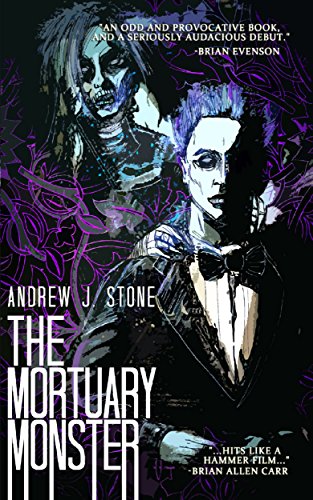 It’s Corpse Bride meets Eraserhead despite Gonzalo’s best efforts to live a life like Leave It to Beaver’s. Gonzalo grew up in the cemetery under the care of his monstrous parents and in the company of decaying corpses. As a result, he only desired one thing throughout his childhood: To be normal enough to join society. But despite his attempts at running away from his family, he has never been able to leave the mortuary. Now, as an adult, Gonzalo manages the cemetery. His family has died yet he is still unable to leave. Then, on the night of the annual Cadaver Tea party, something impossible happens—he impregnates the corpse Fiona. In an attempt to normalize the cemetery before his child’s birth, Gonzalo begins to close all the coffins, forever locking the dead inside. Without the intercession of corpses like Henry, the voluntary babysitter of abused children, Lionel, the life-long explorer, Victoria, the world’s first professional deep-sea water ski champion, and Vincent, Victoria’s long-time lover and trainer, Gonzalo believes he and Fiona will be able to raise their child to join the rest of the world. But in the throes of terminal calcium deficiency, Fiona’s bones deteriorate to dust immediately after she gives birth. Can Gonzalo make the young Frank, his now motherless, half-corpse son, normal enough for society? Can he raise his son without becoming like his own parents? Will Gonzalo become the Mortuary Monster he has spent his whole life trying to escape?  Comments are closed.
|


Archives
May 2023
|

|

|
 RSS Feed