


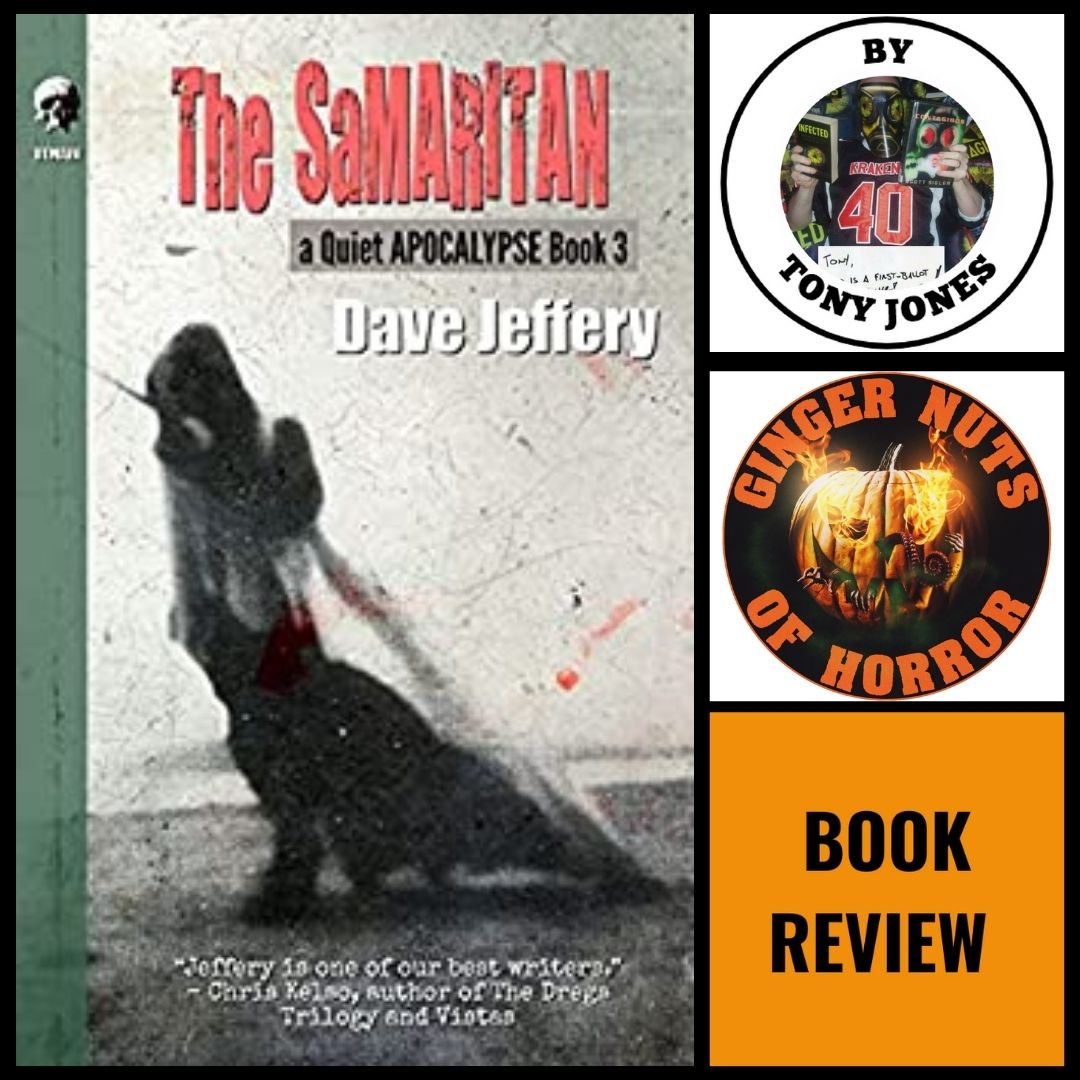
THE SAMARITAN BY DAVE JEFFERY (BOOK REVIEW by tony jones)When I started reading the latest instalment in Dave Jeffrey’s excellent post-apocalyptic series A Quiet Apocalypse, I was unsure how many further parts lay ahead and was cheered to discover that The Samaritan (part three) would not be the end of the road. What a relief. There is absolutely no drag or diminishing returns in this series and its continuation was very much welcomed. This was partially because I could not bear to see this terrific sequence end with the bleak manner in which The Samaritan concludes. Granted, in reality all the books are dark, but the finish of part three sent me spinning and I read the final page a couple of times just on the off chance I missed a glimmer of light and hope. No chance. It was not a long book, but the second half in particular was outstanding and I absorbed every work, slowly, hoping for sunlight at the end of the tunnel. Fat chance and I believe I would rather be a nameless victim in one of Jeffery’s werewolf or yeti stories than feature in what must be the grimmest and hopeless version of Birmingham ever committed to paper. I would strongly recommend reading the books in the order in which they were written, which begins with A Quiet Apocalypse, followed by Cathedral and continues with The Samaritan. I thoroughly enjoyed part three and the series still has plenty of legs and once it is done and dusted, I hope the publisher Demain release a compendium as one volume in the same way Grey Matter Press have dropped a ‘definitive edition’ of John Taff’s The Fearing series of novellas. I was amazed to read Amazon has The Samaritan listed as 143-pages, as I was certain it was much shorter, I sped through it so fast. Actually, my major criticism of the book was that it was just too short and if you’re new to A Quiet Apocalypse you have the cool opportunity of reading all three back-to-back. Although Jeffery provides useful recaps, let us quickly flip back to the original novella, A Quiet Apocalypse. The story is set some time after a mutant strain of meningitis (MNG-U) has wiped out most of mankind, the majority died horribly with symptoms which began with pneumonia before developing into bacterial meningitis and eventual death with catastrophic brain damage. The few who survived the epidemic were left deaf, an even smaller percentage retained their hearing, and the focus of the book concerns the horrible relationship which develops between those with hearing and those deprived of it. The novel is told, in the first person, by ex-schoolteacher Chris, who has been enslaved by a deaf man who uses Chris to be his ears and part of his early-warning-system towards potential threats. Communication is done via ‘Tell-Pads’ in which they exchange abbreviated messages similar to texts informing him of any sounds and disturbances. The Tell-Pads are crucial in subsequent books, particularly the second. The second instalment Cathedral introduces a new group of characters and is set in the town of Cathedral, a location which is hinted at (with fear) in the original. Like its predecessor, Cathedral throws out the window most of the Mad Max type stereotypes you might expect in a post-apocalyptic novel and concentrates on characterisation, developing location and presenting a very convincing but brutal system of law and order which the inhabitants of the town follow in order to exist and survive. This is the core of the novella: how main character Sarah, who narrates the entire story in the first person, exists on a day-to-day basis. This element has a serious Handmaid’s Tale vibe to it and even features similar ritualistic torture and execution which all inhabitants have to watch by law, however, what makes Cathedral different from the Margaret Atwood classic is that the women are not subjugated, and this cleverly changes the dynamics of the plot moving away from the well-trodden route of women being oppressed in dystopian fiction and is more about the skewered relationship between those who can hear and those who cannot. The Samaritan looks at the MNG-U apocalypse from a fresh angle focussing upon a Samaritan called Nathan when he goes on a scouting mission beyond Cathedral to scour the Wilderness for both resources and people who might have the ability to hear. There are rumours that there might be a camp of survivors nearby and they are looking to hunt them down to either enslave, kill or indoctrinate. Samaritans are a cross between policemen and enforcers who ensure everybody follows the system which is explained in book two. However, after things go wrong Nathan finds himself at the mercy of outsiders, given the chance, he would kill these people in seconds, but things do not go to plan, and this is key to this gripping novella. Cathedral successfully pulls off the same trick as its predecessor and eschews any broad sweeps of the effects on MNG-U and instead focusses on a microcosm, which once it gets going involves only a few characters. It develops into a very warm story where Nathan, technically a ‘bad guy’ seemingly re-evaluates his life and role as a Samaritan through an inner first-person dialogue. Along the way we realise that areas of the Wilderness have regressed almost to an old feudal system where terrifying prices have to be paid for protection in a world where money is worthless. There was also a terrific sequence where a bear (probably escaped from a zoo) swaggers out of the overlying forest and threatens the group. What made the novella extra special was the friendship which develops with Nathan and a little deaf girl called Lily. The child loves to draw and create cartoons, and this allows us to flip back into Nathan’s backstory, where he was a successful children’s author and starts to draw new ‘Pooch’ pictures for her. In a story which was altogether unforgiving this was a fleeting taste of innocence and hope for the reader to savour in the most desolate of landscapes. Jeffery has stated that part four will be his final A Quiet Apocalypse story and as they are all loosely interconnected, I look forward to seeing what happens in the end and hope there is some payback for some of the darker events in Samaritan. There are various hints about which direction part four might take, potentially bringing together elements of parts one to three, or alternatively might focus on a specific part of the big picture. If it is to be the end, I hope Dave Jeffery decides to go large! Samaritan is an excellent continuation of the A Quiet Apocalypse world and although all three novellas are great reads, it is significantly stronger when seen as one bigger package. New readers are in for a treat, and I imagine many will read the books straight through. The horror world is bubbling with great talent waiting to be discovered by a wider mass audience and via A Quiet Apocalypse Dave Jeffery deserves to be nudged several rungs up the ladder. Tony Jones The Samaritan |


Archives
May 2023
|

|

|

 RSS Feed