


 I do not read enough anthologies (books featuring lots of authors) or collections (books featuring short fiction by one author) as I should, and the main reason is the simple fact that they are so time consuming to write-up for review. Because of time restrictions I often, sadly, turn them down when asked to read, or politely ask after how many pages or stories are included before accepting! I prefer them to be short and sweet, with quality over quantity being a key factor. Having said that, this year I have still read and reviewed a decent number of both anthologies and collections, which have all featured previously on either Ginger Nuts of Horror or Horror DNA. If you want to find the full reviews, they are easy to find online, otherwise these shortened versions pick up on a few favourite short stories from each work. These are all outstanding books which I am very happy to recommend. collectionsCharlotte Bond – The Watcher in the Woods The Watcher in the Woods might be small, but it is also exquisitely formed, with Charlotte Bond presenting five delicious short stories, taking us from a remote part of Iceland to equally isolated areas of Scotland, involving local superstitions, curses, ghosts, hauntings, werewolves, and the occasional pagan ritual. Even the Devil himself makes a sneaky appearance in one story. Released on the Black Shuck Shadows range, this is one of their latest micro-collections which could easily be devoured in a single sitting. Neither were there were any particularly weak links, with the title story The Watcher in the Woods being my personal favourite, as I am always a sucker for Scottish set tales, which is one of the two stories this review focusses upon. The collection opens with Hessian Sky and a young woman, Petra, driving across a remote part of Iceland when she gets car trouble in an isolated part of the island. Stressed and unable to speak the language, she chances upon a pub which has one room available to rent, however, the landlord is reluctant to let it to her, gruffly mumbling about a curse. Petra, of course, does not believe in the local superstition and thinks that the only thing that awaits in the room is a good night’s sleep. I am not going to say what goes on in the room, but it was very entertaining with a sharp ending. I really liked Petra and the lengths she was prepared to go to save her own bacon was both cunning and industrious. The collection closes with The Watcher in the Woods which is framed around a guy called Fergus who is about to write a memoir. However, Fergus is not writing a normal book, by day he works as a mechanic, but before and after his shift in the garage he works as a ‘Watcher’ who guards the local forest which is rumoured to be haunted. This was a terrific meditation on loneliness, which reveals its secrets quite slowly and had a nice mix of the old and the new, as the reader slowly realises where and when the story is set. With short story collections the temptation of often to pile in as many stories as possible, digging out old rejects or other pieces, Bond does not do this and as a result presents a well-rounded and balanced collection. The author does not go for ‘BOO!’ scares, violence or shock horror, instead her stories are framed around convincing and varied settings, strong characterisation and a deep respect for the fairy tales of yesteryear which she references in her informative endnotes. Gary Budden - London Incognita I stumbled upon the late D.A Northwood’s striking Judderman a couple of years ago when the novella was originally published by the Eden Book Society. Although it was not exactly a secret, Gary Budden was later ‘outed’ as the author around the time the piece was deservedly nominated for a prestigious Shirley Jackson Award. London Incognita is best described as a hallucinogenic (often bad) trip into the underside and lesser-known areas of London and you certainly will not find the tourist hotspots such as Buckingham Palace or Madame Tussauds. I have now read the centrepiece of the collection, the eighty-page Judderman twice and if you were to ask me to reveal what the ‘Judderman’ was in a single sentence I would struggle to nail it. Perhaps he is best described as a mythical being which lurks in the London shadows and becomes real to those who believe in him, effectively attracted to those who inhabit the darkness and the alleyways. Set in 1972, the story is framed around Gary who is looking for his brother, who he suspects is a victim of the Judderman. Interestingly, this supernatural being vibrates throughout the collection, in memories, whispers, dreams and graffiti on walls. Having lived in London since 1994 I connected strongly with the central London theme of London Incognito and the cool musical vibe which is also threaded through some stories. One of my favourite, I Precede Myself, was about a guy obsessively trying to track down a rare vinyl of a band called ‘Scarp’ which he once owned but later sold when he was strapped for cash. The collection features multiple snapshots of pub life, streets, journeys, conversations and has a deep sense of melancholy threaded throughout proceedings. Another outstanding example was Sky City, about a guy (Mick) who works at evicting people from their properties and enjoys his work until he suffers a seismic shift of thought after finding something in a flat he forced entry into. There is much to admire in London Incognito and although I doubt it will have tourists flocking to Blackheath, Morden or New Cross Gate, the way in which it documents London is refreshing and from a perspective which is both slightly off-kilter and unnerving. Is there genuinely a story lurking behind every dustbin or memory behind every boarded-up pub? Who knows, but Gary Budden does a fine job at bringing an alternative version of this great city of London to life but watch out for the Judderman! Dan Coxon - Only the Broken Remain I am also very happy to recommend Dan Coxon’s sublime Only the Broken Remain, a collection of totally unique short stories which dance around the horror genre, but probably resides more comfortably under the banner of ‘weird fiction’. If you are after “Boo!” type scares, blood and guts, or twist endings this is not that kind of book and it is much better for it, being a series of snapshots of uncanny or strange moments and moods. Since his first short story arrived in the 1990s Coxon has had over fifty stories published, and with such an impressive range of short fiction to draw upon, it is no surprise this collection is so strong, with all the stories being previously published. There are no fillers, and although I liked some more than others, it is an incredibly rounded collection which often focuses upon people at the fringes of society, loners, the disenfranchised and those with nobody to turn to for help. Considering many of the stories were built around isolation, two of my favouries slightly broke this mould, as they both featured more than one character. Baddavine was both a beautiful and ultimately very sad tale, the locals in a rural community begin to hear weird noises in the wind, which they suspect to be a creature they then begin to hunt. Even though the main character is a family man, the feeling of isolation which threads the collection is instead connected to the creature. The sheer variety of the tales on offer is highly impressive and the final story, All the Letters in his Van was surely one of the strangest and quirkiest. A couple out walking lose track of the time and find themselves stranded in a remote village where nobody wants them to leave and even give them a cottage to live in. This was classic weird horror at its finest. Stanislav in Foxtown was another highlight, an immigrant with poor English skills fantasising about murdering the mean Mr Sharples, the owner of the fried chicken shop where he works. After feeding scraps to a few stray foxes, events take a highly unexpected turn when he becomes drawn to the animals, leading to a terrific ending. The dark humour continues in the excellent Roll Up, Roll Up, in which unemployed Robbie (he would have undoubtedly loved a job in the chicken shop!) ends up working for a circus, even though he is clumsy and has no skills. But he is desperate for a job and will try his hand at anything. You will find yourself quickly poor Robbie all the way as things escalate, including an unforgettable trip to the highwire and an ending which nail’s Coxon’s style, in which not everything is explained, but it remains a satisfying experience. 2020 will not provide many better collections than Only the Broken Remain, so let this author take you by the hand into some very strange and isolated places. Many are unconventional snapshots of the uncanny and although there were a few which really left me hanging, wishing for a few pages more, it was a great collection. If you have never tried Coxon before, he has a distinctive literary voice which is well worth tapping into and this is the perfect place to start. ADAM NEVILL – WYRD AND OTHER DERELICTIONS I was a massive fan of Wyrd and Other Derelictions and would suggest that those who will enjoy this collection most are long term fans who are accustomed to his descriptive style and slow pace. Also, this is not a normal collection in that few of the entries have genuine beginnings, middle sections, or traditional endings. They read, almost as if an unnamed narrator is describing, or walking the reader through, a horrible crime scene in which an undisclosed atrocity has occurred at some point in the past. The stories have no characters, dialogue, or conventional plots and as the literary rulebook is being effectively being thrown out the window. A collection entirely based around mood, atmosphere, and dangerous locations is not something you come across very often. But Adam Nevill nails it. I would suggest reading the stories gradually, and not necessarily back-to-back, to allow the varied atmospheres from each tale to permeate fully into your thoughts. Along the way you’ll journey along broken coastlines, beaches, swimming pools, burial sites, abandoned villages, deserted holiday resorts and the final outstanding entry Holding the World in My Arms for Three Days and All Will Be Changed, which was perhaps my favourite, as it features more immediacy than many of the other stories with the reader a helpless bystander to a strange supernatural event. With Wyrd and Other Derelictions Adam Nevill leads his readers down a literary sideroad, an experiment which many will enjoy, particularly if they appreciate that these are not traditional short stories. There are no twist endings, characters, or snappy dialogue and that will not be everybody’s cup of tea. If Wyrd is Nevill’s literary version of music’s dreaded ‘concept album’, then I am sure long-term fans are going to enjoy it tremendously and then mull over how it compares to his other work. Ultimately, I thought it was terrific and like all great concept albums is undoubtedly a work the artist felt he needed to get out of his system, and in releasing this Nevill’s already unmatchable back catalogue just got stronger. DIMAS RIO - WHO’S THERE: A COLLECTION OF STORIES Dimas Rio has a very distinct voice, which authentically taps into his homeland of Indonesia and its superstitions for inspiration in his character driven plots. This is not a country many of us know much about and his take on its unique folklore and their belief system is something I would be keen to read more about, as this debut collection truly brings to life in both shadows and multicolour. The Wandering was probably my favourite of the bunch. The setting of this piece was outstanding; a deserted office block after most of the staff have gone home. This story features another rather unlikable and slightly sleazy young man, Badrun, who works as a night security guard patrolling the various floors. Early in the action we realise the 28-year-old cannot be trusted and is responsible for a series of petty thefts in the buildings. Whilst on the prowl for his next booty to steal he reads a letter he finds lying on the floor, which leads to another letter. Bizarrely, the letters then seem to have some eerie resemblance to some circumstances in his own life. This was a very clever slow burner, which also features revenge as a theme, and once again, guilt is never far away. I was also a fan of the rather melancholic Voice Canal which features a homesick young Indonesian man studying in my home city of Aberdeen, Scotland. The simple, but moving story, is built around the student Gio who routinely fixes his flatmate Anggi’s computer and spends much of the story on a telephone call back to his father in Indonesia, who does not want him to return home until after his final exams. However, when the story moves to a group of other Indonesian students, we find out something startling about Gio’s family circumstances. This story also had a slightly abrupt ending, but the tone was pitch perfect and the finish nailed it. There was much to enjoy in Dimas Rio’s Who’s There? collection and if you are looking to dip into an up-and-coming author with an international flavour or just want to try something slightly different this is worth closer inspection. The strong Indonesian sense of time of place, the importance of family and honour, weaved with convincing supernatural elements make this a worthwhile reading experience. Mike X Welch – Enantiodromia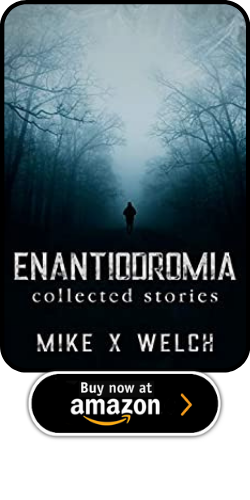 With collections the temptation is often ‘more is better’ but Welch bucks that trend and includes only five stories, the two longest and best, are saved for first and fifth position in the running order and are reviewed below. Each story is entirely unique from the next but are all threaded with the same style of melancholy which I found to be rather moving. Horror is a broad canvas of ideas and themes; this is one of the overwhelming strengths of Enantiodromia. I usually read collections quite slowly, but I found Turning of the Bones so striking it got me in the mood for devouring the remaining four in quick succession. How often do you read a ghost story set in Madagascar? This strange little story opens in 1947 with the ‘rebel’ soldiers fighting the invading French forces. The story is told, in the first person, from a rebel fighter who is captured and killed in the early stages. I looked up some of the terms used in Turning of the Bones, which utilises Madagascar mythology and folklore, and found this obscure subject fascinating. If the dead are not buried in the correct manner, there is a funeral tradition called ‘famadihana’, and if this is not honoured the dead may return as ghosts. But things can get worse; if someone is buried in an unmarked grave and their family do not tend it, then the dead may come back as ghosts, or ‘angatra’, especially if they died violently. This very moving story is built around this cultural philosophy, with the ghost of the dead rebel fighter trying to reconnect his lost body with his surviving family who have no idea where the mass grave is. This was a beautiful meditation on both loss and tradition, and I felt for the descendants who never gave up trying to find where the bones lay hidden. The final story Peta Bebkama Luruba was also outstanding. This time out Welch abandons Madagascar and takes us to Babylon 4,000BC where a slave recounts the supernatural events which led to both her emancipation and revenge on her cruel masters. The slave is around ten years old when her first-person narration begins, where she recounts a death a couple of years earlier which had a profound impact upon her life. Jumping forward three years one of her owners begins to take an interest in her when she hits puberty and the story follows her personal trials of rape and domestic abuse until she discovers a way to connect with her past and the spirits, which refers to the title “Peta Bebkama Luruba” which is translated as “open the gate for me.” This was another thoughtful and clever tale, which like Turning the Bones had a great ending. Readers might think twice about buying a collection from an unknown author, but Enantiodromia is a read with many highlights; featuring a great blend of horror, dark sense of humour and cleverly selected five stories. Where else can you jump thematically from Babylon 4000BC, to Madagascar 1947 with three contemporary stories sandwiched between them? Highly recommended. ANTHOLOGIESPaul Finch – Terror of the Home Counties This is the twelfth in the long running anthology series which has already covered much of the UK. Starting way back in 2011, I guess we had to get to Surrey and the Home Counties eventually! I’m going to pick out a few of my absolute favourites of what was a top-quality anthology which admirably stuck to its theme in some style…. The anthology opens with a corker, Steve Duffy’s In the English Rain, which is about a 16-year-old-boy who lives next door to a house supposedly owned by famous Beatle John Lennon. He uses this musical tip-bit to impress his best friend Sally Holden “so what’s it like living next door to a Beatle?” she asks, and they make the big mistake of breaking into the house. Paul Finch’s The Doom was another of my favourites, which asks interesting questions about faith. Reverend Bilks and his wife work at St Brownwyn’s Priority church and enjoy a cosy village existence where the Church of England is all about fayres, bake sales and raffles. However, whilst the church is being restored a brutal and horrific Middle Ages mural is uncovered and its depiction of Hell and punishment is incredibly graphic. It quickly becomes a tourist attraction, and the Reverend gets into an uncomfortable conversation with a visitor who has something nasty on his conscience who asks him questions of faith he struggles to answer. Love Leaves Last by Mick Sims was an absolute blast and has a very quirky concept at its centre. Two couples, head to a stately home to secure a business property deal and when they meet their hosts are given a key rule which they must follow at all costs: no sex in the house! Of course, rules are there to be broken, are they not? The anthology closes with another beauty, and I cannot say I was prepared for a dystopian(ish) style story set in Stevenage! with Jason Gould’s clever The old Man in Apartment Ninety. A mother tells her kid whatever you do, never go to Apartment 90, as there is a weird shimmering light coming from under the door. Of course, kids being kids, you know where he is heading. There was much to enjoy in the many other stories of Terror of the Home Counties and if you are a fan of short stories, especially the British variety, then this anthology is well worth closer inspection. Jonathan Maberry – Don’t Turn Out The Lights If you fancy a massive multi-author anthology of horror stories to scare young kids (ages 8-12 according to the cover) then Don’t Turn Out the Lights, has much to recommend. 35 stories, spread across 380 pages, is a lot of reading with many a mere five-to-seven pages in length. One could easily imagine many of the stories being read aloud in class by teachers, during circle time with the lights dimmed, around the campfire or at sleepovers. They would be at their most potent in these situations and many will have been written for such occasions. The anthology is a tribute to Alvin Schwartz’s legendary Scary Stories to Tell in the Dark, and it was nice to see many of the stories written in a similar style to the original. My three personal favourite stories were those by Madeleine Roux (The Tall Ones), Amy Lukavics (The Neighbor) and Christopher Golden (The Open Window). Roux’s story closes the anthology in some style, a small town has its own weird local myth, when strange chalklike signs appear in the local community this is a warning that creatures called the ‘Tall Ones’ are shortly going to visit. Although nobody knows what they look like, everybody follows the rules and leaves out offerings of food and gifts. The story is seen from the point of view of a little girl called Estrella who befriends a new boy, whose family do not believe in the myth and pay the price. Amy Lukavics is one of my favourite YA authors and she comes up trumps once again in The Neighbor, Dennis wakes up and sees a little boy across the street staring at him, they quickly become friends and go wandering in the encroaching forest which Dennis is usually forbidden to play in. This was also a slightly longer story, with a slightly deeper and impressive twist and a great description of a boy digging himself out of a grave, this is a story permeated with a deep sense of melancholy. Christopher Golden’s crazy The Open Window features a little boy who has a nightmare night when he is stalked by multiple doppelganger versions of his dad, to the extent that he does not know who the real one is. It does not end well. Don’t Turn Out the Lights is a fitting tribute to Alvin Schwartz and there is much fun to be had within these pages. This anthology will undoubtedly mean much more to American readers than UK readers, however, it remains highly entertaining and am sure lots of kids will be really taken by it. Potentially, it is a lovely gateway book into more mature horror for many kids. Azzurra Nox - Strange Girls: Women in Horror Anthology Strange Girls is a meaty and wide-ranging anthology of 22 stories in which women and girls play central roles, which are also all authored by women. Make sure you hang in for the end, as the anthology concludes with very informative interviews with the authors where the editor Azzurra Nox quizzes them about their favourites, pioneering female writers (Mary Shelley and Shirley Jackson are regularly name-checked), favourite books and the coolest question: “Have you ever been identified as a strange girl?” Here’s summaries of a few of my favourites…. Rebecca Rowland’s Extinguishing Fireflies was one of the stronger inclusions which shrouds its direction nicely; a little girl Lea and her mother have a very close relationship, but other things often end up dead or maimed around her, with the family cat playing a major role. It might just put you off having pets forever. Jude Reid’s Sideshow was another of my top picks. This was a fascinating tale concerning consent, a young woman (Sylvia) is at an old-fashioned carnival with her boyfriend (Richie), although it never says when it is, it has a 1950s feel to it. She does not really like Richie, but struggles saying ‘no’, and soon the tables shift when something strange happens at one of the attractions. Revival by Madison Estes was one of the strongest and sneakiest included, as it playfully takes its time laying its cards on the table, whilst retaining a certain amount of ambiguity. It opens with the murder of a young woman, Sara, which was witnessed by the narrator, but then jumps to sometime later when this death has become an obsession and the memory of the killing impossible to shake off. Alyson Faye’s The Doll’s House is also worth a closer look. This was an impressive tale about a deaf little girl, Sophie, sent to live with her aunt after her mother is imprisoned for killing her abusive husband. The story centres upon a very old doll’s house which has been passed down the generations and have figurines which seem to be real and which the deaf little girl can hear. There is much fun to be had here and although the anthology lacks star names, there are plenty of authors featured who will undoubtedly move onto bigger and better things and from the informative interviews which close obviously love the genre. Azzurra Nox has done a fine job of bringing together a large collection of stories loosely themed around women and showcasing authors who we are sure to hear more of in future. BY TONY JONES  Comments are closed.
|


Archives
May 2023
|

|

|
 RSS Feed