


 From my earliest years I’ve been aware that the End of the World is just around the corner, and growing up after the apocalyptic fiction boom of the 70s and 80s I never wanted for reading material to remind me of the fact. Like most people of my generation I was raised under the terrifying shadow of climate change, nuclear war and all the rest. But in fact, there is nothing new about this state of affairs. For over a thousand years people have been convinced that the world was about to end sooner rather than later, and as long as people have needed to hear this message, there have been preachers to deliver it, be they learned collapsologists, holy folk or simple charlatans. Of course, it is also quite possible that we may be really headed for the end of the world this time. But if so, what should a common-or-garden agnostic do about it? These are just a few of the concerns that form the backdrop for R. B. Russell’s latest novel, Waiting for the End of the World. It tells the story of Elliot and Lana, a middle-aged couple who appear to lead a pleasant life in a cultured, impeccably middle-class home, naming their pets after foreign authors, adding extra seeds to their shop-bought muesli and consuming reasonable amounts of wine. But Elliot has a terrible secret harking back to his teenage years in Thirsk, where he and another boy, Vince, formed a close friendship grounded in a shared interest in weird religions, the occult, and books in general. Now, the inevitable has happened. After decades of silence Vince has got in touch, and he Needs to Talk about the shocking events of their long-buried past. And his timing couldn’t be worse: the publishing house Elliot works for has become embroiled in a case of plagiarism, and as he struggles to keep all his plates in the air, placating his boss, keeping up appearances for Lana and above all trying to dodge the sword of Damocles that is Vince, his life inevitably begins to unravel – only for its threads to be woven up again into a pattern far stranger than he could ever have imagined… The vagaries of religious cults, Christian and otherwise, have long been grist to the mill of horror writers, although truth very often leaves fiction standing slack-jawed at the gate, with many real-life cults such as Findhorn or The Panacea Society inspiring mingled feelings of mirth, amazement and eventually a sort of creeping dread. Russell, however, has a different agenda to your average purveyor of religious horror. His treatment of the Children of the Cross, the cult whose activities form the central hub of this novel, is clear-sighted (as seen through the eyes of “doubting Thomas” Elliot) but also unusually respectful and nuanced. Again and again characters that could be portrayed as amusing lunatics or hideous monsters are given depth and ambiguity. And perhaps this is to be expected, given Russell’s background. As one half of the Tartarus Press he has published a lot of Arthur Machen, who is often described as an author of “pagan” tales of terror but in fact was at least as preoccupied with Christian themes, as explored in novels like The Inmost Light and stories like ‘The Great Return’. Another Tartarus-associated writer, Frederick Rolfe, also gets a walk-on part via his novel Hadrian the Seventh (a fascinating forerunner of the recent Jude Law vehicle The Young Pope), which appears on a character’s shelf. In his aims Russell has more in common with these early twentieth-century writers than with many modern horror authors. The novel’s style and structure are both resolutely modern, however. In alternate chapters the action hops back and forth between 2006 and the late eighties in a way that keeps the reader engaged. However, Waiting for the End of the World doesn’t wallow in the shameless 80s nostalgia that is currently so hip in the horror world. It isn’t one of those books with fake crumple marks and a Stranger Things font on the cover, and the vintage details of young Elliot’s life in a Northern town are never allowed to become twee or get in the way of the action. Nobody mentions Thatcher, or stonewashed denim, or even The Smiths. And though the scenes in and around Thirsk hold a melancholy sense of the past that is bound to appeal to lovers of bleak recent-history sites such as Orford Ness, Russell gives equal due to the charms of present-day Saltburn-on-Sea and its remarkable “jewel streets”, not to mention a number of other European locations. The novel is pervaded with the same quiet, soft-voiced quality that sets Russell’s short fiction apart from the herd, but although dreams are an important theme in the novel it is also characterized by a calm, sharp focus that is sustained as the web of Elliot’s life becomes more tangled, and the novel more loaded with themes and ideas. And when I say loaded, I mean it. Russell manages to pack the book with an enormous amount of moral philosophy and religious history, both mainstream and offbeat, while avoiding pomposity. There are some very funny bits, too, especially the youthful Elliott’s face-offs with the charismatic Christian leader, Breeze, and the slothful teacher Ovenden. A couple of Elliot’s conversations are on the didactic side, especially in the middle of the novel when he visits the Children’s HQ, but this doesn’t happen half as much as you might fear given the intellectual breadth and depth of the novel, and after an explosive and frequently confounding second half the final chapters strike the right balance between satisfying explanation and mystery. This is a novel aimed squarely at readers with an enquiring cast of mind, but it’s anything but dry and nerdy. The lush depictions of places and people bring life and colour to all those “big questions”, and Russell never fobs off the reader with easy answers. You do, however, close the book feeling just a bit more prepared to tackle the end of the world, in a way that no post-apocalyptic survival guide could help you with. Review by Daisy Lyle 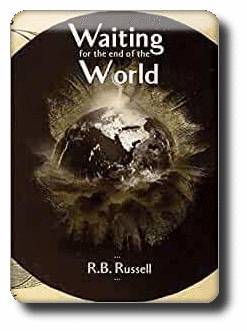 Elliot Barton is haunted by a tragic mistake. At the time it seemed like the end of his world, but somehow he has managed to rebuild his life, and now lives happily with his partner, Lana, in their house on Sapphire Street. But Elliot’s good fortune threatens to implode when his old schoolfriend, Vincent, reappears. He has become a Christian, and wants to tell the authorities what happened so many years before. Rather than simply following the teachings of Christ, however, Vincent also claims to have met him. Elliot becomes involved with Vincent’s millennialist church, which prophesied that the world would end in the year 2000. But what happens to the Messiah and his church when that prophesy does not come to pass? And can Elliot navigate his way through the chaos of incredible experiences back to his happy existence on Sapphire Street? AUTHOR BIO R.B. Russell the author of four short story collections, three novellas, and one previous novel, She Sleeps. With his partner, Rosalie Parker, he publishes modern and classic works of curious and macabre fiction under the Tartarus Press imprint. purchase a copy direct from ps publishing by clicking here  Comments are closed.
|


Archives
May 2023
|

|

|
 RSS Feed